 How to resolve AdBlock issue?
News
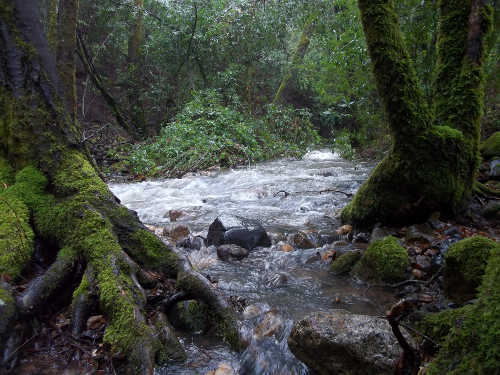
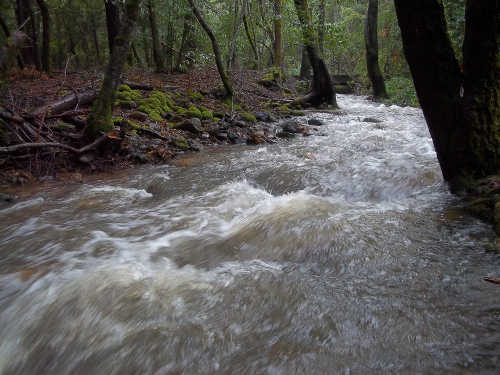
LAKE COUNTY, Calif. – Deluge, trickle or inundation: any way you spell it, rain gear was mandatory earlier this month.
The early February storm was a welcome relief from the dry winter weather we've experienced so far, but even with the south county's rain gauge reading 7 inches from that weekend storm, it did not put a dent in our county's average rainfall.
A typical season in our county's 1,329 square miles yields 33 inches, unless you live under the shadow of Mt. Saint Helena; then, the average reads closer to 55 inches per year.
A Lake County winter rain in all its glory comes down with a vengeance. Science Digest states that raindrops fall at a rate of seven miles per hour.
People aren't the only life forms that “perk” up after a storm. A walk in the woods displays nature in all her glory – but intensified.
Oak trunks swathed in green moss, or Bryophyta, already soft and plush, turn into luxuriant, glowing versions of themselves, and feel even more feathery to the touch after a soaking.
Birds shamelessly bathe in muddy puddles which is their way of keeping their intricate feathers functioning in top condition.
Although Lake County's creeks roar furiously, rough and muddy after big rains occur, the California Department of Fish and Wildlife states that the creek critters – fish and crawdads alike – had been experiencing a shrinking habitat with dwindling food supplies prior to the rains.
It's true that some of the inhabitants of the creeks will wash away; however, much-needed food will arrive from upstream to replenish stores of food. The deeper waters also will provide better habitat for hiding from predators.
Here's to rain in any form! According to the Rain Appreciation Society (who would have known there was such an organization?) there are various types of rain: Convection rain, common in the tropics, frontal rain that occurs with the movement of a weather depression, and relief rainfall, caused by the ocean's moisture.
The storm that we recently enjoyed was a moisture-laden system straight from the Pacific Ocean, known at the Pineapple Express.
As poet Langston Hughes said:
“Let the rain kiss you.
“Let the rain beat upon your head with silver liquid drops.
“Let the rain sing you a lullaby.”
Kathleen Scavone, M.A., is an educator, potter, writer and author of “Anderson Marsh State Historic Park: A Walking History, Prehistory, Flora, and Fauna Tour of a California State Park” and “Native Americans of Lake County.” She also writes for NASA and JPL as one of their “Solar System Ambassadors.” She was selected “Lake County Teacher of the Year, 1998-99” by the Lake County Office of Education, and chosen as one of 10 state finalists the same year by the California Department of Education.
LAKE COUNTY, Calif. – Lake County Animal Care and Control this week features a number of dogs with ancestry that comes from the working breeds.
Border collie, German Shepherd, dachshund and Australian Kelpie are among the mixes available, in ages ranging from 4 months to 3 years.
Dogs that are adopted from Lake County Animal Care and Control are either neutered or spayed, microchipped and, if old enough, given a rabies shot and county license before being released to their new owner. License fees do not apply to residents of the cities of Lakeport or Clearlake.
If you're looking for a new companion, visit the shelter. There are many great pets hoping you'll choose them.
In addition to the animals featured here, all adoptable animals in Lake County can be seen here: http://bit.ly/Z6xHMb .
The following dogs at the Lake County Animal Care and Control shelter have been cleared for adoption (additional dogs on the animal control Web site not listed are still “on hold”).

Male Chihuahua mix
This male Chihuahua mix is 3 years old.
He has a short black and white coat, perky ears and a long tail. It was not reported if he has been altered.
Shelter staff said he is a little shy but happy, and needs some training. Mainly, he just wants to be held.
Find him in kennel No. 4, ID No. 39092.

'Max'
“Max” is a a 3-year-old male Chihuahua mix.
He's got a short tan coat and perky ears. Shelter staff did not report if he has been neutered.
He's described as a “sweet little guy” who gets along with other dogs and is not food aggressive.
Find him in kennel No. 7, ID No. 38940.

Male dachshund mix
This male dachshund mix is 2 years old.
He has a short black and tan coat, and weighs nearly 14 pounds. Shelter staff did not report if he has been neutered.
He's in kennel No. 8, ID No. 39093.

'Zeek'
“Zeek” is a 7-month-old male border collie mix.
He's got a short black and white coat, floppy ears and brown eyes. Zeke weighs 36 pounds and has been neutered.
Zeek is in kennel No. 12, ID No. 39066.

Male pit bull terrier mix
This male pit bull terrier mix is of determined age.
He's got a curly brown brindle and white coat, and weighs 26 pounds. Shelter staff did not report if he has been neutered.
Find him in kennel No. 19, ID No. 39060.

German Shepherd-pit bull terrier mix
This female German Shepherd-pit bull terrier mix is 4 months old.
She has a short tan coat, weighs 32 pounds and has not been spayed.
She's in kennel No. 25, ID No. 39050.

Pit bull terrier mix
This male pit bull terrier mix is 2 years old.
He has a short black and white coat, weighs 67 pounds and has not yet been neutered.
He's in kennel No. 30, ID No. 38943.

Male shepherd mix
This male shepherd mix is 8 months old.
He has a short black and tan coat, and has not yet been neutered.
Find him in kennel No. 32, ID No. 38962.

Australian Kelpie mix
This female Australian Kelpie mix is of undetermined age.
She weighs 20 pounds and has a short brown brindle coat. Shelter staff did not report if she has been spayed.
She's in kennel No. 33, ID No. 39033.
To fill out an adoption application online visit http://www.co.lake.ca.us/Government/Directory/Animal_Care_And_Control/Adopt/Dog___Cat_Adoption_Application.htm .
Lake County Animal Care and Control is located at 4949 Helbush in Lakeport, next to the Hill Road Correctional Facility.
Office hours are Monday through Friday, 8 a.m. to 5 p.m., and 1 p.m. to 3 p.m., Saturday. The shelter is open from 10:30 a.m. to 4:30 p.m. Monday through Friday and on Saturday from 1 p.m. to 3 p.m.
Visit the shelter online at http://www.co.lake.ca.us/Government/Directory/Animal_Care_And_Control.htm .
For more information call Lake County Animal Care and Control at 707-263-0278.
Email Elizabeth Larson at

It has long puzzled scientists that there were enormously massive galaxies that were already old and no longer forming new stars in the very early universe, approximately three billion years after the Big Bang.
Now new research from the Niels Bohr Institute, among others, shows that these massive galaxies were formed by explosive star formation that was set in motion by the collision of galaxies a few billion years after the Big Bang. The results are published in the scientific journal, Astrophysical Journal.
Galaxies are giant collections of stars, gas and dark matter. The smallest galaxies contain a few million stars, while the largest can contain several hundred billion stars.
The first stars already emerged in the very early universe approximately 200 million years after the Big Bang from the gases hydrogen and helium.
Gas is the raw material used to form stars. These giant clouds of gas and dust contract and eventually the gas is so compact that the pressure heats the matter so that glowing gas balls are formed, new stars are born.
The stars are collected in galaxies, the first of which are a kind of baby galaxies. As long as there is gas in the galaxy, new stars are being formed.
Mysteries in the childhood of the universe
The astronomers' theory is therefore that the structure of the universe was built by baby galaxies gradually growing larger and more massive by constantly forming new stars and by colliding with neighboring galaxies to form new, larger galaxies. The largest galaxies in today's universe were therefore believed to have been under construction throughout the history of the universe.
“That is why it surprised us that we already when the universe was only three billion years old, found galaxies that were just as massive as today's large spiral galaxies and the largest elliptical galaxies, which are the giants in the local universe,” explained Sune Toft, Dark Cosmology Centre at the Niels Bohr Institute at the University of Copenhagen.
“Even more surprisingly, the stars in these early galaxies were squeezed into a very small area, so the size of the galaxies were three times smaller than similar mass galaxies today,” Toft said. “This means that the density of stars was 10 times greater. Furthermore, the galaxies were already dead, so they were no longer forming new stars. It was a great mystery.”
The extremely massive and compact galaxies were not flattened spiral galaxies where stars and gas rotate around the center. Rather, they resembled elliptical galaxies where stars move more hither and thither and where the gas for new star formation has been used up.
But how could the galaxies become so massive and so burnt out so early? How were they formed?
Solving the mystery
To find out what happened, Toft had to look even further back in time.
Based on the ages of the galaxies, he knew that they had to have formed very early in the history of the universe, but at that point there was simply not enough time for the galaxies to have grown so massive through normal star formation.
He had a theory that the massive galaxies were formed by the fusion of smaller galaxies, but that alone could not explain how they had become so massive so quickly and were already dead. The theory was, therefore, that there must have been some especially extreme galaxies in the formation process.
“We studied the galaxies that existed when the universe was between 1 and 2 billion years old. My theory that it must have been some galaxies with very specific properties that were part of the formation process made me focus on the special SMG galaxies, which are dominated by intense stare formation hidden under a thick blanket of dust,” explained Toft.
He explains that when such gas-rich galaxies merge, all of the gas is driven into the center of the system where it ignites an explosion of new star formation. A lot of stars are formed in the center and the galaxy quickly becomes very compact. But with the explosive star formation, the gas to form new stars is also used up extremely quickly and then you get a dead galaxy.
“I discovered that there was a direct evolutionary link between two of the most extreme galaxy types we have in the universe – the most distant and most intense star forming galaxies which are formed shortly after the Big Bang – and the extremely compact dead galaxies we see 1-2 billion years later,” said Toft.
The new research is a breakthrough in discovering the formation process of the enormously massive and dead galaxies in the early universe.
KELSEYVILLE, Calif. – The fifth-annual Kelseyville Olive Festival, an event which focuses on the olive industry in Lake County, as well as other local products, will be held from 11 a.m. to 5 p.m. Sunday, April 27, at Chacewater Winery & Olive Mill, located at 5625 Gaddy Lane.
The festival will feature locally produced olive oil, education and demonstrations, and a variety of other contests and activities for the whole family.
Vendors offering olive-related and other local products will be present the day of the event, offering samples and selling products, as well as providing educational materials about olives and our local industry. A children’s area will also be featured.
There is no cost to attend the festival; samples and demonstrations are free of charge. Local wine and beer tasting with a commemorative glass will be available for a $15 fee from noon to 4 p.m.
Several related contests will be held up to and during the festival, including a poster contest, amateur recipe contest, olive pit spitting contest and people’s choice olive oil contest. For details visit www.KelseyvilleOliveFestival.com .
Event proceeds from the silent auction, wine store sales, and wine and beer tasting fees will benefit Lake Family Resource Center.
The Resource Center is a 501(c)3 nonprofit agency in Kelseyville that provides several programs in Lake County, including the Child Abuse Treatment Program, Rape Crisis Center, 24/7 Community Crisis Line, Behavioral Health Services, Early Head Start, Domestic Violence Assistance, and the Adolescent Family Life Program. For more information, call 707-279-0563.
Sponsorship opportunities are available. For more information about the Kelseyville Olive Festival, contact Beth Berinti, Lake Family Resource Center at 707-279-0563 or visit www.KelseyvilleOliveFestival.com .
In the latest report from the state, health officials said Friday that the number of confirmed seasonal influenza deaths in California has risen to 278.
Dr. Ron Chapman, director of the California Department of Public Health (CDPH) and state health officer, said those 278 deaths for the 2013-14 season were in persons under 65 years of age.
Chapman said that of the total confirmed flu deaths, six were children.
There are an additional 29 deaths under investigation, not yet confirmed, Chapman said.
One flu death in Lake County was reported earlier this month in a woman in the 30- to 40-year-old age group, as Lake County News has reported.
The 278 confirmed influenza-associated deaths this season have been reported by the following jurisdictions: Alameda (6), Butte (1), Calaveras (2), Contra Costa (6), El Dorado (2), Fresno (21), Glenn (1), Humboldt (1), Imperial (1), Kern (10), Kings (4), Lake (1), Lassen (1), Long Beach (7), Los Angeles (36), Madera (2), Marin (2), Mendocino (4), Merced (5), Monterey (5), Nevada (1), Orange (10), Riverside (10), Sacramento (25), San Bernardino (19), San Diego (23), San Francisco (3), San Joaquin (6), San Luis Obispo (1), San Mateo (6), Santa Barbara (3), Santa Clara (14), Santa Cruz (3), Shasta (3), Siskiyou (2), Solano (3), Sonoma (7), Stanislaus (13), Sutter (1), Tulare (3), Tuolumne (1) and Ventura (3).
By this time last year, CDPH had received reports of a total of 32 influenza fatalities in persons under 65 years of age and in all of the 2012-13 season, a total of 106 deaths were reported.
The great majority of reported influenza deaths in persons under 65 years of age have occurred in people with underlying medical conditions. Both outpatient visits and hospitalizations continue to decrease. The influenza season status remains widespread.
“Even a single death from the flu is a tragedy,” said Dr. Chapman. “The best way to prevent influenza is by getting vaccinated. The influenza season continues and it’s not too late for vaccination.”
Those at highest risk – the elderly, pregnant women, infants, or those with other health conditions – who show flu symptoms should contact their physician immediately in order to get the most effective treatment. Symptoms include fever, cough, sore throat, runny or stuffy nose, muscle or body aches, headaches and fatigue.
For information on local vaccinations, call Lake County Public Health, 707-263-1090 or 800-794-9291.
State officials are urging residents to be vaccinated against the measles in response to a spike in the number of cases reported around the state.
The California Department of Public Health said it has received reports of 15 confirmed measles cases in California residents so far this year. Cases have occurred throughout California.
This time last year, only two measles cases had been reported, the agency said.
“Immunization is the best defense against measles, with 99 percent of persons developing immunity after two doses,” said Dr. Ron Chapman, state health officer and director of CDPH.
“With an outbreak in the Philippines and measles transmission ongoing in many parts of the world outside of North and South America, we can expect to see more imported cases of this vaccine-preventable disease,” Chapman said.
Imported cases can spread to the community, especially among unvaccinated persons, including infants too young to be vaccinated, according to Chapman.
High immunization rates in California have kept preventable childhood diseases, such as measles, at record lows during the past 20 years.
Since 2000, when measles was declared eliminated in the United States, the number of cases per year in California has ranged from four to 40 cases, according to the California Department of Public Health. In that time, almost all measles cases in the United States have been linked to travel to areas of the world where measles still circulates.
Among the California cases with onset in 2014, three had traveled to the Philippines, where a large outbreak is occurring, and two had traveled to India, where measles is endemic, health officials said.
Measles is a highly contagious viral disease that is spread through the air when someone who is ill with the disease coughs or sneezes.
Symptoms begin with a fever that lasts for a couple of days, followed by a cough, runny nose, red, watery eyes, and rash.
The rash typically appears first on the face, along the hairline, and behind the ears and then affects the rest of the body. Infected people are usually contagious for about eight days: four days before their rash starts and four days after.
Complications can include diarrhea, ear infections, and pneumonia and death can occur from severe complications. Infants, pregnant women and immunocompromised persons are more susceptible to complications from measles.
“We want to do everything we can to prevent measles cases and we must do everything possible to limit the disease from spreading,” said Chapman.
Children are recommended to get their first dose of MMR (measles, mumps, rubella) vaccine at 12 to 15 months. The second dose of MMR is usually administered before children start kindergarten at 4 to 6 years.
Immunized adults do not need boosters. However, anyone born since 1957 who has not had two doses of vaccine may still be vulnerable to measles and should ask their doctor about getting immunized.
Unvaccinated Californians who are traveling outside of North or South America should receive MMR vaccine before they go. Infants who are traveling can be vaccinated as young as six months of age (though they should also have the two standard doses of MMR vaccine after their first birthday).
Individuals getting ready to travel abroad can find helpful information about travel vaccines from the Centers for Disease Control and Prevention at www.cdc.gov/travel/contentVaccinations.aspx .
For more information about measles and other vaccine-preventable diseases in California, visit www.getimmunizedca.org or call your doctor to make sure your family’s immunizations are complete and up-to-date.