 How to resolve AdBlock issue?
News
As Arthur C. Clarke once remarked, “How inappropriate to call this planet Earth when it is quite clearly Ocean.”
Indeed, Earth is a water world. The dry land most of us call home covers less than a third of the planet’s surface.
Water moves around Earth with a circulation as complex as that of the human body. Evaporation, condensation and precipitation transport warmth and moisture from place to place, sustaining life and setting the stage for weather and climate.
“The water-cycle, so familiar to all school-age young scientists, is one of the most dynamic and important elements in our studies of Earth,” said John Grunsfeld, associate administrator for NASA's Science Mission Directorate in Washington DC.
NASA's launch on Thursday of a new satellite will result in the agency getting critical information about how the water-cycle works.
It's called the Global Precipitation Measurement Core Observatory – or “GPM” for short. Built by NASA and JAXA, the Japan Aerospace Exploration Agency, the satellite was launched from the Tanegashima Space Center in Japan.
GPM will fly 253 miles above Earth in an orbit inclined 65-degrees to the equator. This orbit allows the satellite to monitor precipitation all the way from the Arctic to the Antarctic circles.
Working with a network of other satellites – some already in orbit and some planned for the future – GPM can measure rain and snow every three hours anywhere on the globe.
“The kind of data we'll get from the GPM network is unprecedented,” said Gail Skofronick-Jackson, GPM project scientist at Goddard. “We'll be able to observe detailed characteristics of rain and snow systems that are extremely important for improving weather and climate forecasts.”
Normal operations will begin about 60 days after launch. Data will be downlinked through NASA's Tracking and Data Relay Satellite System to NASA's Precipitation Processing Center in Greenbelt, Md., where it will be processed and distributed over the Internet.
GPM carries two instruments to measure rain and snowfall: a Dual-frequency Precipitation Radar and the GPM Microwave Imager.
Compared to instruments flown on previous Earth science satellites, GPM’s precipitation radar and microwave imager can see deeper into clouds and detect smaller particles of rain, ice and snow.
The radar will be able to form 3D profiles of precipitation, revealing the inner workings of cloudy storm systems.
The microwave imager will measure not only heavy and moderate rain, as other satellites do, but also light rain and snow – two forms of precipitation important over mountain ranges and high-latitude sites in North America, Europe and Asia.
What we learn from GPM network, concluded Grunsfeld, “will help us cope with future extreme weather events and manage fresh water resources” in a changing world.
Dr. Tony Phillips works for the National Aeronautics and Space Administration.
LAKE COUNTY, Calif. – Lake County Animal Care and Control is offering four female cats for adoption this week.
The cats range in age from 6 months to 11 years. All have been spayed in preparation for new homes.
In addition to spaying or neutering, cats that are adopted from Lake County Animal Care and Control are microchipped before being released to their new owner. License fees do not apply to residents of the cities of Lakeport or Clearlake.
If you're looking for a new companion, visit the shelter. There are many great pets there, hoping you'll choose them.
The following cats at the Lake County Animal Care and Control shelter have been cleared for adoption (other cats pictured on the animal control Web site that are not listed here are still “on hold”).

Female Siamese mix
This female Siamese mix is 6 months old.
She has bright blue eyes, seal point markings and a short coat, and she weighs 7 pounds. Shelter staff said she has been spayed.
She's in cat room kennel No. 5, ID No. 39132.

'Marcia'
“Marcia” is an 11-year-old female domestic short hair mix.
She has a black and white coat, and has been spayed.
Find her in cat room kennel No. 41, ID No. 39095.
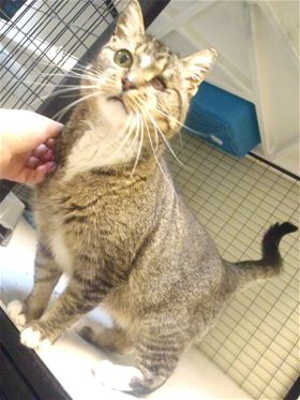
Brown tabby
This female brown tabby is 2 years old.
She weighs 9 pounds and has a short coat. It appears she lost her left eye due to an injury. She has been been spayed.
She's in cat room kennel No. 91, ID No. 39077.

Domestic short hair mix
This female domestic short hair mix is 1 year old.
She weighs 10 pounds, has been spayed and has tortie point markings.
Find her in cat room kennel No. 96, ID No. 39075.
Adoptable cats also can be seen at http://www.co.lake.ca.us/Government/Directory/Animal_Care_And_Control/Adopt/Cats_and_Kittens.htm or at www.petfinder.com .
Please note: Cats listed at the shelter's Web page that are said to be “on hold” are not yet cleared for adoption.
To fill out an adoption application online visit http://www.co.lake.ca.us/Government/Directory/Animal_Care_And_Control/Adopt/Dog___Cat_Adoption_Application.htm .
Lake County Animal Care and Control is located at 4949 Helbush in Lakeport, next to the Hill Road Correctional Facility.
Office hours are Monday through Friday, 8 a.m. to 5 p.m., and 1 p.m. to 3 p.m., Saturday. The shelter is open from 10:30 a.m. to 4:30 p.m. Monday through Friday and on Saturday from 1 p.m. to 3 p.m.
Visit the shelter online at http://www.co.lake.ca.us/Government/Directory/Animal_Care_And_Control.htm .
For more information call Lake County Animal Care and Control at 707-263-0278.
Email Elizabeth Larson at

LAKE COUNTY, Calif. – The combined swim team made up of swimmers from Kelseyville High School and Clear Lake High School traveled to Santa Rosa on Thursday to compete in their first double-dual swim meet against Calistoga High School and Piner High School.
The girls won both meets and achieved a first for the girls’ team: a first-place finish in every single race against both teams.
“This year’s girl’s team is incredibly effective,” said Head Coach Agustin Merodio. “They started the meet strong with a first place in the 200 Medley Relay – and never let up.”
The boys won their meet against Calistoga but lost the second meet to Piner by just 6 points.
“The boys swam strong but Piner had a few more swimmers and got us in the end,” according to Merodio. “However, the win over Calistoga, a bigger team, shows that we are swimming competitively and will only continue to improve.”
Merodio went on to say, “The deciding factor for our victories on this first road trip was the speed we got back into the water after the Lakeport Unified School District decided not to open Westshore Pool. If Quail Run hadn’t opened their doors to us as quickly as they did, we would not have been as competitive in the water in Santa Rosa. This first victory is dedicated to Quail Run.”
Allison Hanson, senior swimmer from Clear Lake High School mentioned another advantage of this first meet.

“Kelseyville High School was generous enough to provide the swim team with a school bus for all of our road trips this season,” she said. “This is the first time that the entire team was able to travel to our meet together as one unit. We were able to go over the lineup on the road, practice our pre-meet cheer, and get a last minute pep talk from our coach.”
Two new team records were recorded at the meet in relay events.
The first was in the girl’s 200 Medley Relay – swam by Liz Fricker, Lauren Rudnick, Sarah Merodio and Allison Hanson – winning first with a time of 2:21.06.
The second team record was in the 200 Free Relay – swam by Kim English, Sarah Merodio, Allison Hanson and Lauren Rudnick – winning first with a time of 2:11.24.
Other swimmers with first place finishes were Andres Tejeda, Owen Lawler, Connor Disney and Tim Peterson.
The newest relay team of Kaylie Williams, Shannon Fronsman, Tasia Jardstrom and Ciera Moreno also finished first in the 400 Free Relay.
Next up for the swim team is their meet against Healdsburg next Thursday.

LAKE COUNTY, Calif. – Looking for a big dog? A little dog? Lake County Animal Care and Control has a number of canines this week that just might fit the bill.
They have mixes of German and Anatolian shepherds, kelpie, Chihuahua and pit bull needing homes, with the dogs ranging in age from 9 months to 8 years.
Dogs that are adopted from Lake County Animal Care and Control are either neutered or spayed, microchipped and, if old enough, given a rabies shot and county license before being released to their new owner. License fees do not apply to residents of the cities of Lakeport or Clearlake.
If you're looking for a new companion, visit the shelter. There are many great pets hoping you'll choose them.
In addition to the animals featured here, all adoptable animals in Lake County can be seen here: http://bit.ly/Z6xHMb .
The following dogs at the Lake County Animal Care and Control shelter have been cleared for adoption (additional dogs on the animal control Web site not listed are still “on hold”).

'Max'
“Max” is a 3-year-old male Chihuahua mix.
He weighs 7 pounds, has a short tan coat and perky ears, and has been neutered.
He's described as a “sweet little guy” who gets along with other dogs and is not food aggressive.
Find him in kennel No. 3, ID No. 38940.

'Gremlin'
“Gremlin” is an 8-year-old female Chihuahua mix.
She weighs 4 pounds and has a short tan coat. She has not yet been spayed.
Gremlin needs a home with plenty of attention, as she has a skin allergy, will need a special diet and also may be deaf. She does well with other small dogs, but may need a one-dog home.
Meet Gremlin in kennel No. 5, ID No. 39118.
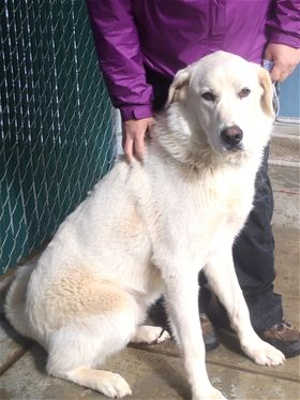
'Baron'
“Baron” is a 1-year-old Anatolian Shepherd mix.
He has a short white coat, weighs 97 pounds and has been neutered.
Shelter staff said he's a great dog who is friendly to everyone and just needs some training.
Baron is in kennel No. 16, ID No. 36853.

Male pit bull terrier mix
This male pit bull terrier mix is of determined age.
He's got a curly brown brindle and white coat, and weighs 26 pounds. Shelter staff did not report if he has been neutered.
Find him in kennel No. 19, ID No. 39060.

'Sasha'
“Sasha” is a female German Shepherd.
She is 1 year old, weighs 64 pounds, has a short black and tan coat, and has been spayed.
Shelter staff said she is a great dog who gets along with everyone and walks well on a leash. She can use some basic training, which shouldn't be hard because she's eager to please.
Sasha is in kennel No. 27, ID No. 39122.

Male shepherd mix
This male shepherd mix is 9 months old.
He has a short black and tan coat, and has not yet been neutered.
Find him in kennel No. 32, ID No. 38962.

Australian Kelpie mix
This female Australian Kelpie mix is 9 months old.
She weighs 20 pounds and has a short brown brindle coat. Shelter staff did not report if she has been spayed.
She's in kennel No. 33, ID No. 39033.
To fill out an adoption application online visit http://www.co.lake.ca.us/Government/Directory/Animal_Care_And_Control/Adopt/Dog___Cat_Adoption_Application.htm .
Lake County Animal Care and Control is located at 4949 Helbush in Lakeport, next to the Hill Road Correctional Facility.
Office hours are Monday through Friday, 8 a.m. to 5 p.m., and 1 p.m. to 3 p.m., Saturday. The shelter is open from 10:30 a.m. to 4:30 p.m. Monday through Friday and on Saturday from 1 p.m. to 3 p.m.
Visit the shelter online at http://www.co.lake.ca.us/Government/Directory/Animal_Care_And_Control.htm .
For more information call Lake County Animal Care and Control at 707-263-0278.
Email Elizabeth Larson at
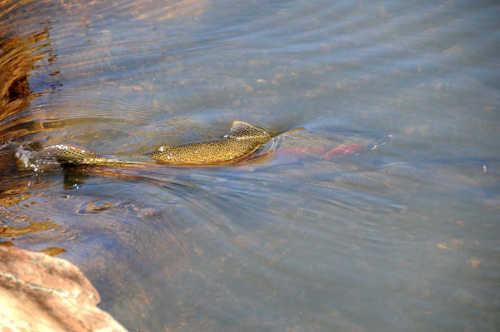
NORTH COAST, Calif. – Ninety-six Russian River steelhead were spawned Feb. 20 at Warm Springs Hatchery, marking a strong but late start for the hatchery’s annual steelhead spawning operation.
The Russian River and its tributaries comprise one of the most significant steelhead populations in the Central Coast area of California.
The Russian River watershed also provides important habitat for endangered Coho and Chinook salmon.
Although steelhead normally begin entering the river with the first heavy rains in the fall and can be found throughout the river and its tributaries through April, this year little rain fell from November through the first week in February, creating extremely low river conditions and few opportunities for steelhead to move into and up the river system.
Low water conditions in January also allowed the naturally occurring sandbar to form at the mouth of the river, blocking the migration of steelhead.
“Once the first rains hit in February, the sandbar blocking the mouth of the river washed out, allowing the steelhead to move in from the ocean into the river system,” said Brett Wilson, Senior Hatchery Supervisor for the California Department of Fish and Wildlife (CDFW). “Based on what we are seeing right now, we should be able to meet our goal of taking enough eggs to rear a half million young steelhead for release into the Russian River.”
Emergency regulations that went into effect Feb. 19 closed most of the Russian River to fishing, adding extra protection for migrating steelhead and salmon.
March is an excellent time to visit the hatchery and view the steelhead moving through the concrete fish ladder into the restored stream habitat leading to the hatchery. A visitor viewing area also provides excellent photographic opportunity.
“The new restoration stream habitat just outside the hatchery intake gives visitors a chance to see steelhead up close and in native type of habitat,” Wilson said.
Warm Springs Hatchery is the end of a lengthy migration for the hatchery produced steelhead. From the Pacific Ocean, they enter the Russian River at Jenner and travel 40 miles upriver to Dry Creek near Healdsburg before following the stream 14 more miles west to the hatchery. Steelhead are also spawned at Coyote Valley Fish Facility on the East Fork of the Russian below Lake Mendocino.
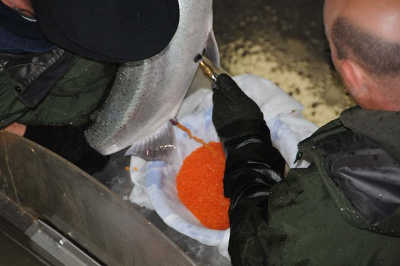
The steelhead are generally held captive one week before the eggs are artificially taken. Spawning is open to the public and occurs throughout the entire season on most Thursdays at 10:30 a.m.
The steelhead eggs spawned at the Hatchery and the Coyote Valley Fish Facility are incubated, hatched and reared at the hatchery for one year before they are released back into the Russian River to begin their migration to the sea.
Warm Springs Hatchery is located just below Warm Springs Dam on Lake Sonoma, approximately 14 miles above the confluence of Dry Creek with the Russian River at an elevation of 322 feet.
The hatchery began operation in 1980 and is designed to produce a maximum of 161,300 pounds of salmonid fish annually.
Although the hatchery is owned by the U.S. Army Corps of Engineers, it is operated by CDFW.
CDFW also operates the Coyote Valley Fish Facility for trapping and spawning adult steelhead and imprinting steelhead destined for release in the Russian River. The Coyote Valley Fish Facility is located upstream on the east branch of the Russian River near the town of Ukiah.
Warm Springs Hatchery is a mitigation hatchery that produces steelhead to enhance the river’s natural steelhead population required due to the loss of natural spawning and rearing habitat associated with the construction of the Warm Springs and Coyote Valley dams. The mitigating agency is the U.S. Army Corps of Engineers.
The Warm Springs Hatchery also is home to the Coho Salmon Broodstock Program, which produces coho for release to 21 tributaries of the Russian River as part of a multi-agency recovery effort for this endangered species.
As California grapples with the driest period in its history, Gov. Edmund G. Brown Jr. on Saturday signed legislation to assist drought-affected communities and provide funding to better use local water supplies.
“Legislators across the aisle have now voted to help hard-pressed communities that face water shortages,” said Brown. “This legislation marks a crucial step – but Californians must continue to take every action possible to conserve water.”
The legislation had broad, bipartisan support. SB 103 passed 34-2 in the Senate and 64-3 in the Assembly. SB 104 passed 33-3 in the Senate and 68-1 in the Assembly.
The bills provide $687.4 million to support drought relief, including money for housing and food for workers directly impacted by the drought, bond funds for projects to help local communities more efficiently capture and manage water and funding for securing emergency drinking water supplies for drought-impacted communities.
In addition, the legislation increases funding for state and local conservation corps to assist communities with efficiency upgrades and reduce fire fuels in fire risk areas, and includes $1 million for the Save Our Water public awareness campaign – which will enhance its mission to inform Californians how they can do their part to conserve water.
“Like the rain this weekend, this package is badly needed to help mitigate the effects of the historic drought California is facing. But also like the rain, we need to see more,” said Assembly Speaker John A. Pérez. “That’s why every Californian needs to continue to conserve water, and there’s more work to do on storage, water quality improvement and environmental protections. If we don’t act now, the problems we face will only get worse.”
“Swift action is what’s needed to make sure we get the most out of every drop of water, to help our hardest-hit communities and to give emergency help to those who have lost their jobs from this severe drought. That swift action is exactly what we’ve taken with these measures,” said Senate President pro Tem Darrell Steinberg. “Neither the rain storms we’re having now, nor this legislation will eliminate the drought and its impacts. But just like any amount of rain and snow will help, saving a year or even a few months in getting money out the door and getting water projects on-line can benefit California enormously.”
In addition to the funding provided by the legislation, the bill calls for the California Department of Public Health (DPH) to adopt new groundwater replenishment regulations by July 1, 2014, and for the State Water Resources Control Board and the DPH to work on additional measures to allow for the use of recycled water and storm water capture for increasing water supply availability.
The bill also makes statutory changes to ensure existing water rights laws are followed, including streamlined authority to enforce water rights laws and increased penalties for illegally diverting water during drought conditions. The bill also provides the California Department of Housing and Community Development with the greatest flexibility to maximize migrant housing units.
The governor signed the following bills:
• SB 103 by the Committee on Budget and Fiscal Review – Budget Act of 2013.
• SB 104 by the Committee on Budget and Fiscal Review – Drought Relief.
For full text of the bills, visit: http://leginfo.ca.gov/bilinfo.html .
Highlights of the legislation include:
Enhancing water conservation and improving water supplies
- $549 million from the accelerated expenditure of voter-approved bonds, Proposition 84 and Proposition 1E, in the form of infrastructure grants for local and regional projects that are already planned or partially completed to increase local reliability, including recapturing of storm water, expanding the use and distribution of recycled water, enhancing the management and recharging of groundwater storage and strengthening water conservation.
- $30 million from the Greenhouse Gas Reduction Fund to the Department of Water Resources (DWR) for direct expenditures and grants to state and local agencies to improve water use efficiency, save energy and reduce greenhouse gas emissions from state and local water transportation and management systems.
- $14 million for groundwater management across the state, including assistance to disadvantaged communities with groundwater contamination exacerbated by the drought.
- $10 million from the Greenhouse Gas Emissions Fund for the California Department of Food and Agriculture to invest in irrigation and water pumping systems that reduce water use, energy use and greenhouse gas emissions.
- $15 million from the General Fund for Emergency Drinking Water Fund to address emergency water shortages due to drought.
- $13 million from the General Fund to augment the California Conservation Corps and local community conservation corps to expand water use efficiency and conservation activities and to reduce fuel loads to prevent catastrophic fires.
Assisting Californians disproportionately impacted by the drought
- $25.3 million from the General Fund for food assistance, which will be structured to maximize the potential federal drought assistance that can be provided to provide food assistance to those impacted by the drought.
- $21 million from the General Fund and federal funds for housing related assistance for individuals impacted by the drought.