How to resolve AdBlock issue?
News
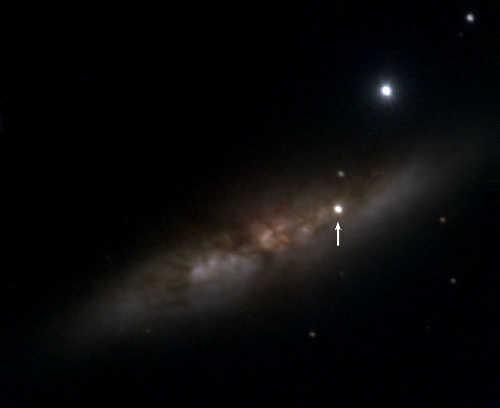
A bright supernova discovered only six weeks ago in a nearby galaxy is provoking new questions about the exploding stars that scientists use as their main yardstick for measuring the universe.
Called SN 2014J, the glowing supernova was discovered by a professor and his students in the United Kingdom on Jan. 21, about a week after the stellar explosion first became visible as a pinprick of light in its galaxy, M82, 11.4 million light years away.
Still visible today through small telescopes in the Big Dipper, it is the brightest supernova seen from Earth since SN1987A, 27 years ago, and may be the closest Type Ia supernova – the kind used to measure cosmic distances – in more than 77 years.
When University of California, Berkeley, astronomer Alex Filippenko’s research team looked for the supernova in data collected by the Katzman Automatic Imaging Telescope (KAIT) at Lick Observatory near San Jose, Calif., they discovered that the robotic telescope had actually taken a photo of it 37 hours after it appeared, unnoticed, on Jan. 14.
Combining this observation with another chance observation by a Japanese amateur astronomer, Filippenko’s team was able to calculate that SN 2014J had unusual characteristics – it brightened faster than expected for a Type Ia supernova and, even more intriguing, it exhibited the same unexpected, rapid brightening as another supernova that KAIT discovered and imaged last year – SN 2013dy.
“Now, two of the three most recent and best-observed Type Ia supernovae are weird, giving us new clues to how stars explode,” said Filippenko, referring to a third, though apparently 'normal,' Type Ia supernova, SN 2011fe, discovered three years ago. “This may be teaching us something general about Type Ia supernovae that theorists need to understand. Maybe what we think of as 'normal' behavior for these supernovae is actually unusual, and this weird behavior is the new normal.”
A paper describing the SN 2014J observations – the first published on this newly discovered supernova – was posted online this week by The Astrophysical Journal Letters and appeared in the March 1 print issue.
Type Ia supernovae as standard candles
Astronomers noticed decades ago that Type Ia supernovae explode with about the same brightness, no matter where they are in the universe. This makes them good “standard candles” with which to judge distance.
In the 1990s, two teams (both of them included Filippenko) used Type Ia supernovae to determine the distances to galaxies, compared distance with velocity and discovered that the universe is expanding faster and faster, rather than slowing down as expected.
The teams’ leaders, including UC Berkeley astrophysicist Saul Perlmutter, shared the 2011 Nobel Prize in Physics for this discovery.
While the latest discoveries do not contradict these results, refinements in understanding Type Ia explosions could help improve distance measurements and lead to more precise calculations of the expansion rate of the universe, thereby setting constraints on the nature of “dark energy,” a still mysterious energy comprising 70 percent of the universe and thought to be responsible for its acceleration.
The new data also provide information about the physics occurring in the core of the explosion.
A Type Ia supernova is thought to be the explosion of a white dwarf – an old and very dense star that has shrunk from the size of the Sun to the size of Earth.
When a white dwarf has a stellar companion, it can sometimes gain matter from it until the white dwarf becomes unstable, completely obliterating itself through a gigantic nuclear explosion.
New telescopes to catch more supernovae
Because of the importance of supernovae in measuring the universe, many new telescopes, such as the Palomar Transient Factor in San Diego County and the Pan-STARRS in Hawaii, continually rescan the sky to discover more of them.
The KAIT telescope has a smaller field of view than newer ones do, so Filippenko’s team has switched its focus to discovering supernovae earlier: it scans the same patches of sky every night or every other night.
The sooner a new explosion is discovered, the sooner astronomers can capture information, such as spectra showing how the supernova brightens in different colors or wavelengths.
Last year, for example, KAIT and Filippenko's Lick Observatory Supernova Search (LOSS) team discovered and photographed SN 2013dy within two and a half hours of its appearance, earlier than for any other Type Ia.
KAIT, which is operated by postdoctoral scholar WeiKang Zheng, is programmed to automatically take images of likely supernovae in five different wavelength bands, and in 2012 captured one supernova, SN 2012cg, three minutes after its discovery.
“Very, very early observations give us the most stringent constraints on what the star's behavior really is in the first stages of the explosion, rather than just relying on theoretical speculation or extrapolating back from observations at later times, which is like observing adolescents to understand early childhood,” Filippenko said.
Filippenko's colleagues include Zheng; UC Berkeley graduate student Isaac Shivvers; assistant specialist Kelsey I. Clubb; postdoctoral scholars Ori D. Fox, Melissa L. Graham, Patrick L. Kelly and Jon C. Mauerhan; and amateur astronomer Koichi Itagaki of the Itagaki Astronomical Observatory in Yamagata, Japan, who captured an image of SN 2014J just 20 hours after it exploded.
The research was funded by the TABASGO Foundation, the Sylvia & Jim Katzman Foundation, the Christopher R. Redlich Fund, Gary and Cynthia Bengier, the Richard and Rhoda Goldman Fund, Weldon and Ruth Wood, and the National Science Foundation.
Robert Sanders writes for the UC Berkeley News Center.
In the latest update on California's flu deaths, the state's health officer reported an increase of two dozen deaths, with this year's fatal cases reaching nearly three times last year's total.
Dr. Ron Chapman, director of the California Department of Public Health (CDPH) and state health officer, announced Friday that the number of confirmed influenza related deaths in persons under 65 years of age reported in the state has increased by 24 to a total of 302 confirmed deaths for the 2013-14 season.
Six of the 302 are pediatric deaths, Chapman said.
There are an additional 19 deaths under investigation, not yet confirmed, according to Chapman.
The 302 confirmed influenza-associated deaths this season have been reported by the following jurisdictions: Alameda (6), Butte (1), Calaveras (2), Contra Costa (6), El Dorado (2), Fresno (21), Glenn (1), Humboldt (1), Imperial (1), Kern (10), Kings (6), Lake (1), Lassen (1), Long Beach (7), Los Angeles (44), Madera (2), Marin (2), Mendocino (4), Merced (5), Monterey (5), Nevada (1), Orange (13), Riverside (13), Sacramento (25), San Bernardino (23), San Diego (25), San Francisco (3), San Joaquin (7), San Luis Obispo (1), San Mateo (6), Santa Barbara (3), Santa Clara (15), Santa Cruz (3), Shasta (3), Siskiyou (2), Solano (3), Sonoma (7), Stanislaus (13), Sutter (1), Tulare (3), Tuolumne (1) and Ventura (3).
By this time last year, CDPH had received reports of a total of 34 influenza fatalities in persons under 65 years of age and in all of the 2012-13 season, a total of 106 deaths were reported.
The great majority of reported influenza deaths in persons under 65 years of age have occurred in people with underlying medical conditions, Chapman's office reported.
Outpatient visits continued to decrease and both outpatient visits and hospitalizations are within expected baseline levels for this time of year. Chapman said the influenza season status was decreased to regional.
“The influenza season continues and it’s not too late for vaccination, which is still the best way to prevent illness and the spread of illness,” said Dr. Chapman.
Those at highest risk – the elderly, pregnant women, infants, or those with other health conditions - who show flu symptoms should contact their physician immediately in order to get the most effective treatment. Symptoms include fever, cough, sore throat, runny or stuffy nose, muscle or body aches, headaches and fatigue.
Influenza vaccine remains available and there is no widespread shortage of antivirals for treatment. CDPH continues to closely monitor influenza activity statewide and related resources.
For information on local vaccinations, call Lake County Public Health, 707-263-1090 or 800-794-9291.

KELSEYVILLE, Calif. – The service of a search warrant by the Sheriff’s Narcotics Task Force has resulted in the arrest of a Kelseyville couple, and the seizure of methamphetamine and a firearm.
James Russell Samson, 44, and 46-year-old Susan Nalani Samson were arrested Friday morning, according to Lt. Steve Brooks of the Lake County Sheriff's Office.
On Feb. 20 narcotics detectives secured a search warrant for the Samson residence, which is located in the 4000 block of Clark Drive in Kelseyville, Brooks said. At 7:20 a.m. Friday detectives served the warrant at the home.
When detectives entered the residence, they located the Samsons in a bedroom they were sharing with their 2-year-old child. Brooks said both were detained without incident.
During a search of the bedroom where the Samsons were detained, detectives located and seized 10 grams of methamphetamine and a glass meth pipe, which were inside a coin purse, according to Brooks.
The coin purse was on the night stand, next to where Susan Samson was sleeping, Brooks said. Detectives noticed that the Samson’s had placed the crib next to the bed and their child could have easily accessed the methamphetamine.
During a search of one of the spare bedrooms, detectives located approximately 6 ounces of methamphetamine, packaging materials and a digital scale inside a tool box. Brooks said they also located a loaded revolver inside a safe in the master bedroom. All of the items were seized as evidence.
During the service of the search warrant both Susan and James Samson were interviewed. Brooks said both admitted to possessing the methamphetamine for the purpose of sales.
Susan Samson was arrested for child endangerment, possession of a controlled substance for sale and possession of drug paraphernalia. James Samson was arrested for the possession of a controlled substance for sale, according to Brooks.
Brooks said both were transported to the Lake County Hill Road Correctional Facility and booked. The firearm charge will be submitted for complaint, due to not being able to prove who it actually belongs to at this time.
The Sheriff’s Narcotics Task Force can be reached through its anonymous tip line at 707-263-3663.

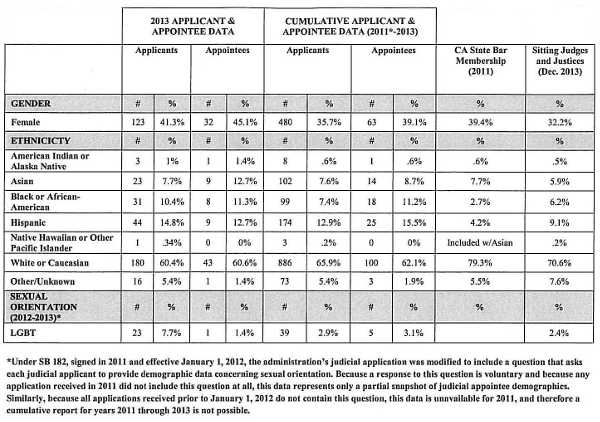
California Gov. Edmund G. Brown Jr. on Friday released annual applicant and appointee data for the administration’s judicial appointments.
From 2011 through 2013, there were 1,345 applicants for judicial appointments and Gov. Brown appointed 161 judges, including 71 in 2013.
Women accounted for about 41 percent of the applicant pool and 45 percent of Gov. Brown’s judicial appointees in 2013.
Approximately 40 percent of Gov. Brown’s appointees in 2013 identified their ethnicity as American Indian or Alaska Native; Asian; Black or African-American; Hispanic; Native Hawaiian or other Pacific Islander; or other/unknown.
Gov. Brown’s 2013 judicial appointees included a number of notable firsts, including:
- Paul Lo, the first Hmong American judge ever appointed in the country;
- Sunshine Sykes, the first Native American judge ever appointed to the Riverside County Superior Court;
- Sunil Kulkarni, the first South Asian American judge ever appointed in Northern California; and
- Rupa Goswami, the first South Asian American woman judge ever appointed in California.
This follows a number of other notable firsts in 2011 and 2012, including:
- Halim Dhanidina, the first American-Muslim judge ever appointed in California;
- Jim Humes, the first openly gay justice ever appointed to the California Court of Appeal;
- Miguel Marquez, the first Latino justice ever appointed to the Sixth District Court of Appeal;
- Rosendo Peña, the first Latino justice ever appointed to the Fifth District Court of Appeal;
- Chris Doehle, the first female judge ever appointed to the Del Norte County Superior Court;
- Kimberly Colwell, the first openly lesbian judge ever appointed to the Alameda County Superior Court;
- Mark Andrew Talamantes, the first Latino judge ever appointed to the Marin County Superior Court;
- Kathleen O’Leary, the first female presiding justice ever appointed to the Fourth District Court of Appeal, Division Three; and
- Raquel Marquez, the first Latina judge ever appointed to the Riverside County Superior Court.
Under SB 56 and SB 182, the governor is required to disclose aggregate statewide demographic data provided by all judicial applicants by March 1.
Years ago, before the launch of NASA’s Kepler spacecraft, astronomers were thrilled when they discovered a single planet.
On Feb. 26, the Kepler team announced 715.
Kepler has always been good at finding planets. Even before the announcement, the observatory had confirmed 246 new worlds outside the solar system. The latest discoveries almost quadruple that number.
Kepler works by looking for the slight dimming of starlight caused when a distant planet transits its parent star. Any dip in stellar brightness attracts the attention of the Kepler team, and can prompt them to declare a planet candidate. Verification of candidates can be a laborious process, proceeding slowly, planet-by-planet.
Now, however, a research team co-led by Jack Lissauer of the Ames Research Center has figured out a way to speed the process up.
“We've developed a procedure to verify multiple planet candidates in bulk to deliver planets wholesale, and have used it to unveil a veritable bonanza of new worlds,” said Lissauer.
The technique is called “verification by multiplicity,” which relies in part on the logic of probability. Out of the 160,000 stars Kepler has observed, a few thousand have planet candidates.
But not all candidate systems are equal. A subset of the total, numbering in the hundreds, have not just one but multiple candidates. By concentrating on those busy systems, the team found 715 planets orbiting 305 stars.
The method of multiplicity can be likened to the behavior of lions and lionesses.
Suppose that Kepler’s stars are like lions, and the planets are lionesses. If you see two big cats it could be a lion and a lioness or it could be two lions. But if more than two cats are gathered, then it is very likely a lion and his pride. Thus, through multiplicity, the lionesses – or planets – can be reliably identified.
All of the newly-discovered worlds are located in multi-planet systems. Nearly 95 percent of the planets are smaller than Neptune – that is, less than four times the size of Earth. This is a marked increase in the known number of relatively small planets.
“This study shows us that planets in multi-systems tend to be small and their orbits are flat and circular, much like the inner parts of our own solar system,” said Jason Rowe a co-leader of the research at the SETI Institute.
Four of the new planets are less than two-and-a-half times the size of Earth. Moreover, they orbit in their sun's habitable zone, where the surface temperature of the planets may be suitable for liquid water, a key ingredient for life as we know it.
“The more we explore,” concluded Rowe, “the more we find familiar traces of ourselves amongst the stars that remind us of home.”
For more information about the discovery of these and other new worlds, visit PlanetQuest at http://planetquest.jpl.nasa.gov/ .
Dr. Tony Phillips works for the National Aeronautics and Space Administration.
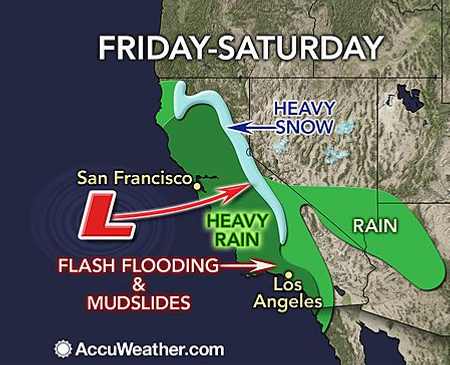
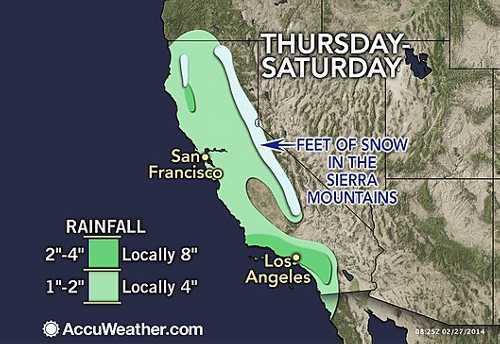
AccuWeather.com reports another round of rain is headed for California before the end of the week, bringing further relief from the extreme drought gripping much of the Golden State.
This rain is forecast to move in on Friday, right on the heels of the storm that brought rain to parts of the state on Wednesday.
This second storm will have some differences though, including a heavier rain that will span across the entire state.
As beneficial as this rain will be, it does pose some dangers, particularly to those living in Southern California.
According to AccuWeather.com Western Weather Expert Ken Clark, “Rain will fall everywhere in the state Friday and Friday night with the heavy rain mostly in the southern third of the state.”
This is a big difference from that storm that affected the state Wednesday into Thursday, as some residents of Southern California did not even see a drop of rain.
Not only will the rain help battle the drought, but heavy snow is expected to fall in the mountains with several feet possible in the Sierra through Saturday. This snow is crucial during the warmer months when the runoff helps to fill water reservoirs downstream.
Several inches of rain are likely through Saturday along the California coast with the heaviest rain focusing along the coast of Southern California.
“I would expect to see some amounts in the 6- to 8-inch range Friday into Saturday in the mountains with 4 to 6 inches in the spots in the lower foothills. This would include the recent burn area around the San Gabriel Valley.” Clark said.
Periods of heavy rain are also in store for southern parts of Nevada and Utah as well as northern Arizona as the moisture associated with the storm travels inland.
This rain does bring some hazards with it, however. Heavy rain can quickly lead to flash floods or even mudslides, especially in areas that have been affected by wildfires over the past several months.
Folks living in these areas are encouraged to have a plan in place in the event that you must leave your home with little warning.
Thunderstorms will also develop over Southern California on Saturday, bringing the risk of damaging winds and hail. A brief tornado or waterspout cannot be ruled out either.
According to the U.S. Drought Monitor report on Feb. 18, 2014, more than 90 percent of California was under a severe drought, and 68 percent under an extreme drought.
Although the rainfall through the weekend will help to lower these percentages, it will take much more rain to have a long-term impact on the current drought.
The chance of rain will return again to California during the first half of next week; however, most of this rain appears like it will stay mainly over the northern half of the state.
Brian Lada is a meteorologist for www.AccuWeather.com .