How to resolve AdBlock issue?
Refresh this page
How to resolve AdBlock issue?
Refresh this page
Lake County News,California
  • Home
    • Registration Form
  • News
    • Education
    • Veterans
    • Community
      • Obituaries
      • Letters
      • Commentary
    • Police Logs
    • Business
    • Recreation
    • Health
    • Religion
    • Legals
    • Arts & Life
    • Regional
  • Calendar
  • Contact us
    • FAQs
    • Phones, E-Mail
    • Subscribe
  • Advertise Here
  • Login

News

Lakeport Police Department to host National Night Out Against Crime Oct. 1

LAKEPORT, Calif. — An annual gathering to foster a safer community is coming up next week.

The Lakeport Police Department and its community partners are hosting the National Night Out Against Crime on Tuesday, Oct. 1.

It will take place from 4 to 7 p.m. in Lakeport’s new Xabatin Community Park.

This event is a community building partnership meant to bring law enforcement, other agencies and the public together in public spaces under positive circumstances. The goal is to reduce crime and build a more resilient community.

There will be numerous games and other fun activities for the whole family at the event including face painting, raffle prizes, balloons, music and a kid’s bike parade.

Children who want to participate in the parade can bring their bicycles and enter the Lakeport Main Street Association bicycle decorating contest.

This free event is sponsored by many local citizens and businesses. Community partners will be present with booths providing important public information and resources.

Lakeport Kiwanis Club will again be serving hot dogs, donated by Lakeport Grocery Outlet, and popcorn, donated by Lakeport Cinema 5.

Lakeport Police, supported by local youth volunteers, will have snow cones, lemonade and water available.

Safety Pup, Chipper and McGruff the Crime Dog will be on-hand interacting with the community.

There will be many raffle prizes for both kids and adults. All in attendance will be given two general prize raffle tickets with opportunities to earn more by adults visiting all of the partner booths and completing a bingo card, and by kids participating in games. Gift Cards for free ice cream, at Lyndall's Sports Stop, or donuts, at Susie Q's Donuts & Espresso, will be given to those meeting and greeting a Lakeport Police officer.

Complete details including names of participating agencies and sponsors as well as prize details will be posted on the event Facebook page.

CHP Clear Lake Area office welcomes two new officers

Lt. Dan Fansler, commander of the California Highway Patrol’s Clear Lake Area office, with new officers Luis Estrada and Steven Andre. Photo courtesy of the CHP.

LAKE COUNTY, Calif. — Two new officers have joined the ranks of the California Highway Patrol’s Clear Lake Area office.

The agency welcomed Steven Andre and Luis Estrada, newly promoted officers from the CHP Academy in West Sacramento.

Andre and Estrada were among 119 new officers who graduated from the CHP Academy on Friday, Sept. 13. After 26 weeks of intensive training, the group was officially sworn in.

Andre came from Lake County, said CHP Sgt. Joel Skeen.

Newly promoted officers receive extensive in-field training with more experienced officers for approximately four months.

Lake County is different from larger metropolitan areas, with its unique landscape and rural roadways that will test these officer’s skills.

The ultimate goal is to get all newly promoted officers ready to face the challenges they will encounter on a day-to-day basis so they can provide the highest level of safety, service, and security to the people of California.

The CHP is hiring. Visit www.chpmadeformore.com for more information on how to make a difference in your community, save lives, and have a great career as a CHP officer.

State controller publishes 2023 UC institutions and community colleges

State Controller Malia M. Cohen on Tuesday published the 2023 self-reported payroll data for University of California institutions and California Community College districts on the Government Compensation in California website.

The data covers 433,180 positions and approximately $27.74 billion in total wages.

All 11 UC institutions — including 10 campuses and the Office of the President — voluntarily filed compliant reports with the State Controller’s Office.

UC data covers 334,825 employees and more than $23.11 billion in total wages. 38 CCC districts voluntarily filed compliant reports with the State Controller’s Office.

California Community College data published covers 98,355 employees and nearly $4.63 billion in total wages.

Twenty-one CCC districts did not file a report with SCO, while another 14 filed reports that were not compliant.

Among the districts that did not file were the two that serve Lake County — Mendocino-Lake Community College District and the Yuba Community College District.

California law requires cities, counties and special districts to annually report compensation data to the state controller.

The state controller also maintains and publishes state and CSU salary data. No such statutory requirement exists for UC, California Community Colleges, superior courts, fairs and expositions, First 5 commissions, or K-12 education providers; their reporting is voluntary.

The Government Compensation in California site contains pay and benefit information on more than two million government jobs in California, as reported annually by each entity.

Users of the site can view compensation levels on maps and search by region; narrow results by name of the entity or by job title; and export raw data or custom reports.

As the chief fiscal officer of California, Controller Cohen is responsible for accountability and disbursement of the state’s financial resources. The controller has independent auditing authority over government agencies that spend state funds.

Why home insurance rates are rising so fast across the US – climate change plays a big role


The U.S. has seen a large number of billion-dollar disasters in recent years. AP Photo/Mark Zaleski

Millions of Americans have been watching with growing alarm as their homeowners insurance premiums rise and their coverage shrinks. Nationwide, premiums rose 34% between 2017 and 2023, and they continued to rise in 2024 across much of the country.

To add insult to injury, those rates go even higher if you make a claim – as much as 25% if you claim a total loss of your home.

Why is this happening?

There are a few reasons, but a common thread: Climate change is fueling more severe weather, and insurers are responding to rising damage claims. The losses are exacerbated by more frequent extreme weather disasters striking densely populated areas, rising construction costs and homeowners experiencing damage that was once more rare.
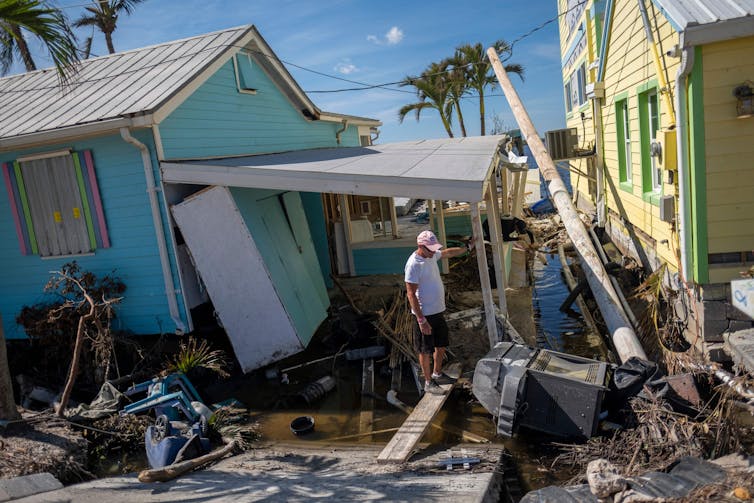
A man stands on porch of a house that is leaning precariously, with shreds of wood and a broken palm tree laying in the yard.
Hurricane Ian, supercharged by warm water in the Gulf of Mexico, hit Florida as a Category 4 hurricane in October 2022 and caused an estimated $112.9 billion in damage. Ricardo Arduengo/AFP via Getty Images

Parts of the U.S. have been seeing larger and more damaging hail, higher storm surges, massive and widespread wildfires, and heat waves that kink metal and buckle asphalt. In Houston, what used to be a 100-year disaster, such as Hurricane Harvey in 2017, is now a 1-in-23-years event, estimates by risk assessors at First Street Foundation suggest. In addition, more people are moving into coastal and wildland areas at risk from storms and wildfires.

Just a decade ago, few insurance companies had a comprehensive strategy for addressing climate risk as a core business issue. Today, insurance companies have no choice but to factor climate change into their policy models.

Rising damage costs, higher premiums

There’s a saying that to get someone to pay attention to climate change, put a price on it. Rising insurance costs are doing just that.

Increasing global temperatures lead to more extreme weather, and that means insurance companies have had to make higher payouts. In turn, they have been raising their prices and changing their coverage in order to remain solvent. That raises the costs for homeowners and for everyone else.

The importance of insurance to the economy cannot be understated. You generally cannot get a mortgage or even drive a car, build an office building or enter into contracts without insurance to protect against the inherent risks. Because insurance is so tightly woven into economies, state agencies review insurance companies’ proposals to increase premiums or reduce coverage.

The insurance companies are not making political statements with the increases. They are looking at the numbers, calculating risk and pricing it accordingly. And the numbers are concerning.

The arithmetic of climate risk

Insurance companies use data from past disasters and complex models to calculate expected future payouts. Then they price their policies to cover those expected costs. In doing so, they have to balance three concerns: keeping rates low enough to remain competitive, setting rates high enough to cover payouts and not running afoul of insurance regulators.

But climate change is disrupting those risk models. As global temperatures rise, driven by greenhouse gases from fossil fuel use and other human activities, past is no longer prologue: What happened over the past 10 to 20 years is less predictive of what will happen in the next 10 to 20 years.

The number of billion-dollar disasters in the U.S. each year offers a clear example. The average rose from 3.3 per year in the 1980s to 18.3 per year in the 10-year period ending in 2024, with all years adjusted for inflation.

With that more than fivefold increase in billion-dollar disasters came rising insurance costs in the Southeast because of hurricanes and extreme rainfall, in the West because of wildfires, and in the Midwest because of wind, hail and flood damage.

Hurricanes tend to be the most damaging single events. They caused more than US$692 billion in property damage in the U.S. between 2014 and 2023. But severe hail and windstorms, including tornadoes, are also costly; together, those on the billion-dollar disaster list did more than $246 billion in property damage over the same period.

As insurance companies adjust to the uncertainty, they may run a loss in one segment, such as homeowners insurance, but recoup their losses in other segments, such as auto or commercial insurance. But that cannot be sustained over the long term, and companies can be caught by unexpected events. California’s unprecedented wildfires in 2017 and 2018 wiped out nearly 25 years’ worth of profits for insurance companies in that state.

To balance their risk, insurance companies often turn to reinsurance companies; in effect, insurance companies that insure insurance companies. But reinsurers have also been raising their prices to cover their costs. Property reinsurance alone increased by 35% in 2023. Insurers are passing those costs to their policyholders.

What this means for your homeowners policy

Not only are homeowners insurance premiums going up, coverage is shrinking. In some cases, insurers are reducing or dropping coverage for items such as metal trim, doors and roof repair, increasing deductibles for risks such as hail and fire damage, or refusing to pay full replacement costs for things such as older roofs.

Some insurances companies are simply withdrawing from markets altogether, canceling existing policies or refusing to write new ones when risks become too uncertain or regulators do not approve their rate increases to cover costs. In recent years, State Farm and Allstate pulled back from California’s homeowner market, and Farmers, Progressive and AAA pulled back from the Florida market, which is seeing some of the highest insurance rates in the country.
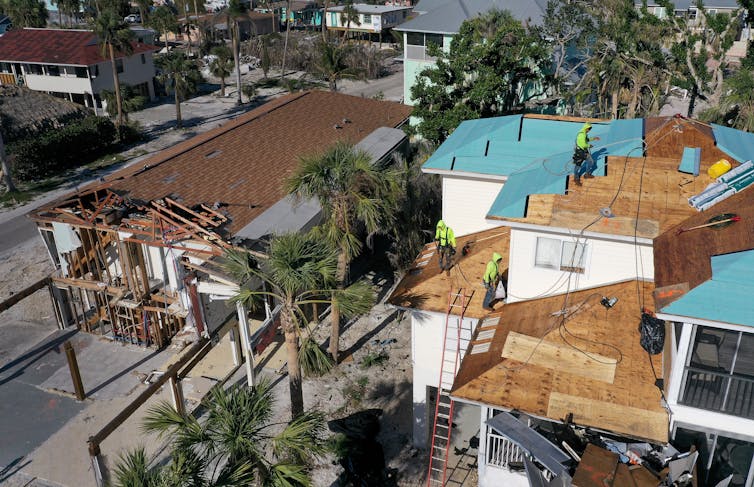
Workmen repairing the roof of a damaged house, surrounded by other homes with roof damage.
In some cases, insurers are restricting coverage. Roof repairs, like these in Fort Myers Beach, Fla., after Hurricane Ian, can be expensive and widespread after windstorms. Joe Raedle/Getty Images

State-run “insurers of last resort,” which can provide coverage for people who can’t get coverage from private companies, are struggling too. Taxpayers in states such as California and Florida have been forced to bail out their state insurers. And the National Flood Insurance Program has raised its premiums, leading 10 states to sue to stop them.

About 7.4% of U.S. homeowners have given up on insurance altogether, leaving an estimated $1.6 trillion in property value at risk, including in high-risk states such as Florida.

No, insurance costs aren’t done rising

According to NOAA data, 2023 was the hottest year on record “by far.” And 2024 could be even hotter. This general warming trend and the rise in extreme weather is expected to continue until greenhouse gas concentrations in the atmosphere are abated.

In the face of such worrying analyses, U.S. homeowners insurance will continue to get more expensive and cover less. And yet, Jacques de Vaucleroy, chairman of the board of reinsurance giant Swiss Re, believes U.S. insurance is still priced too low to fully cover the risk from climate change.


Climate change is a major factor in the rising cost of insurance. Join us for a special free webinar with experts Andrew Hoffman of the University of Michigan and Melanie Gall of Arizona State University to discuss the arithmetic behind these rising rates, what climate change has to do with it, and what may be coming in your future insurance bills.

Wednesday, October 9, 2024, 11:30 a.m. PT/2:30 p.m. ET.
Register for the webinar here.

The Conversation


Andrew J. Hoffman, Professor of Management & Organizations, Environment & Sustainability, and Sustainable Enterprise, University of Michigan

This article is republished from The Conversation under a Creative Commons license. Read the original article.

Special Lakeport City Council meeting called to consider grant support for Parkside Apartments project

LAKEPORT, Calif. – The Lakeport City Council will hold a special meeting this week to consider whether to support a request for a grant extension that would benefit an affordable housing project.

The council will meet Thursday, Sept. 26, at 6 p.m. in the council chambers at Lakeport City Hall, 225 Park St.

The agenda can be found here.

If you cannot attend in person, and would like to speak on an agenda item, you can access the Zoom meeting remotely at this link or join by phone by calling toll-free 669-900-9128 or 346-248-7799.

The webinar ID is 973 6820 1787, access code is 477973; the audio pin will be shown after joining the webinar. Those phoning in without using the web link will be in “listen mode” only and will not be able to participate or comment.

Comments can be submitted by email to This email address is being protected from spambots. You need JavaScript enabled to view it.. To give the city clerk adequate time to print out comments for consideration at the meeting, please submit written comments before 3:30 p.m. on Tuesday, Sept. 26.

The only item on the council’s agenda is consideration of authorizing City Manager Kevin Ingram to execute a 2018 CDBG-DR grant extension request letter to the California Department of Housing and Community Development.

The letter includes a reallocation of $2,396,301 in CDBG-DR funds from the Bevins Senior project to the Parkside Apartments project.

The Parkside project would be located on three acres at 1310 Craig Ave., and would include 64 units of affordable housing.

While the council approved the project in December 2022, in May it voted against supporting the submission of an application to the California State Department of Housing and Community Development for funding under the Competitive Permanent Local Housing Allocation to support the project.

Email Elizabeth Larson at This email address is being protected from spambots. You need JavaScript enabled to view it.. Follow her on Twitter, @ERLarson, or Lake County News, @LakeCoNews.

Clearlake City Council candidates’ forum planned for Sept. 30

CLEARLAKE, Calif. — The eight candidates running for seats on the Clearlake City Council will participate in a forum next week.

The forum will be held on Monday, Sept. 30, in the council chambers at Clearlake City Hall, 14050 Olympic Drive.

It will take place from 6 to 8 p.m. Doors open at 5:30 p.m.

Running for the three available seats on Clearlake’s council this fall are incumbents David Claffey, Joyce Overton and Russell Perdock, and challengers Tara Downey, Brett Freeman, Jessica Hooten, James Rivera and Mary Wilson.

The forum will be recorded for broadcast.

Elizabeth Larson, editor and publisher of Lake County News, will moderate the forum.

If you would like to recommend a question, email This email address is being protected from spambots. You need JavaScript enabled to view it..
  • 355
  • 356
  • 357
  • 358
  • 359
  • 360
  • 361
  • 362
  • 363
  • 364

Community

  • Lake County Wine Alliance offers sponsor update; beneficiary applications open 

  • Mendocino National Forest announces seasonal hiring for upcoming field season

Public Safety

  • Lakeport Police logs: Thursday, Jan. 15

  • Lakeport Police logs: Wednesday, Jan. 14

Education

  • Woodland Community College receives maximum eight-year reaffirmation of accreditation from ACCJC

  • SNHU announces Fall 2025 President's List

Health

  • California ranks 24th in America’s Health Rankings Annual Report from United Health Foundation

  • Healthy blood donors especially vital during active flu season

Business

  • Two Lake County Mediacom employees earn company’s top service awards

  • Redwood Credit Union launches holiday gift and porch-to-pantry food drives

Obituaries

  • Rufino ‘Ray’ Pato

  • Patty Lee Smith

Opinion & Letters

  • The benefits of music for students

  • How to ease the burden of high electric bills

Veterans

  • CalVet and CSU Long Beach team up to improve data collection related to veteran suicides

  • A ‘Big Step Forward’ for Gulf War Veterans

Recreation

  • Wet weather trail closure in effect on Upper Lake Ranger District

  • Mendocino National Forest seeking public input on OHV grant applications

  • State Parks announces 2026 Anderson Marsh nature walk schedule 

  • BLM lifts seasonal fire restrictions in central California

Religion

  • Kelseyville Presbyterian to host Ash Wednesday service and Lenten dinner Feb. 18

  • Kelseyville Presbyterian Church to hold ‘Longest Night’ service Dec. 21

Arts & Life

  • Auditions announced for original musical ‘Even In Shadow’ set for March 21 and 28

  • ‘The Rip’ action heist; ‘Steal’ grounded in a crime thriller

Government & Politics

  • Lake County Democrats issue endorsements in local races for the June California Primary

  • County negotiates money-saving power purchase agreement

Legals

  • March 3 hearing on ordinance amending code for commercial cannabis uses

  • Feb. 12 public hearing on resolution to establish standards for agricultural roads

How to resolve AdBlock issue?
Refresh this page