How to resolve AdBlock issue?
Refresh this page
How to resolve AdBlock issue?
Refresh this page
Lake County News,California
  • Home
    • Registration Form
  • News
    • Education
    • Veterans
    • Community
      • Obituaries
      • Letters
      • Commentary
    • Police Logs
    • Business
    • Recreation
    • Health
    • Religion
    • Legals
    • Arts & Life
    • Regional
  • Calendar
  • Contact us
    • FAQs
    • Phones, E-Mail
    • Subscribe
  • Advertise Here
  • Login

News

Changes to notification alert system used to find missing Native Americans signed into law

Gov. Gavin Newsom has signed AB 2348, a bill that would revise and strengthen California’s Feather Alert — a notification alert system similar to the AMBER and Silver alerts — by requiring law enforcement agencies to respond within 24 hours of a request, and allowing tribal governments to directly communicate with the California Highway Patrol.

Assemblymember James C. Ramos (D-San Bernardino) authored the original bill, AB 1314, that created the alert system to notify the public when Indigenous people are missing in 2022.

“In the almost two years since the Feather Alert was activated, we have learned that the process can be streamlined and made more accessible to tribal communities,” Ramos said.

Since the Feather Alert took effect, tribal communities made five requests from tribal communities, but the California Highway Patrol, in consultation with local law enforcement, granted activation in two instances.

Of the two approved alerts, only one missing individual was found.

AB 2348 would further streamline the process for activating the Feather Alert and remove ambiguity in the process of requesting the alert activation.

The proposed changes would provide tribal governments with a pathway to directly communicate with CHP, as long as certain criteria are met with local law enforcement within 24 hours.

“AB 2348 will be a helpful tool in getting Feather Alerts activated quicker,” Ramos said. “The 24-hour window of determination by our law enforcement partners will help to determine the direction our tribal partners and their family can take in regards to their missing family members. Earlier this year, the Assembly reviewed the effectiveness of this important tool one year after its enactment, and listened to tribal members and law enforcement. We are committed to ensuring that this life-saving notification system works effectively and easily for families worried about missing loved ones.”

Diet-related diseases are the No. 1 cause of death in the US – yet many doctors receive little to no nutrition education in med school


Nearly 60% of respondents to one medical school survey said they received no nutritional education at all. Peter Dazeley/The Image Bank via Getty Images

On television shows like “Grey’s Anatomy,” “The Resident” and “Chicago Med,” physicians seem to always have the right answer.

But when it comes to nutrition and dietary advice, that may not be the case.

One of us is an assistant professor of nutrition and dietetics; the other is a medical student with a master’s degree in nutrition.

Both of us understand the powerful effects that food has on your health and longevity. A poor diet may lead to cardiovascular disease, diabetes, obesity and even psychological conditions like depression and anxiety. Diet-related diseases are the leading causes of death in the U.S., and a poor diet is responsible for more deaths than smoking.

These health problems are not only common and debilitating, but expensive. Treating high blood pressure, diabetes and high cholesterol costs about US$400 billion per year. Within 25 years, those costs are expected to triple, to $1.3 trillion.

These facts support the need for physicians to give accurate advice about diet to help prevent these diseases. But how much does a typical physician know about nutrition?

The deficiencies in nutrition education happen at all levels of medical training.

What doctors don’t know

In a 2023 survey of more than 1,000 U.S. medical students, about 58% of respondents said they received no formal nutrition education while in medical school for four years. Those who did averaged about three hours of nutrition education per year.

That is woefully short of the goals set by the U.S. Committee on Nutrition in Medical Education back in 1985: that med students should receive a total of 25 hours of nutrition education while in school – a little more than six hours per year.

But a 2015 study showed only 29% of medical schools met this goal, and a 2023 study suggests the problem has become even worse – only 7.8% of med students reported 20 or more hours of nutrition education across all four years of med school. If this is representative of medical schools throughout the country, it has happened despite efforts to bolster nutrition education through numerous government initiatives.

Not surprisingly, the lack of education has had a direct impact on physicians’ nutrition knowledge. In a study of 257 first- and second-year osteopathic medical students taking a nutrition knowledge quiz, more than half flunked the test. Prior to the test, more than half the students – 55% – felt comfortable counseling patients on nutrition.

Unfortunately, this problem is not limited to U.S. medical schools. A 2018 global study concluded that no matter the country, nutrition education of med students is insufficient throughout the world.

Bringing nutrition education back

Even though evidence suggests that nutrition education can be effective, there are many reasons why it’s lacking. Medical students and physicians are some of the busiest people in society. The amount of information taught in medical curricula is often described as overwhelming – like drinking out of a fire hose.

First- and second-year medical students focus on dense topics, including biochemistry, molecular biology and genetics, while they learn clinical skills such as interviewing patients and understanding heart and lung sounds. Third- and fourth-year students are practicing in clinics and hospitals as they learn from physicians and patients.

As a result, their schedules are already jammed. There is no room for nutrition. And once they are physicians, it gets no better. Providing preventive care including nutrition counseling to patients would take them more than seven hours per week – and that’s not counting the time they would have to spend on continuing education to keep up with new findings in nutrition science.

On top of that, the lack of nutrition education in medical schools has been attributed to a dearth of qualified instructors for nutrition courses, as most physicians do not understand nutrition well enough to teach it.

Ironically, many medical schools are part of universities that have nutrition departments with Ph.D.-trained professors; those academicians could fill this gap by teaching nutrition to medical students. But those classes are often taught by physicians who may not have adequate nutrition training – which means truly qualified instructors, within reach of most medical schools, are left out of the process.

This doctor said he learned virtually nothing about nutrition in medical school.

Finding the right advice

The best source of nutrition information, whether for medical students or the general public, is a registered dietitian, certified nutrition specialist or some other type of nutrition professional with multiple degrees and certification. They study for years and record many practice hours in order to give dietary advice.

Although anyone can make an appointment with a nutrition professional for dietary counseling, typically a referral from a health care provider like a physician is needed for the appointment to be covered by insurance. So seeing a physician or other primary care provider is often a step before meeting with a nutrition professional.

This extra step might be one reason why many people look elsewhere, such as on their phones, for nutrition advice. However, the worst place to look for accurate nutrition information is social media. There, about 94% of posts about nutrition and diet are of low value – either inaccurate or lacking adequate data to back up the claim.

Keep in mind that anyone can post nutrition advice on social media, regardless of their qualifications. Good dietary advice is individualized and takes into account one’s age, sex, body weight, goals and personal preferences. This complexity is tough to capture in a brief social media post.

The good news is that nutrition education, when it occurs, is effective, and most medical students and physicians acknowledge the critical role nutrition plays in health. In fact, close to 90% of med students say nutrition education should be a mandatory part of medical school.

We hope that nutrition education, after being devalued or ignored for decades, will soon be an integral part of every medical school’s curriculum. But given its history and current status, this seems unlikely to happen anytime soon.

In the meantime, those who want to learn more about a healthy diet should meet with a nutrition professional, or at the very least read the 2020-2025 Dietary Guidelines for Americans or the World Health Organization’s healthy diet recommendations.The Conversation

Nathaniel Johnson, Assistant Professor of Nutrition and Dietetics, University of North Dakota and Madeline Comeau, Medical Student, University of North Dakota

This article is republished from The Conversation under a Creative Commons license. Read the original article.
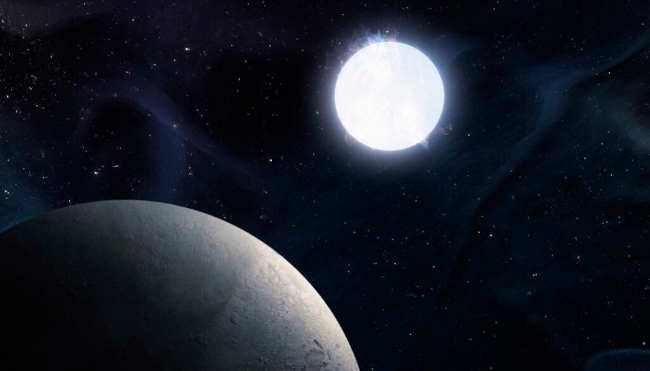

Space News: This rocky planet around a white dwarf resembles Earth — 8 billion years from now

Astronomers have discovered a distant white dwarf with an Earth-like planet in an orbit just beyond where Mars is in our solar system. Earth could end up in such an orbit circling a white dwarf in about 8 billion years, if, like this exoplanet, it can survive the sun's red giant phase on its way to becoming a white dwarf. Image credit: Adam Makarenko.

BERKELEY, Calif. — The discovery of an Earth-like planet 4,000 light years away in the Milky Way galaxy provides a preview of one possible fate for our planet billions of years in the future, when the sun has turned into a white dwarf, and a blasted and frozen Earth has migrated beyond the orbit of Mars.

This distant planetary system, identified by University of California, Berkeley, astronomers after observations with the Keck 10-meter telescope in Hawaii, looks very similar to expectations for the sun-Earth system: it consists of a white dwarf about half the mass of the sun and an Earth-size companion in an orbit twice as large as Earth’s today.

That is likely to be Earth’s fate. The sun will eventually inflate like a balloon larger than Earth's orbit today, engulfing Mercury and Venus in the process. As the star expands to become a red giant, its decreasing mass will force planets to migrate to more distant orbits, offering Earth a slim opportunity to survive farther from the sun.

Eventually, the outer layers of the red giant will be blown away to leave behind a dense white dwarf no larger than a planet, but with the mass of a star. If Earth has survived by then, it will probably end up in an orbit twice its current size.

The discovery, published Thursday in the journal Nature Astronomy, tells scientists about the evolution of main sequence stars, like the sun, through the red giant phase to a white dwarf, and how it affects the planets around them.

Some studies suggest that for the sun, this process could begin in about 1 billion years, eventually vaporizing Earth's oceans and doubling Earth's orbital radius — if the expanding star doesn't engulf our planet first.

Eventually, about 8 billion years from now, the sun's outer layers will have dispersed to leave behind a dense, glowing ball — a white dwarf — that is about half the mass of the sun, but smaller in size than Earth.

“We do not currently have a consensus whether Earth could avoid being engulfed by the red giant sun in 6 billion years,” said study leader Keming Zhang, a former doctoral student at the University of California, Berkeley, who is now an Eric and Wendy Schmidt AI in Science Postdoctoral fellow at UC San Diego. “In any case, planet Earth will only be habitable for around another billion years, at which point Earth's oceans would be vaporized by runaway greenhouse effect — long before the risk of getting swallowed by the red giant.”

The planetary system provides one example of a planet that did survive, though it is far outside the habitable zone of the dim white dwarf and unlikely to harbor life. It may have had habitable conditions at some point, when its host was still a sun-like star.

“Whether life can survive on Earth through that (red giant) period is unknown. But certainly the most important thing is that Earth isn't swallowed by the sun when it becomes a red giant,” said Jessica Lu, associate professor and chair of astronomy at UC Berkeley. “This system that Keming's found is an example of a planet — probably an Earth-like planet originally on a similar orbit to Earth — that survived its host star's red giant phase.”

Microlensing makes star brighten a thousandfold

The far-away planetary system, located near the bulge at the center of our galaxy, came to astronomers' attention in 2020 when it passed in front of a more distant star and magnified that star's light by a factor of 1,000. The gravity of the system acted like a lens to focus and amplify the light from the background star.

The team that discovered this “microlensing event” dubbed it KMT-2020-BLG-0414 because it was detected by the Korea Microlensing Telescope Network in the Southern Hemisphere. The magnification of the background star — also in the Milky Way, but about 25,000 light years from Earth — was still only a pinprick of light.

Nevertheless, its variation in intensity over about two months allowed the team to estimate that the system included a star about half the mass of the sun, a planet about the mass of Earth and a very large planet about 17 times the mass of Jupiter — likely a brown dwarf. Brown dwarfs are failed stars, with a mass just shy of that required to ignite fusion in the core.

The analysis also concluded that the Earth-like planet was between 1 and 2 astronomical units from the star — that is, about twice the distance between the Earth and sun. It was unclear what kind of star the host was because its light was lost in the glare of the magnified background star and a few nearby stars.

To identify the type of star, Zhang and his colleagues, including UC Berkeley astronomers Jessica Lu and Joshua Bloom, looked more closely at the lensing system in 2023 using the Keck II 10-meter telescope in Hawaii, which is outfitted with adaptive optics to eliminate blur from the atmosphere.

Because they observed the system three years after the lensing event, the background star that had once been magnified 1,000 times had become faint enough that the lensing star should have been visible if it was a typical main-sequence star like the sun, Lu said.

But Zhang detected nothing in two separate Keck images.

“Our conclusions are based on ruling out the alternative scenarios, since a normal star would have been easily seen,” Zhang said. “Because the lens is both dark and low mass, we concluded that it can only be a white dwarf.”

“This is a case of where seeing nothing is actually more interesting than seeing something,” said Lu, who looks for microlensing events caused by free-floating stellar-mass black holes in the Milky Way.

Finding exoplanets through microlensing

The discovery is part of a project by Zhang to more closely study microlensing events that show the presence of a planet, in order to understand what types of stars exoplanets live around.

“There is some luck involved, because you'd expect fewer than one in 10 microlensing stars with planets to be white dwarfs,” Zhang said.

The new observations also allowed Zhang and colleagues to resolve an ambiguity regarding the location of the brown dwarf.

“The original analysis showed that the brown dwarf is either in a very wide orbit, like Neptune's, or well within Mercury’s orbit. Giant planets on very small orbits are actually quite common outside the solar system,” Zhang said, referring to a class of planets called hot Jupiters. “But since we now know it is orbiting a stellar remnant, this is unlikely, as it would have been engulfed.”

The modeling ambiguity is caused by so-called microlensing degeneracy, where two distinct lensing configurations can give rise to the same lensing effect. This degeneracy is related to the one Zhang and Bloom discovered in 2022 using an AI method to analyze microlensing simulations. Zhang also applied the same AI technique to rule out alternative models for KMT-2020-BLG-0414 that may have been missed.

“Microlensing has turned into a very interesting way of studying other star systems that can't be observed and detected by the conventional means, i.e. the transit method or the radial velocity method,” Bloom said. “There is a whole set of worlds that are now opening up to us through the microlensing channel, and what's exciting is that we're on the precipice of finding exotic configurations like this.”

One purpose of NASA's Nancy Grace Roman Telescope, scheduled for launch in 2027, is to measure light curves from microlensing events to find exoplanets, many of which will need follow up using other telescopes to identify the types of stars hosting the exoplanets.

“What is required is careful follow up with the world's best facilities, i.e. adaptive optics and the Keck Observatory, not just a day or a month later, but many, many years into the future, after the lens has moved away from the background star so you can start disambiguating what you're seeing,” Bloom said.

Zhang noted that even if Earth gets engulfed during the sun's red giant phase in a billion or so years, humanity may find a refuge in the outer solar system. Several moons of Jupiter, such as Europa, Callisto and Ganymede, and Enceladus around Saturn, appear to have frozen water oceans that will likely thaw as the outer layers of the red giant expand.

"As the sun becomes a red giant, the habitable zone will move to around Jupiter and Saturn's orbit, and many of these moons will become ocean planets," Zhang said. "I think, in that case, humanity could migrate out there."

Other co-authors are Weicheng Zang and Shude Mao of Tsinghua University in Beijing, China, who co-authored the first paper about KMT-2020-BLG-0414; former UC Berkeley doctoral student Kareem El-Badry, now an assistant professor at the California Institute of Technology in Pasadena; Eric Agol of the University of Washington in Seattle; B. Scott Gaudi of The Ohio State University in Columbus; Quinn Konopacky of UC San Diego; Natalie LeBaron of UC Berkeley; and Sean Terry of the University of Maryland in College Park.

Robert Sanders writes for the UC Berkeley News Center.

Lakeport to hold fall Community Cleanup Day Oct. 12

LAKEPORT, Calif. — The city of Lakeport and Lakeport Disposal Co. have announced a Community Cleanup Day for city residents on Saturday, Oct. 12.

The fall cleanup day will be held from 9 a.m. to 2 p.m. in the public parking lot of the Fifth Street boat ramp in downtown Lakeport.

This event is limited to city of Lakeport residents and business owners; those dropping off trash and solid waste will be required to provide photo identification and a copy of a current city utility bill.

Participants are asked to follow these guidelines:

• Stay in their vehicle while Lakeport Disposal staff unloads materials.
• Two visits maximum per each city of Lakeport address.

Acceptable materials: Household trash; televisions; appliances (stoves, washers, dryers, dishwashers and water heaters); electronic waste; mattresses; household furniture; unusable clothes, blankets, towels; and similar materials.

Not acceptable: Refrigerators, hot tubs/spas, air conditioners, construction debris, used tires and household hazardous waste.

For more details, please see the city’s website, www.cityoflakeport.com, or contact Lakeport Disposal at 707-263-6080.

Clearlake Animal Control: ‘Nemo’ and the dogs

“Nemo.” Photo courtesy of Clearlake Animal Control.

CLEARLAKE, Calif. — Clearlake Animal Control has more new dogs in the shelter this week in need of new homes.

The shelter has 40 adoptable dogs listed on its website.

This week’s dogs include “Nemo,” a male Chihuahua mix with a short white coat.

The shelter is located at 6820 Old Highway 53. It’s open from 9 a.m. to 6 p.m. Tuesday through Saturday.

For more information, call the shelter at 707-762-6227, email This email address is being protected from spambots. You need JavaScript enabled to view it., visit Clearlake Animal Control on Facebook or on the city’s website.

This week’s adoptable dogs are featured below.

Email Elizabeth Larson at This email address is being protected from spambots. You need JavaScript enabled to view it.. Follow her on Twitter, @ERLarson, or Lake County News, @LakeCoNews.

Governor signs bill to require K-12 education to accurately reflect historical mistreatment of Native Americans

California students will learn about the impact on California Native Americans during the Spanish Colonization and Gold Rush Eras in California public schools after Gov. Gavin Newsom on Friday signed AB 1821.

Assemblymember James C. Ramos (D-San Bernardino), the first and only California Native American elected to the Legislature, authored the bill.

It was one of seven tribal-related measures Newsom approved on Friday, which was California Native American Day.

“I am pleased that Gov. Newsom approved AB 1821; it is another step forward in the path toward writing a new chapter in the state’s relationship to California tribes,” Ramos said. “For far too long California’s First People and their history have been ignored or misrepresented. Classroom instruction about Spanish Colonization and Gold Rush periods fails to include the loss of life, enslavement, starvation, illness and violence inflicted upon California Native Americans.”

“We thank Assemblymember Ramos for authoring AB 1821 to ensure that a more complete and accurate history of our state is taught,” said Soboba Band of Luiseño Indians Chairman Isaiah Vivanco. “Any teaching of the Spanish colonization and Gold Rush eras should include the impact on California’s Native Americans. During those devastating periods, Native Americans endured great loss of life, enslavement, and other perils. Those truths are often absent from instruction about California’s history and the nation’s westward expansion. Omitting this history erases the truth of Native Americans’ presence on this land and through silence perpetuates the injustices of those eras. That is why AB 1821 is an important step in the telling of our state’s history and its First People.”

State Superintendent of Public Instruction Tony Thurmond, who co-sponsored AB 1821, said he was proud to see the bill become law.

“This legislation will help ensure curriculum on California’s Spanish Mission and Gold Rush eras accurately captures the treatment and impact of Native Americans during these significant eras in state history. This initiative supports California’s diverse students to be seen, heard, and understood in their instructional materials, and to foster a deeper appreciation for our Native communities’ history and cultures,” Thurmond said.

“AB 1821 will create a more relevant and accurate curriculum when students learn about the Spanish colonization and Gold Rush periods in California’s history. We are thankful Governor Newsom has signed this bill into law so that California students can learn the true history and culture of tribes during those periods,” said Chairwoman Lynn Valbuena of the San Manuel Band of Mission Indians.

Late last year, a poll released by the Institute of Governmental Studies showed strong support to require California schools to incorporate teaching about Native American tribes’ history and culture. An overwhelming 80% of respondents were in support of a requirement such as AB 1821.

AB 1821 is cosponsored by the San Manuel Band of Mission Indians, Soboba Band of Luiseno Indians and State Superintendent of Public Instruction Tony Thurmond. A partial list of other supporters include California Teachers Association, California State PTA, California Tribal Business Alliance, Santa Ynez Band of Chumash Indians and Tule River Tribe.

Other Ramos tribal bills signed included:

• AB 81 reinforces California protections for Native American families and the Indian Child Welfare Act
• AB 1284 encourages the Natural Resources Agency, and its departments, boards, conservancies, and commissions, to enter into cogovernance and comanagement agreements with federally recognized tribes
• AB 1863 requires California Highway Patrol (CHP) to state reasons for denying request for a Feather Alert, a public notification system used when Native Americans are missing and overseen by the CHP
• AB 2108 requires county social workers and others to immediately notify parents, guardians, legal counsel and other pertinent adults when a foster child is missing.
• AB 2348 revises and strengthens California’s Feather Alert, requiring law enforcement agencies to respond within 24 hours of a request, and also allowing for tribal governments to directly communicate with the State.
• AB 2695 requires specified entities reporting criminal record data to the Department of Justice to disaggregate the data based on whether incidents took place in Indian country.
  • 353
  • 354
  • 355
  • 356
  • 357
  • 358
  • 359
  • 360
  • 361
  • 362

Community

  • Lake County Wine Alliance offers sponsor update; beneficiary applications open 

  • Mendocino National Forest announces seasonal hiring for upcoming field season

Public Safety

  • Lakeport Police logs: Thursday, Jan. 15

  • Lakeport Police logs: Wednesday, Jan. 14

Education

  • Woodland Community College receives maximum eight-year reaffirmation of accreditation from ACCJC

  • SNHU announces Fall 2025 President's List

Health

  • California ranks 24th in America’s Health Rankings Annual Report from United Health Foundation

  • Healthy blood donors especially vital during active flu season

Business

  • Two Lake County Mediacom employees earn company’s top service awards

  • Redwood Credit Union launches holiday gift and porch-to-pantry food drives

Obituaries

  • Rufino ‘Ray’ Pato

  • Patty Lee Smith

Opinion & Letters

  • The benefits of music for students

  • How to ease the burden of high electric bills

Veterans

  • CalVet and CSU Long Beach team up to improve data collection related to veteran suicides

  • A ‘Big Step Forward’ for Gulf War Veterans

Recreation

  • Wet weather trail closure in effect on Upper Lake Ranger District

  • Mendocino National Forest seeking public input on OHV grant applications

  • State Parks announces 2026 Anderson Marsh nature walk schedule 

  • BLM lifts seasonal fire restrictions in central California

Religion

  • Kelseyville Presbyterian to host Ash Wednesday service and Lenten dinner Feb. 18

  • Kelseyville Presbyterian Church to hold ‘Longest Night’ service Dec. 21

Arts & Life

  • Auditions announced for original musical ‘Even In Shadow’ set for March 21 and 28

  • ‘The Rip’ action heist; ‘Steal’ grounded in a crime thriller

Government & Politics

  • Lake County Democrats issue endorsements in local races for the June California Primary

  • County negotiates money-saving power purchase agreement

Legals

  • March 3 hearing on ordinance amending code for commercial cannabis uses

  • Feb. 12 public hearing on resolution to establish standards for agricultural roads

How to resolve AdBlock issue?
Refresh this page