 How to resolve AdBlock issue?
News
“That's one small step for (a) man; one giant leap for mankind.”
When Neil Armstrong took his first steps on the moon, many strides came before to achieve that moment in history.
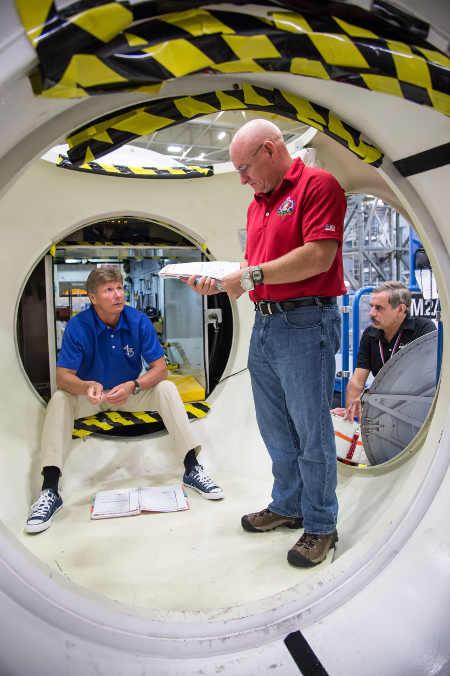
The same is true for a human mission to Mars. One step towards that journey begins in March 2015, when NASA astronaut Scott Kelly will make history as the first American to spend a year in space.
“This will be a significantly different experience; being aboard the International Space Station more than twice the duration of my previous flights will not be easy, but I am looking forward to the challenge,” said Kelly, a veteran of three space flights.
This one-year mission will be a stepping stone to human exploration beyond low-Earth orbit. Scott Kelly and Russian Federal Space Agency (Roscosmos) cosmonaut Mikhail Kornienko will embark on the first joint U.S.-Russian one-year mission, underscoring the “international” in International Space Station as the partners exemplify multilateral cooperation with regard to science.
How will their bodies react to a year of weightlessness? NASA's Human Research Program is about to find out.
“The one-year expedition will be a focused effort to reach across international and technological boundaries to enhance integrated science on the station,” said John Charles, NASA Human Research Program associate manager for international science.
Researchers expect the mission's investigations to provide data on physical and mental changes and challenges astronauts may face when they embark on longer-duration missions, like those to an asteroid, Mars, or beyond.
“It's not always easy for the body to adapt to microgravity,” said Kelly. “The conditions in a weightless environment take getting used to.”
NASA and Roscosmos recently selected several collaborative investigations for this mission to evaluate the effects of long-duration spaceflight on humans.
Each of the U.S. investigations will be grouped into one of seven categories: functional, behavioral health, visual impairment, metabolic, physical performance, microbial, and human factors.
The “functional” category will include investigations that will study the changes in performance of functional tasks for lunar and Mars operations. The field test and functional task test are two investigations in the “functional” category.
After returning to Earth, some astronauts have difficulty with movements like standing up straight. These investigations will examine what happens to the body when astronauts return to Earth's gravity after 12 months of weightlessness.
Researchers hope to develop a recovery timeline for crew members and to evaluate methods to help retrain the body's ability to do those tasks.
“These tests will mimic potential astronaut activities and their capability to perform them after they trek the six or eight months to Mars,” Charles said.
Results of these investigations may be applicable to patients recuperating from a long period of bed rest.
The “behavioral health” category will include studies to learn more about our brain and how it relates to stress and fatigue in space.
In cognition and sleep monitoring, researchers will test how astronauts manage their sleep and how fatigued they become during long-duration missions.
From this data researchers plan to develop software that tests the crew's comprehension, memory, attention and reasoning.
The results of these studies will be helpful for the larger international medical community by learning more about the effects of stress and fatigue, and more importantly, how to combat it.
The neuromapping investigation will use MRI before launch and after landing back on Earth to look at how changes in gravity affect the brain's ability to control movements after a year in space.
The Journals study will analyze the astronauts' diaries to gather data on how crew members adjust emotionally to their spaceflight environment, and how they perceive their ability to perform tasks during long-duration missions.
The Reaction Self Test will provide objective feedback and inform researchers of astronauts' level of cognitive performance while on space station missions. It also seeks to evaluate effects of sleep loss and circadian disruption.
The “visual impairment” category will include the fluid shifts and ocular health investigations to study what happens when fluids shift into the upper body during weightlessness. This shift may cause changes in vision.
Physiological data will be collected using non-invasive tools to study visual impairment and intracranial pressure caused by prolonged weightlessness.
Patients on Earth suffering from similar problems, such as Idiopathic Intracranial Hypertension (IIH), may benefit from research of this syndrome and the increased focus on non-invasive measurement techniques.
Experiments in the “metabolic” category will study the effects of long-duration spaceflight on body chemistry, the heart and immune systems.
The biochemical profile study will result in a database of biomedical data before, during and after flight to share among investigators and medical personnel.
The cardio ox investigation will provide insight into the role of oxidative stress on the body. It will also look at how these biological markers may pose a risk for plaque build-up in arteries following extended stays in space.
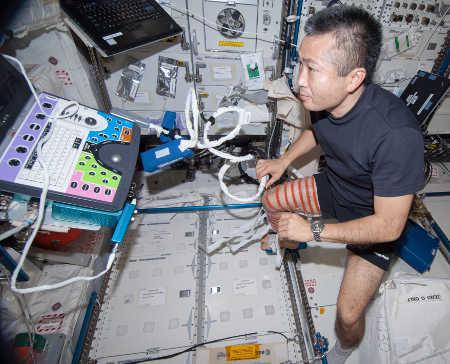
The integrated immune studies will look at the effects of spaceflight on human immunology, and validate an immune monitoring strategy.
Although there is evidence that the immune system can become dysfunctional during spaceflight, the cause is unknown.
These studies may have potential applications for the monitoring of immune functions of people on Earth with altered immunity.
The “physical performance” category includes studies that will enhance our knowledge of the effects of weightlessness on bones, muscles and heart.
The sprint investigation, currently ongoing on station, evaluates a new exercise regimen involving less frequent, higher intensity tasks, to minimize loss of muscle, bone, and cardiovascular functions that can occur over long periods in space.
The hip QCT study will help define the risks for early onset osteoporosis and bone fracture due to long duration spaceflight, as well as for individuals on Earth.
Included in the “microbial” category is the microbiome investigation. This ongoing study will continue during the one year mission to help researchers determine what happens when microbial species, which help to manage the body's health, live in space for long periods. The study will also evaluate potential impact on a crew member's health.
Samples of crew members' saliva, blood, perspiration and stool will be collected, as well as surface samples from air vents, sleep quarters, exercise equipment, water dispensers and the lavatory. These samples will be correlated with hygiene and environmental factors such as temperature and humidity.
By sampling the microbiome of astronauts on Earth and comparing it to their microbiome in space, researchers will be able to define how the body responds to various aspects of space travel.
The “human factors” category will include investigations to assess how astronauts interact with the space station environment.
The fine motor control study will determine the effects of long-duration weightlessness on fine motor performance by using a tablet computer that measures tasks of pointing, dragging, pinch-rotating, and tracing.
The habitability investigation will determine how livable the station is with crew members' observations in periodic questionnaires, crew-collected video footage and videos of key areas of the orbiting complex. This data will aid in the design of future space vehicles and habitats.
During the training retention study, researchers will collect data at three-month intervals on the astronaut's ability to retain training techniques in space, examine how much assistance will be needed from the ground, and compare training retention on a long-duration mission with that on Earth.
“These studies will help us determine if crews could go to Mars and return to Earth safely,” Kelly said.
The research to be conducted on this one-year mission will help NASA and the international community better understand the effects of spaceflight on the human body.
This is a key stepping stone to ensuring the health of our astronauts as NASA makes its next giant leap for humanity.
NICE, Calif. – The body of a local man who didn't return from a late December kayaking trip has been located.
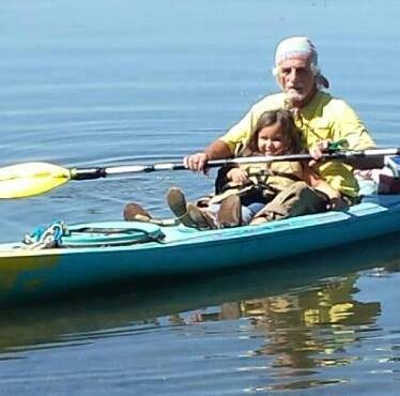
A Lake County Sheriff's deputy on Saturday afternoon found the body of Michael Harold Belhumeur, 68, of Upper Lake, along the lakeshore near Nice, according to Lt. Steve Brooks.
Belhumeur was reported missing by his niece on the evening of Dec. 30. He had gone out on one of his routine kayaking trips earlier in the day, and when he didn't return home, his niece became concerned and called authorities, as Lake County News has reported.
A water search was conducted that same night by Lake County Marine Patrol deputies, while patrol deputies carried out a shore search, Brooks said.
Brooks said the search – which went well into the night – was hampered by high winds and waves.
Early the next morning the search resumed, by water, land and air. The searchers included Lake County Marine Patrol, a California Highway Patrol helicopter and Lake County Search and Rescue members, Brooks said.
While conducting a grid search on the water, a Lake County Sheriff's Marine Patrol deputy located a blue kayak, a life jacket and a paddle, which were positively identified as belonging to Belhumeur, Brooks said.
The search for Belhumeur has continued since the time he was reported missing, Brooks said.
Last weekend, search activities took place at the Davis Rest Area in Lucerne, Sheriff Brian Martin confirmed to Lake County News.
On Saturday afternoon, Brooks said a Lake County Sheriff’s Marine Patrol deputy was conducting a shoreline search for Belhumeur east of Ceago Winery, which is located in the 5000 block of E. Highway 20 in Nice.
Brooks said the deputy noticed an object in the water close to the shore. As the deputy was able to get closer, he determined the object was a body, which was positively identified as being that of Belhumeur.
A California Department of Fish and Wildlife officer was in the area and assisted the deputy with the recovery, Brooks said.
Brooks said family members were notified of the the recovery of Belhumeur's body.
An autopsy will be scheduled for sometime next week to determine the exact cause of death, Brooks said.
LOWER LAKE, Calif. – A Lower Lake residence was damaged in a fire on Wednesday, but the quick work of firefighters saved the structure from destruction.
Lake County Fire Protection District firefighters responded to the fire on Lakeridge Road, off Morgan Valley Road, early Wednesday afternoon.
The fire resulted in partial damage to the interior of the single story structure, according to Lake County Fire Chief Willie Sapeta.
“It was one heck of a save,” Sapeta said.
The fire was initially spotted by Battalion Chief George Murch who was in the area at the time. Upon arrival he found the structure to be about 50-percent involved.
Units were dispatched to the scene at 12:14 p.m., arriving at 12:27 p.m. Sapeta said the fire was contained at 12:45 p.m. and cleanup continued for about two hours with units cleared from the incident at 3 p.m.
Sapeta said the structure had a metal roof, which caused the fire to burn laterally rather than vertically.
“The fire found its exit through the front and the back. We had 20- to 30-foot flames coming out the front,” he said. “We were able to contain the fire to living room and kitchen areas with only water damage to the rest of the home.”
Sapeta said Lake County Fire responded with its chief, two battalion chiefs, three engines, a water tender and two medic units.
Sapeta said one person was transported to the hospital with burns to the hands.
Cal Fire provided mutual aid with a battalion chief and an engine, Sapeta said.
Email Denise Rockenstein at
NORTHERN CALIFORNIA – Napa County Sheriff's detectives have recovered most of the wine stolen from the famed French Laundry restaurant on Christmas night.
Capt. Doug Pike reported that on Monday, following weeks of investigation, analysis of forensic evidence and numerous interviews, Napa County Sheriff’s detectives traveled to Greensboro, North Carolina, to recover the majority of the wines stolen from the renowned Yountville restaurant.
Authorities reported that 76 bottles of wine, valued at an estimated $300,000, was taken in the theft.
Pike said no arrests have been made to date, but the investigation is ongoing.
The Napa County Sheriff’s Office will be working with both state and federal law enforcement authorities to following up on leads developed in this case, Pike said.
The year 2014 ranks as Earth's warmest since 1880, according to two separate analyses by NASA and National Oceanic and Atmospheric Administration (NOAA) scientists.
The 10 warmest years in the instrumental record, with the exception of 1998, have now occurred since 2000.
This trend continues a long-term warming of the planet, according to an analysis of surface temperature measurements by scientists at NASA's Goddard Institute of Space Studies (GISS) in New York.
In an independent analysis of the raw data, also released Friday, NOAA scientists also found 2014 to be the warmest on record.
“NASA is at the forefront of the scientific investigation of the dynamics of the Earth's climate on a global scale,” said John Grunsfeld, associate administrator for the Science Mission Directorate at NASA Headquarters in Washington. “The observed long-term warming trend and the ranking of 2014 as the warmest year on record reinforces the importance for NASA to study Earth as a complete system, and particularly to understand the role and impacts of human activity.”
Since 1880, Earth's average surface temperature has warmed by about 1.4 degrees Fahrenheit (0.8 degrees Celsius), a trend that is largely driven by the increase in carbon dioxide and other human emissions into the planet's atmosphere.
The majority of that warming has occurred in the past three decades.
“This is the latest in a series of warm years, in a series of warm decades. While the ranking of individual years can be affected by chaotic weather patterns, the long-term trends are attributable to drivers of climate change that right now are dominated by human emissions of greenhouse gases,” said GISS Director Gavin Schmidt.
While 2014 temperatures continue the planet's long-term warming trend, scientists still expect to see year-to-year fluctuations in average global temperature caused by phenomena such as El Niño or La Niña.
These phenomena warm or cool the tropical Pacific and are thought to have played a role in the flattening of the long-term warming trend over the past 15 years.
However, 2014's record warmth occurred during an El Niño-neutral year.
“NOAA provides decision makers with timely and trusted science-based information about our changing world,” said Richard Spinrad, NOAA chief scientist. “As we monitor changes in our climate, demand for the environmental intelligence NOAA provides is only growing. It's critical that we continue to work with our partners, like NASA, to observe these changes and to provide the information communities need to build resiliency.”
Regional differences in temperature are more strongly affected by weather dynamics than the global mean.
For example, in the U.S. in 2014, parts of the Midwest and East Coast were unusually cool, while Alaska and three western states – California, Arizona and Nevada – experienced their warmest year on record, according to NOAA.
The GISS analysis incorporates surface temperature measurements from 6,300 weather stations, ship- and buoy-based observations of sea surface temperatures, and temperature measurements from Antarctic research stations.
This raw data is analyzed using an algorithm that takes into account the varied spacing of temperature stations around the globe and urban heating effects that could skew the calculation.
The result is an estimate of the global average temperature difference from a baseline period of 1951 to 1980.
NOAA scientists used much of the same raw temperature data, but a different baseline period. They also employ their own methods to estimate global temperatures.
GISS is a NASA laboratory managed by the Earth Sciences Division of the agency's Goddard Space Flight Center, in Greenbelt, Maryland. The laboratory is affiliated with Columbia University's Earth Institute and School of Engineering and Applied Science in New York.
NASA monitors Earth's vital signs from land, air and space with a fleet of satellites, as well as airborne and ground-based observation campaigns.
NASA develops new ways to observe and study Earth's interconnected natural systems with long-term data records and computer analysis tools to better see how our planet is changing.
The agency shares this unique knowledge with the global community and works with institutions in the United States and around the world that contribute to understanding and protecting our home planet.
CLEARLAKE, Calif. – On Thursday police arrested an 11-year-old Clearlake boy who is alleged to have tried to set fire to his dog.
Clearlake Police Sgt. Rodd Joseph said the dog involved, a teacup Chihuahua, did not appear to be seriously injured.
Just before noon on Thursday School Resource Officer Bobi Thompson, who Joseph said is primarily assigned to the Konocti Unified School District, was notified of a possible animal abuse case.
A staff member from a local school reported to Thompson that an 11-year-old student had a small burn mark on his hand, Joseph said. When staff asked the child how the injury occurred, the child admitted to burning himself while trying to light his dog on fire the previous day.
When the school obtained this information, Thompson was notified, Joseph said.
Thompson met with the child at the school. Joseph said the child had a small red burned area on one of his hands. The burn was superficial and did not require medical attention.
The child admitted to Thompson that on Wednesday one of his dogs had urinated and defecated on the floor of the home he shares with his parents, Joseph said.
Joseph said the child, wanting to punish the dog, waited for his parents to leave the house.
After the child was left alone in the home, he located some matches and a bottle of isopropyl rubbing alcohol. Joseph said the child poured some of the rubbing alcohol onto the dog's back and lit a match. The rubbing alcohol caught on fire, partially burning some of the dog’s hair as well as the child’s hand.
Thompson and Clearlake Animal Control Officer Jenna Tuller responded to the child’s residence, located in the 16000 block of 20th Avenue, where Joseph said the crime was committed.
At the home Thompson and Tuller located three dogs – a young female teacup Chihuahua, a young male teacup Chihuahua and a male dachshund, according to Joseph.
Joseph said the young female teacup Chihuahua did have some burned hair along her back but did not need immediate veterinary care. The other two dogs appeared uninjured.
Tuller seized the three dogs from the home for safekeeping and further proceedings, Joseph said.
Thompson arrested the juvenile on a felony charge of animal cruelty and booked him into Lake County Juvenile Hall, Joseph said.
Joseph said the child’s parents are fully cooperating with the investigation.
The case, Joseph said, will be submitted to the Lake County Juvenile Probation Department for review of charges.
Joseph said the Clearlake Police Department and Clearlake Animal Control take cases of animal abuse seriously. Violators will be prosecuted.
Anyone wishing to report suspected animal abuse is asked to contact Animal Control Officer Jenna Tuller at 707-994-8251, Extension 115.