 How to resolve AdBlock issue?
News
NICE, Calif. – The Upper Lake High School Booster Club will host its annual “Lights of Love” Valentine's Day dinner and dance to benefit Upper Lake High School on Saturday, Feb. 14.
The seventh annual fundraiser will be held beginning at 5 p.m. at the North Shore Event Center – formerly the Sons of Italy hall – located at 2817 E. Highway 20 in Nice.
The booster club holds the benefit as part of its continuing efforts to raise money to install stadium lights on the Upper Lake High School athletic field.
Over the last six years, the group has raised $100,000 for the light installation project.
Upper Lake is the only high school in Lake County without stadium lights, and the acquisition of these lights will allow the school to host evening games – which organizers said will increase school spirit and pride.
The committee invites the community to attend the Feb. 14 event and enjoy a night of food, fun and entertainment, and help them make this dream possible.
The event begins with happy hour at 5 p.m. Beer and wine will be available.
The buffet style dinner menu – consisting of tri-tip or chicken – will be served from 6 to 7:30 pm.
The evening's silent auction takes place from 5 to 8 p.m., with live dance music from 8 to 11 p.m.
Tickets can be purchased at Judy’s Junction restaurant in Upper Lake or from boosters club members.
Advance ticket purchase is advised because the event is limited to 200 participants.
If you are interested and would like to participate or contribute to this vision, there are several ways that you can help.
Purchase tickets for $25 each or reserve an exclusive table for eight for $250.
You also can donate a prize for the silent auction or could simply make a tax-deductible monetary donation.
For more information contact Melanie Sneathen at 707-349-4226 or Ron Raetz at 707-275-2824.
LAKE COUNTY, Calif. – Lake County Animal Care and Control has a big group of big dogs set for adoption this week.
Dogs available to new homes include mixes of border collie, Chihuahua, German Shepherd, Great Dane, Labrador Retriever, pit bull, Pomeranian and terrier.
Dogs that are adopted from Lake County Animal Care and Control are either neutered or spayed, microchipped and, if old enough, given a rabies shot and county license before being released to their new owner. License fees do not apply to residents of the cities of Lakeport or Clearlake.
If you're looking for a new companion, visit the shelter. There are many great pets hoping you'll choose them.
In addition to the animals featured here, all adoptable animals in Lake County can be seen here: http://bit.ly/Z6xHMb .
The following dogs at the Lake County Animal Care and Control shelter have been cleared for adoption (additional dogs on the animal control Web site not listed are still “on hold”).
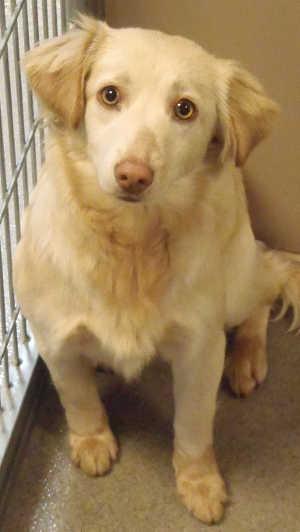
Female Pomeranian mix
This female Pomeranian mix has a medium-length white coat.
She's in kennel No. 4, ID No. 1619.
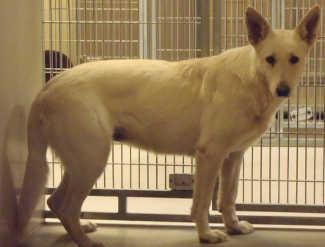
German Shepherd mix
This female German Shepherd mix has a white coat.
She's in kennel No. 8, ID No. 1499.
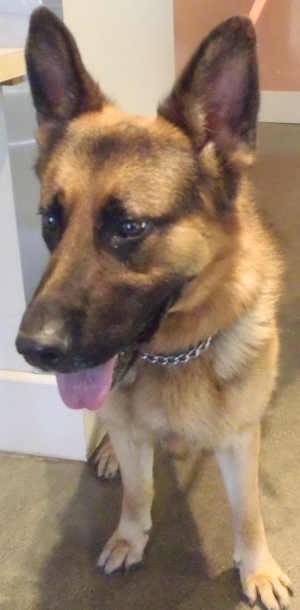
German Shepherd mix
This male German Shepherd mix has a black and tan coat.
He's in kennel No. 14, ID No. 1572.
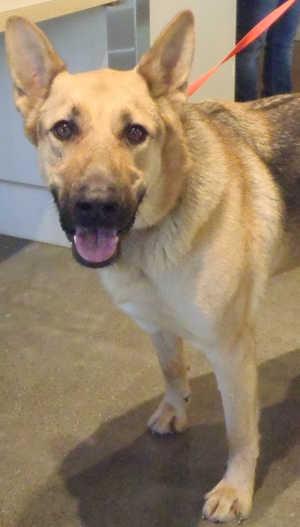
German Shepherd mix
This male German Shepherd mix has a medium-length blond and black coat.
He's in kennel No. 15, ID No. 1571.
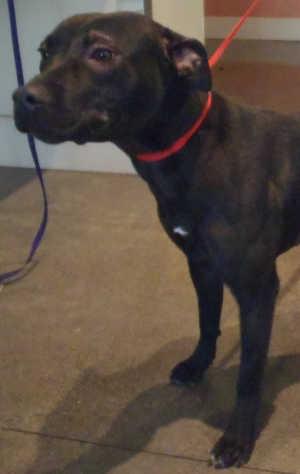
Pit bull mix
This female pit bull terrier mix has a short black coat.
She's in kennel No. 16, ID No. 1380.

Pit bull terrier puppy
This male pit bull terrier puppy has a short brown coat.
He's in kennel No. 24, ID No. 1446.
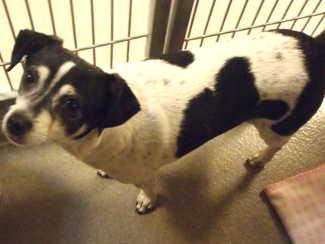
'Rascal'
“Rascal” is a terrier-Chihuahua mix.
He has a short black and white coat.
He's in kennel No. 25a, ID No. 1430.

'Copper'
“Copper” is a male terrier mix.
He has a short brown and white coat.
Copper is in kennel No. 25b, ID No. 1429.
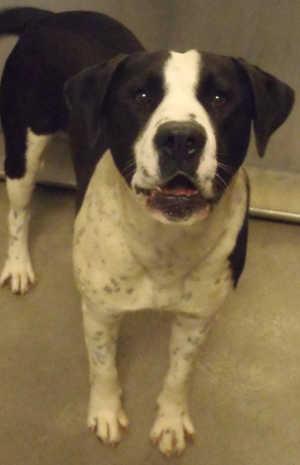
Great Dane mix
This male Great Dane mix has a black and white coat.
He's in kennel No. 26, ID No. 1582.
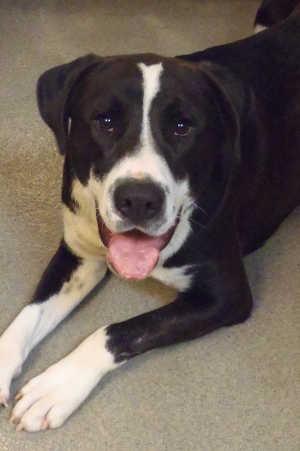
Great Dane mix
This male Great Dane mix has a black and white coat.
He's in kennel No. 27, ID No. 1581.
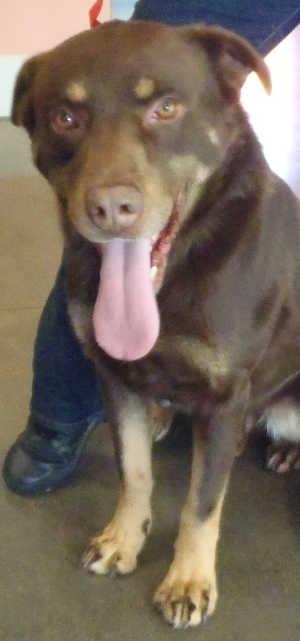
Labrador Retriever mix
This male Labrador Retriever mix has a short tan and brown coat.
He's in kennel No. 28, ID No. 1577.
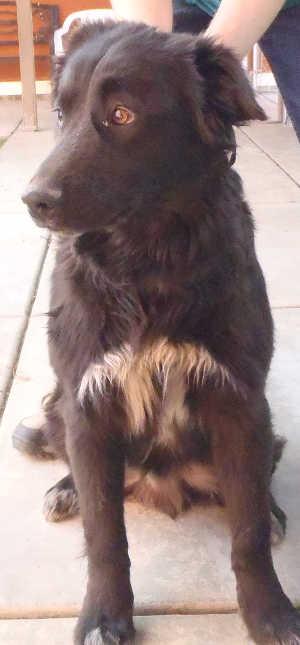
Border collie mix
This male border collie mix has a medium-length black coat with white markings.
He's in kennel No. 29, ID No. 1517.

German Shepherd mix
This male German Shepherd mix has a black and tan coat.
He's in kennel No. 32, ID No. 1623.
To fill out an adoption application online visit http://www.co.lake.ca.us/Government/Directory/Animal_Care_And_Control/Adopt/Dog___Cat_Adoption_Application.htm .
Lake County Animal Care and Control is located at 4949 Helbush in Lakeport, next to the Hill Road Correctional Facility.
Office hours are Monday through Friday, 11 a.m. to 5 p.m., and 11 a.m. to 3 p.m., Saturday. The shelter is open from 11 a.m. to 4 p.m. Monday through Friday and on Saturday from 11 a.m. to 3 p.m.
Visit the shelter online at http://www.co.lake.ca.us/Government/Directory/Animal_Care_And_Control.htm .
For more information call Lake County Animal Care and Control at 707-263-0278.
Email Elizabeth Larson at

Two teams of astronomers led by researchers at the University of Cambridge have looked back nearly 13 billion years, when the Universe was less than 10 percent its present age, to determine how quasars – extremely luminous objects powered by supermassive black holes with the mass of a billion suns – regulate the formation of stars and the build-up of the most massive galaxies.
Using a combination of data gathered from powerful radio telescopes and supercomputer simulations, the teams found that a quasar spits out cold gas at speeds up to 2000 kilometers per second, and across distances of nearly 200,000 light years – much farther than has been observed before.
How this cold gas – the raw material for star formation in galaxies – can be accelerated to such high speeds had remained a mystery.
Detailed comparison of new observations and supercomputer simulations has only now allowed researchers to understand how this can happen: the gas is first heated to temperatures of tens of millions of degrees by the energy released by the supermassive black hole powering the quasar.
This enormous build-up of pressure accelerates the hot gas and pushes it to the outskirts of the galaxy.
The supercomputer simulations show that on its way out of the parent galaxy, there is just enough time for some of the hot gas to cool to temperatures low enough to be observable with radio telescopes.
The results are presented in two separate papers published Jan. 16 in the journals Monthly Notices of the Royal Astronomical Society and Astronomy & Astrophysics.
Quasars are amongst the most luminous objects in the universe, and the most distant quasars are so far away that they allow us to peer back billions of years in time.
They are powered by supermassive black holes at the center of galaxies, surrounded by a rapidly spinning disk-like region of gas.
As the black hole pulls in matter from its surroundings, huge amounts of energy are released.
“It is the first time that we have seen outflowing cold gas moving at these large speeds at such large distances from the supermassive black hole,” said Claudia Cicone, a PhD student at Cambridge's Cavendish Laboratory and Kavli Institute for Cosmology, and lead author on the first of the two papers. “It is very difficult to have matter with temperatures this low move as fast as we observed.”
Cicone's observations allowed the second team of researchers specializing in supercomputer simulations to develop a detailed theoretical model of the outflowing gas around a bright quasar.
“We found that while gas is launched out of the quasar at very high temperatures, there is enough time for some of it to cool through radiative cooling – similar to how the Earth cools down on a cloudless night,” said Tiago Costa, a PhD student at the Institute of Astronomy and the Kavli Institute for Cosmology, and lead author on the second paper. “The amazing thing is that in this distant galaxy in the young Universe the conditions are just right for enough of the fast moving hot gas to cool to the low temperatures that Claudia and her team have found.”
Working at the IRAM Plateau De Bure interferometer in the French Alps, the researchers gathered data in the millimeter band, which allows observation of the emission from the cold gas which is the primary fuel for star formation and main ingredient of galaxies, but is almost invisible at other wavelengths.
An analysis of 727 mass die-offs of nearly 2,500 animal species from the past 70 years has found that such events are increasing among birds, fish and marine invertebrates.
At the same time, the number of individuals killed appears to be decreasing for reptiles and amphibians, and unchanged for mammals.
Such mass mortality events occur when a large percentage of a population dies in a short time frame. While the die-offs are rare and fall short of extinction, they can pack a devastating punch, potentially killing more than 90 percent of a population in one shot.
However, until this study, there had been no quantitative analysis of the patterns of mass mortality events among animals, the study authors noted.
“This is the first attempt to quantify patterns in the frequency, magnitude and cause of such mass kill events,” said study senior author Stephanie Carlson, an associate professor at the University of California, Berkeley’s Department of Environmental Science, Policy and Management.
The study, published Jan. 12 in the Proceedings of the National Academy of Sciences, was led by researchers at UC Berkeley, the University of San Diego and Yale University.
The researchers reviewed incidents of mass kills documented in scientific literature. Although they came across some sporadic studies dating back to the 1800s, the analysis focused on the period from 1940 to the present.
The researchers acknowledged that some of their findings may be due to an increase in the reporting of mass die-offs in recent decades. But they noted that even after accounting for some of this reporting bias, there was still an increase in mass die-offs for certain animals.
Overall, disease was the primary culprit, accounting for 26 percent of the mass die-offs. Direct effects tied to humans, such as environmental contamination, caused 19 percent of the mass kills.
Biotoxicity triggered by events such as algae blooms accounted for a significant proportion of deaths, and processes directly influenced by climate – including weather extremes, thermal stress, oxygen stress or starvation – collectively contributed to about 25 percent of mass mortality events.
The most severe events were those with multiple causes, the study found.
Carlson, a fish ecologist, and her UC Berkeley graduate students had observed such die-offs in their studies of fish in California streams and estuaries, originally piquing their interest in the topic.
“The catastrophic nature of sudden, mass die-offs of animal populations inherently captures human attention,” said Carlson. “In our studies, we have come across mass kills of federal fish species during the summer drought season as small streams dry up. The majority of studies we reviewed were of fish. When oxygen levels are depressed in the water column, the impact can affect a variety of species.”
The study found that the number of mass mortality events has been increasing by about one event per year over the 70 years the study covered.
“While this might not seem like much, one additional mass mortality event per year over 70 years translates into a considerable increase in the number of these events being reported each year,” said study co-lead author Adam Siepielski, an assistant professor of biology at the University of San Diego. “Going from one event to 70 each year is a substantial increase, especially given the increased magnitudes of mass mortality events for some of these organisms.
This study suggests that in addition to monitoring physical changes such as changes in temperature and precipitation patterns, it is important to document the biological response to regional and global environmental change. The researchers highlighted ways to improve documentation of such events in the future, including the possible use of citizen science to record mass mortality events in real time.
“The initial patterns are a bit surprising, in terms of the documented changes to frequencies of occurrences, magnitudes of each event and the causes of mass mortality,” said study co-lead author Samuel Fey, a postdoctoral fellow in ecology and evolutionary biology at Yale. “Yet these data show that we have a lot of room to improve how we document and study these types of rare events.”
Funding from the Environmental Protection Agency and the National Science Foundation helped support this research.
Sarah Yang writes for the UC Berkeley News Center.
LAKE COUNTY, Calif. – The Lake County Water Resources Department is looking for community members interested in assisting with monitoring public boat ramps as part of the ongoing effort to protect Clear Lake from damaging invasive mussels.
As quagga and zebra mussels have continued to spread to bodies of water across the Western United States – including a number of Southern California lakes – the county has worked to protect Clear Lake, including putting in place a boat screening and sticker program.
“The county depends on this lake,” said Mark Miller, invasive species program volunteer coordinator. “If we were to lose it to any kind of invasive, the economic impact on the lake would be astronomical.”
With no state or federal funding available to protect the lake – and with lake sales tax measures having failed – Miller said the county has to enlist community help in keeping the water body mussel-free.
It's a big task, said Miller, pointing out that there are more than 600 private and public boat ramps around Lake County.
Last year, he said, the county screened more than 15,000 boats that went out on Clear Lake.
With so many boats on the lake, help from the public is very important, Miller said.
Miller said that his goal for this year is to get at least 30 volunteers – with more being even better – to assist him with the work of monitoring the county's primary public boat launches at locations in Clearlake, Clearlake Oaks, Kelseyville, Lakeport, Lucerne, Nice and elsewhere.
The volunteers will be especially important during major holidays that bring tourists to the lake – including Memorial Day and July 4, as well as the springtime Catfish Derby in Clearlake Oaks, Miller said.
Miller said volunteers will be vital in the information sharing aspect of the program.
“The best tool we’ve found in the whole program is just educating the public,” he said.
Miller said the last thing recreational boaters want to do is infest the lake, but they need the information about protecting it. He explained that it's very simple to clean, drain and dry a boat.
When meeting with boaters, volunteers will check for the county's mussel stickers – which signify that boats have been deemed safe to enter local water bodies – as well as handing out literature to boaters and directing boats, when necessary, to screening stations.
One of the issues that volunteers will help address have arisen from the state of California introducing its own mussel sticker.
That sticker is merely a way to raise money, and doesn't mean that a boat is clear to launch, Miller said.
As a result, he said it's resulted in “mass confusion” for residents and visitors alike. Volunteers, he said, will explain the difference.
He wants the program to offer a positive experience to residents and visitors alike.
The assessment for nonrisk boats is three to five minutes, Miller said, adding that they don't want to inconvenience people.
When screening the boats, the No. 1 thing volunteers look for is where the boats have been in the last 30 days, said Miller.
If the boats have been in a high-risk location – such as a county where there are quagga or zebra mussels – a hands-on inspection is deemed necessary. At that point, Miller said volunteers will direct the boaters to one of 30 screening locations around the lake.
Miller said they don't want to screen at the ramps, as that will create bottlenecks, especially at busy times.
It's unlikely that screeners will find adult mussels, Miller said. Rather, it's the veligers – the mussels' microscopic larva – that is their greatest concern.
If it's determined after a screening that a boat is high-risk, Miller said a decontamination will be carried out.
“It's simple to kill these things,” he said, explaining that hot water – at least 140 degrees – as well as chlorine or salt water can kill the mussels.
Decontaminations take place away from the lake – so there isn't a risk of runoff getting into it – at a county yard in Lakeport on Campbell Lane. There, Miller said they can capture all of the water that comes off the boats; that water then goes into the sanitary treatment plant system.
He said they thoroughly clean the boat, including flushing out the motor and cooling system, which helps prevent mussels destroying the boat motor.
Miller said Water Resources has been doing about 12 to 15 of those decontaminations a year. “To me, that's a success story.”
He said the busiest time of year for decontaminations is in September and October, during the big bass tournaments, as many of those boats come from areas like Lake Mead, which is infested with mussels.
“That’s when I do the majority of my decontaminations,” he said.
Miller said that, so far, he's got about half a dozen volunteers lined up. Once he has a larger group, he'll have a training session.
“We don't have a perfect program,” said Miller, adding that he welcomes input and ideas about how to improve the program both from volunteers and the public at large.
For more information or to apply to become a program volunteer monitor, contact Miller at 707-263-2344 or email
Email Elizabeth Larson at
LAKE COUNTY, Calif. – Fog and light rain settled in over parts of Lake County on Friday evening, with forecasters predicting more chances of showers through the weekend.
The National Weather Service's Sacramento office reported that weak Pacific frontal systems are bringing light precipitation to parts of Northern California over the next few days.
The first of the systems arrived on Friday, with the second expected on Sunday, the agency said.
The two systems, combined, are expected to bring an inch or more of rain to parts of Northern California, according to forecasters.
In Lake County, chances of rain on Saturday range between 20 and 30 percent after 10 a.m., with less than a tenth of an inch expected. Lights winds of up to 8 miles per hour are included in the forecast.
On Sunday, forecasters are predicting a greater chance of rain – between 50 and 60 percent – but the total amount is again expected to be small, about a tenth of an inch. There is about a 20-percent chance of rain on Sunday night.
Conditions are expected to clear on Monday, the Martin Luther King Jr. Day holiday, according to the forecast.
Sunny and clear conditions are forecast to follow the rest of the week, with temperatures into the high 60s during the daytime and ranging into the high 30s at night.
Email Elizabeth Larson at