 How to resolve AdBlock issue?
News
In what is being hailed as a landmark move for higher education, on Tuesday the California Community Colleges Board of Governors gave initial approval to 15 colleges to develop bachelor’s degree programs in fields such as respiratory therapy, dental hygiene, automotive technology and aerospace manufacturing technology as part of a pilot program approved by the Legislature and Gov. Jerry Brown.
“These colleges are embarking on a new mission for the California Community Colleges that will expand opportunities in public higher education,” said California Community Colleges Chancellor Brice W. Harris. “Students will have a range of programs from which to choose to earn high quality, affordable and in-demand degrees. California employers win too, as they will have improved access to highly qualified candidates in these fields.”
State officials said a total of 34 applications were submitted.
Among them was an application from Yuba Community College District – which serves part of Lake County – for a baccalaureate of science degree in the area of manufacturing processing and design. However, Yuba College's proposal wasn't among the initial selections.
Mendocino College, which also serves Lake County, did not submit an application, state officials said.
The programs selected will undergo additional review by the California Community Colleges Chancellor’s Office as well as further consultation with the California State University and University of California before final approval is considered by the Board of Governors at its March meeting.
The bachelor’s degree programs receiving initial approval are:
• Airframe Manufacturing Technology, Antelope Valley College;
• Industrial Automation, Bakersfield College;
• Emergency Services and Allied Health Systems, Crafton Hills College;
• Mortuary Science, Cypress College;
• Equine Industry, Feather River College;
• Dental Hygiene, Foothill College and West Los Angeles College;
• Bio-manufacturing, MiraCosta College;
• Respiratory Care, Modesto Junior College and Skyline College;
• Automotive Technology, Rio Hondo College;
• Health Information Management, San Diego Mesa College;
• Occupational Studies, Santa Ana College;
• Interaction Design, Santa Monica College;
• Health Information Management, Shasta College.
The board action is in response to legislation sponsored by Sen. Marty Block (D-San Diego) and signed by the governor last year that allows up to 15 districts to establish a pilot baccalaureate degree program at one of their colleges in a field of study not offered by the California State University or University of California.
Lower-division coursework would cost $46 and upper-division coursework would cost $84 under the new program, with an estimated total cost of about $10,000 to obtain a bachelor’s degree.
“SB 850 will expand opportunities for California students by increasing affordable and accessible paths to a four-year degree while also helping veterans and other nontraditional students,” Block said. “This historic and landmark change will also help keep our state a global economy – competitive and open for business.”
The college districts that the board approved today were chosen from 34 applications. A team comprised of Chancellor’s Office staff, reviewers from the University of California and California Department of Education, a member of the business and workforce community, and community college administrators, faculty and staff from districts that did not apply to host a program reviewed the applications.
Considerations for selecting a district included geographic distribution of the pilot programs, diversity of pilot programs, ability of the district to establish a rigorous program in their proposed field and that the proposed program will meet an unaddressed local or statewide workforce need.
Under the law the four-year degree programs must be up and running by at least the 2017-18 academic year, however, districts may start their programs by the fall 2015 semester. Districts must also seek approval from the Accrediting Commission for Community and Junior Colleges to start a program.
The legislation sunsets after the 2022-23 school year, after which the Legislature and governor may renew it pending two Legislative Analyst’s Office reviews of the pilot program – one in 2018 and another in 2022.
The law was enacted to assist the state in meeting the need for individuals in high demand technical disciplines which are increasingly requiring baccalaureate degrees and to increase college participation rates and improve workforce training opportunities for local residents who are unable to relocate because of family or work commitments.
CLEARLAKE, Calif. - The Clear Lake Chamber of Commerce met for its first dinner meeting of the year at Main Street Bar and Grill last Tuesday.
Incoming president Pete Loustalot set the table with expectations for the coming year.
“If I'm going to be president, (the chamber) needs to start changing now,” Loustalot said.
Loustalot began with the board of directors calling for consistency and stability among the panel.
He said he will be looking for increased participation from the board as well as the membership.
“We have 485 business license holders in Clearlake and we have about 160 members,” Loustalot said. “There is a lot of room for growth.”
The chamber is looking to hire a new manager to assist with increasing membership, events and “get some structure,” Loustalot said.
The chamber anticipates gaining a permanent home in the near future.
With the assistance of the city of Clearlake and the county of Lake, the chamber is planning to move into the building adjacent to Highlands Park on Lakeshore Drive. The site will provide for a county visitor center as well.
Loustalot said meeting the requirements of the contracts between the chamber and two entities will be of vital importance in the coming year.
He said renovations of the building are expected to be complete in about six months.
Membership announcements included an update about a special section in the San Francisco Chronicle, “Destination Lake County,” set to run April 12.
Other announcements included the Lakeshore Lioness Club's “Walk for Fun, Walk for Paws” event, to take place May 2 at Austin Park in Clearlake. The event will feature a walk extending through downtown Clearlake.
There is no cost to walk; however, a donation of $25 will include a T-shirt, bottle of water and a ticket for prizes.
In order to reserve a T-shirt, preregistration by April 25 is required. Walkers may also register at the event. Walking teams are encouraged.
Proceeds from the event will benefit Lake County Animal Coalition, the ACME Foundation and free spay/neuter programs. For more information, contact Joan Mingori at 707-994-2178.
The Lakeshore Lioness Club will also host its 45th annual fish fry and raffle, 3 to 7 p.m. Sunday, March 1, at Howard's Grotto on Lakeshore Drive in Clearlake. Donation is $10 per person.
Raffle prizes include $200 cash from Mendo Lake Credit Union in Clearlake; a night's stay with dinner and free play at Twin Pine Casino; $150 gift certificate from Griffin's Furniture; and a lube, oil and filter change and tire rotation and alignment from Tire Pros in Clearlake valued at $130.
Proceeds will assist the Lioness in its community service efforts.
Email Denise Rockenstein at
CLEARLAKE, Calif. – Coming right off of another successful Community Christmas Dinner, the Rotary Club of Clear Lake is gearing up for its 12th annual Seafood Boil and Auction.
The popular event will be held beginning at 5:30 p.m. Saturday, Feb. 28, at the Highlands Senior Service Center, 3245 Bowers Ave. in Clearlake.
About 30 tickets are left for the event, organizers said Monday. More than 200 people are expected to attend.
The feast includes salad, bread, tri-tip, lobster tail and traditional seafood boil prepared by the Rotarians and delivered by the bucketful to each table by student volunteers.
The $75 per-person ticket price includes two drink tickets, bottomless soft drinks and water, and for each adult guest, a complementary wine tasting presented by Gregory Graham Winery, and a no-host bar.
There also will be a silent and live auction featuring such items as a stay in a cabin in the jungles of Costa Rica and a private flyover of Lake County.
The seafood boil is the club’s main fundraiser of the year, netting more than $23,000, which will allow the club to provide community benefits.
These benefits include new dictionaries for all third graders in the Konocti Unified School District, college scholarships for high school seniors, and support of Lower Lake High School, St. Helena Hospital Clear Lake, the Safe House, the Senior Center and more.
The largest of these community benefits, the Community Christmas Dinner, was held last month and provided 860 dinners, including 68 meals-on-wheels for homebound seniors; 270 pictures with Santa were taken; and 428 toys given to children.
Mendo Lake Credit Union and Westamerica Bank also helped support that event.
To purchase tickets to this year’s seafood boil, please contact Jen Totten at 707-490-5681 or any Clear Lake Rotarian.
LAKE COUNTY, Calif. – Lake County Animal Care and Control has new cats and kittens that it is offering to new homes this week.
The cats range in age from kittens to older cats, with a variety of coat colors.
In addition to spaying or neutering, cats that are adopted from Lake County Animal Care and Control are microchipped before being released to their new owner. License fees do not apply to residents of the cities of Lakeport or Clearlake.
If you're looking for a new companion, visit the shelter. There are many great pets there, hoping you'll choose them.
In addition to the animals featured here, all adoptable animals in Lake County can be seen here: http://bit.ly/Z6xHMb .
The following cats at the Lake County Animal Care and Control shelter have been cleared for adoption (other cats pictured on the animal control Web site that are not listed here are still “on hold”).

Domestic short hair mix
This male adult short hair mix cat has a coat with brown and white markings.
He's in cat room kennel No. 48, ID No. 1364.
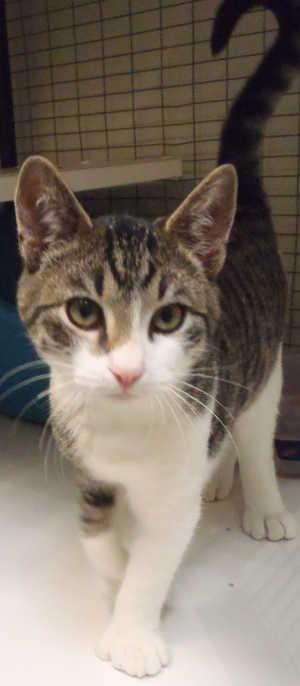
Domestic short hair mix kitten
This male domestic short hair mix kitten has white and gray tabby markings.
He's cat room kennel No. 49a, ID No. 1606.
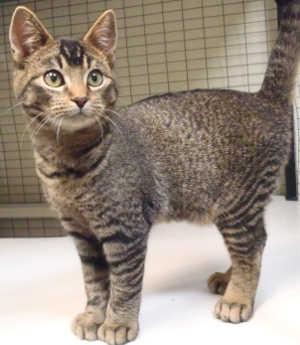
Abyssinian mix kitten
This Abyssinian mix kitten has a short gray coat.
He's in cat room kennel No. 49b, ID No. 1607.
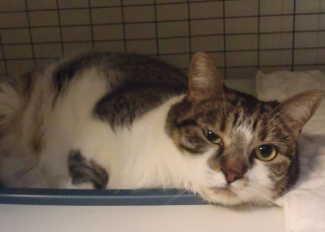
Domestic short hair
This female domestic short hair mix has a coat with white and brown tabby markings.
She's in cat room kennel No. 73, ID No. 1316.
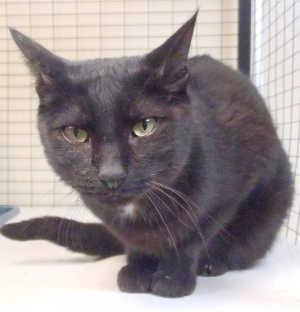
Domestic short hair mix
This male domestic short hair mix has an all almost entirely black coat, with a white mark on his chest.
He's in cat room kennel No. 79, ID No. 1605.
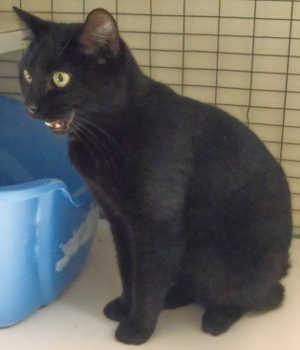
Domestic short hair mix
This young black cat has a short, all-black coat.
Shelter staff did not report the cat's gender.
The cat is in cat room kennel No. 99, ID No. 1618.
Adoptable cats also can be seen at http://www.co.lake.ca.us/Government/Directory/Animal_Care_And_Control/Adopt/Cats_and_Kittens.htm or at www.petfinder.com .
Please note: Cats listed at the shelter's Web page that are said to be “on hold” are not yet cleared for adoption.
To fill out an adoption application online visit http://www.co.lake.ca.us/Government/Directory/Animal_Care_And_Control/Adopt/Dog___Cat_Adoption_Application.htm .
Lake County Animal Care and Control is located at 4949 Helbush in Lakeport, next to the Hill Road Correctional Facility.
Office hours are Monday through Friday, 11 a.m. to 5 p.m., and 11 a.m. to 3 p.m., Saturday. The shelter is open from 11 a.m. to 4 p.m. Monday through Friday and on Saturday from 11 a.m. to 3 p.m.
Visit the shelter online at http://www.co.lake.ca.us/Government/Directory/Animal_Care_And_Control.htm .
For more information call Lake County Animal Care and Control at 707-263-0278.
Email Elizabeth Larson at
LAKEPORT, Calif. – Following voters' November approval of a bond measure to modernize Lakeport Unified School District's schools and facilities, the district's administration and board are now taking the next steps to begin the bond sales process so the work to create a 21st century learning environment for students can begin.
Voters approved the $17 million Measure T bond with a 65.9 percent yes vote, versus 34.1 percent of voters who opposed the measure, according to the Lake County Registrar of Voters.
In the tax rate statement to voters in the sample ballot booklet, Lakeport Unified Superintendent Erin Hagberg said that it was estimated that the highest tax rate to fund the bond issuance would be $59.87 per $100,000 per assessed value on properties in the school district.
The funds must be spent only on school improvements, not on administrator or teacher salaries.
In August, when the district board approved putting the bond on the fall ballot, its members also approved a lengthy list of projects as part of a districtwide modernization effort.
The proposed projects include improving student access to computers and modern technology, especially important now as students are doing Common Core testing on computers.
“We're going to try to create 21st century classrooms throughout the whole district,” Hagberg said.
Other projects on the list include replacing outdated heating, ventilation and air-conditioning systems; upgrading outdated classrooms, restrooms and school facilities; renovating the Westshore Pool for school and community use; constructing a new library/media center at the Terrace Middle School; replacing temporary portables with permanent classrooms; constructing a food service dining area for high school students; upgrading and expanding telecommunications; making Americans with Disabilities Act accessibility upgrades; renovating playground equipment, play structures, and physical education fields and facilities; school site parking upgrades; and other general repairs to buildings, utilities and grounds, including health and safety improvements.
No other local school district has as extensive a bond measure effort in place, Hagberg said.
Measure T also is significantly larger than the district's last bond measure – passed in 2001 and totaling $7.5 million. That measure funded the Marge Alakszay Center multipurpose building, and repair and renovation of classrooms, among other projects.
Hagberg called the newest bond measure exciting, noting how impressed she has been with the community support.
“I just think it's going to make a tremendous difference for kids' education,” she said.
With the bond now approved, on Jan. 8 the Lakeport Unified School District Board certified the election results, Hagberg said.
At the board's Feb. 12 meeting, the district's bond consultant or bond attorney will give a presentation to the board on how the process ahead will work, Hagberg said. The board also will need to adopt a resolution at that time authorizing the sale of the bonds.
The district also is preparing to issue a request for proposals for an architect to work on the district's modernization projects.
Letters of application and statement of qualification are due in early February, with applicant evaluations and interviews anticipated to take place next month. Board approval of the selected firm and contract negotiations are expected to occur in March, according to the district's anticipated schedule.
Hagberg said the district wants to keep as much of the work local as it possibly can, and is selecting a number of architects to whom it will send the request for proposals.
The selection of the architect is important, as Hagberg said that individual will oversee the many projects to be carried out under the bond.
Hagberg will form a district facilities committee that will work with the architect to create a master plan for using the bond proceeds.
The district facilities committee will be comprised of school site principals; the director of maintenance, operations and transportation; classified managers, as appropriate (such as food service); staff; a consultant; and Hagberg herself, she said.
As the district addresses each of the many projects under the bond, it will pull in experts, stakeholders, county representatives and anyone else who has special knowledge or talents, Hagberg said. “There will be a lot of little subcommittees.”
In the case of the Westshore Pool – one of the projects listed – Hagberg said a member of the Channel Cats and a representative from the city of Lakeport, which has helped run the pool, would be included.
She said the district board wants to get community feedback on the projects list and the timeline for completing the tasks.
“The district facilities committee will be looking at those rankings to see what the community wants us to do,” she said, which then will lead to the search for a contractor, or contractors, for the specific projects.
Once the architect is hired, that individual will work with the committee to set timelines. Hagberg said the architect – who will know what projects must be addressed first based on the law – also will work with the Division of the State Architect, which must certify all school building projects.
Hagberg said the school district board's certification of the bond election on Jan. 8 began the clock on the requirement to establish a bond oversight committee within 60 days.
The seven-member committee will ensure all expenditures of projects and uses of bond revenues are in compliance with appropriate laws, Hagberg said. Each member must apply and be approved by the board.
In addition, Hagberg said the district will hire an auditor to ensure fiscal responsibility. She said there will be “many sets of eyes” on the money and how it's used.
The bond oversight committee's specific makeup is determined both by state education code and Lakeport Unified board policy, Hagberg said.
Different constituent groups – including a business representative, a taxpayer organization, senior citizen actively involved in a senior organization, a parent of a student attending a district school and a parent who is actively involved in an organization supporting the district – must be represented on the committee, the district reported.
Residents interested in serving as community-at-large members are also welcome to apply for a position on the committee, officials said.
Similar bond oversight committees report annually on the use of bond funds approved by voters in 2006 for the Mendocino Community College District and the Yuba Community College District for major building and modernization projects – including the building of Mendocino's Lake Center in Lakeport and the new buildings at the Yuba Clear Lake Campus.
Hagberg said Lakeport Unified already is taking applications from community members for bond oversight committee positions.
“We have had people express interest just as soon as the bond was passed,” she said.
The bond oversight committee meetings will be governed by the Brown Act, and therefore open to the public, so anyone can attend, Hagberg said.
“My intention is to keep the community informed throughout the process,” Hagberg said.
The district plans to have a page on its Web site, www.lakeport.k12.ca.us , devoted to the bond and the bond oversight committee, she said.
Community members wishing to volunteer for the bond oversight committee must submit applications by Feb. 2.
Applications for membership on the committee are available upon request by calling the district office at 707-262-3000 or by downloading the application from the Lakeport Unified School District Web site at http://www.lakeport.k12.ca.us .
Hagberg said the community showed faith in the district by approving the bond.
“We want to spend the monies wisely, for the best interest of the kids,” she said.
Email Elizabeth Larson at
LAKE COUNTY, Calif. – Once upon a time in Lake County we had a myriad of mines – gold, silver and, most of all, quicksilver, also known as, mercury mines.
Lake County borders what are now Napa, Sonoma, Colusa, Mendocino, Yolo and Glenn counties.
In the south county, in the Middletown region is where much of the mining action occurred in the 1800s.
As you are driving out of town toward Mount St. Helena, note the names of the street signs, as many denote names of mines of times past.
Some of the more prominent mines were the Bradford, Great Western, Ida Clayton, Oat Hill, Mirabel and Yellowjacket.
As per my student's book written for the California State Sesquicentennial along with former Coyote Valley Elementary School teacher, Joyce Anderson's class in 1999, which now resides in the State Archives, Sacramento, “The Mirabel Mine was the fourth largest of all of the quicksilver (mercury) mines. The last time it operated was in 1945. They got real silver from this mine, too. The Bradfords used to own the Mirabel Mine, then in the 1890s they sold it to three men: Mills, Randol and Bell. They got the name 'Mirabel' from the first parts of all of their names – Mirabel.”
The Great Western Mine in south Lake County was written about extensively in the 1950s by Helen Rocca Goss. She was the daughter of the mine's owner, Andrew Rocca.
According to Ms. Goss, her father, Andrew Rocca was the superintendent of the Great Western Mine from Sept. 12, 1876, to May 1, 1900.
In the foreword of one of her books, entitled, “The Life and Death of a Quicksilver Mine,” Helen Rocca Goss states, “For many years it has seemed to me that the long and interesting life my father led in the gold and quicksilver mines of California deserved to be recorded as a modest contribution to the state's history. To that end I began as long ago as the middle of 1930s to collect the necessary facts about his life and the milieu in which he lived by researching contemporary newspapers, mining reports, county archives – such as the assessment rolls, the recorded deeds, the court records, etc. I also talked with many people who had known Andrew Rocca, and most important of all, I asked my older sisters and brothers to write down for me their own memories of the events they themselves had witnessed or heard Father recount on numerous occasions.”
Helen Rocca Goss also relied upon her mother's diary, an invaluable wealth of information. Mary Thompson Rocca kept records in her diary from Jan. 1, 1891, to July 19, 1896.
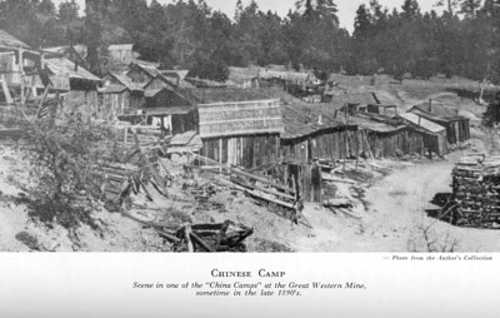
The mine employed anywhere from 200 to 250 Chinese workers at a time, who performed the majority of the manual labor.
The Chinese laborers, known as “celestials” at the time, came from different areas of China, speaking differing dialects.
The newspapers of the time displayed blatantly bigoted monikers for the Chinese workers, such as “pigtail wearers” and “almond-eyed heathens.”
The Chinese workers at the Great Western Mine resided in two camps. The camps were basically crude huts, and sanitary conditions were not provided for.
Anything that was salvaged, such as used shingles, boxes, bits of lumber or hammered-out kerosene cans, were fashioned into huts.
Each year in the Chinese camps – sometime in late January to the third week in February – one of the grandest events of the year would occur: the celebrations of the Chinese New Year.
Then, the Andrew Rocca family, and many other non-Chinese families at the mine, would be presented with loads of gifts from the Chinese workers.
They received so many celebratory gifts, that they considered the Chinese New Year as one of their own traditional holidays.
The gifts from the Chinese included poultry, nuts, candy, silk handkerchiefs, bourbon, cigars, cakes and more.
Prior to the Chinese New Year's festivities the Chinese would present gifts of Chinese sacred lily, or narcissus bulbs.
Sometimes lovely brocaded silk fabrics were given, as well as Chinese slippers, vases, fans and foods like litchi nuts, cocoanuts, ginger, tangerines and sugar cane.
A variety of firecrackers as well as a prodigious amount of fireworks would make their way into the Chinese camps at the Great Western Mine.
This was a time of celebration for not only the Chinese workers, the mine workers and their families, but numerous Middletown residents would come up to the mine for the festivities.
Helen Rocca Goss wrote, “Long strings of dozens of bunches of firecrackers were hung by their fuses from poles, topped with figures of birds and beasts full of black powder. The string was lighted at the bottom, and after all of the firecrackers had exploded with a sharp sizzle, the powder went off with a terrifying roar. Bombs full of powder were also thrown, and rockets were sent up. An entry in my mother's diary one year says that, '110,000 fire crackers and numerous bombs were exploded.' After the fireworks were over, the Chinese passed out gifts of nuts and candy to all the spectators.”
This year, in 2015, Chinese New Year is celebrated on Thursday, Feb. 19.
Chinese New Year translates as “spring festival” in China, and has been celebrated for centuries. In the past it was a celebration to honor ancestors and gods.
The Chinese calendar marks 12 months in major cycles of 60 years, with the year named for one of the 12 animals in the Chinese zodiac. The 12-year cycles repeat themselves.
This year, in 2015, it is the year of the sheep (goat). For a listing of Chinese New year animals from calendar years beginning in 1900: http://www.infoplease.com/ipa/A0002076.html .
Kathleen Scavone, M.A., is an educator, potter, writer and author of “Anderson Marsh State Historic Park: A Walking History, Prehistory, Flora, and Fauna Tour of a California State Park” and “Native Americans of Lake County.” She also writes for NASA and JPL as one of their “Solar System Ambassadors.” She was selected “Lake County Teacher of the Year, 1998-99” by the Lake County Office of Education, and chosen as one of 10 state finalists the same year by the California Department of Education.