 How to resolve AdBlock issue?
News
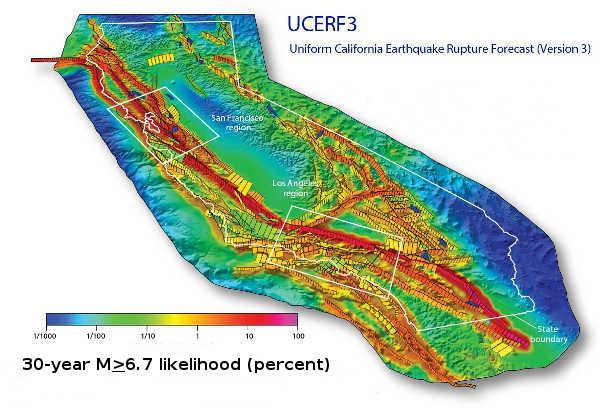
LAKE COUNTY, Calif. – For those who live along the Pacific Rim, earthquakes are part of life.
In Lake County, in recent years earthquakes have seemed to become more common, an issue attributed primarily to activities at The Geysers geothermal steamfield, the largest complex of geothermal power plants in the world, according to Calpine.
Being able to better predict the state's earthquake activity in order to help keep its residents safe is an ongoing task for seismologists, who recently completed an updated California earthquake forecast.
The forecast, the Third Uniform California Earthquake Rupture Forecast, or UCERF3, was released in March by the U.S. Geological Survey, which completed the work along with the Southern California Earthquake Center, the California Geological Survey and the California Earthquake Authority.
The new forecast revised scientific estimates for the chances of having large earthquakes over the next several decades, confirmed many previous findings, shed new light on how the future earthquakes will likely be distributed across the state and estimated how big those earthquakes might be, the US Geological Survey reported.
The agency said UCERF3 improved upon previous models by incorporating the latest data on the state’s complex system of active geological faults, as well as new methods for translating these data into earthquake likelihoods.
The US Geological Survey said that, when compared to the previous assessment issued in 2008, UCERF2, the estimated rate of earthquakes around magnitude 6.7 – the size of the destructive 1994 Northridge earthquake – has gone down by about 30 percent in the new forecast.
The UCERF3 forecast says the expected frequency of such events statewide has dropped from an average of one per 4.8 years to about one per 6.3 years.
At the same time, however, the new estimate is that the likelihood that California will experience a magnitude 8 or larger earthquake in the next 30 years has increased from about 4.7 percent for UCERF2 to about 7.0 percent for UCERF3.
“The new likelihoods are due to the inclusion of possible multi-fault ruptures, where earthquakes are no longer confined to separate, individual faults, but can occasionally rupture multiple faults simultaneously,” said lead author and USGS scientist Ned Field. “This is a significant advancement in terms of representing a broader range of earthquakes throughout California’s complex fault system.”
“We are fortunate that seismic activity in California has been relatively low over the past century. But we know that tectonic forces are continually tightening the springs of the San Andreas fault system, making big quakes inevitable,” said Tom Jordan, director of the Southern California Earthquake Center and a co-author of the study. “The UCERF3 model provides our leaders and the public with improved information about what to expect, so that we can better prepare.”
The Lake County picture
Concern about big earthquakes also is present in Lake County, where impacts of large quakes have been felt in the past – even when those quakes have occurred on faults that don't run through Lake County.
That was the case with the earthquake on April 18, 1906, that ravaged San Francisco. While that quake was on the San Andreas fault, which is west of Lake County, its destructive power had a definite impact on Lake County.
The quake damaged the bell tower of the Lower Lake Schoolhouse as well as many buildings – including the Lake County Courthouse – in Lakeport, and destroyed the Lakeport Masonic Lodge. For more information on that quake's local impact, see http://goo.gl/BocWtW .
Jack Boatwright of the US Geological Survey said seismologists believe that the recurrence rate of 1906-type events on the northern San Andreas fault is about once every 200 years.
“Since only 100 years has gone by, that means that it's not perceived as particularly ready to have an earthquake there,” he said.
Other major earthquakes on the San Andreas fault, including one on the north end of San Pablo bay at the end of March 1898 and another in April of that same year in Mendocino County, also were felt in Lake County, Boatwright said.
“They didn't cause any damage,” said Boatwright.
Boatwright said old newspaper accounts helped him track those events. Such accounts also help create a historical record of major events, which is critical for seismologists.
But those earthquake events are relatively recent in geological terms, Boatwright said.
Overall, seismologists only have about 250 years of really hard information, and in Northern California they're not sure how good that information really is, he said.
The best information that Boatwright said geologists have goes back to about 1776, the time of the Spanish settlement of San Francisco.
The real difficulty in California, Boatwright said, is that in order to make or to test a model of this sort of statistical depth, scientists need thousands of years of data.
“That's why when we changed the model we get these changes in the probability,” he said. Between the model that came out four years ago and this one, “we don't really have improved information in Northern California.”
Boatwright said that, for the purposes of classifying seismic regions, Lake County is located in the Coastal Northern California region, which is just slightly outside of the San Francisco region.
While the San Andreas fault doesn't run through Lake County, there are other major faults here and other seismicity issues, Boatwright said.
Major faults in Lake County include the Maacama, which US Geological Survey geologist Jim Lienkaemper said runs from the Russian River area, from Cloverdale to Hopland and into Lake County, as well as up to Ukiah and Willits, following Highway 101.
Then there is the extension of the Concord-Green Valley fault, a fault system which includes a subsection known as the Bartlett Springs Fault Zone. Another subsection is in the Berryessa area, Boatwright said.
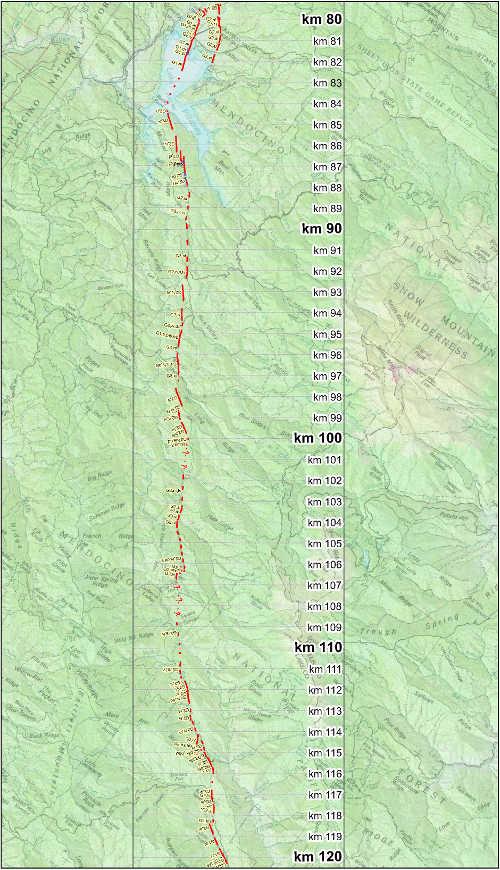
The Bartlett Springs Fault Zone is associated with the larger San Andreas fault system, although the San Andreas fault itself doesn't cross into Lake County. According to the US Geological Survey the Bartlett Springs fault is estimated to be as much as 2 miles wide to roughly 100 miles long,
The Green Valley fault is basically the same at the Bartlett Springs fault, except it is in Sonoma and Napa counties, not Lake, Lienkaemper said.
US Geological Survey reports indicate that the agency mapped a large portion of the Bartlett Springs Fault Zone in the 1980s as part of a mineral resource appraisal of two U.S. Forest Service roadless areas.
“It’s not a very well studied fault,” Lienkaemper said of the Bartlett Springs fault. “That’s the big problem there.”
A lot of effort has been put into studying the Hayward and San Andreas fault, said Lienkaemper. However, the farther one gets out from the urban areas, the less study there is of faults.
The takeaway from the report is that the state's large faults – including the San Andreas, Maacama and Bartlett Springs – are more likely to host a 6.5-magnitude and above event than previous models showed, Boatwright said.
The increase in the likelihood of such larger events “is well within the uncertainty of our estimates,” Boatwright added.
While Boatwright noted, “The Geysers is very active,” he said it isn't on the Maacama fault. “It's its own little piece.”
He explained that earthquakes didn't start happening at The Geysers until water was being pumped into the area for steam injection.
“It's not a coherent, through-going fault,” he said, explaining that it's the stress underneath the ground, not a bigger fault system, that is the cause of The Geysers area's seismic activity.
Boatwright said there has been some good work done to understand the Maacama fault near Ukiah, as well as on the geodetics – or earth measurement – of the North Coast region to show how the area is progressively deforming, straining or building up strain on faults.
Overall, the Maacama fault moves, or creeps, by about 10 millimeters a year, compared to the 20 millimeters a year tracked on the San Andreas. Boatwright said the Bartlett Springs fault builds up about 6 millimeters of strain per years.
“Six millimeters a year seems like a very strong result,” said Boatwright.
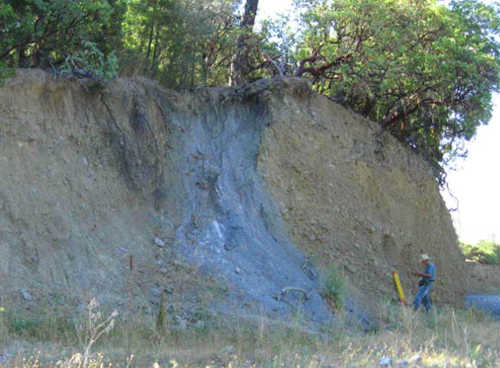
When they can, geologists like to dig trenches in fault areas to so they can see what Boatwright calls “paleoseismic events” – meaning, they can find geologic records for the time before they have historical accounts for the area.
“If we're particularity lucky, we can get some material and date the events,” he said.
Lienkaemper said paleoseismic research gives scientists a look at the real history of faults, and allows them to form a long-term estimate of how frequently long-term quakes happen.
That, he said, is better than theoretical data.
Such trench work has been done in Ukiah and on the Bartlett Springs fault area, Boatwright said.
Lienkaemper worked on a mini trench on a connection between the Bartlett Springs and Green Valley faults in the summer of 2014.
It's been hard to find good trench locations in the area, and while he said he didn't find a lot of useful information in that trench, he had better success on a site on the Berryessa fault in Napa County a few years earlier, where there is a lot of seismicity.
One place where a big earthquake could occur in Lake County is the area of Newman Springs, one mile north of Bartlett Springs, Lienkaemper said.
“That is the bad place,” he said, noting it's been showing a small amount of creep.
Lienkaemper explained that the Bartlett Springs fault north of Lake Pillsbury “creeps quite a bit,” or around 6 millimeters annually.
That's good, he explained, because the creep releases the strain that would otherwise store up energy.
“The more efficient it creeps, the better it is,” Lienkaemper said.
Email Elizabeth Larson at
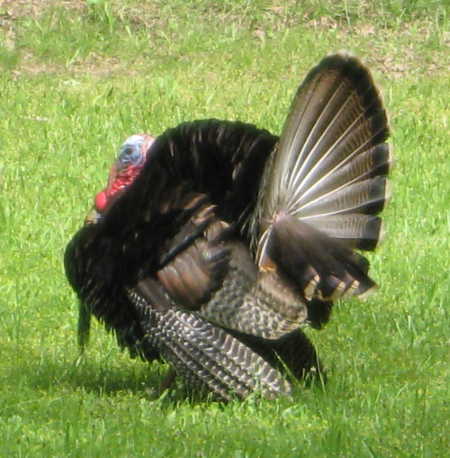
LAKE COUNTY, Calif. – Wild turkeys are not native to Lake County, however, they are abundant.
Wild turkeys, or Meleagris gallopavo, are native to North America.
They were brought to California in the 1870s, then again in the 1920s, 1950s and again in the 1970s.
In the 1970s the Department of Fish and Game brought in turkeys from Texas, the M. gallopavo intermedia.
These turkeys took a liking to their new digs in Lake County. Now estimates for wild turkeys in California exceed 240,000.
Turkey antics are fun to watch , but they can be true pests when they leave “calling cards” and dig up gardens.
The male, or tom, has quite striking coloration in his feathers with iridescent copper colors, gold tones and some greens.
His head has red areas and red wattles or fleshy, hanging “caruncles.”
They have a distinctive “snood,” or flesh-type appendage over the beak.
Both sexes have dark and white barred wing feathers, and dark overall coloration.
Female turkeys, or hens, weigh on average 6 to 12 pounds, while the toms can weigh 11 to 24 pounds when fully grown.
Wild turkey habitat includes anything from conifer forests, oak woods to fields, marshes and pastures.
Being omnivores, they seek out nuts, acorns, roots, along with lizards and snakes.
Turkeys can be seen feasting on toyon and other berries as well. They are quite ungainly perching and swaying in toyon shrubs while devouring the crimson berries.
Turkeys like to get their fill of toyon before robins, coyotes and bears steal them away.
Hens lay up to 14 eggs, often one per day, after mating season.
The clutch has many predators, so the hen usually does not leave the nest for about 28 days. She has to watch for skunks, gopher snakes, hawks, raccoons and other hungry predators.
For more information on keeping turkeys wild, visit the Department of Fish and Wildlife's “Keep Me Wild” Web site, http://www.dfg.ca.gov/keepmewild/turkey.html .
Kathleen Scavone, M.A., is an educator, potter, writer and author of “Anderson Marsh State Historic Park: A Walking History, Prehistory, Flora, and Fauna Tour of a California State Park” and “Native Americans of Lake County.” She also writes for NASA and JPL as one of their “Solar System Ambassadors.” She was selected “Lake County Teacher of the Year, 1998-99” by the Lake County Office of Education, and chosen as one of 10 state finalists the same year by the California Department of Education.

LAKE COUNTY, Calif. – A big and varied group of dogs is available for adoption at Lake County Animal Care and Control this week.
The dogs available this week include mixes of Akita, Chihuahua, English Bulldog, German Shepherd, hound, Labrador Retriever, pit bull, Rottweiler, Shar Pei and terrier.
Dogs that are adopted from Lake County Animal Care and Control are either neutered or spayed, microchipped and, if old enough, given a rabies shot and county license before being released to their new owner. License fees do not apply to residents of the cities of Lakeport or Clearlake.
If you're looking for a new companion, visit the shelter. There are many great pets hoping you'll choose them.
In addition to the animals featured here, all adoptable animals in Lake County can be seen here: http://bit.ly/Z6xHMb .
The following dogs at the Lake County Animal Care and Control shelter have been cleared for adoption (additional dogs on the animal control Web site not listed are still “on hold”).
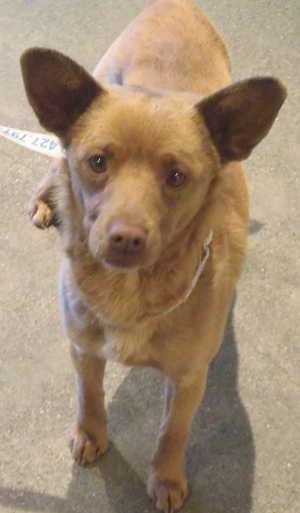
Chihuahua-terrier mix
This male Chihuahua-terrier mix has a short brown coat.
He's in kennel No. 2, ID No. 2054.
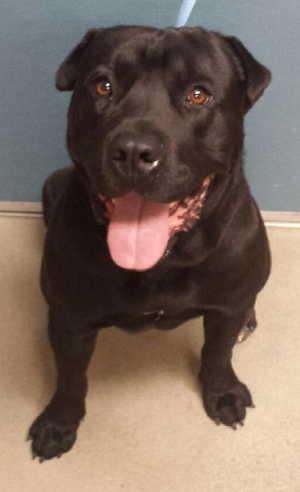
Rottweiler-Shar Pei mix
This male Rottweiler-Shar Pei mix has a short black coat and big brown eyes.
Shelter staff said that the family who found him said he was good with children and got along with other dogs.
He's in kennel No. 8, ID No. 1983.
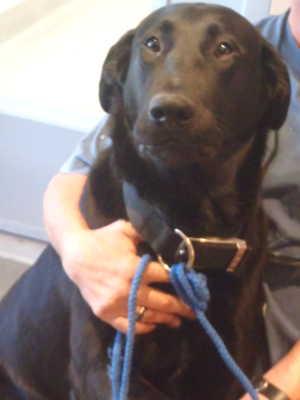
Male German Shepherd-Labrador Retriever mix
This male German Shepherd-Labrador Retriever mix has a short black coat.
Shelter staff said he's one big ball of energy, loving to fetch, run and play with other dogs. He is being socialized with other dogs and is learning very fast.
He's in kennel No. 10, ID No. 2004.

Male pit bull terrier mix
This male pit bull terrier mix has a short gray and white coat.
Shelter staff calls him a “big squishy guy” who is very gentle. They believe he would be fine with children.
He has no food aggression, gets along with other dogs both male and female, and is very appropriate in every way.
The shelter is looking for that special "pitty" lover to take him home and care for him.
He's in kennel No. 13, ID No. 2035.

Hound-Labrador Retriever mix
This pretty young girl is a hound-Labrador Retriever mix.
She has a short sable, black and white coat.
She's in kennel No. 14, ID No. 2041.
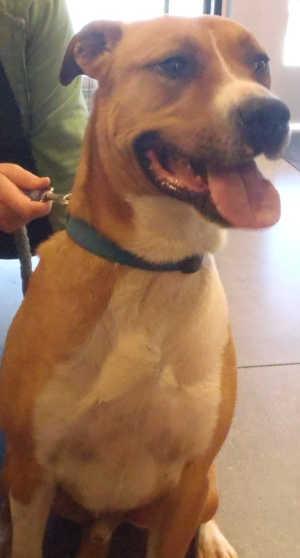
Labrador Retriever-pit bull mix
This handsome male Labrador Retriever-pit bull mix has a short tan and white coat.
Shelter staff estimate that he is 4 years old.
He's in kennel No. 28, ID No. 2045.
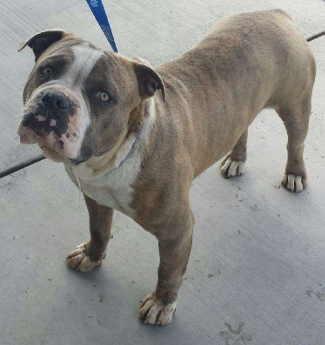
'Bear'
“Bear” is a male English Bulldog mix.
He has a short tan and white coat.
Shelter staff said he is great with other dogs and very social with people.
He's in kennel No. 29, ID No. 1972.
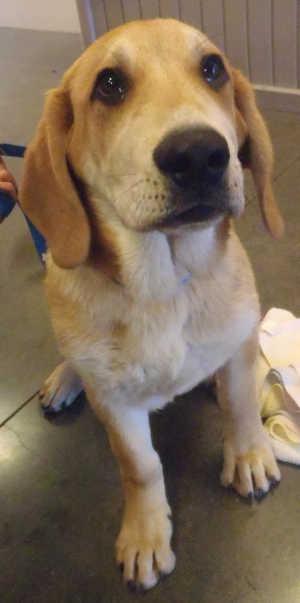
Hound-lab mix
This handsome male hound-Labrador Retriever mix has a short tan and white coat.
He's in kennel No. 30, ID No. 2040.
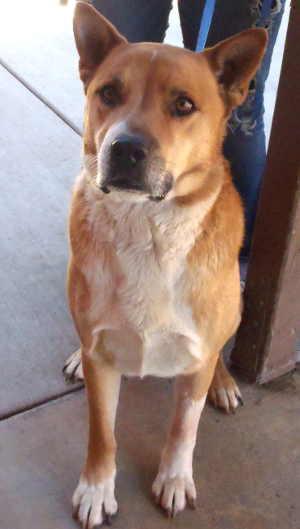
Akita mix
This 5-year-old male Akita mix has a short tan and white coat.
He knows basic commands and his housebroken, and needs some leash training.
Shelter staff said he likes toys and they're looking for an owner for him who would love to spend time taking him for walks.
He is mellow and would be great with kids, but they recommend no cats.
He's in kennel No. 31, ID No. 1938.
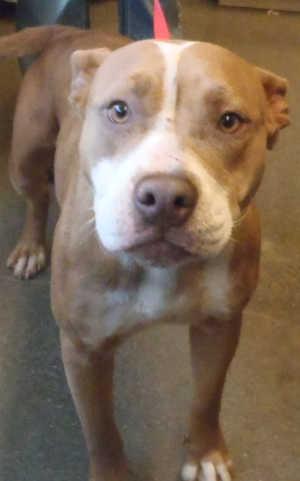
Female pit bull terrier mix
This female pit bull terrier mix is about a year and a half old.
Shelter staff said she was found on Lakeshore Boulevard in Lakeport taking a stroll.
She weighs 42 pounds and is very friendly.
She's in kennel No. 32, ID No. 1985.
To fill out an adoption application online visit http://www.co.lake.ca.us/Government/Directory/Animal_Care_And_Control/Adopt/Dog___Cat_Adoption_Application.htm .
Lake County Animal Care and Control is located at 4949 Helbush in Lakeport, next to the Hill Road Correctional Facility.
Office hours are Monday through Friday, 11 a.m. to 5 p.m., and 11 a.m. to 3 p.m., Saturday. The shelter is open from 11 a.m. to 4 p.m. Monday through Friday and on Saturday from 11 a.m. to 3 p.m.
Visit the shelter online at http://www.co.lake.ca.us/Government/Directory/Animal_Care_And_Control.htm .
For more information call Lake County Animal Care and Control at 707-263-0278.
Email Elizabeth Larson at
Spring is a busy time of year for wildlife. Bears, deer, birds and bobcats as well as dozens of other species emerge from winter ready to fill their bellies and raise their young.
Because of this increase in wildlife activity, the California Department of Fish and Wildlife (CDFW) reminds people to leave young wildlife alone if they come across them.
The improper handling of young wildlife is a problem in California and across the nation, especially in spring.
“Many people don’t realize that it is illegal to keep California native wildlife as pets,” said Nicole Carion, CDFW’s statewide coordinator for wildlife rehabilitation. “Never assume when you see young wildlife alone that they need assistance. Possibly, their mother is simply out foraging for food. If you care, leave them there.”
Healthy fawns may lay or stand quietly by themselves in one location for hours while their mother is away feeding.
Once a fawn is removed from its mother, it can lose the ability to survive in the wild. The same danger applies to most animals, including bears, coyotes, raccoons and most birds.
The state’s rehabilitation facilities receive an average of around 400-500 fawns per year from well-meaning members of the public.
Many of these fawns were healthy and in no danger, and should not have been disturbed.
People can call a rehabilitator, who will determine whether there is a need for a rescue. Rehabilitators are trained to provide care for wild animals so they retain their natural fear of humans and do not become habituated or imprinted.
Dave Cook, a rehabilitator with Sierra Wildlife Rescue in El Dorado County, said his organization receives about 60 fawns a year, mainly between June and July, from people who believe the animals have been orphaned or injured.
“When people call me and say they have an orphaned fawn, I first tell them to monitor it from a distance,” Cook explained. “If it’s crying plaintively that’s a bad sign. If its coat is ungroomed, that’s another sign that it may be an orphan. As a last resort, I ask them to look at its butt. If the butt is clean, it’s likely not an orphan because a doe will meticulously clean the fawn’s bottom after it feeds.”
Cook estimates that over 50 percent of fawns that people report as orphaned are actually not orphans at all.
“They look so small and defenseless, almost like someone stepped on them, but this is actually a defense mechanism. They flatten themselves out so that predators won’t detect them,” he said.
Cook explained that fawns also can “play opossum,” going completely limp when someone tries to pick them up.
This happened to a family who found a fawn near the American River in Carmichael a few years back. When they picked it up, it went limp and they assumed the fawn had four broken legs, so they took it home and called Sierra Wildlife Rescue.
Cook arrived at the home and evaluated the animal, which jumped up and began running around the family room, apparently in perfect health.
Fortunately, he was able to return the animal to where it was found and reunite it with its mother. But not all fawns are so lucky.
“I almost always advise that people leave the fawn alone,” he said, “or at least call a wildlife rehabber before intervening. They can help evaluate the situation over the phone or will come out in person to help.”
It’s also important to remember that wild animals carry ticks, fleas and lice, and they can transmit diseases to humans, including rabies and tularemia, so it is best to leave the responsibility for intervention to CDFW personnel or permitted wildlife rehabilitators.
In addition, it is illegal to keep orphaned or injured animals for more than 48 hours in California.
To learn more about how to live responsibly with wildlife, including the importance of keeping food and garbage secured and not feeding wild animals, please visit CDFW’s Keep Me Wild Web site at www.keepmewild.org .
For more information on wildlife rehabilitation, visit www.dfg.ca.gov/wildlife/rehab/facilities.html .

Astronomers have shown for the first time how star formation in “dead” galaxies sputtered out billions of years ago.
The European Southern Observatory's Very Large Telescope and the NASA/ESA Hubble Space Telescope have revealed that three billion years after the Big Bang, these galaxies still made stars on their outskirts, but no longer in their interiors.
The quenching of star formation seems to have started in the cores of the galaxies and then spread to the outer parts.
The results were published in the Friday issue of the journal Science.
A major astrophysical mystery has centered on how massive, quiescent elliptical galaxies, common in the modern Universe, quenched their once furious rates of star formation.
Such colossal galaxies, often also called spheroids because of their shape, typically pack in stars ten times as densely in the central regions as in our home galaxy, the Milky Way, and have about ten times its mass.
Astronomers refer to these big galaxies as red and dead as they exhibit an ample abundance of ancient red stars, but lack young blue stars and show no evidence of new star formation.
The estimated ages of the red stars suggest that their host galaxies ceased to make new stars about ten billion years ago. This shutdown began right at the peak of star formation in the Universe, when many galaxies were still giving birth to stars at a pace about twenty times faster than nowadays.
“Massive dead spheroids contain about half of all the stars that the Universe has produced during its entire life,” said Sandro Tacchella of ETH Zurich in Switzerland, lead author of the article. “We cannot claim to understand how the Universe evolved and became as we see it today unless we understand how these galaxies come to be.”
Tacchella and colleagues observed a total of 22 galaxies, spanning a range of masses, from an era about three billion years after the Big Bang.
The SINFONI instrument on ESO’s Very Large Telescope collected light from this sample of galaxies, showing precisely where they were churning out new stars. SINFONI could make these detailed measurements of distant galaxies thanks to its adaptive optics system, which largely cancels out the blurring effects of Earth’s atmosphere.
The researchers also trained the NASA/ESA Hubble Space Telescope on the same set of galaxies, taking advantage of the telescope’s location in space above our planet’s distorting atmosphere. Hubble’s WFC3 camera snapped images in the near-infrared, revealing the spatial distribution of older stars within the actively star-forming galaxies.
“What is amazing is that SINFONI’s adaptive optics system can largely beat down atmospheric effects and gather information on where the new stars are being born, and do so with precisely the same accuracy as Hubble allows for the stellar mass distributions,” commented Marcella Carollo, also of ETH Zurich and co-author of the study.
According to the new data, the most massive galaxies in the sample kept up a steady production of new stars in their peripheries. In their bulging, densely packed centers, however, star formation had already stopped.
“The newly demonstrated inside-out nature of star formation shutdown in massive galaxies should shed light on the underlying mechanisms involved, which astronomers have long debated,” said Alvio Renzini, Padova Observatory, of the Italian National Institute of Astrophysics.
A leading theory is that star-making materials are scattered by torrents of energy released by a galaxy’s central supermassive black hole as it sloppily devours matter.
Another idea is that fresh gas stops flowing into a galaxy, starving it of fuel for new stars and transforming it into a red and dead spheroid.
“There are many different theoretical suggestions for the physical mechanisms that led to the death of the massive spheroids,” said co-author Natascha Förster Schreiber, at the Max-Planck-Institut für extraterrestrische Physik in Garching, Germany. “Discovering that the quenching of star formation started from the centers and marched its way outwards is a very important step towards understanding how the Universe came to look like it does now.”
MIDDLETOWN, Calif. – The Lake County Sheriff's Office said that a Middletown girl who claimed that a stranger attempted to abduct her last month has admitted that she made up the story.
Sheriff Brian Martin said that, because of the girl's age, he couldn't go into specifics about the situation, including what had prompted her to make the false report.
“She's a 12-year-old,” said Martin, himself the father of three. “She made a bad decision.”
On March 23, sheriff's deputies responded to the area of Armstrong Street in Middletown on the report of the girl's attempted kidnapping, as Lake County News has reported.
Deputies searched the area but failed to locate the man – described as an older white male adult – who the girl claimed had approached her outside of the Middletown Methodist Church, took her by the wrist and tried to pull her into his pickup.
In her story, the girl claimed she had kicked the man in the shin, causing him to let go of her and immediately leave the area, officials said.
The sheriff's office said detectives canvassed the area in an attempt to locate any surveillance video of the male subject the girl had described from businesses and homeowners.
Martin said the case garnered numerous leads from community members, who contacted his department either via phone or through social media.
There even had been reports about a black Toyota pickup – like the one the girl described her attacker as driving – as having been in the area, Martin said.
There was enough input from the community that Martin said his investigators felt the case needed to be pursued and couldn't be dismissed out of hand.
Detectives followed up on the leads it received, even questioning several individuals, Martin said.
The Lakeport Police Department also lent an officer who is a trained sketch artist to the investigation. Officer Joe Eastham spoke to the girl, got additional details and created a drawing that was published in the local media.
Det. Kellie Joseph was assigned to lead the investigation. Martin said Joseph found that the leads weren't panning out. She also began to notice inconsistencies in the girl's story and her behavior.
Finally, the girl admitted she had made up the story, Martin said.
Martin said he didn't have an estimate of exactly how many hours were spent on investigating the case.
“It was quite a few,” he said. “Certainly more time than should have been dedicated to it.”
Even so, Martin said such reports have to be taken seriously.
The important thing, he said, is that such an attempted stranger abduction didn't happen.
Martin thanked the community members who had provided information, the Lakeport Police Department for its assistance and sheriff's detectives, who Martin said worked nonstop on the case in the weeks since it was reported.
As for the potential ramifications for the girl, Martin said his agency has documented the incident in the event that something similar involving her occurs in the future.
However, Martin said that, considering the girl's age, no legal action is planned against her, and instead the consequences she faces will be left up to her parents.
Children do dumb things and make mistakes, Martin said.
He added, “Getting involved in the justice system isn’t always the best way of correcting that behavior.”
Email Elizabeth Larson at