 How to resolve AdBlock issue?
News

The glittering tapestry of young stars flaring to life in this new NASA/ESA Hubble Space Telescope image aptly resembles an exploding shell in a fireworks display.
This vibrant image of the star cluster Westerlund 2 has been released to celebrate Hubble's 25th year in orbit and a quarter of a century of new discoveries, stunning images and outstanding science.
On April, 24, 1990, the NASA/ESA Hubble Space Telescope was sent into orbit aboard the space shuttle Discovery as the first space telescope of its kind.
It offered a new view of the Universe and has, for 25 years, reached and surpassed all expectations, beaming back data and images that have changed scientists' understanding of the Universe and the public's perception of it.
In this image, the sparkling centrepiece of Hubble's silver anniversary fireworks is a giant cluster of about 3000 stars called Westerlund 2.
The cluster resides in a raucous stellar breeding ground known as Gum 29, located 20,000 light-years away in the constellation Carina.
The stellar nursery is difficult to observe because it is surrounded by dust, but Hubble's Wide Field Camera 3 peered through the dusty veil in near-infrared light, giving astronomers a clear view of the cluster.
Hubble's sharp vision resolves the dense concentration of stars in the central cluster, which measures only about 10 light-years across.
The giant star cluster is only about two million years old, but contains some of the brightest, hottest and most massive stars ever discovered.
Some of the heftiest stars are carving deep cavities in the surrounding material by unleashing torrents of ultraviolet light and high speed streams of charged particles, known as stellar winds.
These are etching away the enveloping hydrogen gas cloud in which the stars were born and are responsible for the weird and wonderful shapes of the clouds of gas and dust in the image.
The pillars in the image are composed of dense gas and dust, and are resisting erosion from the fierce radiation and powerful winds.
These gaseous monoliths are a few light-years tall and point to the central cluster. Other dense regions surround the pillars, including dark filaments of dust and gas.
Besides sculpting the gaseous terrain, the brilliant stars can also help create a succeeding generation of offspring. When the stellar winds hit dense walls of gas, they create shocks, which generate a new wave of star birth along the wall of the cavity.
The red dots scattered throughout the landscape are a rich population of forming stars that are still wrapped in their gas and dust cocoons.
These stellar fetuses have not yet ignited the hydrogen in their cores to light-up as stars. However, Hubble's near-infrared vision allows astronomers to identify these fledglings. The brilliant blue stars seen throughout the image are mostly in the foreground.
The image's central region, containing the star cluster, blends visible-light data taken by the Advanced Camera for Surveys and near-infrared exposures taken by the Wide Field Camera 3. The surrounding region is composed of visible-light observations taken by the Advanced Camera for Surveys.
This image is a testament to Hubble's observational power and demonstrates that, even with 25 years of operations under its belt, Hubble's story is by no means over.
Hubble has set the stage for its companion the James Webb Space Telescope – scheduled for launch in 2018 – but will not be immediately replaced by this new feat of engineering, instead working alongside it.
Now, 25 years after launch, is the time to celebrate Hubble's future potential as well as its remarkable history.
The Hubble Space Telescope is a project of international cooperation between ESA and NASA.

CLEARLAKE OAKS, Calif. – Lake County Sheriff's deputies have arrested a Clearlake man for attacking and stabbing another man on Wednesday night.
Jared Silverio Rosalez, 26, was arrested for attempted murder, according to Lt. Steve Brooks.
Brooks said deputies responded to a reported stabbing just after 9 p.m. Wednesday at the Clearlake Oaks Tower Mart, located at 12583 E. Highway 20.
The deputies contacted the victim, who said he had been stabbed and noticed he was bleeding from a laceration to his stomach, Brooks said.
The victim told deputies he was sitting on a bench located at the business when a subject – later identified as Rosalez – walked up and punched him multiple times for no reason, according to Brooks.
Brooks said the victim was not sure when he was stabbed, but noticed the knife in Rosalez’s hand when he was running from the scene.
Several witnesses provided a description of Rosalez and said he was last seen running westbound on Highway 20, Brooks said.
A short time later, deputies located Rosalez near the intersection of Highway 20 and Lakeview Drive, where Brooks said Rosalez was attempting to flag down vehicles to obtain a ride.
When deputies contacted Rosalez they noticed he tossed a knife toward the side of the road. Brooks said they were able to seize the knife as evidence and take Rosalez into custody without further incident.
Rosalez was arrested for attempted murder and transported to the Lake County Hill Road Correctional Facility where he was booked, Brooks said.
Rosalez's booking sheet showed he was being held on $1 million bail, with a court appearance tentatively scheduled for April 28.
Brooks said the victim was transported to a medical facility where he received treatment for his injuries.

CLEARLAKE, Calif. – A young family has a new home thanks to the assistance of Habitat for Humanity Lake County.
Habitat for Humanity Lake County dedicated its 18th home on April 18, welcoming Angela Philpot, Jeremy Kotoff and their children to the ranks of Habitat partner families.
Volunteers, staff, friends and family joined in the celebration at noon in the new home, sharing food, good wishes, and words of welcome and encouragement to the family as they embark on their new life as homeowners.
Habitat for Humanity Lake County President Richard Birk spoke about the needs of the community and how each individual could contribute to make a difference in the lives of others before sharing a brief key-passing ceremony and fellowship with all of the guests in attendance.
“It’s hard to put into words; we’re still in shock,” Philpot said. “God has blessed us with a safe home for the girls, and we’re so grateful and appreciative to everyone who helped make this possible. It just hasn’t hit us yet that this is really real.”
For information on how you can become a Habitat for Humanity homeowner, or for an application, visit www.lakehabitat.org or contact the Habitat for Humanity office at 707-994-1100.
LAKE COUNTY, Calif. – The California Department of Forestry and Fire Protection, or Cal Fire, in conjunction with the California Department of Corrections and Rehabilitation, operates 39 conservation camps with approximately 200 fire crews throughout California.
This partnership of state agencies provides a large force of trained crews for all types of emergency incidents and resource conservation projects.
The Cal Fire Sonoma-Lake-Napa Unit inmate fire crews from Delta Conservation Camp and Konocti Conservation Camp will hold their annual fire crew preparedness exercises in Lake County on Wednesday, April 29, and Thursday, April 30.
The fire crew preparedness exercises provide the opportunity for 11 fire crews from the two conservation camps to be evaluated on their physical conditioning, firefighting knowledge, fire safety and personal protective equipment.
The exercises will be managed by using the Incident Command System, or ICS.
The ICS is a management system designed to enable effective and efficient domestic incident management by integrating a combination of facilities, equipment, personnel, procedures, and communications operating within a common organizational structure.
The annual fire crew preparedness exercise is an important part of preparing for fires in California.
The crew members are educated and trained to work under extreme fire conditions, many times in triple-digit heat.
Under competitive pressure; the fire crews will construct fire lines utilizing chainsaws and hand tools, hike a set distance on varying terrain into a pre-designated location, deploy fire shelters, as well as expand their knowledge in fire, bulldozer and helicopter safety.
During the exercises, proctors will remind them of the importance of their personal protective gear, communication, and proper hydration.
Officials said it is an outstanding opportunity to put their year’s training to the test and to gear-up both physically and mentally for the ensuing fire season.
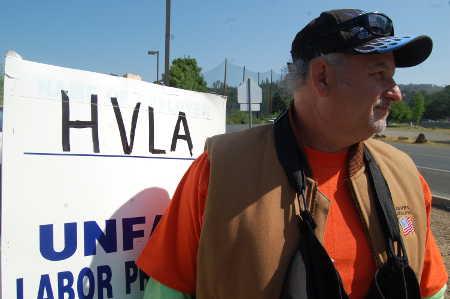
HIDDEN VALLEY LAKE, Calif. – Disagreements over labor issues led this week to a picket by the Hidden Valley Lake Association's unionized workers, who are lodging complaints alleging unfair practices, with the association in turn arguing that the union has been unwilling to come to the table.
Early Tuesday morning a letter signed by Randy LeMoine, business manager for Local 324 of the Laborers’ International Union, notified the HVLA administration that the union was initiating an unfair labor strike in response to discrimination against golf course and maintenance employees.
The letter was hand-delivered to the offices of HVLA General Manager Cindy Spears and Human Resource Director Julie Vonada.
It accused HVLA’s employers of bad-faith bargaining and unilateral changes in terms and conditions of employment impeding the rights of employees. HVLA also received an eight-page document citing several charges of alleged infractions.
The document’s cover said that the National Labor Relations Board Region 20 director has issued a formal complaint against HVLA.
In addition, the document poses the questions, “Why is Hidden Valley Lake violating employee rights and federal law?” and “How much will the litigation costs be for Cindy Spears’ unlawful conduct?”
National Labor Relations Board records online show that Local 324 and the Northern California District Council filed charges against the Hidden Valley Lake Association on April 15 for repudiation/modification of contract and again on April 20 for coercive actions.
In January, the union filed similar complaints against HVLA with the National Labor Relations Board, as well as charges of refusing to bargain in good faith and coercive statements, the agency's records show.
More complaints of repudiation/modification of contract followed in February, along with allegations that HVLA refused to bargain in good faith and furnish information, based on the federal records search.
All of those specific January and February cases remain open, according to the National Labor Relations Board.
However, it's the association's view that the refusal to bargain in good faith and to avoid meeting is the union's issue.
In a statement issued to Lake County News, the association said the impasse between Hidden Valley Lake Association and the Laborers Union Local 324 employees “is based on the Association’s beliefs that staff equity in pay and benefits are key ingredients to a productive workforce. The Union doesn’t share that viewpoint,” which led to the call for a picket line that began early Tuesday morning.
While the union continues to picket, “staff has jumped in to supplant those duties and temporary workers have been hired to replace striking Union employees,” the statement said.
According to HVLA, a point of contention is the union’s insistence that the association pay a flat rate of $30 for mileage versus paying the standard Internal Revenue Service rate of $.55 per mile when “on-call” union employees are called into work.
“The IRS standard is the amount the association pays to its other employees for mileage reimbursement,” the statement said.
A second issue concerns health insurance. The statement said union employees and their families receive full health care benefits for $64.04 per pay period. “The association has countered that union
employees should be responsible for sharing more of the ever-rising healthcare burden.”
As a result, the association implemented a $36.04 per paycheck increase in what it said was a small attempt to level the playing field between union and nonunion employees. “The association is considering other equalization standards,” the statement said.
However, Maggie Campbell, a researcher and labor relations representative who joined picketers out front of Hidden Valley Golf Club on Wednesday morning, tells a far different story
“Back in October we were bargaining with the employer who refused to talk to us,” she said. “So we talked from then till now for some 20 odd days for them to come and meet with us and they’d say ‘Oh, no, we’re not going to meet with you.’”
Campbell indicated that the documents were only the first shot in a battle against the HVLA’s management practices.
Spears has clearly been singled out. Her office phone number has been posted on signs carried by picketers.
“I don’t know whether Cindy Spears is going to take her direction from the board (of directors) or is on her own,” said Campbell. “So far we have not been able to get board directors to talk to us.”
Campbell went on to cite an alleged Aug. 23 incident in which she said Spears “skipped the union and went directly out to try to make a deal with employees.
“She was soliciting grievances to find out ‘what’s your problem?’ and ‘how can I fix it for you?’” Campbell said.
“The message I want to send to Cindy is that this is California, not Florida,” she added. “We have labor laws in California. This is not a ‘right-to-work’ state.”
The allusion was to Spears’ former position in Florida just before moving to Hidden Valley Lake.
What is unknown and likely will remain that way is how many calls Spears has received because of the campaign to circulate her phone number.
But a member of the HVLA administration team observed that Spears receives as many supportive emails as negative phone calls.
Motorists, on the other, seem to be supportive of the picketers, as indicated by how many honk their horns.
“It’s been amazing,” said Campbell. “Back in 2008 it took us a couple of weeks to get past the negativity and to the point where folks supported us. This time with Cindy in place there is so much unhappiness and distrust by the homeowners.”
One of several charges the union has brought against HVLA is that it has created a “beautification committee” that has performed grounds keeping work normally done by union personnel.
The question is, does it perform tasks that should be done by contract employees?
“I have not seen anything from that committee that they’re not conducting our work,” said Campbell, noting they've taken photographs of them doing the work.
A more serious concern involved mechanic Todd Everhart and his wife. Everhart was accused of being on social media on a day that he took his wife to the doctor’s office for ultrasound treatment.
“I was off the job,” he said. “But when I came back from the hospital I was told I would have to leave for the day. I was suspended because I was doing social media work while on the job, which was untrue.”
Everhart said he was exonerated and called back the following day.
Over the past year, HVLA has had more than its share of strife. There has been community division over a new event center project. A board member was ousted by a partisan recall campaign. The board’s president survived a recall effort only to be voted out of office by the board. Workers also picketed last October.
Late Wednesday, Spears told Lake County News that there was nothing new to report from the association side.
There’s more to come from the union. Maybe even on Thursday, which Campbell says will provide a major development.
What’s next?
“Oh no,” she answered. “If I tell you that I lose my strategy.”
Email John Lindblom at
UPPER LAKE, Calif. – On Wednesday night the boards of the Upper Lake Union Elementary School District and the Upper Lake Union High School District took the next steps in the process of deciding whether or not to unify into one district.
The third joint meeting of the two boards this year saw all 10 board members approve the final three criteria that state education code requires them to consider.
Present at the hourlong meeting were several community members and parents, as well as Lake County Superintendent of Schools Brock Falkenberg; Michelle Buell, senior director of business services for the Lake County Office of Education; and County Board of Education members David Browning, Mark Cooper and Pat Hicks, who also compose the Committee on School District Organization that is anticipated to take its steps in the process this summer.
Altogether, the boards have approved the nine main criteria; state education code includes a 10th as a catch-all if the districts want to add in their own special considerations. But that hasn't happened in this case.
The three criteria approved unanimously Wednesday are as follows: that the unification would not result in a significant increase in school housing costs, that the unification is primarily designed for purposes other than to significantly increase property values and that bringing the two districts together would not cause a substantial adverse effect on the fiscal management or fiscal status of the new unified district.
During public comment, Sara Sanchez – a mother of four students of the Upper Lake schools – told the boards that it would be great if all of her children had the same days off, and their records followed them in one district.
“It would be very helpful for us if we could combine it all into one,” said Sanchez, noting that other parents have expressed the same opinion.
“I know this is the furthest that we have come in the unification process,” and Sanchez said she hoped it made it through, as she believes there is no reason for the two districts to be separate.
Another man in the audience also expressed his support for the process, applauding the boards for sitting down and discussing the matter.
He added that if unification is better for students, the districts should do it.
One community member who doesn't believe that unification is the right path is Walt Christensen, who also was in the audience and questioned the board during the meeting about various aspects of the process.
In response to a question previously posed by board members about the potential cost for hiring an interim superintendent during the unification process, Upper Lake Elementary Chief Business Official Becky Jeffries said she did projected costs for six-, 12- and 18-month periods.
For the six-month period, it would range between just over $57,000 to $72,750, and could range between $190,000 and $241,000 for a year and a half, Jeffries said.
Hiring an interim superintendent would be up to the new board that will be appointed to carry out the work of forming the new district, Jeffries noted.
Upper Lake Elementary Principal/Superintendent Valerie Gardner added that it's common practice in unifications to use an interim superintendent.
Upper Lake High School Board member Rich Swaney said they have discussed hiring a retired annuitant for six months to cover the position.
The board went over the three criteria up for approval briefly before accepting them and moving on to a question raised at the March 25 meeting on unification.
That question was whether the parent teacher organization would continue to run just under the Upper Lake Elementary School and Upper Lake Middle School or if it would now include Upper Lake High School.
The answer is that the PTO may operate separately from the high school or be combined, said Upper Lake High Principal/Superintendent Patrick Iaccino
“It's an entity unto itself,” said Iaccino. “The board has no jurisdiction over the booster club.”
Gardner pointed out that there is an elementary and middle school PTO and one for the high school.
It was then on to a brief review of the draft unification feasibility study. Iaccino said district staffers are in the process of finishing the final report, which will be presented for approval at the last joint meeting next month.
During the discussion, from the audience, Christensen told the boards, “My big objection in this whole process is 10 people make a decision for an entire community,” then five – the new board – will be responsible for fixing something that he said should have gone to the electorate.
“My response is these 10 individuals were elected by the electorate to make those decisions on their behalf,” said Iaccino.
Iaccino said public meetings and open forums were offered to allow the community to weigh in on the unification proposal.
Christensen responded that the 10 board members hadn't been elected for the sole purpose of unifying the two school districts, but were put in office to bring to the students of Upper Lake the best education possible.
He said people are leaving the district because that's not happening. “They're not fighting city hall, they're just moving.”
The process ahead
According to the process as it's outlined so far, at the joint meeting May 27 the two district boards will consider the final feasibility study.
They will then have separate June meetings – the high school on June 10 and the elementary school district on June 17 – to consider resolutions to approve the unification proposal.
The Lucerne Elementary School District Board also will meet in June to pass a “Thompson resolution” – named for a 1994 bill written by then-state Sen. Mike Thompson, now a congressman, to allow a high school district to unify without affecting all of its feeder elementary districts. That will enable Lucerne to opt out of taking part in the unification.
Once the study and resolutions are finalized, they would be given to Falkenberg, who would then have 30 days to vet the documents and present them to the Lake County Board of Education, sitting jointly as the Committee on School District Organization.
The county board would have up to 120 days to hold hearings and do its work before making a recommendation to the California Department of Education Board for final approval this fall.
On Wednesday night Falkenberg gave the boards an update on what the part of the process he's involved might look like. He has consulted with other county superintendents who have been through the process in order to be prepared.
He said if the districts indicate they want to unify, his office would pursue an election waiver which would allow him to appoint the board to represent the new district. “It would initially be an interim board.”
Falkenberg said he believed a thorough vetting process was needed for the new board, including an application process and an advisory panel.
Adding that he respects the voters, he said he would take into account who they have elected by giving special consideration to current board members.
Iaccino said the interim board would be appointed in December. From that point until the end of June, that board would work alongside the current boards of the two existing districts.
He said they are waiting for a response from the county clerk regarding whether they can remain on an odd-year election cycle, meaning that there wouldn't be a board election until November 2017. If they have to be on the even-year cycle, the election would be in November 2016.
Iaccino said that the top three vote getters would have four-year terms, with the next two finishers getting two-year terms.
Falkenberg said that in July he would prepare to submit a waiver to the state to allow the unification to go forward even though there are less than 1,500 students. He would aim to be on the California Board of Education's September agenda for approval.
Hicks told the board that she was concerned about the brief window for the county board to get its work done, including holding public meetings. “It's going to be very, very tight in those months.”
Email Elizabeth Larson at