 How to resolve AdBlock issue?
News
LAKE COUNTY, Calif. – Lake County's annual burn ban starts on Friday, May 1.
All burn permits expire on Thursday, April 30.
Officials said the ban is meant to address concerns over both fire hazard and air quality.
The burn restriction applies to all areas in Lake County.
An annual burn ban was first implemented in 1986 in response to weather conditions that often create extreme fire danger and poor air quality.
For many years a managed approach which incorporates fire and air agency concerns has been implemented and improved upon.
The ban allows a quick fire agency response to all fires observed from May 1 on, as they are all assumed to be uncontrolled fires unless specifically authorized by an exemption for time and place.
The Lake County Air Quality Management District said the program is one of the primary reasons Lake County has superior and healthful air quality. This week, Lake County was once again given the honor of having the cleanest air in the United States.
The ban also helps prevent smoke impacts to the general public and large planned outdoor events by unrestricted vegetative waste burns.
The burn ban includes all open waste burning, though exceptions are possible for agricultural operations, essential control burns for fire safety projects, public safety burns and others.
To obtain an exemption for a necessary burn after May 1, first contact the Lake County Air Quality Management District, 707-263-7000, to determine need, then your local fire protection agency so that your burn site can be inspected and evaluated for fire safety.
Only after the fire agency has inspected the burn site and notified the Lake County Air Quality Management District that the proposed burn is fire safe, can you obtain a written exemption permit.
Anyone responsible for open burning during the ban without a valid written exemption permit may be subject to a citation, fines, and the cost of the fire agency response to extinguish the fire.
Burn restrictions will remain in effect until Cal Fire declares an end to fire season.
The Lake County Air Quality Management District asks the community to help reduce the danger and losses caused by uncontrolled fires, and protect the county's designation as the only air basin in the state to meet all ambient air quality standards.
Public cooperation is greatly appreciated and results in a safer and more healthful environment for everyone, the district said.
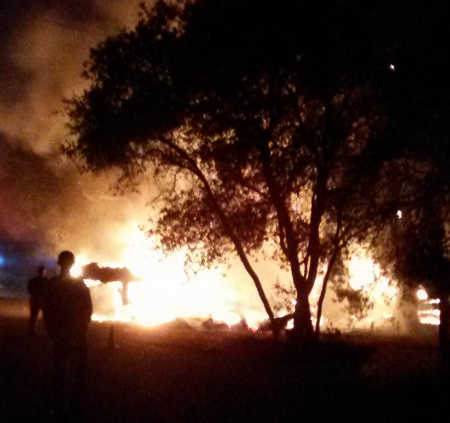
CLEARLAKE, Calif. – The cause of a fire that destroyed a vacant mobile home and a fifth wheel trailer on Tuesday night in Clearlake is under investigation.
The fire was first dispatched at about 8:30 p.m. on Sixth Street, a block north of the Oak Street intersection, according to Lake County Fire Protection District Chief Willie Sapeta.
Sapeta said the fire burned a single-wide mobile home, a fifth wheel and a couple of outbuildings on the property.
The structures were vacant at the time, Sapeta said. “We did a search and no victims were located.”
He said the property had been used by squatters. “We had a fire there about a month and a half ago in the front part of the fifth wheel.”
When firefighters first arrived Tuesday night, power lines were down and arcing, so they couldn't access the fire directly for nearly an hour while waiting for Pacific Gas and Electric to arrive on scene, Sapeta said.
He said there were mobile homes on both sides of the burning structures that sustained some superficial fire damage.
Lake County Fire Protection District sent two engines, a water tender, a rescue and two medic units, while Cal Fire supplied two engines and Northshore Fire responded with one engine, Sapeta said.
In all there were about 20 firefighters on scene, Sapeta said. No injuries were reported.
Sapeta cleared the scene shortly after 10 p.m., at which point he estimated that about another hour of investigation was going to take place in order to conclude on a preliminary cause and origin for the fire.
Email Elizabeth Larson at
LAKE COUNTY, Calif. – The American Lung Association has released its annual State of the Air 2015 Report, with Lake County once again getting top honors for its clean air.
The report grades state and local area air quality on an A through F scale by comparing local ozone and small particulate concentrations with the federal air quality standards.
Although many areas – especially within California – were given failing grades, Lake County passed with flying colors.
Lake County received a “B” grade for ozone, an “A” grade for short term particulate pollution and is ranked the “Cleanest County in the Nation” for annual particulate average concentrations for an unprecedented third consecutive year.
Out of California’s 58 counties, Lake County is one of only eight counties in California that did not have any days of particulate matter exceeds from 2011 through 2013.
Douglas Gearhart, Lake County's air pollution control officer, attributes the success of the program to strong community support, cooperation of local agencies, fire protection districts, Cal Fire, the agricultural community, industry, the district board of directors, and to the dedication and hard work of Lake County Air Quality Management District staff.
“It is great to have our local community’s efforts nationally recognized,” said Gearhart. “To be ranked number one for three consecutive years is unprecedented, and something our community should be proud of and enjoy. ”
The county's impressive air quality record has been documented by continuous air quality monitoring, which showed that fine particulate in the air never exceeded allowable levels during that time.
The American Lung Association report presents data showing what the residents of Lake County actually are breathing on a daily basis.
It does not exclude wildfire impacts or other natural events that may be excluded when determining the county's attainment status.
This shows that despite the Wye, Walker and Scotts fires, the residents of Lake County overall still enjoy the cleanest air in the nation.
The American Lung Association grades are the latest recognition of a long history of air quality accomplishments in Lake County.
Strong local support for clean air measures has enabled the county to comply in full with not only the Federal Clean Air Standards, but also with the more rigorous California Standards for ozone and other air pollutants for the past 24 consecutive years, according to the Lake County Air Quality Management District.
No other air district in California can match that record, the district said.

LAKE COUNTY, Calif. – U.S. Rep. Mike Thompson (CA-5) on Tuesday announced that judges selected Jake Hogan from Kelseyville High School as the Lake County winner of the 2015 Congressional Art Competition.
Hogan is taught by Debbie Inglass.
“Congratulations to Jake for being named the Lake County Winner of the 2015 Congressional Art Competition,” said Thompson. “Every year, this event brings out the best student artists in our district and I continue to be blown away by their talent. Many thanks to all the students who participated, and to Art Gallery Napa Valley for hosting our event.”
Judges will now select a grand prize winner.

The grand prize winner will be chosen from the winners from various counties in the Fifth Congressional District.
The grand prize winner will be flown with a guest to Washington, D.C. to attend an awards ceremony in June.
The grand prize winner’s art work will be displayed in the U.S. Capitol for one year.
Thompson represents California’s Fifth Congressional District, which includes all or part of Contra Costa, Lake, Napa, Solano and Sonoma counties.

Gov. Jerry Brown, meeting with mayors from across the state on Tuesday, announced that he will propose legislation to help local officials better enforce conservation requirements and will direct state agencies to streamline environmental review of local water supply projects.
“These measures will strengthen the ability of local officials to build new water projects and ensure that water is not wasted,” said Brown. “As this drought stretches on, we’ll continue to do whatever is necessary to help communities save more water.”
The proposed legislation will give new enforcement authority to local entities that don’t currently have it and increase potential penalties against water wasters.
It will specifically:
– Establish a new penalty of up to $10,000 per violation, expanding on $500 per day maximum infraction established in last year’s drought legislation.
– Allow penalties to be issued administratively by wholesale and retail water agencies, as well as city and county governments. This change speeds up an infraction process involving courts that was established in last year’s emergency drought legislation.
– Enable these entities to enforce local water restrictions against water waste, as well as conservation restrictions established by the State Water Resources Control Board.
– Allow local public agencies to deputize staff to issue water conservation-related warnings and citations.
This legislation will give all water agencies and local governments a consistent, minimum set of enforcement authorities to achieve required water conservation.
Local water agencies with existing authorities to enforce against water waste can continue to use those authorities.
Under the proposed legislation, any monetary penalties from this enforcement will be used for local conservation efforts.
Separately, to streamline environmental permitting for critical water supply projects, the governor has directed his Office of Planning and Research and other state agencies to help local water agencies reduce the time required to comply with state-required environmental reviews.
These permit streamlining efforts will focus on projects that can increase local water supplies with limited environmental impacts.
The Governor’s Office will also explore legislative changes that can speed-up delivery of critical water supply projects.
California’s drought response so far
In recent weeks, Gov. Brown has convened top agricultural, environmental, urban water agency and business leaders from across California to discuss the state’s drought and conservation efforts.
Earlier this month, Gov. Brown announced the first ever 25 percent statewide mandatory water reductions and a series of actions to help save water, increase enforcement to prevent wasteful water use, streamline the state's drought response and invest in new technologies that will make California more drought resilient.
This order included measures to help: replace lawns with drought tolerant landscaping and old appliances with more water and energy efficient models; cut water use at campuses, golf courses, cemeteries and other large landscapes; prevent potable water irrigation at new developments unless water-efficient drip systems are used; and stop watering of ornamental grass on public street medians.
Within days of the governor's order, the State Water Resources Control Board released its framework to achieve the mandatory water reductions and the California Energy Commission approved new water appliance standards to save billions of gallons of water per year.
The California Department of Water Resources also announced that due to the severe drought it will install an emergency, temporary rock barrier across a Sacramento San Joaquin Delta channel to help prevent the saltwater contamination of water that 25 million Californians depend on.
These measures build on unprecedented action by the State Water Resources Control Board over the past year to prohibit other wasteful water use and encourage Californians to conserve, including strict limits on outdoor irrigation – two days a week in much of California – and bans on hosing down outdoor surfaces, decorative water fountains that don't recirculate water and car washing without an automatic shut-off nozzle.
Bars and restaurants are also now required to only serve water upon request and hotels must ask guests staying multiple nights whether linens and towels need to be washed.
Gov. Brown proclaimed a drought state of emergency in January 2014 and for more than two years, the state's experts have been managing water resources to deal with the effects of the drought, which include severely curtailed water supplies to agricultural producers, farmworker job losses due to fallowed fields, drinking water vulnerability in communities across California, heightened fire danger and threats to endangered and threatened fish and wildlife.
To learn more about the state's drought response, visit www.Drought.CA.Gov . To learn more about conservation, visit www.SaveOurWater.com .

LAKE COUNTY, Calif. – Time is running out to purchase tickets for boat rides for the upcoming Heron Days event on Saturday, May 2, and Sunday, May 3.
There are only 50 spaces left for this popular event that features pontoon boat rides on Clear Lake, one of California’s largest natural fresh water lakes.
An abundance of bird and animal life will be viewed by all who participate.
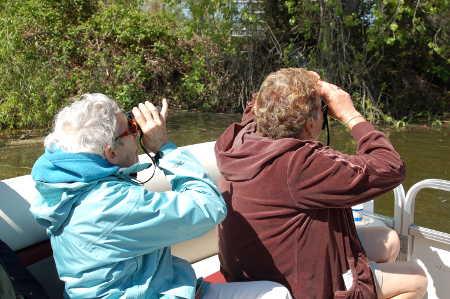
The event is sponsored by Lake County’s Redbud Audubon Society and the pontoon boat rides on Clear Lake will feature Audubon volunteers who will point out and identify the variety of bird life on Clear Lake.
On Saturday, May 2, boats will leave from Lakeside County Park near Kelseyville and venture along the shoreline of Clear Lake to the Corinthian Bay area where viewers are likely to see nesting great blue herons along with a variety of other waterfowl and songbirds, including Western and Clark’s Grebes.
On Sunday, May 3, boats will leave from Redbud Park in the city of Clearlake and head down Cache Creek and into Anderson Marsh. There is also a heron nesting site that may be seen on this trip along with other waterfowl, raptors and songbirds.
The event will once again feature only boat excursions as the “festival” part of Heron Days has been retired.
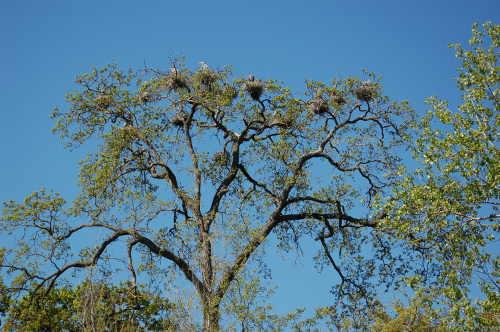
Redbud Audubon started Heron Days 20 years ago.
It has gone from a small event at Anderson Marsh State Historic Park to a huge festival, held for many years at Clear Lake State Park, back to a simplified version that includes only boat rides to view the birds on Clear Lake, explained Redbud Audubon President Roberta Lyons.
“All versions of the event have been great and we look forward to being able to offer the opportunity once again for residents and visitors alike to enjoy the birdlife of Clear Lake,” Lyons said.
The boat trips last about an hour and a half and cost $25 per person.
For more information about the event and to purchase tickets go to www.redbudaudubon.org .
 l
l