 How to resolve AdBlock issue?
News

A NASA-funded research team led by Dr. Bill Bottke of Southwest Research Institute (SwRI) independently estimated the Moon's age as slightly less than 4.5 billion years by analyzing impact-heated shock signatures found in stony meteorites originating from the Main Asteroid Belt.
Their work will appear in the April 2015 issue of the journal Science.
“This research is helping to refine our time scales for 'what happened when' on other worlds in the solar system,” said Bottke, of the Institute for the Science of Exploration Targets (ISET). ISET is a founding member of NASA's Solar System Exploration Research Virtual Institute (SSERVI) and is based in SwRI's Boulder, Colo. Office.
The Moon-forming giant impact, which took place between a large protoplanet and the proto-Earth, was the inner Solar System's biggest and most recent known collision.
Its timing, however, is still uncertain. Ages of the most ancient lunar samples returned by the Apollo astronauts are still being debated.
The team used numerical simulations to show that the giant impact likely created a disk near Earth that eventually coalesced to form the Moon, while ejecting huge amounts of debris completely out of the Earth-Moon system.
The fate of that material has been a mystery. However, it is plausible that some of it would have blasted other ancient inner-solar-system worlds such as asteroids, leaving behind telltale signs of impact-heating shock on their surfaces.
Subsequent, less violent collisions between asteroids have since ejected some shocked remnants back to Earth in the form of fist-sized meteorites.
By determining the age of the shock signatures on those meteorites, scientists were able to infer that their origin likely corresponds to the time of the giant impact, and therefore to the age of the Moon.
The SSERVI research indicates that material accelerated by the giant impact struck Main Belt asteroids at much higher velocities than typical Main Belt collisions. The craters left behind by this bombardment contained an abundance of shocked and melted material with formation ages that provide a characteristic of the ancient giant impact event.
Evidence that the giant impact produced a large number of kilometer-sized fragments can be inferred from laboratory and numerical impact experiments, the ancient lunar impact record itself, and the numbers and sizes of fragments produced by major Main Belt asteroid collisions.
Once the team concluded that pieces of the Moon-forming impact hit Main Belt asteroids and made ancient impact age signatures in meteorites, they set out to deduce both the timing and the relative magnitude of the bombardment.
By modeling their evolution over time, and fitting the results to ancient impact heating signatures in stony meteorites, the team was able to infer the Moon formed about 4.47 billion years ago, in agreement with many previous estimates.
These impact signatures also provide insights into the last stages of planet formation in the inner solar system.
For example, the team is exploring how they can be used to place new constraints on how many planet formation “leftovers,” many in the form of asteroid-like bodies, still existed in the inner solar system in the aftermath of planet formation.
“It is even possible,” Bottke said, “that tiny remnants of the Moon-forming impactor or proto-Earth might still be found within meteorites that show signs of shock heating by giant impact debris. This would allow scientists to explore for the first time the unknown primordial nature of our home world.”
UPPER LAKE, Calif. – A Windsor man sustained major injuries when he collided with a US Forest Service staffer's pickup on Saturday afternoon.
Joel Higuera, 41, suffered a broken right leg, according to a report from Officer Erich Paarsch of the California Highway Patrol's Clear Lake Area office.
Higuera was riding his 2015 KTM dirt bike northbound on Elk Mountain Road north of Penny Pines above Upper Lake when the crash happened at 12:50 p.m., based on Paarsch's report.
The report said Higuera was being followed closely by Santa Rosa resident Frank Tibbens, 54, on his 2010 Yamaha dirt bike.
The two men entered a lefthand curve and collided with a southbound US Forest Service vehicle – a 2012 Ford F-150 pickup – driven by Robert Seehase, 31, Paarsch said.
Higuera was transported to Santa Rosa Memorial Hospital by REACH air ambulance, according to Paarsch's report.
Tibbens and Seehase were uninjured, the report said.
Elk Mountain Road remained partially closed for approximately an hour and a half while the crash was investigated, Paarsch said.
All three of the men were using their safety equipment, according to the report.
Email Elizabeth Larson at
On average, Americans drive 29.2 miles a day or 10,658 miles a year, according to a ground-breaking study underway by the AAA Foundation for Traffic Safety and the Urban Institute.
The foundation’s new American Driving Survey offers the most up-to-date, comprehensive look at how much Americans drive on a daily and yearly basis.
The first year data, collected from May 2013 through May 2014 is now available from the ongoing study.
This study sets the benchmark for future data and will ultimately reveal trends in Americans’ driving habits.
“This is the first ongoing study that provides a look at when and how much Americans are driving,” said Peter Kissinger, president and chief executive officer of the AAA Foundation for Traffic Safety. “Existing federal data with this level of detail was last released in 2009, eight years after the previous release. This substantially limits the extent to which we can use existing data to draw conclusions about Americans’ current driving practices.”
“The information from these ongoing studies will allow states to make more informed choices when looking at traffic trends,” said Cynthia Harris, AAA Northern California spokeswoman.
The first-year results of the American Driving Survey revealed that:
· Motorists in the South drive the most (11,826 miles annually), while those in the Northeast drive the least (8,468 miles annually). Drivers in the West drive the second most (11,279 miles annually).
· Motorists age 16 years and older drive, on average, 29.2 miles per day or 10,658 miles per year.
· Women take more driving trips, but men spend 25 percent more time behind the wheel and drive 35 percent more miles than women.
· Both teenagers and seniors over the age of 75 drive fewer miles than any other age group; motorists 30-49 years drive an average 13,140 miles annually, more than any other age group.
· The average distance and time spent driving increase in relation to higher levels of education. A driver with a grade school or some high school education drives an average of 19.9 miles and 32 minutes daily. Drive time and distance correlate to higher levels of education.
· Drivers who reported living “in the country” or “a small town” drive greater distances (12,264 miles annually) and spend a greater amount of time driving than people who described living in a “medium sized town” or city (9,709 miles annually).
· On average, Americans drive fewer miles on weekends than on weekdays.
· Americans drive, on average, the least during the winter months (January through March) at 27.5 miles daily, they drive the most during the summer months (July through September) at 30.6 miles daily. Interestingly, Western drivers drove the most in January through March at 35.2 miles daily and second most in October through December at 33.5 miles daily.
The data from this study will be especially useful when combined with crash data. For the first time, researchers will be able to conduct unique, timely studies of crash rates.
The results for the American Driver Survey are based on telephone interviews with drivers living in a random sample of households nationwide.
The drivers reported detailed information about all their driving trips taken the day before the interview. Data collection is ongoing.
The information reported in the first-year results was collected between May 21, 2013 and May 31, 2014.
The full results from the inaugural American Driver Survey are available online at www.aaafoundation.org .
CLEARLAKE OAKS, Calif. – The Clearlake Oaks County Water District Board on Friday held it second hearing on proposed water and sewer rate increases, making modifications that will result in another reading next month.
The district held an initial hearing on April 16 before the Friday meeting. While there were about 50 people in attendance at the first hearing, that number was down to about half a dozen on Friday, according to General Manager Matt Bassett.
Bassett said the increases are needed to cover district operating expenses as well as providing needed funding for extensive updates to the district's aging decades-old infrastructure.
Increases, as detailed in the documents and charts shown here, would be rolled out over three years, beginning in the July billing cycle, Bassett said.
At Friday's meeting, “The board made some proposed revisions and we’re going to work on them,” said Bassett.
The district's rate increase proposal has included switching its billing system from only charging active accounts to charging all service connections.
The biggest change that the board agreed to work into its increase proposals, Bassett said, is that it will allow individuals who don't want to pay the monthly base rate to disconnect their water and sewer connections without being charged capital expansion fees.
In other words, they will not have to pay thousands of dollars to reconnect to the system in the future, as they have already paid that cost once, he said.
“That is by far the main change” to the rate increase proposals, Bassett said. The documents are still open to additional revision if necessary.
The changes the board accepted on Friday will necessitate a new second reading, which Bassett said will happen at the next regular board meeting, Thursday, May 21.
Even with the changes, the new rates are still set to go into effect in July, Bassett said.
Bassett said the updated documents will be posted on the district's Web site, www.clocwd.org , next week. Below are posted the documents in their current form, along with the hearing notice.
Also on Friday, Bassett presented a preliminary district budget for the 2015-16 budget year.
Bassett has crafted a budget that shows no increases in the cost of labor or supplies.
However, he said it will include an increased cost for infrastructure repairs.
Email Elizabeth Larson at
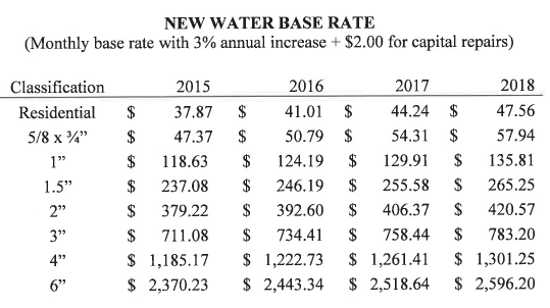
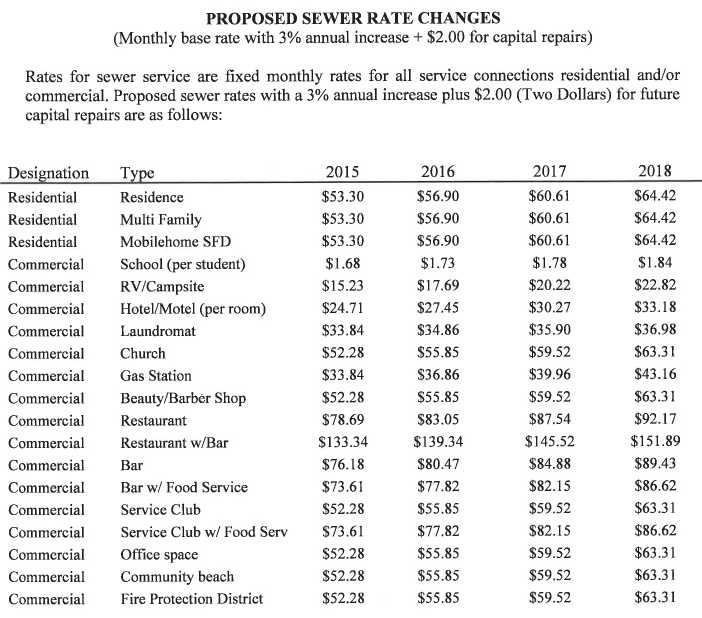
April 2015 - Clearlake Oaks County Water District water and sewer rate ordinance
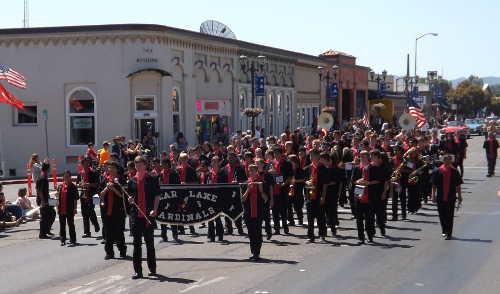
LAKE COUNTY, Calif. – Communities are once again gearing up for the Memorial Day weekend, with popular longtime celebrations set to help usher in the summer season.
Two of the county's main events are once again planned for Lakeport and Lower Lake.
In Lakeport, the annual Memorial Day Parade, sponsored by the Lake County Chamber of Commerce, will commence at 11 a.m. sharp on Main Street on Saturday, May 23.
The theme this year is “Salute to Our Veterans.” Each year this parade salutes the members of the Armed Forces – retired and active.
The parade route travels from the fairgrounds on Martin Street, entering Main at Martin Street and traveling north to 10th Street, with the judges' stand in front of the Lake County Special Districts office across from the Courthouse Museum, between Second and Third streets.
The parade is sanctioned by the California State Horsemen’s Association, which presents an opportunity for equestrians to earn points for the CSHA annual award. Kim Cipro of Hidden Valley Lake is the sanctioned CSHA Judge for the parade.
The chamber requests that members of the public honor the no parking signs, which will be posted on Main Street from First to Fourth streets, from 10 a.m. to noon. This area will allow unobstructed views of the parade for spectators.
Entry applications are available on the Lake County Chamber Web site, www.lakecochamber.com; click on the parade banner on the home page. They also may be obtained at the chamber office at 875 Lakeport Blvd. at Vista Point or by calling 707-263-5092.
The annual 4H Pancake Breakfast at Natural High School on Main Street, will be hosted again this year from 7 to 11 a.m. that day by the Lakeport Kiwanis who also sponsor a two-day craft faire at the same location.
Then, on Sunday, May 24, Lower Lake hosts its Lower Lake Daze Parade & Pet Parade.
The celebration begins at 11 a.m. and continues until 3 p.m.
The Lower Lake Community Action Group plans to include an old time barbecue, craft vendors, face painting, games for children, pony rides, music during the afternoon and a raffle.
Proceeds from the raffle will benefit community projects.
Following the parade, all activities are in the Russell Rustici Community Park, behind the Brick Hall.
Call 707-995-9174 for more information on the Lower Lake activities.
KELSEYVILLE, Calif. – The California Highway Patrol's Clear Lake Area office will hold its next free traffic safety class for young people on Tuesday, April 28, in Kelseyville.
The “Start Smart” traffic safety class for newly licensed and teenage drivers and their parents/guardians will take place from 6 to 8 p.m. at the Clear Lake Area CHP office, located at 5700 Live Oak Drive.
The leading cause of death for Americans between the ages of 15 and 20 years old is motor vehicle collisions, according to the National Highway Traffic Safety Administration.
The CHP's goal is to reduce the death rate among young drivers as the result of these collisions.
The CHP’s “Start Smart” program is aimed at helping newly licensed and future licensed teenage drivers understand the critical responsibilities of driving and to understand that accidents happen, but collisions are 100 percent preventable.
The program is designed to provide interactive safe driving awareness class which will illustrate how poor choices behind the wheel of a car can affect the lives of numerous people.
“Start Smart” also focuses on responsibilities of newly licensed drivers, responsibilities of parents/guardians and, collision avoidance techniques.
“The CHP is committed to mitigating traffic collisions involving young, inexperienced drivers, because they are preventable,” said Lt. Hector Paredes, commander of the Clear Lake Area office. “Start Smart is an excellent program that promotes safe driving for young new drivers.”
Space is limited for this class. For more information or reservations, call Officer Kory Reynolds at the CHP office, 707-279-0103.