 How to resolve AdBlock issue?
News
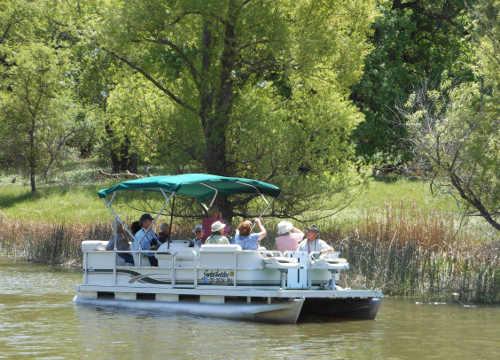
LAKE COUNTY, Calif. – It is time to make your reservations for the upcoming popular Heron Days event slated for Saturday, May 2, and Sunday, May 3.
This popular event, which features pontoon boat rides on Clear Lake – one of California’s largest natural fresh water lakes – was on hiatus last year because of low lake levels, but this year’s rains, although minimal, have brought the lake to a navigable level.
The event is sponsored by Lake County’s Redbud Audubon Society and features pontoon boat rides on Clear Lake with each boat staffed by Audubon volunteers who will point out and identify the variety of bird life on Clear Lake.
On Saturday, May 2, boats will leave from Lakeside County Park near Kelseyville and venture along the shoreline of Clear Lake to the Corinthian Bay area where viewers are likely to see nesting great blue herons along with a variety of other waterfowl and songbirds, including Western and Clark’s Grebes.
On Sunday, May 3, boats will leave from Redbud Park in the city of Clearlake and head down Cache Creek and into Anderson Marsh.
There also is a heron nesting site that may be seen on this trip along with other waterfowl, raptors and songbirds.
The event will once again feature only boat excursions as the “festival” part of Heron Days has been retired.
Redbud Audubon started Heron Days 20 years ago. It has gone from a small event at Anderson Marsh State Historic Park to a huge festival, held for many years at Clear Lake State Park, back to a simplified version that includes only boat rides to view the birds on Clear Lake, explained Redbud Audubon President Roberta Lyons.
“All versions of the event have been great and we look forward to being able to offer the opportunity once again for residents and visitors alike to enjoy the birdlife of Clear Lake,” Lyons said.
The boat trips last about an hour and a half and cost $25 per person.
For more information about the event and to purchase tickets go to www.redbudaudubon.org .
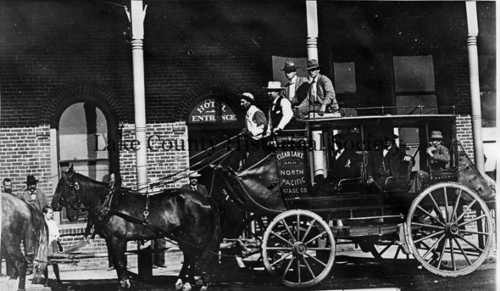
LAKE COUNTY, Calif. – The settlement of Lake County by European-Americans changed forever the lifeways of native cultures that resided here on this bountiful land for thousands of years.
Our county, like most of California, was a magnet for mining and agricultural ventures.
Quicksilver mining companies, like the “Dead Broke,” “Pioneer” and “Bradford” formed.
“The California Borax Company” was kept busy, as there was a big demand for the mineral, borax.
Lake County's native peoples – the Pomo, Miwok, Yuki and Wappo – enjoyed their traditional lifestyle for a slightly longer period of time than did coastal tribes who met up with the Spanish missionaries.
Not that all Lake County tribes were exempt from the enslavement of working at the missions. It is clearly written in history that some American Indians who lived in what is now Lake County were sent to work at the missions.
Russians from the Fort Ross settlement on the North Coast traveled to the Clear Lake Basin area in 1811 to retrieve furs and trapping paraphernalia
Ethnographic studies began on the coast of California by Juan Rodriguez Cabrillo’s expedition of 1542-43.
Cabrillo met with American Indian tribes, including the Chumash of Southern California. Although the Chumash were a peaceful people they possessed no silver, gold or other inducement for European conquer.
The Pacific Coast off of California came alive with further European exploration around the late 1700s, prompting the Spanish crown to affirm settlement of lands north of Mexico.
The Franciscan Mission Order was organized in San Diego in 1769. Twenty-one missions were established, with the last occurring in the town of Sonoma in 1823.
There was little early Euro-American exploration of the Clear Lake Basin area early on, but in the late 1820s a few trapping and hunting parties made their way through our area.
In 1836 Gen. Mariano Guadalupe Vallejo, commander of the Mexican forces north of San Francisco sent his brother, Capt. Salvador Vallejo to the Clear Lake Basin to explore in 1836.
Capt. Vallejo applied for a Mexican land grant of 16 leagues. Charles Stone and Andrew Kelsey garnered permission from Vallejo to graze their cattle on his land.
The story gets quite involved, ending tragically for local tribes, with the Bloody Island massacre chapter.
Settlement of Lake County had begun. On May 20, 1861 Lake County was established. It had originally been a part of Napa County.
Not many people know that there was a mission to the north of Sonoma, here in Lake County.
Father Osuna, who belonged to the Franciscan Order, established Mission St. Turibius in a district schoolhouse on Kelsey Creek, near present-day Kelseyville in 1867.
It was located on 235 acres and served as both church and school. There were approximately 100 American Indians living at the mission then.
The vast landscape that is Lake County continues to draw new people with mining and agriculture ventures in mind.
By looking back in the pages of Lake County history we benefit from the old stories.
Henry David Thoreau said, “The earth is not a mere fragment of dead history, stratum upon stratum like the leaves of a book, to be studied by geologists and antiquaries chiefly, but living poetry like the leaves of a tree, which precede flowers and fruit- not a fossil earth, but a living earth; compared with whose great central life all animal and vegetable life is merely parasitic. Its throes will heave our excuviae from their graves.”
Kathleen Scavone, M.A., is an educator, potter, writer and author of “Anderson Marsh State Historic Park: A Walking History, Prehistory, Flora, and Fauna Tour of a California State Park” and “Native Americans of Lake County.” She also writes for NASA and JPL as one of their “Solar System Ambassadors.” She was selected “Lake County Teacher of the Year, 1998-99” by the Lake County Office of Education, and chosen as one of 10 state finalists the same year by the California Department of Education.
LAKE COUNTY, Calif. – It's another full kennel this week at Lake County Animal Care and Control, where you can find dogs of all sizes and types needing new homes.
Available this week for adoption are canines who are mixes of Akita, Australian Shepherd, English Bulldog, fox terrier, German Shepherd Labrador Retriever, hound, husky, pit bull, Rhodesian Ridgeback, shepherd and terrier.
Low adoption fees are offered for some of the dogs.
Dogs that are adopted from Lake County Animal Care and Control are either neutered or spayed, microchipped and, if old enough, given a rabies shot and county license before being released to their new owner. License fees do not apply to residents of the cities of Lakeport or Clearlake.
If you're looking for a new companion, visit the shelter. There are many great pets hoping you'll choose them.
In addition to the animals featured here, all adoptable animals in Lake County can be seen here: http://bit.ly/Z6xHMb .
The following dogs at the Lake County Animal Care and Control shelter have been cleared for adoption (additional dogs on the animal control Web site not listed are still “on hold”).
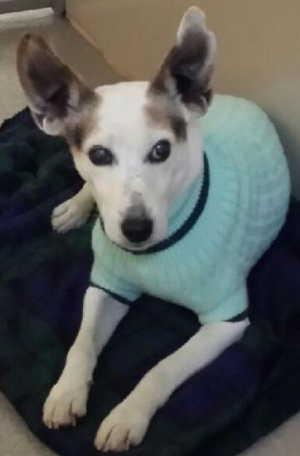
Male fox terrier mix
This male fox terrier mix has a short tricolor coat.
Shelter staff said he appears to be deaf but is very attentive and seems to know some hand signals.
He's in kennel No. 5, ID No. 2019.
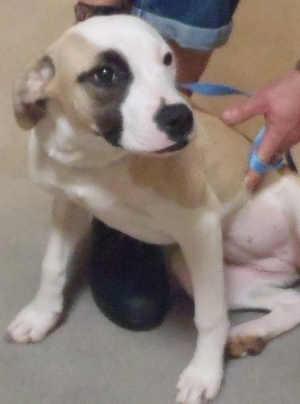
'Bella'
“Bella” is a young female pit bull terrier mix, estimated to be about 6 months old.
Shelter staff said she is a very loving little girl that just wants to be petted and held.
She's in kennel No. 6, ID No. 1971.
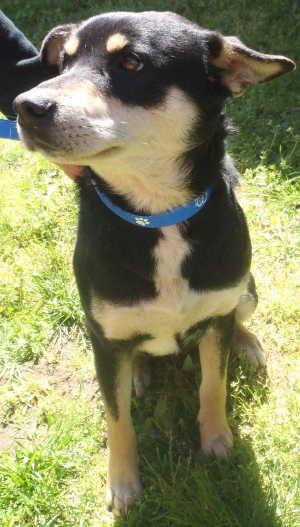
Male shepherd mix
This male shepherd mix has a short tricolor coat.
Shelter staff said he has a sweet disposition.
He's in kennel No. 7, ID No. 2042.
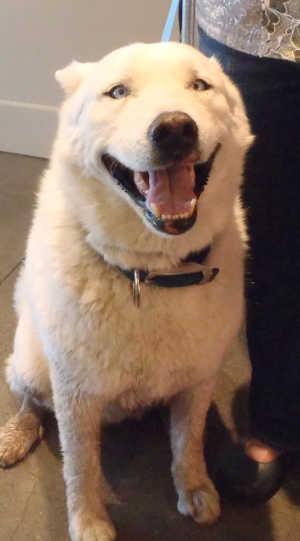
'Phantom'
“Phantom” is a male husky mix with a white coat.
Shelter staff said he was picked up in Lower Lake. He has a microchip and they are hoping his owners will come and redeems him.
Phantom is 9 years old and a big boy at 83 pounds. He is very friendly and loves everyone he meets.
He's in kennel No. 8, ID No. 2000.
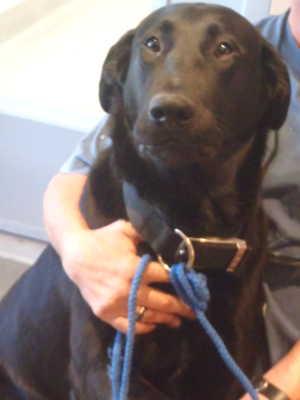
Male German Shepherd-Labrador Retriever mix
This male German Shepherd-Labrador Retriever mix has a short black coat.
Shelter staff said he's one big ball of energy, loving to fetch, run and play with other dogs. He is being socialized with other dogs and is learning very fast.
He's in kennel No. 10, ID No. 2004.
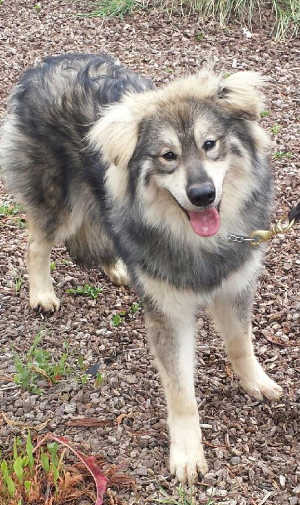
'Max'
“Max” is a beautiful 2-year-old male Australian Shepherd-husky mix who came to the shelter because his owner died.
Shelter staff said he's already neutered, crate- and house-trained, is very smart and a really good dog.
He is great with other dogs and shows no signs of food aggression. However, he needs to be in a home with no small animals – chickens, cats, etc. Max is good with children ages 9 years and up.
Max is in shelter No. 12, ID No. 1931.

Male pit bull terrier mix
This male pit bull terrier mix has a short gray and white coat.
Shelter staff calls him a “big squishy guy” who is very gentle. They believe he would be fine with children.
He has no food aggression, gets along with other dogs both male and female, and is very appropriate in every way.
The shelter is looking for that special "pitty" lover to take him home and care for him.
He's in kennel No. 13, ID No. 2035.
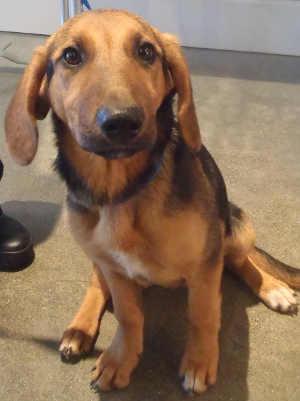
Hound-Labrador Retriever mix
This pretty young girl is a hound-Labrador Retriever mix.
She has a short sable, black and white coat.
She's in kennel No. 14, ID No. 2041.
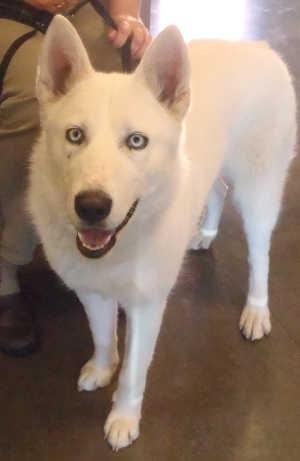
Female husky mix
This pretty female husky mix is about 7 months old.
She has an all-white coat and blue eyes.
Shelter staff said she's a very good pup and walks well on a leash. She would do best with an experienced dog owner who can give her some basic training.
She's in kennel No. 16, ID No. 2037.
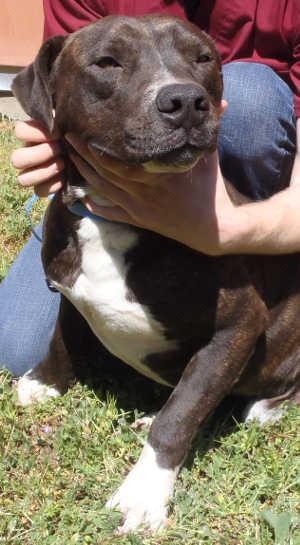
Male pit bull mix
This male pit bull terrier mix is about 1 year old.
He's shy and needs some training, but loves to play and have his belly rubbed.
He's in kennel No. 17, ID No. 1991.
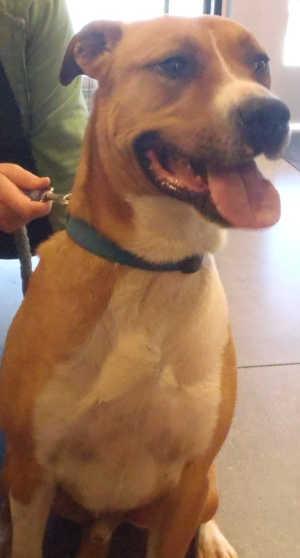
Lab-pit bull mix
This male Labrador Retriever-pit bull mix is 4 years old.
He's in kennel No. 28, ID No. 2045.
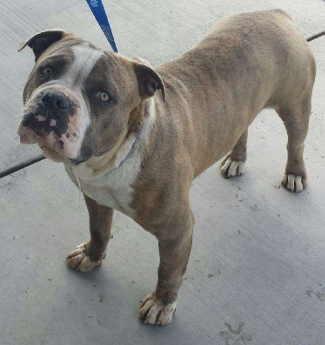
'Bear'
“Bear” is a male English Bulldog mix.
He has a short tan and white coat.
Shelter staff said he is great with other dogs and very social with people.
He's in kennel No. 29, ID No. 1972.
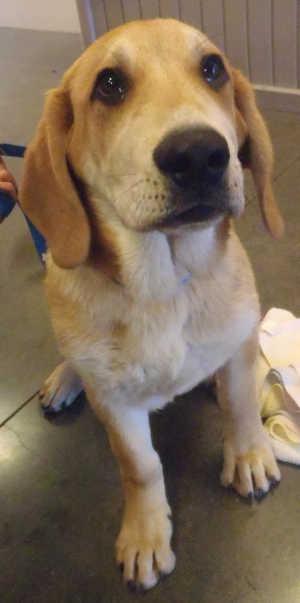
Hound-lab mix
This male hound-Labrador Retriever mix has a short tan and white coat.
He's in kennel No. 30, ID No. 2040.
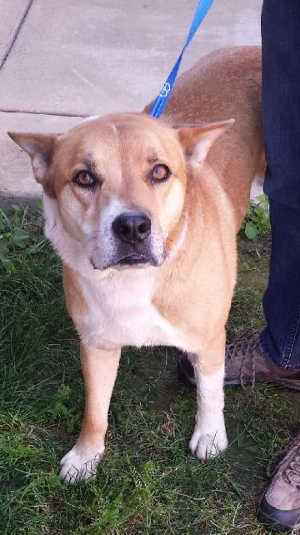
Akita mix
This 5-year-old male Akita mix has a short tan and white coat.
He knows basic commands and his housebroken, and needs some leash training.
Shelter staff said he likes toys and they're looking for an owner for him who would love to spend time taking him for walks.
He is mellow and would be great with kids, but they recommend no cats.
He's in kennel No. 31, ID No. 1938.
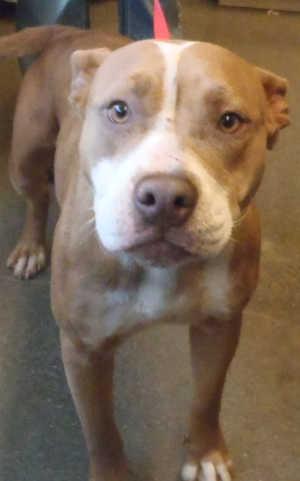
Female pit bull terrier mix
This female pit bull terrier mix is about a year and a half old.
Shelter staff said she was found on Lakeshore Boulevard in Lakeport taking a stroll.
She weighs 42 pounds and is very friendly.
She's in kennel No. 32, ID No. 1986.
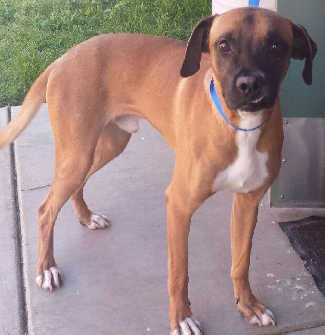
Rhodesian Ridgeback mix
This 4-year-old male Rhodesian Ridgeback mix gets along well with cats; his tail wagged as he watched them play.
Anyone who is interested in adopting him and who has dogs already is asked to submit an application and introduce bring their dogs in for an introduction.
He is slightly shy but with some training he could be a wonderful addition to your family or for an individual.
He's in kennel No. 34, ID No. 1762.
To fill out an adoption application online visit http://www.co.lake.ca.us/Government/Directory/Animal_Care_And_Control/Adopt/Dog___Cat_Adoption_Application.htm .
Lake County Animal Care and Control is located at 4949 Helbush in Lakeport, next to the Hill Road Correctional Facility.
Office hours are Monday through Friday, 11 a.m. to 5 p.m., and 11 a.m. to 3 p.m., Saturday. The shelter is open from 11 a.m. to 4 p.m. Monday through Friday and on Saturday from 11 a.m. to 3 p.m.
Visit the shelter online at http://www.co.lake.ca.us/Government/Directory/Animal_Care_And_Control.htm .
For more information call Lake County Animal Care and Control at 707-263-0278.
Email Elizabeth Larson at

The Sun undergoes a type of seasonal variability with its activity waxing and waning over the course of nearly two years, according to a new study by a team of researchers led by the National Center for Atmospheric Research, or NCAR.
This behavior affects the peaks and valleys in the approximately 11-year solar cycle, sometimes amplifying and sometimes weakening the solar storms that can buffet Earth’s atmosphere.
The quasi-annual variations appear to be driven by changes in the bands of strong magnetic fields in each solar hemisphere.
These bands also help shape the approximately 11-year solar cycle that is part of a longer cycle that lasts about 22 years.
“What we’re looking at here is a massive driver of solar storms,” said Scott McIntosh, lead author of the new study and director of NCAR’s High Altitude Observatory. “By better understanding how these activity bands form in the Sun and cause seasonal instabilities, there’s the potential to greatly improve forecasts of space weather events.”
The overlapping bands are fueled by the rotation of the Sun’s deep interior, according to observations by the research team.
As the bands move within the Sun’s northern and southern hemispheres, activity rises to a peak over a period of about 11 months and then begins to wane.
The quasi-annual variations can be likened to regions on Earth that have two seasons, such as a rainy season and a dry season, McIntosh said.
The study, published this week in Nature Communications, can help lead to better predictions of massive geomagnetic storms in Earth’s outer atmosphere that sometimes disrupt satellite operations, communications, power grids, and other technologies.
The research was funded by NASA and the National Science Foundation, which is NCAR’s sponsor.
A 'jet stream' in the Sun
The new study is one of a series of papers by the research team that examines the influence of the magnetic bands on several interrelated cycles of solar magnetism.
In a paper last year in Astrophysical Journal, the authors characterized the approximately 11-year sunspot cycle in terms of two overlapping parallel bands of opposite magnetic polarity that slowly migrate over almost 22 years from high solar latitudes toward the equator, where they meet and terminate.
McIntosh and his co-authors detected the twisted, ring-shaped bands by drawing on a host of NASA satellites and ground-based observatories that gather information on the structure of the Sun and the nature of solar flares and coronal mass ejections, or CMEs.
These observations revealed the bands in the form of fluctuations in the density of magnetic fuel that rose from the solar interior through a transition region known as the tachocline and on to the surface, where they correlated with changes in flares and CMEs.
In the new paper, the authors conclude that the migrating bands produce seasonal variations in solar activity that are as strong as the more familiar 11-year counterpart. These quasi-annual variations take place separately in both the northern and southern hemispheres.
“Much like Earth’s jet stream, whose warps and waves have had severe impact on our regional weather patterns in the past couple of winters, the bands on the Sun have very slow-moving waves that can expand and warp it too,” said co-author Robert Leamon, a scientist at Montana State University. “Sometimes this results in magnetic fields leaking from one band to the other. In other cases, the warp drags magnetic fields from deep in the solar interior, near the tachocline, and pushes them toward the surface.”
The surges of magnetic fuel from the Sun’s interior catastrophically destabilize the corona, the Sun’s outermost atmosphere. They are the driving force behind the most destructive solar storms.
“These surges or ‘whomps’ as we have dubbed them, are responsible for over 95 percent of the large flares and CMEs – the ones that are really devastating,” McIntosh said.
The quasi-annual variability can also help explain a cold-war era puzzle: why do powerful solar flares and CMEs often peak a year or more after the maximum number of sunspots? This lag is known as the Gnevyshev Gap, after the Soviet scientist who first reported it in the 1940s.
The answer appears to be that seasonal changes may cause an upswing in solar disturbances long after the peak in the solar cycle.
Researchers can turn to advanced computer simulations and more detailed observations to learn more about the profound influence of the bands on solar activity.
McIntosh said this could be assisted by a proposed network of satellites observing the Sun, much as the global networks of satellites around Earth have helped advance terrestrial weather models since the 1960s.
“If you understand what the patterns of solar activity are telling you, you’ll know whether we’re in the stormy phase or the quiet phase in each hemisphere,” McIntosh said. “If we can combine these pieces of information, forecast skill goes through the roof.”
The safety of the public, as well as law enforcement and first responders, frequently depends on a group of highly trained professionals who are heard far more often than they are seen.
The California Highway Patrol honors these skilled men and women during National Public Safety Telecommunicators Week, April 12 to 18.
“I am very proud of our dedicated professionals and the services they provide the public every single day,” said CHP Commissioner Joe Farrow. “Public Safety Telecommunicators, or dispatchers, are the first and most critical contact people have with emergency services. In addition to assisting the public, they help our officers in the field by providing valuable information, so that officers can get the job done on the front lines.”
CHP dispatchers handle the majority of California’s wireless 9-1-1 emergency and non-emergency calls.
Dispatchers ensure the appropriate assistance is provided, whether it is sending an officer to respond to a call, or contacting fire, ambulance, or other emergency services.
In addition, they are in constant radio communication with the patrol officers, often assisting them by looking up vehicle identification, license plate and driver license numbers, or by running checks for wanted subjects.
The CHP has 25 communications centers statewide that employ more than 900 public safety dispatchers. Last year these employees were responsible for handling approximately 9.3 million calls for service.
Calling 9-1-1 can be intimidating. The following tips will help callers during an emergency.
– Stay as calm as possible.
– Be prepared to provide your name, phone number, address or location and a detailed description of the incident or vehicle being reported.
– Cellular telephones may not tell the call-taker where you are. The location of the emergency may be the single most important information for the dispatcher in case the call is cut off.
– Wait for the dispatcher to ask questions, and then answer clearly and calmly.
– Listen carefully and follow all directions provided by the dispatcher.
– Be prepared to provide a physical description if the emergency involves a criminal suspect.
– Remember, 9-1-1 is for life-threatening emergencies. Misuse of the emergency 9-1-1 system will result in a delay for callers with real emergencies and is punishable by a fine of not more than $1,000.
NORTHERN CALIFORNIA – A Chico man was found alive and safe on Thursday after his girlfriend reported him missing in the Mendocino National Forest.
Alex Canto, 44, and his dog Brava were reunited with girlfriend Monica Smith, who had reported him missing on Tuesday, according to Glenn County Undersheriff Todd James.
Canto – an experienced outdoorsman – had left last Saturday to go camping in the Mendocino National Forest in Glenn County west of Elk Creek. He sent Smith a text message later that day that he was heading up Forest Highway 7, and then she heard nothing more from him, according to James.
Smith reported him missing and a search ensued with Glenn County Sheriff’s Search and Rescue and agencies in Mendocino County also assisting, authorities said.
On Thursday, the California Highway Patrol's Air Ops began flying the forest, locating Canto that same afternoon, James reported.
CHP Air Ops found Canto, who had become stuck. James said CHP advised that they spotted a sign that Canto had made in the roadway out of wood saying “Alex” with an arrow pointing toward his location, which aided the CHP in finding him.
James said Canto and his dog were hungry, but otherwise in good condition.
Canto and his dog were reunited with his girlfriend just before 5 p.m. Thursday, James said.