 How to resolve AdBlock issue?
News
LAKE COUNTY, Calif. – Lake County Animal Care and Control has a shelter filled with dogs this week needing new, loving homes.
This week's dogs feature mixes of Australian Shepherd, boxer, cattle dog, Chihuahua, fox terrier, Jack Russell terrier, Labrador Retriever, mastiff, pit bull, Schnauzer and terrier.
Dogs that are adopted from Lake County Animal Care and Control are either neutered or spayed, microchipped and, if old enough, given a rabies shot and county license before being released to their new owner. License fees do not apply to residents of the cities of Lakeport or Clearlake.
If you're looking for a new companion, visit the shelter. There are many great pets hoping you'll choose them.
In addition to the animals featured here, all adoptable animals in Lake County can be seen here: http://bit.ly/Z6xHMb .
The following dogs at the Lake County Animal Care and Control shelter have been cleared for adoption (additional dogs on the animal control Web site not listed are still “on hold”).

Chihuahua-fox terrier mix
This male Chihuahua-fox terrier mix has a short tan and white coat.
He's in kennel No. 2, ID No. 2304.

'Barney'
“Barney” is a Jack Russell Terrier-Chihuahua mix with a short brown and tan coat.
Shelter staff said Barney is shy at first but is very nice once he warms up. They said he would be good for an older couple, or somebody who doesn't have any children.
He's in kennel No. 3, ID No. 2051.

Male Chihuahua mix
This male Chihuahua mix has a short white coat.
He's in kennel No. 4, ID No. 2321.

Labrador Retriever-cattle dog mix
This male Labrador Retriever-cattle dog mix has a short tan and white coat.
He's in kennel No. 5, ID No. 2227.
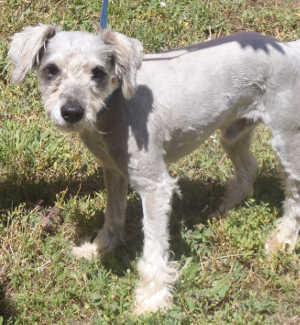
Male Schnauzer mix
This male Schnauzer mix has a clipped gray coat.
He's in kennel No. 6, ID No. 2331.
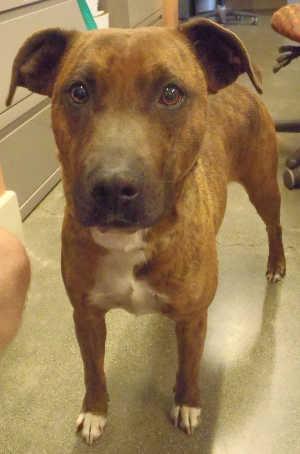
Female pit bull mix
This female pit bull terrier mix has a short brown brindle and white coat.
She's in kennel No. 7, ID No. 2241.

Male pit bull terrier mix
This male pit bull terrier mix has a short gray coat and a friendly face.
He's in kennel No. 11, ID No. 2269.

'Amadeus'
“Amadeus” is a male Chihuahua mix with a short tan coat.
He's in kennel No. 12, ID No. 2208.

Male pit bull terrier mix
This male pit bull terrier mix has a short gray and white coat.
Shelter staff calls him a “big squishy guy” who is very gentle. They believe he would be fine with children.
He has no food aggression, gets along with other dogs both male and female, and is very appropriate in every way.
The shelter is looking for that special "pitty" lover to take him home and care for him.
He's in kennel No. 13, ID No. 2035.

Male pit bull mix
This male pit bull mix has a short dark brown and white coat.
Shelter staff said he is pretty well behaved with a moderate to low energy level.
They said he has been through a lot he appears to have been dumped in the middle of nowhere; when he arrived he was full of punctures all on his legs, possibly from a dog fight.
Despite all of that, shelter staff said he is very social and friendly with dogs.
He's in kennel No. 15, ID No. 2094.
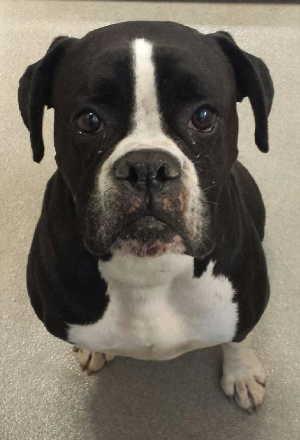
'Diesel'
“Diesel” is a boxer mix with a short black and white coat.
He's in kennel No. 16, ID No. 2270.

Chihuahua-terrier mix
This female Chihuahua-terrier mix has a short tan coat.
She's in kennel No. 17, ID No. 2237.

'Abu'
“Abu” is a male mastiff-pit bull terrier mix.
He has a short brown and white coat.
Abu is in kennel No. 24A, ID No. 2218.

'Panda'
“Panda” is a young female mastiff-pit bull terrier mix.
She has a short dark brown coat with white markings.
She's in kennel No. 24B, ID No. 2219.

'Tippy'
“Tippy” is a female Australian Shepherd.
Shelter staff said they do not know her background, but she needs a home with women only, as she is very afraid of men.
Tippy is good with other dogs and has been fine with mellow children.
She is being fostered; ID No. 2142.
To fill out an adoption application online visit http://www.co.lake.ca.us/Government/Directory/Animal_Care_And_Control/Adopt/Dog___Cat_Adoption_Application.htm .
Lake County Animal Care and Control is located at 4949 Helbush in Lakeport, next to the Hill Road Correctional Facility.
Office hours are Monday through Friday, 11 a.m. to 5 p.m., and 11 a.m. to 3 p.m., Saturday. The shelter is open from 11 a.m. to 4 p.m. Monday through Friday and on Saturday from 11 a.m. to 3 p.m.
Visit the shelter online at http://www.co.lake.ca.us/Government/Directory/Animal_Care_And_Control.htm .
For more information call Lake County Animal Care and Control at 707-263-0278.
Email Elizabeth Larson at
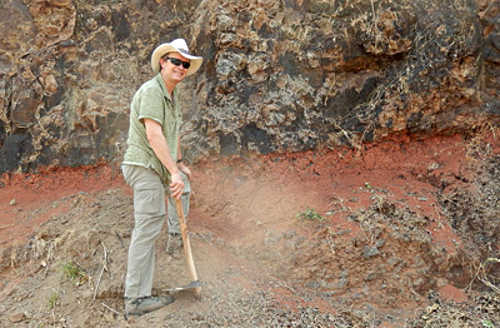
The asteroid that slammed into the ocean off Mexico 66 million years ago and killed off the dinosaurs probably rang the Earth like a bell, triggering volcanic eruptions around the globe that may have contributed to the devastation, according to a team of University of California, Berkeley, geophysicists.
Specifically, the researchers argue that the impact likely triggered most of the immense eruptions of lava in India known as the Deccan Traps, explaining the “uncomfortably close” coincidence between the Deccan Traps eruptions and the impact, which has always cast doubt on the theory that the asteroid was the sole cause of the end-Cretaceous mass extinction.
“If you try to explain why the largest impact we know of in the last billion years happened within 100,000 years of these massive lava flows at Deccan … the chances of that occurring at random are minuscule,” said team leader Mark Richards, UC Berkeley professor of earth and planetary science. “It’s not a very credible coincidence.”
Richards and his colleagues marshal evidence for their theory that the impact reignited the Deccan flood lavas in a paper published in The Geological Society of America Bulletin.
While the Deccan lava flows, which started before the impact but erupted for several hundred thousand years after re-ignition, probably spewed immense amounts of carbon dioxide and other noxious, climate-modifying gases into the atmosphere, it’s still unclear if this contributed to the demise of most of life on Earth at the end of the Age of Dinosaurs, Richards said.
“This connection between the impact and the Deccan lava flows is a great story and might even be true, but it doesn’t yet take us closer to understanding what actually killed the dinosaurs and the ‘forams,’” he said, referring to tiny sea creatures called foraminifera, many of which disappeared from the fossil record virtually overnight at the boundary between the Cretaceous and Tertiary periods, called the KT boundary.
The disappearance of the landscape-dominating dinosaurs is widely credited with ushering in the age of mammals, eventually including humans.
He stressed that his proposal differs from an earlier hypothesis that the energy of the impact was focused around Earth to a spot directly opposite, or antipodal, to the impact, triggering the eruption of the Deccan Traps.
The “antipodal focusing” theory died when the impact crater, called Chicxulub, was found off the Yucatán coast of Mexico, which is about 5,000 kilometers from the antipode of the Deccan traps.
Flood basalts
Richards proposed in 1989 that plumes of hot rock, called “plume heads,” rise through Earth’s mantle every 20-30 million years and generate huge lava flows, called flood basalts, like the Deccan Traps.
It struck him as more than coincidence that the last four of the six known mass extinctions of life occurred at the same time as one of these massive eruptions.
“Paul Renne’s group at Berkeley showed years ago that the Central Atlantic Magmatic Province is associated with the mass extinction at the Triassic/Jurassic boundary 200 million years ago, and the Siberian Traps are associated with the end Permian extinction 250 million years ago, and now we also know that a big volcanic eruption in China called the Emeishan Traps is associated with the end-Guadalupian extinction 260 million years ago,” Richards said. “Then you have the Deccan eruptions – including the largest mapped lava flows on Earth – occurring 66 million years ago coincident with the KT mass extinction. So what really happened at the KT boundary?”
Richards teamed up with experts in many areas to try to discover faults with his radical idea that the impact triggered the Deccan eruptions, but instead came up with supporting evidence.
Paul Renne, a professor in residence in the UC Berkeley Department of Earth and Planetary Science and director of the Berkeley Geochronology Center, redated the asteroid impact and mass extinction two years ago and found them essentially simultaneous, but also within approximately 100,000 years of the largest Deccan eruptions, referred to as the Wai subgroup flows, which produced about 70 percent of the lavas that now stretch across the Indian subcontinent from Mumbai to Kolkata.
Michael Manga, a professor in the same department, has shown over the past decade that large earthquakes – equivalent to Japan’s 9.0 Tohoku quake in 2011 – can trigger nearby volcanic eruptions.
Richards calculates that the asteroid that created the Chicxulub crater might have generated the equivalent of a magnitude 9 or larger earthquake everywhere on Earth, sufficient to ignite the Deccan flood basalts and perhaps eruptions many places around the globe, including at mid-ocean ridges.
“It’s inconceivable that the impact could have melted a whole lot of rock away from the impact site itself, but if you had a system that already had magma and you gave it a little extra kick, it could produce a big eruption,” Manga said.
Similarly, Deccan lava from before the impact is chemically different from that after the impact, indicating a faster rise to the surface after the impact, while the pattern of dikes from which the supercharged lava flowed – “like cracks in a soufflé,” Renne said – are more randomly oriented post-impact.
“There is a profound break in the style of eruptions and the volume and composition of the eruptions,” said Renne. “The whole question is, ‘Is that discontinuity synchronous with the impact?’”
Reawakened volcanism
Richards, Renne and graduate student Courtney Sprain, along with Deccan volcanology experts Steven Self and Loÿc Vanderkluysen, visited India in April 2014 to obtain lava samples for dating, and noticed that there are pronounced weathering surfaces, or terraces, marking the onset of the huge Wai subgroup flows.
Geological evidence suggests that these terraces may signal a period of quiescence in Deccan volcanism prior to the Chicxulub impact.
Apparently never before noticed, these terraces are part of the western Ghats, a mountain chain named after the Hindu word for steps.
“This was an existing massive volcanic system that had been there probably several million years, and the impact gave this thing a shake and it mobilized a huge amount of magma over a short amount of time,” Richards said. “The beauty of this theory is that it is very testable, because it predicts that you should have the impact and the beginning of the extinction, and within 100,000 years or so you should have these massive eruptions coming out, which is about how long it might take for the magma to reach the surface.”
Since the team’s paper was accepted for publication, a group from Princeton University published new radioisotopic dates for the Deccan Traps lavas that are consistent with these predictions.
Renne and Sprain at UC Berkeley also have preliminary, unpublished dates for the Deccan lavas that could help solidify Richards’ theory, Renne said.
Co-authors of the paper, in addition to Richards, Renne, Manga and Sprain, are Walter Alvarez, a UC Berkeley professor emeritus of earth and planetary science and the co-originator of the dinosaur-killing asteroid theory; Stephen Self, an adjunct professor in the same department at UC Berkeley; Leif Karlstrom of the University of Oregon; Jan Smit of Vrije Universeit in Amsterdam, the Netherlands; Loÿc Vanderkluysen of Drexel University in Philadelphia, Pennsylvania; and Sally A. Gibson of the University of Cambridge in the United Kingdom.
Robert Sanders writes for the UC Berkeley News Center.
LAKE COUNTY, Calif. – District attorney's offices around California – including Lake's – have reached a settlement with Dollar Tree Stores Inc. over environmental violations.
The Virginia-based corporation agreed to pay $2.72 million in civil penalties, costs and supplemental environmental projects as part of the settlement with 46 county district attorneys and two city attorneys.
Alameda County Superior Court Judge Morris Jacobson ordered Dollar Tree Stores Inc. to pay the settlement amount and to implement an improved hazardous waste compliance program at its retail stores and distribution centers in California.
The suit, led by Alameda County District Attorney Nancy O'Malley, alleged that Dollar Tree illegally disposed of hazardous wastes at its more than 480 retail stores and distribution centers around California.
O'Malley called the settlement “a significant step toward protection of our environment and statewide public health.”
Officials said an investigation that included statewide inspections of Dollar Tree Stores’ dumpsters by inspectors from district attorney’s offices and other environmental regulators discovered that Dollar Tree was routinely and systematically putting hazardous waste products into store trash bins and, subsequently, sending it into local landfills not permitted to accept such waste products.
Those hazardous items included ignitable and corrosive liquids, toxic materials, batteries, electronic devices and other e-waste, and other hazardous waste generated by circumstances including spills and damage, according to a statement issued by O'Malley.
O'Malley reported that inspections of Dollar Tree Stores over the years also demonstrated that the corporation routinely failed to properly handle and dispose of hazardous waste.
When prosecutors alerted Dollar Tree Stores to the widespread violations, Dollar Tree Stores was cooperative throughout the continued investigation, O'Malley said, adopting and implementing new policies and procedures and training programs designed to properly manage and dispose of hazardous waste.
The hazardous waste is now being collected by state-registered haulers who transport it to authorized disposal facilities, and disposal is properly documented, according to O'Malley.
Lake County District Attorney Don Anderson said this was not a big case for his office, which was represented by a circuit prosecutor from the California District Attorneys Association.
His office's portion of the settlement comes to $1,250 and Lake County Environmental Health receiving $875, with the county's settlement checks arriving on Friday.
Anderson said the settlement was distributed based on the number of stores in a jurisdiction.
In the case of Lake County, there are two Dollar Tree stores – one in Clearlake on Olympic Drive and one in Lakeport on S. Main Street.
As for Lake County's stores, Anderson said they were not specifically investigated, and to his knowledge those two stores had not done anything wrong.
Email Elizabeth Larson at
NORTHERN CALIFORNIA – The Glenn County Sheriff's Office is investigating the Thursday discovery of human remains that appear to be those of a child.
The agency said that just before 10:30 a.m. Thursday the Artois Volunteer Fire Department was extinguishing a grass fire in the area of County Road D south of County Road 33 when firefighters noticed what appeared to be possible burned human remains in the fire area.
They immediately notified the Glenn County Sheriff’s Office, which sent personnel who secured the scene and began an investigation with the assistance of crime scene specialists from the California Department of Justice and forensic pathologist Dr. Thomas Resk.
Glenn County Sheriff’s personnel were able to confirm the remains of one human body found in the burnt area, with the agency reporting that the body had been damaged in the fire.
At that point, they couldn't tell how long the body may have been in the area, but officials said the proximity to the road suggested it may have been recent.
An initial autopsy of the remains was conducted Friday morning, the agency reported.
Officials said the autopsy revealed the body was a juvenile female estimated to be between 5 and 10 years of age. The body has been turned over to the Chico State Human Identification Laboratory for further investigation.
The early indications are that this is a homicide; however, the identity of the victim and the cause of death still have not been determined, officials said. DNA has been collected and submitted to help identify the victim.
Although this victim was found burned, there appears to be no connection or similarities to any other burned body found in Glenn County, sheriff's officials said.
Anyone who may have any information, or who may have seen any unusual activity or parked vehicles in the area of County Road D between County Roads 33 and 35 is asked to contact Det. Kelly Knight at the Glenn County Sheriff’s Office, 530-934-6431 or email
NORTHERN CALIFORNIA – SACRAMENTO — Construction of a temporary emergency drought barrier at West False River in the Sacramento-San Joaquin Delta is nearing completion about two weeks sooner than anticipated, according to the Department of Water Resources (DWR).
The barrier now spans the approximately 750-foot-wide river between Jersey and Bradford islands and blocks salt water that tidal action attempts to push eastward from San Francisco Bay into Franks Tract.
The trapezoidal barrier is about 120 feet wide at its base and 12 feet wide at its top above the waterline. About 150,000 tons of rocks have been dropped from barges with hinged bottoms or lifted from barges and dropped by crane into the river’s channel to create the barrier.
Typically when saltwater threatens to encroach deeper into the Delta, water project operators repel it either by slowing the pumping of water from the Delta or increasing the amount of water flowing into the Delta from upstream reservoirs.
In this fourth year of drought, Delta pumping by the state and federal water projects is already negligible, and it takes three to five days for fresh water released from Lake Oroville or Shasta Lake to reach the Delta.
The emergency barrier is an additional tool to help limit salinity intrusion should high winds or another unexpected event push salt farther east than expected this summer.
The emergency barrier also will help mitigate a worst-case circumstance in which upstream reservoirs lack sufficient water to meet the minimum outflow requirements to limit Delta salinity intrusion.
Some 25 million people rely on the Delta-based federal and state water projects for at least some of their supplies, including residents of the Delta and Contra Costa, Alameda and Santa Clara counties.
Adding to water managers’ concerns during the drought is California’s record-low snowpack, which will contribute little runoff into reservoirs as it melts.
Storage in all of California’s major reservoirs currently is far below historical averages for late May. Shasta Lake, the state’s largest, is at 62 percent of that average, Lake Oroville is at 53 percent and New Melones now holds 30 percent of its late May average.
Boat passage on West False River is now blocked by the barrier, which will be removed by mid-November to avoid the traditional flood season and potential harm to migratory fish. Removal is expected to take 45 to 60 days.
Warning signs, lights and buoys alert boaters of the barrier’s presence. DWR notified marinas and individuals in the Delta about these restrictions several weeks before construction began. Alternative routes between the San Joaquin River and interior Delta, including Bethel Island marinas, are available.
Design, installation, monitoring and mitigation are estimated to cost roughly $22 million; the cost for removal is estimated at $15 million. Costs are to be paid with a mix of funding from Proposition 50, a $3.4 billion water bond approved by voters in November 2002, and General Fund dollars.
Earlier consideration of emergency barriers
The West False River site raises fewer concerns for threatened and endangered fish than other potential barrier sites considered by DWR. Last year, DWR studied the potential impacts of potential temporary barriers at three locations: Steamboat Slough, Sutter Slough and West False River.
The analysis found anticipated impacts could be mitigated to a less-than-significant level. DWR received and reviewed considerable public comments on the Initial Study and Proposed Mitigated Negative Declaration, available here.
DWR is not pursuing installation of temporary emergency barriers at Sutter Slough or Steamboat Slough in 2015.
The April 1, 2015 Executive Order by Governor Brown helped expedite installation of the West False River barrier in time to address emergency drought conditions this year.
DWR last used emergency drought barriers to reduce salinity intrusion in 1976-77. DWR considered the installation of emergency drought barriers in 2014 but determined in late May of last year that they would not be needed, in part because February and March storms improved water supply conditions.
Planning for future emergency drought barriers continued after last year’s decision, with a focus on West False River, Steamboat Slough and Sutter Slough.
Earlier this year, based on the input of Delta residents, the Department also considered the feasibility and effectiveness of barriers on Miner Slough in the western Delta and on Steamboat Slough downstream of its confluence with Sutter Slough – in lieu of the original Sutter Slough and Steamboat Slough locations.
Emergency drought barriers on Miner and Steamboat sloughs were eliminated from consideration because of U.S. Fish and Wildlife Service concerns about potential effects on threatened Delta smelt.
Current drought emergency
The three-year period from 2012 through 2014 was the driest three-year period on record in California, and 2015 opened with the driest January in the state’s recorded history.
The Sierra Nevada snowpack typically peaks by April 1; this year, the snowpack was measured at five percent of historic average on April 1, the lowest measurement in recorded history.
Gov. Jerry Brown declared a drought state of emergency on Jan. 17, 2014 and directed state officials to take all necessary actions to prepare for water shortages.
The State Water Resources Control Board on March 17 announced new restrictions on water use, including limiting outdoor watering to two days per week and prohibiting lawn watering during rainfall and during the following two days.
In April, Gov. Brown directed the State Water Board to implement mandatory water reductions in cities and towns across California to reduce water usage by 25 percent. On May 5, the State Water Board established water conservation standards for communities throughout the state, ranging from a low of 4 percent to 36 percent as compared with a community’s 2013 water use and depending on per capita water use in each community.
To learn about all the actions the state has taken to manage our water system and cope with the impacts of the drought, visit www.Drought.CA.Gov .
Everyone has the right to execute a will, or a trust, to say who inherits their assets when they die. Nor is there any requirement to leave any assets to family members.
What then is the remedy when someone does not receive what they had expected due to the possible wrongdoing of a third party?
Sometimes the decedent’s will, or trust, was other than what the decedent truly intended because of fraud or undue influence.
Then a will contest to overturn the will or trust can be brought by someone who would benefit more under the decedent’s prior will or trust, or else inherit more as an heir if there is no earlier document.
A will contest can be risky and expensive. It can violate a “do not contest” clause and may jeopardize the contestant’s right to receive whatever was left under the contested will or trust.
California law conclusively invalidates certain types of inherently untrustworthy gifts, specifically, gifts made to the person who drafted the gift instrument – such as the person who wrote the decedent’s will – are invalid per se.
Also gifts where the beneficiary is either related to or associated with the person who drafted the gift instrument and is also is either “a fiduciary for the giver” or is “a personal caregiver to the giver” are invalid.
Examples of fiduciaries include the giver’s attorney, the giver’s agent and the giver’s accountant. An example would be if the giver’s agent had a will drawn up by the agent’s own personal attorney that left a major gift to the agent.
California law also presumes (but does not conclude) that certain other types of gifts are invalid due to a fraud or undue influence being perpetrated by the recipient of the gift upon the giver.
This includes gifts to a fiduciary of the giver when such person caused the instrument to be drafted, and gifts to personal care givers, unless the caregiver is related to the donor or another exception applies.
California law, however, makes the following notable exceptions: gifts to someone related by blood or affinity (within the fourth degree) to the transferor or the transferor’s cohabitant (i.e., someone who lives with the transferor and has an intimate relationship); gifts that have been approved by court order through a substituted judgment procedure.
Next, sometimes the issue is not whether the will or trust is the product of fraud or undue influence but whether the decedent failed to take action because someone else interfered and prevented this from happening.
For example, take a decedent who while alive was prevented from creating a will (or trust) or was prevented from modifying or revoking his or her existing will or trust. As a result the old distribution scheme for the decedent’s estate was given effect.
Here a will contest does not provide a remedy. Instead a possible remedy is suing the person who interfered personally under a so-called “intentional interference with the expectation of an inheritance” (“IIEI”) cause of action.
To succeed with an “IIEI” lawsuit, one must prove that it was reasonably certain that he or she would have received an expected gift but for the fact that someone intentionally and wrongfully prevented the decedent from following through so that the gift was not made.
The law can only go so far in protecting people against wrongdoing.
Vulnerable people, including those who are lonely and needy, are much more likely to be befriended by predators who gain the person’s confidence.
They are, therefore, more likely than most to fall victim to fraud, undue influence and wrongful interference.
Dennis A. Fordham, attorney (LL.M. tax studies), is a State Bar Certified Specialist in estate planning, probate and trust law. His office is at 870 S. Main St., Lakeport, California. Fordham can be reached by e-mail at