 How to resolve AdBlock issue?
News
LAKE COUNTY, Calif. – The spring job picture has continued to improve for Lake County, which in April had the lowest unemployment rate in nearly nine years, based on the latest state unemployment report.
The California Employment Development Department reported that Lake County's unemployment rate fell to 7.1 percent in April, down from a revised 7.8 percent in March and 8.9 percent in April 2014.
Lake County's April preliminary unemployment rate is the lowest the county has had since October of 2006 – which had a 6.7-percent unemployment rate, according to Employment Development Department historical data.
Lake County's unemployment topped out at 17.5 percent in December 2009, six months after the recession – which ran from December 2007 to June 2009 – is held to have technically ended for most of the country.
The latest employment numbers suggest that Lake County – which went into the recession later than other areas – is advancing well into its economic recovery.
When the nationwide economic recovery began in February 2010, in Lake County there were 4,770 people in a workforce of 29,240 out of work, with a 16.3-percent unemployment rate.
In April of this year, the number of unemployed had fallen to 2,120 people, while the workforce was up slightly to 29,990.
Statewide, unemployment was at 6.3 percent in April, down from 6.5 the previous month and 7.8 percent the previous April, the state reported.
The number of people unemployed in California was 1,199,000 – down by 25,000 over the month, and down by 254,000 compared with April of last year.
Nationwide, unemployment in April was at 5.4 percent, down slightly from 5.5 percent in March and 6.2 percent in April 2014, according to the Bureau of Labor Statistics.
Nonfarm jobs in California totaled 16,012,200 in April, an increase of 29,500 jobs over the month, according to a survey of 58,000 businesses that measures jobs in the economy. The year-over-year change, April 2014 to April 2015, showed an increase of 457,300 jobs, up 2.9 percent.
A federal survey of 5,500 households showed an increase in the number of employed people, estimating that 17,755,000 Californians held jobs in April, an increase of 43,000 from March, and up 464,000 from the employment total in April of last year, the state said.
The report showed that California's nonfarm payroll jobs increased by 29,500 in April for a total gain of 1,890,900 jobs since the recovery began in February 2010.
In April Lake County showed job growth of 1.4 percent. Industries that added jobs in Lake County included total farm, 11.2 percent; and within total nonfarm, which had an overall increase of 0.9 percent, increases occurred in good producing, 3.8 percent, private service producing, 1 percent, and service producing, 0.7 percent.
No local industry sectors showed job losses in April, the report showed.
Lake County was ranked No. 30 statewide for its April unemployment, compared to neighboring counties including Colusa, 15.8 percent, No. 57; Glenn, 9.1 percent, No. 45; Mendocino, 5.5 percent, No. 17; Napa, 4.1 percent, No. 5; Sonoma, 4.2 percent, No. 7; and Yolo, 6.1 percent, No. 22.
The Employment Development Department also reported that there were 415,987 people receiving regular Unemployment Insurance benefits in California during the April survey week, compared to 464,530 in March and 481,018 in April of last year.
New claims for Unemployment Insurance were 47,462 in April, compared with 44,502 in March and 62,715 in April of last year, the agency said.
Email Elizabeth Larson at
UPPER LAKE, Calif. – In a special meeting set to take place this week, the Upper Lake Union Elementary School District Board will discuss a resolution to unify with the Upper Lake Union High School District.
The meeting will take place beginning at 6 p.m. Wednesday, June 3, in the Upper Lake Middle School gymnasium, 725 Old Lucerne Road.
The public is encouraged to attend, according to Principal/Superintendent Valerie Gardner.
Before the board will be a resolution approving the agreement and petition to reorganize the Upper Lake school districts.
Last week, the two school boards held the last of several joint meetings to discuss the unification proposal, accepting a final feasibility report, as Lake County News has reported.
The report, which can be seen below, assesses all of the state-required criteria for such district consolidations.
Last summer, the Upper Lake school districts began having the unification discussion in earnest, with school officials supporting consolidating the two districts because they believe it will improve articulation for students and be a better use of financial resources.
If the elementary district moves forward with approving the resolution on Wednesday, the high school board will consider its own version of the unification resolution at a meeting on June 10.
From there, the resolutions would be submitted to the Lake County Office of Education, with the Lake County Board of Education – sitting jointly as the Committee on School District Organization – required to hold public hearings ahead of sending the matter to the State Board of Education for final approval in the fall.
Lake County Superintendent of Schools Brock Falkenberg also will be tasked with selecting a new board for the unified district by the end of this year, with those three boards working together until next summer.
Should the districts unify in the 2016-17 school year, the resulting district would still be the smallest unified district in the county, according to school officials.
Also on Wednesday's agenda are public hearings on the district's adoption of its local control and accountability plan and the 2015-16 proposed district budget.
Email Elizabeth Larson at
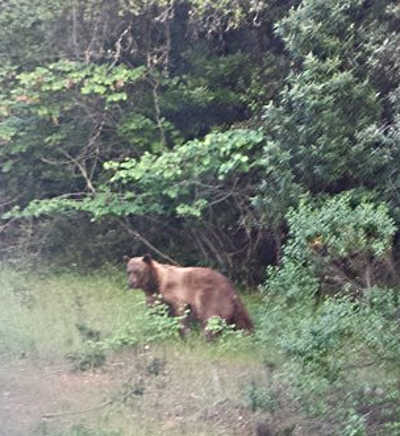
LAKE COUNTY, Calif. – Over the last several weeks residents around Lake County have reported a surge in bear sightings, which has raised concerns for the safety of both humans and the bears.
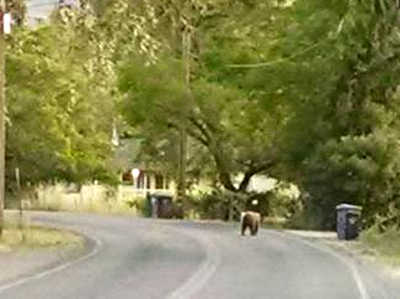
Bear sightings have been reported in areas including Kelseyville, Lucerne and Upper Lake.
The animals have been spotted in yards and even running down Middle Creek Road in Upper Lake.
In one situation in Lucerne, a resident reportedly shot a bear late in April because he said he was afraid of it hurting his animals and children.
On the opposite end of the spectrum, Livia Kurtz and her family worked to minimize harm to a bear that appeared in their backyard in the Riviera Heights on May 2.
She said it was the first time she's seen a bear near her home in the two years she's lived there.
Kurtz posted pictures of what appeared to be a sow bear on Facebook in order to let community members know it was in the area, and also notified the homeowners association.
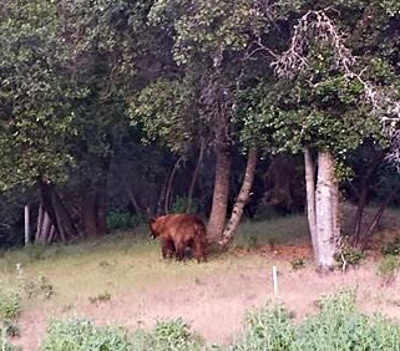
But, beyond that, Kurtz said she didn't make a report for the California Department of Fish and Wildlife, or CDFW.
“The bear was minding its own business,” she said. “We are not fearful and do not want the bear to be killed. Our yard is not fenced and the same goes for most of our neighbors.”
Linda Unruh, office administrator for the Riviera Heights Homeowners Association, received the report from Kurtz and her family, and put out notices to other association residents.
Unruh said they hear a lot about mountain lion sightings, but not bears.
“I've been here nine years, that's the first big bear we've heard of,” she said.
She added, though, that she appreciates being able to see and life near wildlife. “That's what special about Lake County.”
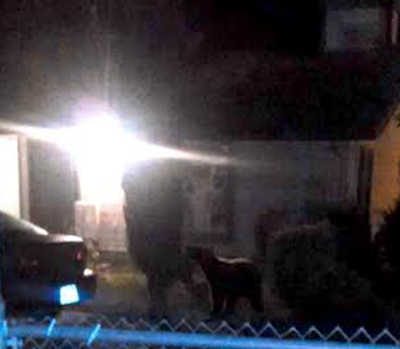
Nate Poe, who lives at Robinson Rancheria in Nice, had two bear sightings this month, the first he's had in the nine years he's lived there.
Poe said he was awakened one morning during the second week of this month when his dogs started barking like he'd never heard them bark before.
He went outside and his neighbors told him to go back in the house, as there was a bear walking around the neighborhood.
Poe said he looked over and saw a big bear near his car. “I went back inside my house and locked my door,” he said, adding, “That was a decent-sized bear.”
About a week later, on May 19, his dogs once again began barking frantically at around 2:30 to 3 a.m. Poe said that time there was a smaller in his neighbor's yard that had knocked over trash cans.
He then watched as the bear easily leaped over his cousin's four-and-a-half-foot-high fence before walking up toward the rancheria's apartments. The bear came back town the houses at around 5 a.m. then retreated into the hills.
“I have not seen it since,” and neither has anyone else, Poe said late last week, adding that he wouldn't be surprised if a bear were to show up again.
He said he'd never seen a bear up close before that early morning encounter. “That pretty much shocked me when that bear showed up here.”
Poe called CDFW, which told him at that point that it was the fifth sighting reported to them this month.
“It's all about food. They’re hungry,” said Poe.
Poe added, “We’ve been cleaning up really well, making sure there’s no potential food for them.”
Normal conditions for bears
The spike in bear sightings locally coincided with May being observed as “Be Bear Aware and Wildlife Stewardship Month,” a designation established by passage of Senate Resolution 347 of the 110th Congress.
CDFW is asking the public to act responsibly when in bear country – which includes Lake County – in order to minimize dangerous interactions with the animals, which tend to be active at this time of year.
CDFW Supervising Wildlife Biologist Jason Holley told Lake County News that activity for bears and other wildlife is starting to pick up around Lake County and Northern California as a whole.
“This is a normal occurrence this time of year – and is not necessarily tied to the drought,” he said.
He added, “That said, people should properly store their food and garbage as some animals may be looking for human resources later in the summer if natural resources significantly dry out.”
In spring, California's black bear population – estimated at about 35,000 bears – emerges from hibernation and begins searching for food. The bears can end up near campsites and neighborhoods where trash and food are readily available.
The availability of food sources for bears in human areas has led to CDFW receiving numerous calls in spring and summer months about “nuisance” bears breaking into homes, campsites and trash bins. CDFW said the animals are just doing what comes naturally and foraging for food.
While Holley didn't consider the drought a main driver of recent activity, wildlife officials said the drought is a concern when it comes to bear and human interactions.
“During this extreme drought, it is particularly important that people who visit or live near bear habitat keep their food and trash secure at all times,” said Jesse Garcia, CDFW’s Bear Program manager. “These dry conditions are forcing some bears to travel longer distances in search of food and water, and sometimes these forays lead them into populated areas where bear-human conflicts occur. Bears that become conditioned to human sources of food and lose their fear of people can be become dangerous and often must be killed in order to protect public safety.”
CDFW reported that there are two subspecies of American black bear in California: the northwestern black bear and the California black bear. The bears range in color from blond to black, with cinnamon brown being the most common coloring.
Males are much larger than females and can weigh up to 500 pounds, although average weight is about 300 pounds. As big as they are, they can spring up to 35 miles per hour, are strong swimmers and great at climbing trees.
While a typical wild bear diet consists of berries, plants, nuts, roots, honey, honeycomb, insects, larvae, carrion and small mammals, they will easily turn to garbage foraging if given the opportunity, CDFW said.
CDFW said black bears will seek to avoid confrontation with humans, and if they're encountered it's important to always leave them an escape route.
However, bears that are accustomed to people – especially those that get used to areas where trash and food is available – can become too bold and lose their fear of humans, officials said.
Bears have powerful noses, allowing them to smell meals from miles away. As such, CDFW said it's important to bear-proof homes and campsites, as bear-proofing is the best defense.
Bear-proofing tips
CDFW offered the following guidelines for bear-proofing homes and campsites in order to prevent human-bear encounters.
Tips for bear-proofing your home:
– Purchase and properly use a bear-proof garbage container.
– Wait to put trash out until the morning of collection day.
– Don’t leave trash, groceries or animal feed in your car.
– Keep garbage cans clean and deodorize them with bleach or ammonia.
– Keep barbecue grills clean and stored in a garage or shed when not in use.
– Only provide bird feeders during November through March and make them inaccessible to bears.
– Don’t leave any scented products outside, even non-food items such as suntan lotion, insect repellent, soap or candles.
– Keep doors and windows closed and locked.
– Consider installing motion-detector alarms and/or electric fencing.
– Harvest fruit off trees as soon as it is ripe, and promptly collect fruit that falls.
– Securely block access to potential hibernation sites such as crawl spaces under decks and buildings.
Tips for bear-proofing your campsite:
– Use bear-proof garbage cans whenever possible or store your garbage in a secure location with your food.
– Store food (including pet food) and toiletries in bear-proof containers or in an airtight container in the trunk of your vehicle if bear lockers are not available.
– Clean dishes and store food and garbage immediately after meals.
– Clean your barbecue grill after each use.
– Never keep food or toiletries in your tent.
– Change out of clothes you cooked in before going to bed.
For more information, including bear-proof containers and where to buy them, visit www.wildlife.ca.gov/Keep-Me-Wild/Products .
Email Elizabeth Larson at
“A geologist is a fault finder.” – Anonymous
“Beneath all the wealth of detail in a geological map lies an elegant, orderly simplicity.” – Tuzo Wilson
LAKE COUNTY, Calif. – Taking a walk almost any place in Lake County can be like viewing a museum in the soil.
The hills, valleys and streams contain a wealth of geologic diversity. In fact, our California Coast Ranges are world-famous for their impressive geologic features.
Here in our own chapter of the geologic history book we can “read” the past's violent volcanics in 2-million-year-old igneous rock features such as andesite – that red-hued rock.
We can walk amongst a myriad of sedimentary stratigraphies, like sandstone, shale, mudstone and copious conglomerates.
If those tilting, lumps and deposits could talk, they would divulge the secrets of their many minerals and metals.
Gold has been mined here in Lake County, most recently at the McLaughlin Gold Mine in Lower Lake, which is now a nature reserve.
The gold found there was usually microscopic in nature, however, nuggets were unearthed from time to time.
Gold is typically found in quartz, gravel and some sulphurets, such as are produced by hot springs.
Our county has produced everything from silver and iron to quicksilver (mercury) and borax.
To explain the geology of Lake County, Dr. Harry Lyons explained in a recent statement for the Lake County Library's “Know Lake County series, “We live in a clutter of marine rocks, delivered from the Pacific by forces beautifully described by a theory called plate tectonics. The position and composition of the rocks, for millions of years, have formed and subsidized the ecosystem of the Clear Lake Basin. Our dynamic landscape, powered by the San Andreas Fault System, has led to the development of our famous eutrophic lake, a favorite of biologists worldwide.”
Lake County's hills and streams house an abundance of shiny serpentine, California's state rock.
Serpentine's color ranges from green to black, and is speckled with both dark and light features. It is also abundant in the Sierra Nevada foothills and the Klamath Mountains.
According to the California Geologic Survey publications, serpentine can be metamorphic as well as igneous, containing peridotite straight from earth's mantle, which is below earth's crust.
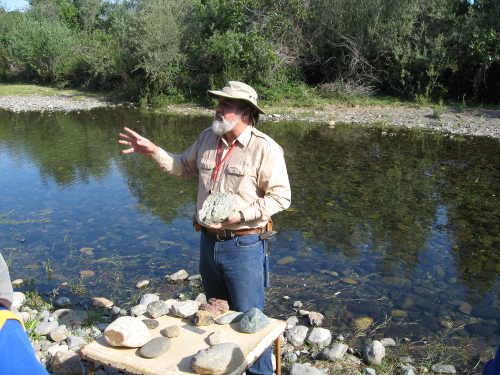
During a Coyote Valley Elementary School field trip recently, we had the honor of taking a mini geology class on Putah Creek with geologist Dean Enderlin. He is a walking geology encyclopedia.
According to Enderlin, you won't be able to find any dinosaur bones or fossils here in Lake County, because during that time – more than 150 million years ago, in the Jurassic Period – all of Lake County was submerged under the ocean.
If you look carefully, perhaps in a chunk of chert rock plucked from a creek, you will see fossils of shells.
Kathleen Scavone, M.A., is an educator, potter, writer and author of “Anderson Marsh State Historic Park: A Walking History, Prehistory, Flora, and Fauna Tour of a California State Park” and “Native Americans of Lake County.” She also writes for NASA and JPL as one of their “Solar System Ambassadors.” She was selected “Lake County Teacher of the Year, 1998-99” by the Lake County Office of Education, and chosen as one of 10 state finalists the same year by the California Department of Education.
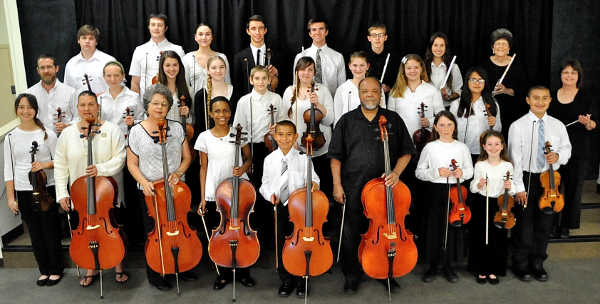
LAKEPORT, Calif. – The Lake County Symphony Association Youth Orchestra is hard at work rehearsing for its annual concert, which takes place at 3 p.m. Sunday, June 7, at Lakeport’s Soper-Reese Theatre.
Now numbering some 25 members, the orchestra is probably the largest in its history.
The opening of the concert will feature all violin, viola and cello students from the beginning and advanced string classes, sponsored by the Lake County Wine Alliance.
Teachers Jeff Ives and Clovice Lewis have planned a program with excerpts from the “String Explorer” lesson book, which their students have been practicing diligently.
The full Youth Orchestra, conducted by Sue Condit, will then take over with “Rondo Alla Turca” by Wolfgang Amadeus Mozart followed by a piece entitled “The Inner Light” composed by Jay Chattaway for the Paramount television series “Star Trek: The Next Generation.”
In the TV show Jean Luc Picard (played by actor Patrick Stewart), captain of the Starship Enterprise plays the number on an instrument closely resembling a tin whistle. In the Youth Orchestra version it will be played as a flute solo by Ethan Jones.
The first half of the concert will conclude with “Ashokan Farewell,” a fiddle tune written by Jay Ungar which features Julianne Carter on violin solo.
Following intermission, where complimentary cookies will be served by members of the Lake County Symphony Association, the concert will resume with “Mythos” written by Soon Hee Newbold.
The next two pieces “Dance in the Clouds” and “Winter Lullaby” were written by local composer and music teacher Jeremy Jernigan and will be performed for the first time in concert. Several of Jernigan’s students will join the Youth Orchestra in this premier performance.
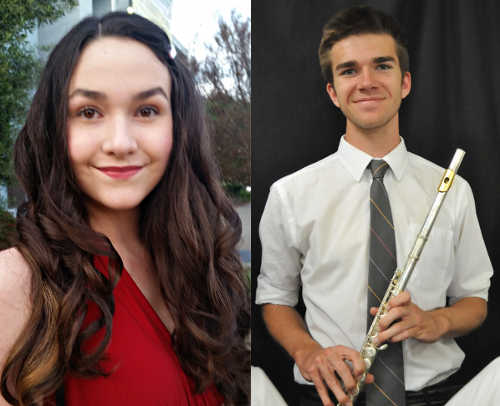
The flute section – Ethan Jones, Jonathan Kincaid and Gabriela Jauregui – will play the Courante movement from Sonate en trio No 4, Op. VII-Paris 1725, by Joseph Bodin de Boismortier. He was a prolific composer of music for virtually all instruments, but music for the flute was one of his favorites.
Violinist Julianne Carter will then play a Bach minuet, accompanied by symphony member Jeanine Mullen-Ison on piano.
The concert will end with the theme from the movie “Pirates of the Caribbean: The Curse of the Black Pearl,” written by Klaus Badelt for Walt Disney Pictures.
The concert admission is only $5 for adults and free for under 18.
The Soper-Reese Theatre, 275 S. Main St., generously waives its usual fees in order to support youth music.
Please attend the concert to show your support for these young musicians who have worked for many months on their concert presentation.
NORTHERN CALIFORNIA – The California Highway Patrol is urging motorcyclists to use extra caution following a spike in crashes in Napa County over the past week.
The CHP's Napa Area office reported that there were three major injury motorcycle crashes in less than an hour last Sunday, May 24. None of the riders or the occupants were from Napa.
The first collision occurred on southbound Highway 29 at Highway 221 just before 4 p.m. The CHP said the rider of the motorcycle, 60-year-old Michael Frates of San Ramon, failed to stop in time behind another vehicle that had stopped for the red light at the intersection.
Frates and his passenger, 54-year-old Carla Frates, were ejected onto the roadway and suffered major non-life threatening injuries, the CHP said.
The CHP reported that the second collision occurred southbound Monticello Road approximately 1.3 miles south of Circle Oaks at 4:35 p.m.
The rider, 59-year-old Jon Spiegel of Vacaville, was unable to negotiate the curve in the roadway and went down, the CHP said.
Spiegel sustained major non-life threatening injuries and the passenger, 59-year-old Connie Kabeary of San Pablo, sustained minor injuries, according to the CHP.
The third Sunday collision occurred westbound Highway 128 approximately 1 mile east of Pope Valley Road at 4:40 p.m. and involved just the motorcyclist, 49-year-old Gail Smith of El Sobrante. The CHP said he suffered major non-life threatening injury.
Then, on Friday at about 2 p.m., 42-year-old Julia Larson of Woodland sustained major injuries in a crash on Butts Canyon Road south of Snell Valley Road when she allowed her motorcycle to go off the roadway edge, according to the CHP.
When Larson attempted to steer back onto the roadway, she was thrown from the motorcycle and hit the pavement, the CHP said.
On Saturday, 44-year-old Manolo Olaso of Sacramento was injured in a crash that the CHP said took place at 7:45 a.m. on Highway 128 approximately 2.9 miles east of Wragg Canyon Road.
The CHP said he was riding westbound at approximately 60 miles per hour when he allowed his motorcycle to go off the roadway, with the bike continuing onto the dirt shoulder, hitting a three.
Olaso was thrown from the motorcycle and suffered major injuries, the CHP said.
As the weather warms, the CHP said there will be a noticeable increase in the number of motorcyclists traveling Napa County roadways. Some will be from the 3,500 motorcycles registered in Napa County, but others will travel from surrounding areas.
“Many motorcyclists will traverse the unincorporated roadways enjoying the scenery and driving safely. There will be some, however, who are inexperienced, inattentive, and who purposely disregard safety by excessively speeding, passing over double yellow lines and driving recklessly,” the CHP said in a statement.
To prepare for this influx of motorcycle traffic, the CHP has dedicated an officer to patrol the roadways near the Lake Berryessa area.
Several enforcement operations are also planned throughout the summer with a specific emphasize on motorcyclist riding safely and vehicles properly sharing the road when traveling with motorcycles.
“The purpose of enforcement operations is to ensure compliance of safe driving habits,” said Capt. Chris Childs, commander of the Napa Area office. “We know the tragedy of what can happen and we want to prevent that from occurring.”