 How to resolve AdBlock issue?
News
With a mandatory average conservation rate of 25 percent beginning this month for all state residents, the State Water Resources Control Board announced that Californians in cities and towns increased their water conservation to 13.5 percent in April.
In addition, nearly 400 water suppliers responded to a first-ever enforcement report, indicating a high level of local activity to respond to reports of leaks and suspected water wasting.
Smaller water suppliers of 3,000 connections or less – which include all of those operating in Lake County – do not need to follow the monthly reporting requirements.
“We hope the improved conservation rate for April shows that residents and businesses stepped up to begin to meet the call for greater conservation in the face of this historic and ongoing drought,” said State Water Board Chair Felicia Marcus.
“While these results are a step in the right direction, there are still too many lush landscapes where irrigation must be reduced to meet the 25 percent statewide reduction mandate,” Marcus said. “We see conservation gains in all regions of the state, but we don’t know whether it was because of cooler weather or concerted action. In particular, the South Coast demonstrated significant improvement, but the real test will be what happens as we move into the hot and dry summer months, when we need to keep the sprinklers off as much as possible.“
In May, the State Water Board adopted an emergency regulation requiring an immediate 25 percent reduction in overall potable urban water use statewide beginning in June, in accordance with Gov. Edmund G. Brown Jr.’s April 1 executive order.
The executive order required, for the first time in the state’s history, mandatory conservation for all residents and directed several state agencies, including the State Water Board, to take immediate action to safeguard the state’s remaining potable urban water supplies in preparation for a possible fifth year of drought.
In the most recent survey of nearly 400 urban water suppliers, the amount of water saved by the state’s large urban water agency customers statewide increased from 3.9 percent in March to approximately 13.5 percent in April, in same month water use comparisons of 2015 to 2013.
The year 2013 serves as a baseline to determine water savings statewide since the 2014 emergency water conservation regulations have been in effect. The cumulative statewide percent reduction for June 2014-April 2015 (11 months) is 9 percent.
The regulation adopted by the State Water Board on May 5 uses a sliding scale, so that communities that have been conserving water will have lower mandates than those that have not conserved this past year and/or over the last decades since the last major drought.
The regulation places each urban water supplier into one of eight tiers which are assigned a conservation standard, ranging between 8 percent and 36 percent.
The State Water Board is currently reviewing new data submitted by over 200 urban water suppliers. The revised data, if accepted, will change the conservation standard for some water suppliers. The Board expects to publish the final conservation standards for all 411 urban water suppliers by the end of the week.
Each month, the State Water Board will compare every urban water suppliers’ water use with their use for the same month in 2013 to determine if they are on track for meeting their conservation standard.
Local water agencies will determine the most cost effective and locally appropriate way to achieve their standard. The State Water Board will be working closely with water suppliers to implement the regulations and improve local efforts that are falling short.
“Whether 12, 24, or 36 percent, these reductions are achievable if we reduce our outdoor irrigation, fix our leaks, and think about our water use every day,” said Marcus. “We know that when people pay attention to their water use they can make significant reductions, so we need everyone to make conservation a part of their summer routine. A quarter of water suppliers statewide still allow 7 days a week watering, which is not sending the right message when on average 50 percent and in some cases 80 percent of urban water use is on outdoor landscapes. This summer, watering lawns should be the exception rather than the rule, while we reserve our precious landscape water for trees.”
Enforcement data now reported every month
In March, the State Water Board renewed an emergency regulation, first adopted in July 2014, which require water districts to report water use every month to the State Water Board.
The renewed emergency regulations monthly reporting requirements were expanded to include the limit on days for outdoor irrigation and a description of compliance and enforcement efforts.
Based on the first full month of enforcement and compliance, in April (395 urban water suppliers reporting):
– 22,674 water waste complaints were submitted to 325 suppliers statewide;
– 22,173 formal warnings were issued for water waste by 260 suppliers statewide;
– 838 penalties were issued by 43 suppliers statewide;
– 12 (3%) suppliers reported that mandatory restrictions are not in place;
– 97 (25%) suppliers reported no restrictions on the number of days per week outdoor irrigation is allowed.
Water conservation efforts improve
Monthly residential water savings statewide were 13.5 percent in April compared with April 2013. That is up from the 3.9 percent water savings in March compared with March 2013.
Broken down by hydrologic region, the results show that all parts of the state showed savings improvements compared to March.
From June 2014 through April 2015, more than 175.6 billion gallons have been saved compared with the same period in 2013 – enough to supply 2.35 million California residents for a year.
In addition to the conservation data, the State Water Board also discussed the reported residential gallons per-capita per day (R-GPCD) for April. The discussion focused on estimated daily water use by residential customers for more than 400 urban water suppliers statewide.
Statewide average R-GPCD for April 2015 was 91 gallons, an increase compared to the March statewide average R-GPCD of 82.8. With the exception of the North Coast Hydrologic Region, hydrologic region R-GPCDs were higher in April than they were in March for all hydrologic regions.
Examples of some communities with the respective R-GPCD averages for April 2015 in various hydrologic areas (in parenthesis) include: San Francisco Public Utilities Commission (San Francisco Bay) with 44 R-GPCD; City of Santa Cruz (Central Coast) with 40 R-GPCD; California-American Water Company Monterey District (Central Coast) 56 R-GPCD; City of Santa Rosa (North Coast) with 56 R-GPCD; City of Stockton (San Joaquin River) with 92 R‑GPCD; City of San Diego (South Coast), with 66 R-GPCD; San Jose Water Company (San Francisco Bay), with 68 R-GPCD; City of Fresno (Tulare Lake), with 108 R-GPCD; City of Sacramento (Sacramento River) with 86 R-GPCD; Los Angeles Department of Water and Power (South Coast), with 75 R-GPCD; City of Riverside (South Coast), with 92 R-GPCD; Sacramento County Water Agency (Sacramento River), with 118 R-GPCD, and California Water Service Company, Bakersfield (Tulare Lake) with 152 R-GPCD.
California Secretary of State Alex Padilla announced Tuesday that the proponent of three new initiatives may begin collecting petition signatures for his measures.
Louis J. Marinelli is seeking to put initiatives before voters involving the state flag, limits to contributions by non-California residents to certain candidates and political groups, and changing the state Constitution to replace the word “governor” with “president.”
The attorney general prepares the legal title and summary that is required to appear on initiative petitions.
When the official language is complete, the attorney general forwards it to the proponent and to the secretary of state, and the initiative may be circulated for signatures.
The secretary of state then provides calendar deadlines to the proponent and to county elections officials.
The attorney general’s official title and summary for the measures follow.
DISPLAY OF STATE FLAG
Requires display of the California State flag in the position of first honor when both the United States flag and the California State flag are displayed at schools, universities, colleges, courtrooms, government buildings, and state parks, and at events held in coliseums, stadiums, bowls, other open air sites, and race tracks.
Summary of estimate by Legislative Analyst and Director of Finance of fiscal impact on state and local government: Likely no fiscal effect on state and local governments.
Marinelli must collect signatures of 365,880 registered voters (5 percent of the total votes cast for governor in the November 2014 gubernatorial election) in order to qualify it for the November 2016 ballot.
POLITICAL CONTRIBUTIONS: OUT-OF-STATE DONORS
Prohibits candidates, committees, and certain political mailer organizations from receiving funds from non-California residents. Exempts funds provided to candidates for federal office, or to political mailer organizations advocating for or against candidates for federal office.
Summary of estimate by Legislative Analyst and Director of Finance of fiscal impact on state and local government: Increased state and local costs to administer and enforce campaign finance and disclosure laws, possibly in the range of a few hundred thousand dollars initially.
Marinelli must collect signatures of 365,880 registered voters in order to qualify it for the November 2016 ballot.
PRESIDENT OF CALIFORNIA
Amends the California Constitution to replace the word governor with the word president.
Summary of estimate by Legislative Analyst and Director of Finance of fiscal impact on state and local government: Potential minor one-time costs to state and local government to change the name of the chief executive in government documents.
Marinelli must collect signatures of 585,407 registered voters (8 percent of the total votes cast for governor in the November 2014 gubernatorial election) in order to qualify it for the November 2016 ballot.
He has 180 days to circulate petitions for each measure, meaning the signatures must be submitted to county elections officials by Nov. 25.
The proponent can be reached at
KELSEYVILLE, Calif. – The Riviera Elementary School Parent Teacher Organization will host its second annual “Spring Fling” this weekend, with proceeds to help purchase technology for the school.
The event will take place from 5 to 10 p.m. Saturday, June 6, at Chacewater Winery and Olive Mill, 5625 Gaddy Lane in Kelseyville. Ages 21 and over are welcome.
Enjoy a catered dinner, wine pairings and dancing, with Lakeport Mayor Martin Scheel acting as the event's master of ceremonies.
There also will be live and silent auctions featuring hot air balloon rides, wine tours in Lake and Napa counties, large format wines, a fishing charter, and art work by Richard Vargas, Ben Van Steenburgh (who did portraiture for President Bill Clinton, among others) and Gail Salituri.
Amber Sheridan, chair of the event, said all proceeds will go to Riviera Elementary's technology program.
Last year's fundraiser paid for Promethean boards and financed field trips, Sheridan said.
This year the proceeds will go to individual computer units for the teachers to use with the Promethean boards as well as to software such as MineCraft Math and other things that will engage the students, according to Sheridan.
Tickets are $50 per person, or $425 for a VIP table of eight people, which includes two bottles of wine and premium seating. The ticket cost for designated drivers is $35 per person.
To purchase tickets visit http://www.eventbrite.com/e/spring-fling-2015-tickets-15510629711 , Chacewater or Riviera Elementary School office . For more information about the PTO visit www.rivpto.com .
Although record low precipitation has been the main driver of one of the worst droughts in California history, abnormally high temperatures have also played an important role in amplifying its adverse effects, according to a recent study by the U.S. Geological Survey and university partners.
Experiments with a hydrologic model for the period Oct. 2013-Sept. 2014 showed that if the air temperatures had been cooler, similar to the 1916-2012 average, there would have been an 86-percent chance that the winter snowpack would have been greater, the spring-summer runoff higher, and the spring-summer soil moisture deficits smaller.
To gauge the effect of high temperatures on drought, lead author Shraddhanand Shukla of the University of California, Santa Barbara devised two sets of modeling experiments that compared climate data from water year 2014 (Oct. 2013-Sept. 2014) to similar intervals during 1916-2012.
In the first simulation set, Shukla substituted 2014 temperature values with the historical temperatures for each of the study’s 97 years, while keeping the 2014 precipitation values.
In the second simulation set, he combined the observed 2014 temperatures with historical precipitation values for each of the preceding years, 1916-2012.
“This experimental approach allows us to model past situations and tease out the influence of temperature in preceding drought conditions,” said Chris Funk, a USGS scientist and a co-author of the investigation. “By crunching enough data over many, many simulations, the effect of temperature becomes more detectable. We can’t do the same in reality, the here and now, because then we only have a single sample.”
Funk, an adjunct professor at UCSB, helps coordinate research at the university that supports USGS programs.
High heat has multiple damaging effects during drought, according to the study, increasing the vulnerability of California’s water resources and agricultural industry.
Not only does high heat intensify evaporative stress on soil, it has a powerful effect in reducing snowpack, a key to reliable water supply for the state.
In addition to decreased snowpack, higher temperatures can cause the snowpack to melt earlier, dramatically decreasing the amount of water available for agriculture in summer when it is most needed.
Although the study did not directly address the issue of long-term climate change, the implications of higher temperatures are clear.
“If average temperatures keep rising, we will be looking at more serious droughts, even if the historical variability of precipitation stays the same,” Shukla said. “The importance of temperature in drought prediction is likely to become only more significant in the future.”
The research was published online in Geophysical Research Letters, a journal of the American Geophysical Union.
For more information about drought in California, visit the USGS California Water Science Center online at http://ca.water.usgs.gov/data/drought/ .
LAKE COUNTY, Calif. – It's kitten season, and this week Lake County Animal Care and Control has a shelter full of the little felines along with an adult cat, all of them needing homes.
Gray tabbies, a tuxedo and kittens with coats of every length are available.
In addition to spaying or neutering, cats that are adopted from Lake County Animal Care and Control are microchipped before being released to their new owner. License fees do not apply to residents of the cities of Lakeport or Clearlake.
If you're looking for a new companion, visit the shelter. There are many great pets there, hoping you'll choose them.
In addition to the animals featured here, all adoptable animals in Lake County can be seen here: http://bit.ly/Z6xHMb .
The following cats at the Lake County Animal Care and Control shelter have been cleared for adoption (other cats pictured on the animal control Web site that are not listed here are still “on hold”).

Domestic short hair mix kitten
This female domestic short hair mix kitten has a gray and white coat.
She's in cat room kennel No. 21a, ID No. 2306.

Domestic short hair mix kitten
This female domestic short hair mix kitten has a black and white coat.
She's in cat room kennel No. 21b, ID No. 2307.

Domestic short hair mix kitten
This female domestic short hair mix kitten has a black and white coat.
She's in cat room kennel No. 21c, ID No. 2308.

Domestic short hair mix kitten
This female domestic short hair mix kitten has a tuxedo coat.
She's in cat room kennel No. 21d, ID No. 2309.
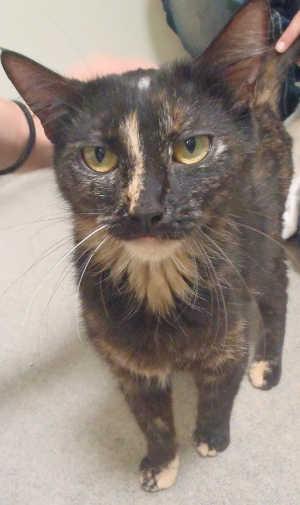
'Mom'
“Mom” is a pretty domestic short hair mix with calico markings.
She's in cat room kennel No. 27, ID No. 2213.

Domestic longhair kitten
This male domestic longhair kitten has a black and white coat.
He's in cat room kennel No. 40a, ID No. 2325.

Domestic longhair kitten
This male domestic longhair kitten has an all-white coat.
He's in cat room kennel No. 40b, ID No. 2326.

Domestic short hair mix kitten
This male domestic short hair mix kitten has a dark gray and white coat.
He's in cat room kennel No. 52a, ID No. 2315.

Domestic short hair mix kitten
This female domestic short hair mix kitten has a light gray and white coat.
She's in cat room kennel No. 52b, ID No. 2318.

Domestic short hair mix kitten
This male domestic short hair mix kitten has a gray tabby coat with white markings.
He's in cat room kennel No. 52c, ID No. 2319.

Domestic short hair mix kitten
This male domestic short hair mix kitten has a light gray tabby coat.
He's in cat room kennel No. 52d, ID No. 2320.

Domestic medium hair mix kitten
This female domestic medium hair mix kitten has a gray tabby coat.
She's in cat room kennel No. 105, ID No. 2248.
Adoptable cats also can be seen at http://www.co.lake.ca.us/Government/Directory/Animal_Care_And_Control/Adopt/Cats_and_Kittens.htm or at www.petfinder.com .
Please note: Cats listed at the shelter's Web page that are said to be “on hold” are not yet cleared for adoption.
To fill out an adoption application online visit http://www.co.lake.ca.us/Government/Directory/Animal_Care_And_Control/Adopt/Dog___Cat_Adoption_Application.htm .
Lake County Animal Care and Control is located at 4949 Helbush in Lakeport, next to the Hill Road Correctional Facility.
Office hours are Monday through Friday, 11 a.m. to 5 p.m., and 11 a.m. to 3 p.m., Saturday. The shelter is open from 11 a.m. to 4 p.m. Monday through Friday and on Saturday from 11 a.m. to 3 p.m.
Visit the shelter online at http://www.co.lake.ca.us/Government/Directory/Animal_Care_And_Control.htm .
For more information call Lake County Animal Care and Control at 707-263-0278.
Email Elizabeth Larson at
NORTH COAST, Calif. – Two Lake County women sustained major injuries in a single-vehicle wreck on Sunday afternoon near Hopland.
Nancy Larios, 28, of Clearlake and 44-year-old Patty Wade of Middletown were injured in the crash, which occurred just after 4 p.m. on Highway 175 east of Buckman Drive, according to the California Highway Patrol's Ukiah Area office.
The CHP said Larios was driving a 1987 Toyota westbound on Highway 175 at an unknown speed when, for an unknown reason, she allowed the vehicle to go off the roadway, causing the passenger-side tires to enter the dirt shoulder on the roadway's north side.
She lost control of the vehicle, which crossed the road and went off the south side, hitting a large oak tree and coming to rest, the CHP said.
Larios was able to get out of the car and was attended to by a concerned citizens until emergency personnel arrived on the scene, the CHP said.
Wade was pinned inside of the vehicle. She also received help from a passerby until she could be extricated by firefighters, according to the CHP.
REACH air ambulance transported Larios to Santa Rosa Memorial Hospital, while Wade was transported by ground ambulance to Ukiah Valley Medical Center for treatment of her injuries, the CHP said.
The CHP said Larios was wearing her seat belt, but Wade was not.
Along with the CHP, the Hopland Fire Protection District, Cal Fire, Verih Health Ambulance and REACH air ambulance responded to the incident, the CHP said.
Email Elizabeth Larson at