How to resolve AdBlock issue?
Refresh this page
How to resolve AdBlock issue?
Refresh this page
Lake County News,California
  • Home
    • Registration Form
  • News
    • Education
    • Veterans
    • Community
      • Obituaries
      • Letters
      • Commentary
    • Police Logs
    • Business
    • Recreation
    • Health
    • Religion
    • Legals
    • Arts & Life
    • Regional
  • Calendar
  • Contact us
    • FAQs
    • Phones, E-Mail
    • Subscribe
  • Advertise Here
  • Login

News

Drinking plenty of water may actually be good for you

Public health recommendations generally suggest drinking eight cups of water a day. And many people just assume it’s healthy to drink plenty of water.

Now researchers at UC San Francisco have taken a systematic look at the available evidence. They concluded that drinking enough water can help with weight loss and prevent kidney stones, as well as migraines, urinary tract infections and low blood pressure.

“For such a ubiquitous and simple intervention, the evidence hasn’t been clear, and the benefits were not well established, so we wanted to take a closer look,” said Benjamin Breyer, MD, MAS, the Taube Family Distinguished Professor and chair of the UCSF Department of Urology.

Besides aiding in weight loss, drinking water can help:

• prevent kidney stones;
• prevent migraines and recurring headaches;
• avoid urinary tract infections;
• control diabetes and blood glucose levels;
• control low blood pressure.

“The amount of rigorous research turned out to be limited, but in some specific areas, there was a statistically significant benefit,” said Breyer, the senior author of the study. “To our knowledge, this is the first study assessing the benefits of water consumption on clinical outcomes broadly.”

The study, which analyzed 18 randomized controlled trials, appears Nov. 25 in JAMA Network Open.

The researchers found the most evidence in favor of drinking water to prevent kidney stones and to help people lose weight.

Drinking eight cups of water a day significantly decreased the likelihood of getting another kidney stone.

Several studies found that drinking about six cups of water a day helped adults lose weight. But a study that included adolescents found that drinking a little more than eight cups of water a day had no effect.

Still, the authors said that encouraging people to drink water before meals would be a simple and cheap intervention that could have huge benefits, given the increased prevalence of obesity.

Other studies indicated that water can help prevent migraines, control diabetes and low blood pressure, and prevent urinary tract infections.

Adults with recurrent headaches felt better after three months of drinking more water.

Drinking about four more cups of water a day helped diabetic patients whose blood glucose levels were elevated.

Drinking an additional six cups a day of water also helped women with recurrent urinary tract infections. It reduced the number of infections and increased the amount of time between them.

And drinking more water helped young adults with low blood pressure.

“We know that dehydration is detrimental, particularly in someone with a history of kidney stones or urinary infections,” Breyer said. “On the other hand, someone who suffers from frequent urination at times may benefit from drinking less. There isn’t a one size fits all approach for water consumption.”

Authors: From UCSF, co-authors are Nizar Hakam, MBBS; Jose Luis Guzman Fuentes; Architha Sudhakar; Kevin D. Li; Catherine Nicholas; Jason L. Lui, MD; Peggy Tahir, MLIS; Charles P. Jones, MD; and Stephen Bent, MD. From Weill Cornell Medicine, Behnam Nabavizadeh, MD.

Elizabeth Fernandez writes for UC San Francisco.

Space News: NASA’s Europa Clipper — millions of miles down, instruments deploying

An artist’s concept of NASA’s Europa Clipper shows the spacecraft in silhouette against Europa’s surface, with the magnetometer boom fully deployed at top and the antennas for the radar instrument extending out from the solar arrays. NASA/JPL-Caltech.

NASA’s Europa Clipper, which launched Oct. 14 on a journey to Jupiter’s moon Europa, is already 13 million miles (20 million kilometers) from Earth.

Two science instruments have deployed hardware that will remain at attention, extending out from the spacecraft, for the next decade — through the cruise to Jupiter and the entire prime mission.

A SpaceX Falcon Heavy rocket launched it away from Earth’s gravity, and now the spacecraft is zooming along at 22 miles per second (35 kilometers per second) relative to the Sun.

Europa Clipper is the largest spacecraft NASA has ever developed for a planetary mission. It will travel 1.8 billion miles (2.9 billion kilometers) to arrive at Jupiter in 2030 and in 2031 will begin a series of 49 flybys, using a suite of instruments to gather data that will tell scientists if the icy moon and its internal ocean have the conditions needed to harbor life.

For now, the information mission teams are receiving from the spacecraft is strictly engineering data (the science will come later), telling them how the hardware is operating. Things are looking good. The team has a checklist of actions the spacecraft needs to take as it travels deeper into space. Here’s a peek:

Boom times

Shortly after launch, the spacecraft deployed its massive solar arrays, which extend the length of a basketball court. Next on the list was the magnetometer’s boom, which uncoiled from a canister mounted on the spacecraft body, extending a full 28 feet (8.5 meters).

To confirm that all went well with the boom deployment, the team relied on data from the magnetometer’s three sensors. Once the spacecraft is at Jupiter, these sensors will measure the magnetic field around Europa, both confirming the presence of the ocean thought to be under the moon’s icy crust and telling scientists about its depth and salinity.

On the radar

After the magnetometer, the spacecraft deployed several antennas for the radar instrument. Now extending crosswise from the solar arrays, the four high-frequency antennas form what look like two long poles, each measuring 57.7 feet (17.6 meters) long. Eight rectangular very-high-frequency antennas, each 9 feet (2.76 meters) long, were also deployed — two on the two solar arrays.

“It’s an exciting time on the spacecraft, getting these key deployments done,” said Europa Clipper project manager Jordan Evans of NASA’s Jet Propulsion Laboratory in Southern California. “Most of what the team is focusing on now is understanding the small, interesting things in the data that help them understand the behavior of the spacecraft on a deeper level. That’s really good to see.”

Instrument checkout

The remaining seven instruments will be powered on and off through December and January so that engineers can check their health.

Several instruments, including the visible imager and the gas and dust mass spectrometers, will keep their protective covers closed for the next three or so years to guard against potential damage from the Sun during Europa Clipper’s time in the inner solar system.

Mars-bound

Once all the instruments and engineering subsystems have been checked out, mission teams will shift their focus to Mars.

On March 1, 2025, Europa Clipper will reach Mars’ orbit and begin to loop around the Red Planet, using the planet’s gravity to gain speed. (This effect is similar to how a ball thrown at a moving train will bounce off the train in another direction at a higher speed.) Mission navigators already have completed one trajectory correction maneuver, as planned, to get the spacecraft on the precise course.

At Mars, scientists plan to turn on the spacecraft’s thermal imager to capture multicolored images of Mars as a test operation. They also plan to collect data with the radar instrument so engineers can be sure it’s operating as expected.

The spacecraft will perform another gravity assist in December 2026, swooping by Earth before making the remainder of the long journey to the Jupiter system. At that time, the magnetometer will measure Earth’s magnetic field, calibrating the instrument.

More about Europa Clipper

Europa Clipper’s three main science objectives are to determine the thickness of the moon’s icy shell and its interactions with the ocean below, to investigate its composition, and to characterize its geology. The mission’s detailed exploration of Europa will help scientists better understand the astrobiological potential for habitable worlds beyond our planet.

Managed by Caltech in Pasadena, California, JPL leads the development of the Europa Clipper mission in partnership with the Johns Hopkins Applied Physics Laboratory in Laurel, Maryland, for NASA’s Science Mission Directorate in Washington. APL designed the main spacecraft body in collaboration with JPL and NASA’s Goddard Space Flight Center in Greenbelt, Maryland, NASA’s Marshall Space Flight Center in Huntsville, Alabama, and Langley Research Center in Hampton, Virginia.

The Planetary Missions Program Office at Marshall executes program management of the Europa Clipper mission. NASA’s Launch Services Program, based at Kennedy, managed the launch service for the Europa Clipper spacecraft.

Find more information about Europa Clipper here: https://science.nasa.gov/mission/europa-clipper.

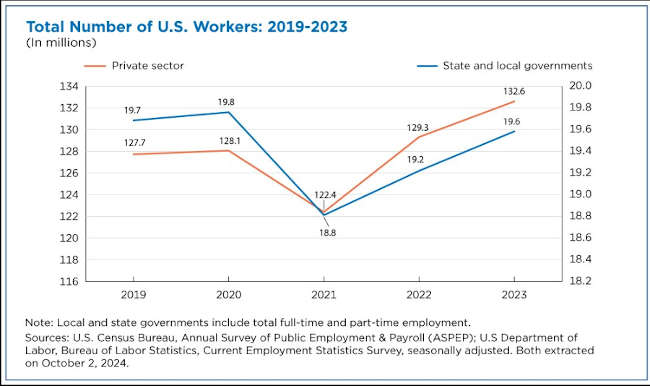
Employment bounced back faster for private industry than for state and local governments


Since the economic downturn caused by the COVID-19 pandemic, total full- and part-time employment in state and local governments has never fully bounced back.

In March 2022, while private industry had surpassed its level of employment from March 2019, state and local governments still had not fully regained their March 2019 employment levels.

The number of state and local government employees took less of a hit than those in private industry, but the belt-tightening by state and local governments has not loosened up enough to return to pre-pandemic employment levels as of 2023.

What happened?

From March 2019 to March 2023, the number of state and local government jobs declined by 101,000 or 0.5% to 19.6 million, according to U.S. Census Bureau statistics from the Annual Survey of Public Employment & Payroll, or ASPEP.

By contrast, private industry experienced a smaller percentage drop in employment and in March 2022 had rebounded beyond pre-pandemic levels with more employees (seasonally adjusted) than in March 2019.

Private industry employment in 2022 reached a total of 129.3 million jobs, according to the Bureau of Labor Statistics, up over 1.2% (nearly 1.6 million jobs) from 127.7 million jobs in 2019 despite the pandemic downturn during that period.

In March 2022, while private industry had surpassed its level of employment from March 2019, state and local governments still had not fully regained their March 2019 employment levels.

Government services hit the hardest

Overall, state and local government employment declined 4.8% from 2020 to 2021, losing just under 948,000 employees.

Elementary and secondary education saw the largest job losses by far – 5.7% or 447,000 employees, close to half of all government jobs lost during this period.

This was followed by losses in higher education (8.5% or 282,000 jobs); and parks and recreation (13.9% or 59,000 jobs).

Growth since the turnaround

Several areas in state and local employment grew but had not rebounded to pre-pandemic levels in 2023. Overall, state and local government employment increased 4.1% from 2021 to 2023, adding just under 772,000 employees, still short about 176,000 jobs from 2020 levels.

Elementary and secondary education, which experienced the largest numeric loss during the downturn in March of 2021, also experienced the largest numeric increase during the recovery, adding just over 452,000 employees or 6.1% in 2023, just surpassing 2020 levels by nearly 6,000 employees.

Higher education employment rose 4.8%, adding nearly 147,000 jobs. Parks and recreation also gained 17.0% or just over 62,000 jobs from 2021 to 2023. Both are still below March 2019 employment levels.

The Annual Survey of Public Employment & Payroll provides more information on state and local government employees and the services they offer through annual statistics on the number of state and local government civilian employees and their gross payrolls for the month of March.

Dylan Maloney is a survey statistician for the Census Bureau’s Economy-Wide Statistics Division.

Light exercise can yield significant cognitive benefits, new research shows


Everyday physical activity, like going for a short walk or playing with the kids, may provide short-term benefits for cognitive health, equivalent to reversing four years of cognitive aging. That was a key finding for my colleagues and me in our new study, which was published in the journal Annals of Behavioral Medicine.

Prior to enrollment into a study of diet and dementia risk, we asked a diverse sample of 204 middle-aged adults to check in five times per day for a period of nine days, via a smartphone application.

Each check-in involved completing a brief survey that asked about their mood, dietary choices and whether they engaged in any physical activity in the roughly three and a half hours leading up to the survey. In addition, participants completed a few brief brain games – meaning performance-based cognitive assessments that lasted about one minute each – to assess mental speed and short-term memory.

My team found that performance on our measure of cognitive processing speed improved during check-ins when participants reported being physically active in the time leading up to the survey. While we didn’t see improvements in our measure of working memory, the time taken to complete the memory task mirrored what we saw for the measure of processing speed.

We observed these improvements in speed regardless of whether the activity was lighter intensity or moderate-to-vigorous intensity. This led us to conclude that movement, whether it took the form of intentional exercise or part of a daily routine, was the essential ingredient for achieving this benefit.

Why it matters

As a rule, we get slower, both physically and mentally, as we age. While research on exercise and living a healthy lifestyle has demonstrated the long-term cognitive and brain health benefits of remaining physically active, much of this work has focused on the moderate- to vigorous-intensity physical activity – or what most of us think of as exercise – recommended by the Physical Activity Guidelines for Americans.

Still, these guidelines and other experts recommend that adults move more and sit less.

My colleagues and I are interested in understanding how moving more can improve our cognitive health or reduce our risk of dementia as we age, at what timescale these benefits show up, and what types of movement qualify.

Exercise promotes blood circulation and the growth of neurons.

What still isn’t known

Our study relied on participants to report whether they had been physically active during the time between each check-in. Even though participants were provided training on how to think about the intensity levels, it’s possible that each participant had a slightly different perception of their activities.

For example, a participant may not have believed their recent walk actually qualified as a moderate-intensity activity. Physical activity monitors that can dissociate time and intensity might help future research unravel these associations more clearly.

What’s next

It isn’t yet clear whether these short-term benefits accumulate over time to result in long-term improvements in brain health and dementia risk reduction. Research efforts are underway by our team to better understand these associations over broader timescales.

My research involves data collection via smartphones and wearable devices to help us better understand how health-promoting behaviors and cognitive health interact as we age. This type of digital approach allows my team to pursue questions about how everyday behavior and experience influence cognition in daily life and represents a significant methodological advancement in the dementia risk and prevention research space.

Using these tools, we aim to better identify individuals at risk for negative cognitive outcomes and new targets for dementia prevention.The Conversation

Jonathan G. Hakun, Assistant Professor of Neurology, Psychology, & Public Health Sciences, Penn State

This article is republished from The Conversation under a Creative Commons license. Read the original article.

Estate Planning: Medi-Cal without the asset test

Dennis Fordham. Courtesy photo.

Since Jan. 1, 2024, when the asset test for Medi-Cal was abolished in California (only), many more people now qualify for Medi-Cal.

Unless a person receives Supplemental Security Income (“SSI”) or intends to leave California, the need to put assets into an irrevocable Special Needs Trust is not relevant to receiving Med-Cal where eligibility is not linked to SSI benefits.

What, however, is now relevant, for many widely used Medi-Cal programs, is one’s available, countable income as determined under California regulations (22 CCR 50500-50517 et seq.); except for the Affordable Care Act and the 250% Working, Disabled Program Medi-Cal

Programs where eligibility is computed using one’s adjusted gross income reported on one’s income tax return.

Thus, if an applicant were able to control their available, countable income they might qualify for the Aged or Disabled (no share of cost) Medi-Cal if their available, countable income was under $1,732 per month (2024).

Otherwise, if their income presently exceeds $1,732/month, they would still benefit by reducing their share of cost by lowering their income for purposes of the Medically Needy (share of cost) Medi-Cal.

Share of cost is what a Medi-Cal beneficiary must first pay on a monthly basis before Medi-Cal pays anything.

California Medi-Cal trust income regulations (22 CCR 50489 to 50489.9) provide a planning opportunity because income received by most revocable and irrevocable trusts is not considered available, countable income for eligibility and share of cost computation purposes for purposes of certain types of Med-Cal, excluding MAGI Medi-Cal, Working, Disabled Medi-Cal and SSI-categorically linked Medi-Cal.

However, distributions by a trust for the benefit of, or directly to, a Medi-Cal applicant or beneficiary may count as income at the time of distributions and then subject to special income rules regarding what is available, countable income.

That is, distributions to the Medi-Cal beneficiary do count as income as many distributions to others to pay for shelter, utilities and food for the Medi-Cal beneficiary’s benefit.

However, distributions to a third party vendor of goods or services, other than shelter, utilities and food, do not count as available, countable income. This is based on an interpretation of California’s trust income rules that is presently accepted by the Department of Health Care Services (“DHCS”) who administers California’s Medi-Cal programs (see All County Wide Director’s Letter’s “ACWDL” #’s 23-20, 23-21, and 23-22E (https://www.dhcs.ca.gov/services/medi-cal/eligibility/letters/Pages/2023ACWDLs.aspx).

Accordingly, if a Medi-Cal beneficiary were to receive, whenever possible, all of his or her income, other than social security and retirement income, by owning all income producing assets (e.g., investments and rental properties) inside a trust for their benefit, then the income earned by such trust owned assets would not count when received by the trust.

However, any distributions (whether of trust income or principal) by the trustee to the Medi-Cal beneficiary would count as income when distributed, as might distributions for shelter, utilities and/or food, collectively referred to as ‘in kind support and maintenance (“ISM ”).

That said, however, such ISM payments only count when one-hundred percent is paid by the trustee (or by any third party provider) and so do not count if the Medi-Cal beneficiary were to pay even a small portion of such support payments (e.g., by using their social security income). Also such ISM payments count at a much reduced rate.

The terms of the Trust may determine whether or not the Medi-Cal eligibility worker counts the trust’s own income as available, countable income. That is, does the Trust require the Trustee to make distributions to or for the benefit of the beneficiary? If so, the eligibility worker may, perhaps, say that income generated by the trust assets is available and countable income for purposes of Medi Cal eligibility and share of cost computations.

A possible solution is to amend (or modify) the trust distribution standard to allow the Trustee discretion over whether to make distributions to or for the benefit of the beneficiary. The desired result is to allow the trustee to make non support payments at the trustee’s discretion.

Much yet remains to be seen as to how DHCS applies the income trust rules to different trust distribution standards. Also, it remains to be seen whether the new president rescinds the federal consent that allowed California to remove its asset test when all other states still have asset tests.

The foregoing discussion is not legal advice. Anyone confronting Medi-Cal issues should consult with a qualified attorney.

Dennis A. Fordham, attorney, is a State Bar-Certified Specialist in estate planning, probate and trust law. His office is at 870 S. Main St., Lakeport, Calif. He can be reached at This email address is being protected from spambots. You need JavaScript enabled to view it. and 707-263-3235.

Space News: Discovery alert — a ‘Hot Neptune’ in a tight orbit

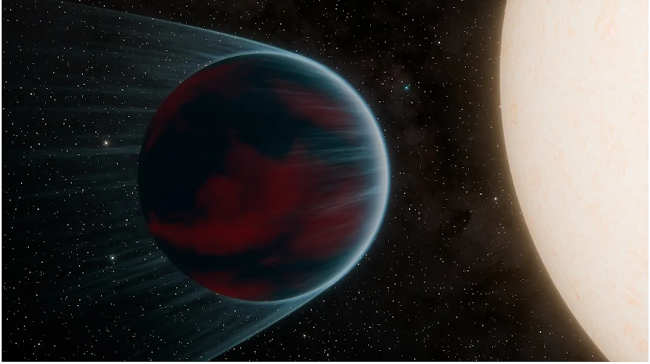
Artist's concept of "hot Neptune" TOI-3261 b. NASA/JPL-Caltech/K. Miller (Caltech/IPAC).

The discovery

A Neptune-sized planet, TOI-3261 b, makes a scorchingly close orbit around its host star. Only the fourth object of its kind ever found, the planet could reveal clues as to how planets such as these form.

Key facts

An international team of scientists used the NASA space telescope, TESS (the Transiting Exoplanet Survey Satellite), to discover the exoplanet (a planet outside our solar system), then made further observations with ground-based telescopes in Australia, Chile, and South Africa.

The measurements placed the new planet squarely in the “hot Neptune desert” — a category of planets with so few members that their scarcity evokes a deserted landscape.

This variety of exoplanet is similar to our own Neptune in size and composition, but orbits extremely closely to its star. In this case, a “year” on TOI-3261 b is only 21 hours long.

Such a tight orbit earns this planet its place in an exclusive group with, so far, only three other members: ultra-short-period hot Neptunes whose masses have been precisely measured.

Details

Planet TOI-3261 b proves to be an ideal candidate to test new computer models of planet formation.

Part of the reason hot Neptunes are so rare is that it is difficult to retain a thick gaseous atmosphere so close to a star. Stars are massive, and so exert a large gravitational force on the things around them, which can strip the layers of gas surrounding a nearby planet. They also emit huge amounts of energy, which blow the gas layers away.

Both of these factors mean that hot Neptunes such as TOI-3261 b might have started out as much larger, Jupiter-sized planets, and have since lost a large portion of their mass.

By modeling different starting points and development scenarios, the science team determined that the star and planet system is about 6.5 billion years old, and that the planet started out as a much larger gas giant. It likely lost mass, however, in two ways: photoevaporation, when energy from the star causes gas particles to dissipate, and tidal stripping, when the gravitational force from the star strips layers of gas from the planet.

The planet also might have formed farther away from its star, where both of these effects would be less intense, allowing it to retain its atmosphere.

The remaining atmosphere of the planet, one of its most interesting features, will likely invite further atmospheric analysis, perhaps helping to unravel the formation history of this denizen of the “hot Neptune desert.”

Planet TOI-3261 b is about twice as dense as Neptune, indicating that the lighter parts of its atmosphere have been stripped away over time, leaving only the heavier components. This shows that the planet must have started out with a variety of different elements in its atmosphere, but at this stage, it is hard to tell exactly what.

This mystery could be solved by observing the planet in infrared light, perhaps using NASA’s James Webb Space Telescope — an ideal way to see the identifying fingerprints of the different molecules in the planet’s atmosphere. This will not just help astronomers understand the past of TOI-3261 b, but also begin to uncover the physical processes behind all hot, giant planets.

Fun facts

The first-ever discovery of an ultra-short-period hot Neptune, LTT-9779 b, came in 2020. Since then, TESS discoveries TOI-849 b and TOI-332 b have also joined the elite ultra-short-period hot-Neptune club (with masses that have been precisely measured).

Both LTT-9779 b and TOI-849 b are in the queue for infrared observations with the James Webb Space Telescope, potentially broadening our understanding of these planets’ atmospheres in the coming years.

The discoverers

An international science team led by astronomer Emma Nabbie of the University of Southern Queensland published their paper on the discovery, “Surviving in the Hot Neptune Desert: The Discovery of the Ultrahot Neptune TOI-3261 b,” in The Astronomical Journal in August 2024.

Grace Jacobs Corban writes for NASA.
  • 308
  • 309
  • 310
  • 311
  • 312
  • 313
  • 314
  • 315
  • 316
  • 317

Community

  • Lake County Wine Alliance offers sponsor update; beneficiary applications open 

  • Mendocino National Forest announces seasonal hiring for upcoming field season

Public Safety

  • Lakeport Police logs: Thursday, Jan. 15

  • Lakeport Police logs: Wednesday, Jan. 14

Education

  • Woodland Community College receives maximum eight-year reaffirmation of accreditation from ACCJC

  • SNHU announces Fall 2025 President's List

Health

  • California ranks 24th in America’s Health Rankings Annual Report from United Health Foundation

  • Healthy blood donors especially vital during active flu season

Business

  • Two Lake County Mediacom employees earn company’s top service awards

  • Redwood Credit Union launches holiday gift and porch-to-pantry food drives

Obituaries

  • Rufino ‘Ray’ Pato

  • Patty Lee Smith

Opinion & Letters

  • The benefits of music for students

  • How to ease the burden of high electric bills

Veterans

  • CalVet and CSU Long Beach team up to improve data collection related to veteran suicides

  • A ‘Big Step Forward’ for Gulf War Veterans

Recreation

  • Wet weather trail closure in effect on Upper Lake Ranger District

  • Mendocino National Forest seeking public input on OHV grant applications

  • State Parks announces 2026 Anderson Marsh nature walk schedule 

  • BLM lifts seasonal fire restrictions in central California

Religion

  • Kelseyville Presbyterian to host Ash Wednesday service and Lenten dinner Feb. 18

  • Kelseyville Presbyterian Church to hold ‘Longest Night’ service Dec. 21

Arts & Life

  • Auditions announced for original musical ‘Even In Shadow’ set for March 21 and 28

  • ‘The Rip’ action heist; ‘Steal’ grounded in a crime thriller

Government & Politics

  • Lake County Democrats issue endorsements in local races for the June California Primary

  • County negotiates money-saving power purchase agreement

Legals

  • March 3 hearing on ordinance amending code for commercial cannabis uses

  • Feb. 12 public hearing on resolution to establish standards for agricultural roads

How to resolve AdBlock issue?
Refresh this page