How to resolve AdBlock issue?
Refresh this page
How to resolve AdBlock issue?
Refresh this page
Lake County News,California
  • Home
    • Registration Form
  • News
    • Education
    • Veterans
    • Community
      • Obituaries
      • Letters
      • Commentary
    • Police Logs
    • Business
    • Recreation
    • Health
    • Religion
    • Legals
    • Arts & Life
    • Regional
  • Calendar
  • Contact us
    • FAQs
    • Phones, E-Mail
    • Subscribe
  • Advertise Here
  • Login

News

Treppa Appointed to Federal Communications Commission’s Native Nations Communications Task Force

UPPER LAKE, Calif. — The Federal Communications Commission has announced the appointment of Ambassador Sherry Treppa to its Native Nations Communications Task Force.

The task force is dedicated to addressing the broadband and communications infrastructure needs of tribal communities across the United States, with a focus on bridging the digital divide and enhancing connectivity for native nations.

“I am deeply honored to join the Native Nations Communications Task Force. This appointment ensures that Tribal voices, including ours, will be heard at the decision-making table. It is an opportunity to advocate for digital sovereignty and to ensure that Tribal Nations remain a key part of the conversation as we work to bridge the digital divide,” Treppa said.

Treppa, who served as chairperson of the Habematolel Pomo of Upper Lake for 16 years, brings extensive experience advocating for tribal sovereignty, economic self-reliance, and cultural preservation.

First elected in 2008, her leadership has been instrumental in fostering economic growth through innovative ventures.

Currently, she serves as ambassador for the tribe and as president of Habemco, the tribe’s fintech enterprise, which is a cornerstone of the Habematolel Pomo of Upper Lake’s economic development strategy.

In her role with the FCC, Treppa will help guide the agency’s efforts to address critical connectivity challenges facing tribal nations, ensuring that infrastructure investments and policy decisions reflect the unique needs of native communities.

Thompson, Padilla announce unanimous Senate vote to pass fire victims tax relief bill, send to president's desk

On Wednesday, Rep. Mike Thompson (D-CA-04) and Sen. Alex Padilla (D-CA) announced the Senate’s unanimous vote to pass the bipartisan Federal Disaster Tax Relief Act (H.R. 5863).

The bill includes Rep. Thompson’s legislation that will exempt thousands of qualified wildfire victims in California from having to pay federal income tax on their settlement money or pay tax on attorney fees included in the settlement. This relief will also apply retroactively to qualified victims.

“Fire survivors have been through enough in the wake of losing their homes and livelihoods to wildfires — it’s wrong to tax them on the settlement money meant to help them rebuild their lives,” said Rep. Thompson on Wednesday. “The Senate’s unanimous vote to pass tax relief for fire survivors is an important step towards recovery for victims in my district and across California. Today’s overwhelming and bipartisan vote to deliver relief to victims was made possible by Senator Padilla and I thank him for his dedication and partnership in getting this passed.”

“Disaster settlement funds are not income, they’re compensation for what wildfire survivors have lost,” said Sen. Padilla. “When a wildfire survivor is combing through the ashes of their former home, the last thing they should have to worry about is how they’re going to pay taxes on any settlement they receive. Our bipartisan, bicameral bill will ensure the tens of thousands of Californians impacted by the Butte, North Bay, and Camp wildfires receive full and proper compensation to rebuild their lives after heartbreaking disaster.”

H.R. 5863 passed the Senate on Wednesday by unanimous consent. The bill will now go to President Biden’s desk to be signed into law.

Rep. Thompson serves as the Ranking Member of the Subcommittee on Tax for the Ways and Means Committee. He introduced the original legislation with Rep. Doug LaMalfa (CA-01) in the House of Representatives to provide tax relief to PG&E fire victims in the 117th Congress and has worked with Senator Padilla and Rep. LaMalfa to advance the legislation.

Earlier this year, Rep. Thompson and Rep. Greg Steube (FL-17) led a bipartisan group of 218 Members of Congress to successfully advance a discharge petition which forced House Speaker Mike Johnson to bring the Federal Disaster Tax Relief Act to the House floor for a vote. The historic advancement of Rep. Thompson and Rep. Steube’s petition marked only the third time a House discharge petition had succeeded in the 21st Century.

The Federal Disaster Tax Relief Act excludes from taxpayer gross income, for income tax purposes, any amount received by an individual taxpayer as compensation for expenses or losses incurred due to a qualified wildfire disaster (a disaster declared after 2014 as a result of a forest or range fire).

It also excludes relief payments for losses resulting from the East Palestine, Ohio, train derailment on Feb. 3, 2023 and designates Hurricane Ian, among other federally declared disasters, as a qualified disaster for the purposes of determining the tax treatment of certain disaster-related personal casualty losses.

More climate-warming methane leaks into the atmosphere than ever gets reported – here’s how satellites can find the leaks and avoid wasting a valuable resource


Far more methane, a potent greenhouse gas, is being released from landfills and oil and gas operations around the world than governments realized, recent airborne and satellite surveys show. That’s a problem for the climate as well as human health. It’s also why the U.S. government has been tightening regulations on methane leaks and wasteful venting, most recently from oil and gas wells on public lands.

The good news is that many of those leaks can be fixed – if they’re spotted quickly.

Riley Duren, a research scientist at the University of Arizona and former NASA engineer and scientist, leads Carbon Mapper, a nonprofit that is planning a constellation of methane-monitoring satellites. Its first satellite, a partnership with NASA’s Jet Propulsion Laboratory and the Earth-imaging company Planet Labs, launches in 2024.

Duren explained how new satellites are changing companies’ and governments’ ability to find and stop methane leaks and avoid wasting a valuable product.
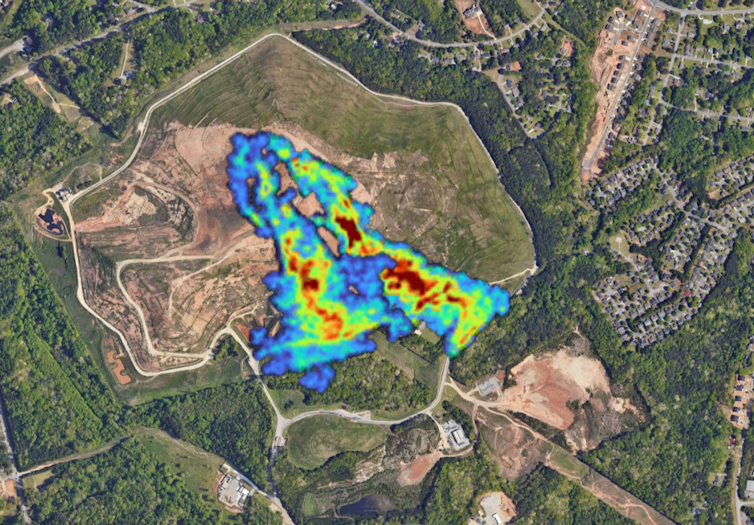
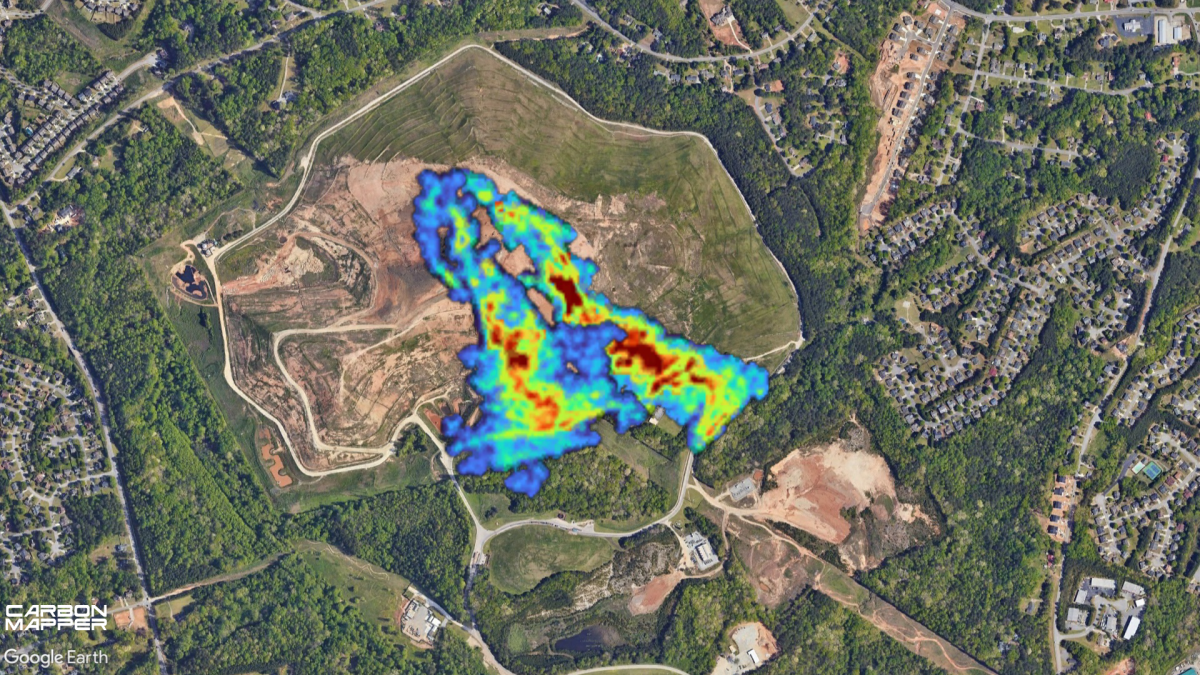
Colored areas show where methane is detected from a landfill surrounded by homes.
Methane plumes detected by plane at a Georgia landfill surrounded by homes. Carbon Mapper

Why are methane emissions such a concern?

Methane is the second-most common global-warming pollutant after carbon dioxide. It doesn’t stay in the atmosphere as long – only about a decade compared to centuries for carbon dioxide – but it packs an outsized punch.

Methane’s ability to warm the planet is nearly 30 times greater than carbon dioxide’s over 100 years, and more than 80 times over 20 years. You can think of methane as being a very effective blanket that traps heat in the atmosphere, warming the planet.

What worries many communities is that methane is also a health problem. It is a precursor to ozone, which can worsen asthma, bronchitis and other lung problems. And in some cases, methane emissions are accompanied by other harmful pollutants, like benzene, a carcinogen.
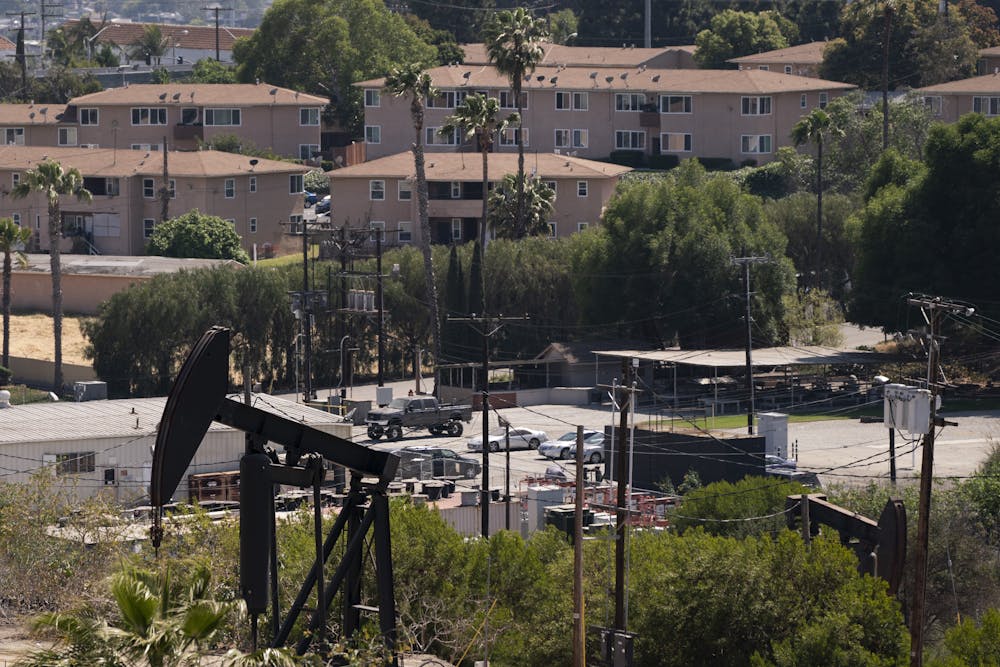
An oil pump across the street from apartment buildings in Los Angeles.
Los Angeles voted in 2022 to ban new oil wells and phase out existing ones. AP Photo/Jae C. Hong

In many oil and gas fields, less than 80% of gas that comes out of the ground from a well is methane – the rest can be hazardous air pollutants that you wouldn’t want anywhere near your home or school. Yet until recently, there was very little direct monitoring to find leaks and stop them.

Why are satellites necessary for catching methane leaks?

In its natural form, methane is invisible and odorless. You probably wouldn’t know there was a massive methane plume next door if you didn’t have special instruments to detect it.

Companies have traditionally accounted for methane emissions using a 19th-century method called an inventory. Inventories calculate emissions based on reported production at oil and gas wells or the amount of trash going into a landfill, where organic waste generates methane as it decomposes. There is a lot of room for error in this assumption-based accounting; for example, it does not account for unknown leaks or persistent venting.

Until recently, the state of the art in leak detection from oil and gas operations involved a technician paying a visit to a well pad every 90 days or so with a handheld infrared camera or gas analyzer. But a large leak can release a massive amount of gas over a period of several days and weeks or may occur in locations not readily accessible, meaning many of these so-called super-emitters go undetected.
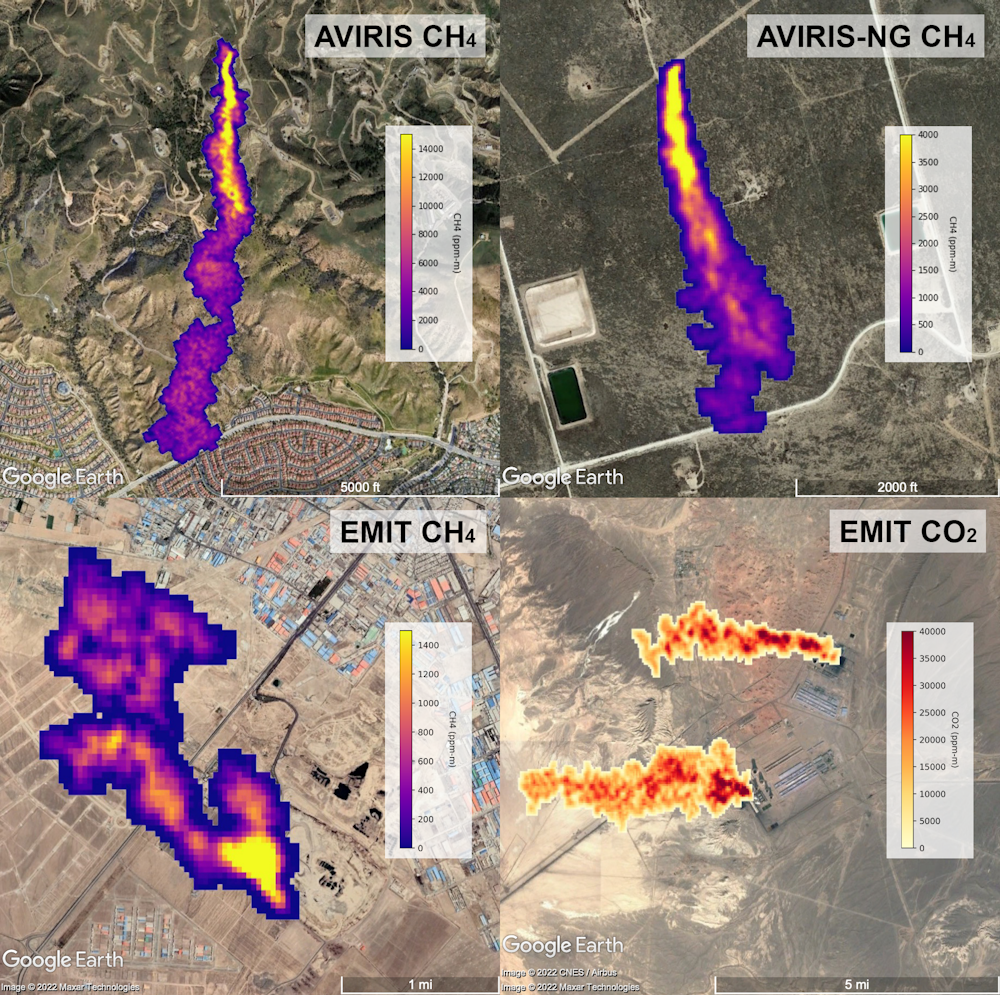
Satellite images show how methane plumes spread from different sources.
Methane plumes captured by NASA-designed airborne instruments (AVIRIS) and the EMIT instrument attached to the International Space Station. Clockwise from the top left: plumes from the Aliso Canyon storage blowout near Los Angeles in 2015, an oil and gas source in the Permian Basin, a power plant, and a landfill in Iran. NASA

Remote sensing satellites and airplanes, on the other hand, can quickly survey large areas routinely. Some of the newer satellites, including the ones we’re launching through the Carbon Mapper Coalition, can zoom in to individual sites at high resolution, so we can pinpoint methane super-emitters to the specific well pad, compressor station or section of a landfill.

You can see an example of the power of remote sensing in our recent paper in the journal Science. We surveyed 20% of the open landfills in the U.S. with airplanes and found that emissions on average were 40% higher than the emissions reported to the federal government using assumption-based accounting.
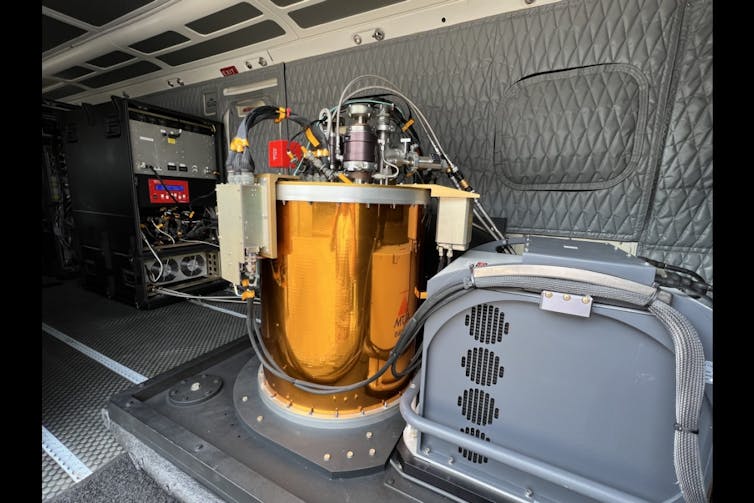
A large round instrument the size of an oil drum inside an airplane with padded walls
The copper-colored instrument is a spectrometer used by Carbon Mapper for airborne surveys of U.S. landfills. Arizona State University

If scientists can monitor regions frequently and consistently from satellites, then they can flag super-emitter activity and notify the operator quickly so the operator can find the problem while it’s still happening and fix any leaks.

How do satellites detect methane from space?

Most satellites capable of methane detection use some form of spectroscopy.

A typical camera sees the world in three colors – red, green and blue. The imaging spectrometers we use were developed by NASA’s Jet Propulsion Laboratory and see the world in almost 500 colors, including wavelengths beyond the visible spectrum into infrared, which is essential for detecting and measuring greenhouse gases.

Greenhouse gases like methane and carbon dioxide absorb heat in the infrared wavelengths – each with unique fingerprints. Our technology analyzes sunlight reflected from the Earth’s surface to detect those infrared fingerprints of methane and carbon dioxide in the atmosphere.

These signatures are distinct from all other gases, so we can image plumes of methane and carbon dioxide to determine the origins of individual super-emitters. Once we use spectroscopy to measure the amount of gas in a given plume, we can calculate an emission rate using wind speed data.

How methane emissions create health and climate problems. PBS.

What can the new satellites Carbon Mapper plans to launch do that others haven’t yet?

Each satellite has different and often complementary capabilities. MethaneSat, which the Environmental Defense Fund just launched in March 2024, is like a wide-angle lens that will produce a very precise and complete picture of methane emissions across large landscapes. Our Carbon Mapper Coalition satellites will complement MethaneSAT by acting like a collection of telephoto lenses – we’ll be able to zoom in to pinpoint individual methane emitters, like zooming in on a bird nesting in a tree.

Working with our partners at Planet Labs and NASA, we plan to launch the first Carbon Mapper Coalition satellite in 2024, with a goal of expanding the constellation in coming years to ultimately provide daily methane monitoring of high-priority regions around the world. For example, about 90% of the methane emissions from fossil-fuel production and use is estimated to come from only 10% of the Earth’s surface. So, we plan to focus Carbon Mapper Coalition satellites on oil, gas and coal production basins; major urban areas with refineries, wastewater plants and landfills; and major agriculture regions.

How will your monitoring data be used?

We expect from experience sharing our aircraft data with facility operators and regulators that a lot of our future satellite data will be used to guide leak detection and repair efforts.

Many oil and gas companies, landfill operators and some large farms with methane digesters are motivated to find leaks because methane in those cases is valuable and can be captured and put to use. So in addition to climate and health impacts, methane leaks are equivalent to venting profits into the atmosphere.

With routine satellite monitoring, we can quickly notify facility owners and operators so they can diagnose and fix any problems, and we can continue to monitor the sites to verify that leaks stay fixed.

Our data can also help to warn nearby communities of risks, educate the public, and guide enforcement efforts in cases where companies aren’t voluntarily fixing their leaks. By measuring trends in high-emission methane events over time and across basins, we can also contribute to assessments about whether policies are having their intended effect.The Conversation

Riley Duren, Research Scientist, University of Arizona

This article is republished from The Conversation under a Creative Commons license. Read the original article.

Police arrest suspect in Clearlake murder

CLEARLAKE, Calif. — Following a standoff, police have arrested a man who they said is a suspect in a murder discovered on Wednesday morning.

The Clearlake Police Department said Martin Jimenez, 55, was taken into custody on Wednesday afternoon.

The agency reported that at around 10:30 a.m. Wednesday its officers were dispatched to a residence in the 5900 block of James Street for a report of a deceased person.

The department’s report said the officers arrived on the scene within minutes and contacted the reporting party, who directed officers to a deceased 47-year-old male.

Based on the evidence at the scene it was apparent the deceased male was a homicide victim, police said.

At that point, a male suspect later identified as Jimenez was still inside the residence and refused to come out, according to the report.

Clearlake Police officers and detectives secured the property and attempted to talk the male subject into coming out of the residence.

A Lakeport Police Detective who frequently assists with Clearlake Police investigations obtained a search warrant for the residence, the report said.

The Lake and Mendocino County Regionalized SWAT team was requested and responded to the scene. Police also put out a Nixle alert asking the community to avoid the area.

Over the next few hours, Jimenez refused to come out but eventually did after chemical agents were deployed inside the residence, police said.

After he emerged from the residence, police arrested Jimenez for murder. Police said he will be booked into the Lake County Jail on the charge.

Police Chief Tim Hobbs told Lake County News that they are not yet sure of when the victim was killed.

As of late Wednesday afternoon, the case remained under investigation and police said no further details would be released.

“Thank you to the Lake County Sheriff's Office, Lakeport Police Department, Mendocino County Sheriff's Office, and the Ukiah Police Department for their assistance in bringing this incident to a safe conclusion,” the Clearlake Police Department said in its statement.

Editor’s note: A previous version of this article said the murder occurred on Wednesday. The article has been updated to show that police are not sure when it took place.

Lake County’s election results finalized; Owen tops Hess for District 1 race

LAKE COUNTY, Calif. — The Lake County Registrar of Voters Office has released the final results of the Nov. 5 election, which show a definitive win for a south county supervisorial candidate and the challengers for the three seats on the Clearlake City Council sweeping out the incumbents.

Registrar of Voters Maria Valadez released the final, certified election results on Tuesday, the deadline for her office to complete the official canvass process.

Among the races awaiting the final count in order to be definitively called was the one for District 1 supervisor, which the final results showed was won by longtime Middletown resident and rancher Helen Owen.

Owen and John Hess, a retired congressional staffer and a Lake County Planning Commission member, had a tight race in the March primary, when Owen bested him by just 179 votes.

The race remained tight in November’s initial count. On election night, the preliminary numbers indicated that Owen led Hess by 118 votes.

The final results released Tuesday showed that, in the end, Owen pulled away from Hess in a clear victory, receiving 3,118 votes, or 57.63%, to Hess’ 2,292 votes, or 42.37%.

Owen led both in vote-by-mail ballots and in election day voting, based on the results.

One result that didn’t change much between the preliminary and final counts was Measure U, the question for the county’s voters on whether or not Kelseyville should have its name changed to “Konocti.”

The election night result put “no” votes at 5,429 or 71.99%, versus “yes” votes of 2,112, or 28.01%.

In the final count, the “no” votes totaled 17,934 votes, or 70.58%, compared to 7,474 “yes votes,” accounting for 29.42% of the vote.

The Board of Supervisors is expected to discuss those results at a meeting later this month.

City council races

In other election news, in the city council races, both saw mayors being voted out and, in the case of Clearlake, all of its incumbent council members losing their reelection bids to three challengers.

Those incumbents seeking reelection in Clearlake were Mayor David Claffey, completing his first term; Joyce Overton, who was seeking her sixth term; and Russell Perdock, who first won a council seat in 2014, resigned to apply for police chief in early 2018 only to run unsuccessfully later that year in a bid to return to the council, was appointed to a vacant seat in 2019 and won a write-in bid in 2020.

An eight-person field had developed for the three council seats over the summer, and in the end Mary Wilson, Tara Downey and Jessica Hooten won the available seats.

Wilson is an adult education specialist for Woodland Community College’s Lake County Campus, while Downey is a high school secretary in the Konocti Unified School District and Hooten is a real estate agent.

The race’s placements are as follows:

• Mary Wilson: 1,360 votes, 15.52%.
• Tara Downey: 1,262 votes, 14.40%.
• Jessica Hooten: 1,256 votes, 14.33%.
• James Rivera: 1,076 votes, 12.28%.
• David Claffey: 1,070 votes, 12.21%.
• Brett Freeman: 1,015 votes, 11.58%.
• Joyce Overton: 982 votes, 11.21%.
• Russell Perdock: 742 votes, 8.47%.

In the Lakeport City Council race, which similarly had a larger-than-ordinary field, incumbents seeking reelection included Kim Costa, an appointed incumbent seeking her first full term; Michael Froio, this year’s mayor who is completing his first term; and Kenny Parlet, a local businessman seeking his fourth term.

The challengers included Carl Porter, a retired teacher, and real estate agent Christina Price, with Andre Williams coming on late in the race as a write-in candidate.

In the end, voters did not return Froio, who finished just out of the running, but elected Costa and Price, and reelected Parlet.

The race standings are as following:

• Christina Price: 944 votes, 22.37%.
• Kenny Parlet: 896 votes, 21.24%.
• Kim Costa: 842 votes, 19.96%.
• Michael Froio: 769 votes, 18.23%.
• Carl Porter: 701 votes, 16.62%.
• Andre Williams (write-in): 67 votes, 1.59%.

Incumbent Brandon Disney ran unopposed for a two-year unexpired seat, receiving 1,803 votes.

School board races

Five school board races were on the November ballot.

In the race for the Yuba Community College District Governing Board Member Trustee Area 7 seat, incumbent Doug Harris topped challenger Jeffrey Dryden.

The seat covers Colusa, Glenn and Lake counties, and a portion of Sutter County. The two men had run against each other in November 2022 for the seat when it was a two-year unexpired term.

While Dryden led Harris by small margins in Colusa, Glenn and Sutter counties, in Lake County Harris more than made up the deficit.

In Lake County, Harris received 5,467 votes, or 56.20%, to Dryden’s 4,260 votes, accounting for 43.80% of the vote.

Altogether, in all four counties, Harris received 6,856 votes and Dryden received 5,772 votes.

In other school board races, retired Lucerne Elementary Principal/Superintendent Mike Brown was the top vote-getter by far in the race for the Kelseyville Unified School District Governing Board.

Three seats were up for election. Brown received 3,338 votes, or 35.80%, followed by another challenger, Sabrina Andrus, with 2,527 votes or 27.10%. Winning the third seat was incumbent Gilbert Rangel with 1,905 votes or 20.43%.

Another incumbent, Mary Beth Mosko, finished outside of the running with 1,555 votes, or 16.68%.

In the race for two seats on the Konocti Unified School District Board, Joan Shelley Mingori topped the three-woman field with 2,896 votes, or 35.41%. Mingori is a previous board member who narrowly lost reelection in 2022.

Winning the second seat is incumbent Zabdy Neria with 2,829 votes, or 34.59%. Challenger Tina Viramontes received 2,454 votes, or 30%.

The Lakeport Unified School Board had three seats on the ballot. Challenger Catherine “Cat” Dunne received the most votes, 2,727 or 34.29%, followed by another challenger, Scott Johnson, with 2,002 votes or 25.17%.

Incumbent Jennifer Richardson won the third and final seat with 1,738 votes, or 21.85%. The second incumbent seeking reelection, Dan Buffalo, finished outside of the running with 1,486 votes or 18.68%.

In the Middletown Unified School District Board race, Annette Lee, a former board member seeking to return to service, topped the field for two four-year seats with 2,149 votes or 39.45%, followed by incumbent Zoi Ann Bracisco with 2,085 votes, or 38.28%.

Challenger Frederic Lahey received 1,213 votes or 22.27%, finishing out of the running.

In the race for a two-year unexpired term on Middletown Unified’s Board, Patricia Pachie received 2,278 votes or 56.08%, defeating Nathan Willis, with 1,784 votes or 43.92%.

School bonds

Two school bond measures also were on the Nov. 5 ballot, both of which required at least a 55% majority to pass.

The Konocti Unified School District put Measure S before voters, seeking $50 million in bonds for school facilities projects.

The final count showed that Measure S passed after receiving 4,191 “yes” votes, or 60.03%, to 2,791 “no” votes, or 39.97%.

At the same time, Kelseyville Unified School District asked voters to approve Measure R, a $36 million bond measure to make upgrades to school facilities.

Measure R fell just short of the required 55%, receiving 2,927 “yes” votes, or 52.51%, to 2,647 “no” votes, or 47.49%.

Email Elizabeth Larson at This email address is being protected from spambots. You need JavaScript enabled to view it.. Follow her on Twitter, @ERLarson, and on Bluesky, @erlarson.bsky.social. Find Lake County News on the following platforms: Facebook, @LakeCoNews; X, @LakeCoNews; Threads, @lakeconews, and on Bluesky, @lakeconews.bsky.social.

Health officials report on success in tobacco prevention policy milestones

LAKE COUNTY, Calif. — A vote by the Lakeport City Council on Tuesday evening became the latest in what county health officials said is a series of tobacco prevention policy milestones meant to improve public health.

On Tuesday, the Lakeport City Council held its second and final reading of a tobacco retailer licensing ordinance, approving it 4-1, with Councilman Kenny Parlet being the loud and only dissenting vote.

Later that night following the Lakeport City Council’s vote, Lake County Health Services released a statement in which it announced “the culmination of years of dedicated collaboration and community engagement in achieving a Tobacco Retail Licensing ordinance, alongside critical Smoke-Free Outdoor Policies. These initiatives underscore Lake County’s commitment to protecting public health and reducing tobacco-related harm, particularly among youth.”

Lake County Health Services said the groundwork for these policies was laid beginning in 2017 with the city of Clearlake.

In an effort to work towards a tobacco retail license, the Clearlake City Council passed a moratorium preventing new tobacco retailers in 2018. This action set the stage for the development of a comprehensive tobacco retail license and smoke-free outdoor policies. By 2019, the city of Clearlake had extended the moratorium twice and adopted a smoke-free outdoor policy.

Concurrently, Lake County Health Services engaged with the Board of Supervisors to present the framework for tobacco retail licensing and smoke-free policies, including discussions on fee structures, enforcement and penalties. However, those efforts were temporarily paused due to the pandemic disruptions in 2020.

In 2022, the Board of Supervisors directed Lake County Health Services to revisit these policies.

In February 2023, a collaborative presentation detailed the public health benefits of tobacco retail licensing and smoke-free outdoor policies. Representatives from NorCal 4 Health, Tobacco Free North Coast, the Health & Social Policy Institute Communities Against Nicotine, Blue Zones Lake County and the Lake County Office of Education’s TUPE program joined the presentation, emphasizing the shared mission to curb youth tobacco use and improve health outcomes.

Countywide, achievements on this effort to date include the following developments this year.

Aug. 13: The Board of Supervisors passed the tobacco retail licensing ordinance with rigorous enforcement measures, setting a Jan. 1, 2025, implementation date.

Sept. 10: Adoption of a smoke-free outdoor air policy covering county-owned and leased properties, as well as multi-unit housing common areas.

Nov. 21: The Clearlake City Council passed the tobacco retail license ordinance, mirroring the efforts of the county of Lake.

Dec. 3: The Lakeport City Council joined efforts to provide a seamless plan across the county for the implementation and enforcement of the local tobacco retail license ordinance.

“It’s inspiring to see our community rally together to protect future generations from the dangers of tobacco addiction,” said Liberty Francis, project director of the Tobacco Education and Prevention program. “This united front demonstrates the power of collaboration.”

Francis was on hand at the council meeting Tuesday night and offered answers and clarifications on some of the issues raised during the meeting.

Health Services said the tobacco retail license ordinance and smoke-free policies represent “more than legislative victories; they are steps toward a healthier future for all Lake County residents. These efforts have already inspired ongoing partnerships with the cities of Clearlake and Lakeport, where TRL [tobacco retail license] ordinances have been adopted to mirror compliance and enforcement efforts.”

Lake County Health Services thanked the Lake County Board of Supervisors, local government leaders, public health organizations, and community members for their unwavering support.

“Together, they’ve achieved monumental progress in the fight against tobacco-related harm,” the agency said.
  • 305
  • 306
  • 307
  • 308
  • 309
  • 310
  • 311
  • 312
  • 313
  • 314

Community

  • Lake County Wine Alliance offers sponsor update; beneficiary applications open 

  • Mendocino National Forest announces seasonal hiring for upcoming field season

Public Safety

  • Lakeport Police logs: Thursday, Jan. 15

  • Lakeport Police logs: Wednesday, Jan. 14

Education

  • Woodland Community College receives maximum eight-year reaffirmation of accreditation from ACCJC

  • SNHU announces Fall 2025 President's List

Health

  • California ranks 24th in America’s Health Rankings Annual Report from United Health Foundation

  • Healthy blood donors especially vital during active flu season

Business

  • Two Lake County Mediacom employees earn company’s top service awards

  • Redwood Credit Union launches holiday gift and porch-to-pantry food drives

Obituaries

  • Rufino ‘Ray’ Pato

  • Patty Lee Smith

Opinion & Letters

  • The benefits of music for students

  • How to ease the burden of high electric bills

Veterans

  • CalVet and CSU Long Beach team up to improve data collection related to veteran suicides

  • A ‘Big Step Forward’ for Gulf War Veterans

Recreation

  • Wet weather trail closure in effect on Upper Lake Ranger District

  • Mendocino National Forest seeking public input on OHV grant applications

  • State Parks announces 2026 Anderson Marsh nature walk schedule 

  • BLM lifts seasonal fire restrictions in central California

Religion

  • Kelseyville Presbyterian to host Ash Wednesday service and Lenten dinner Feb. 18

  • Kelseyville Presbyterian Church to hold ‘Longest Night’ service Dec. 21

Arts & Life

  • Auditions announced for original musical ‘Even In Shadow’ set for March 21 and 28

  • ‘The Rip’ action heist; ‘Steal’ grounded in a crime thriller

Government & Politics

  • Lake County Democrats issue endorsements in local races for the June California Primary

  • County negotiates money-saving power purchase agreement

Legals

  • March 3 hearing on ordinance amending code for commercial cannabis uses

  • Feb. 12 public hearing on resolution to establish standards for agricultural roads

How to resolve AdBlock issue?
Refresh this page
