How to resolve AdBlock issue?
Refresh this page
How to resolve AdBlock issue?
Refresh this page
Lake County News,California
  • Home
    • Registration Form
  • News
    • Education
    • Veterans
    • Community
      • Obituaries
      • Letters
      • Commentary
    • Police Logs
    • Business
    • Recreation
    • Health
    • Religion
    • Legals
    • Arts & Life
    • Regional
  • Calendar
  • Contact us
    • FAQs
    • Phones, E-Mail
    • Subscribe
  • Advertise Here
  • Login

News

Governor declares state of emergency in response to bird flu

Gov. Gavin Newsom meets with FDA Commissioner Dr. Robert Califf to discuss local, state and federal efforts to protect Californians from bird flu on Saturday, Dec. 14, 2024. Photo courtesy of the Governor’s Office.

On Wednesday, Gov. Gavin Newsom proclaimed a state of emergency to streamline and expedite the state’s response to Avian influenza A, or H5N1, commonly known as “bird flu.”

This action comes as cases were detected in dairy cows on farms in Southern California, signaling the need to further expand monitoring and build on the coordinated statewide approach to contain and mitigate the spread of the virus.

The virus has spread in 16 states among dairy cattle, following its first confirmed detection in Texas and Kansas in March.

To date, no person-to-person spread of bird flu has been detected in California and nearly all infected individuals had exposure to infected cattle.

California has already established the largest testing and monitoring system in the nation to respond to the outbreak.

This emergency proclamation will provide state and local agencies with additional flexibility around staffing, contracting, and other rules to support California’s evolving response.

“This proclamation is a targeted action to ensure government agencies have the resources and flexibility they need to respond quickly to this outbreak,” said Newsom. “Building on California's testing and monitoring system — the largest in the nation — we are committed to further protecting public health, supporting our agriculture industry, and ensuring that Californians have access to accurate, up-to-date information. While the risk to the public remains low, we will continue to take all necessary steps to prevent the spread of this virus."

Ongoing efforts to prevent spread and serious infection

California has mobilized a comprehensive cross-agency response to bird flu in dairy cattle and poultry farms to minimize farm worker exposures, reduce raw dairy product contamination and mitigate the spread of the virus.

The state has enlisted local, state and federal government technical and operational expertise to support all facets of the response; worked to educate the public, health professionals, employers, and workers on prevention and control measures to reduce the risk of exposure to bird flu; provided comprehensive information for employers and workers on personal protective equipment, or PPE, requirements; and distributed millions of pieces of PPE to high-risk workers at dairy farms.

Through coordinated public awareness efforts between the California Department of Public Health, the California Department of Food and Agriculture, California Office of Emergency Services, and other agencies, the state is leading a cross-agency response that includes timely public updates, multilingual outreach to dairy and poultry workers, targeted social media efforts to promote preventive practices, online and printed resources for the public and media interviews to keep Californians informed.

Additionally, the state is ensuring that agriculture workers have access to additional doses of seasonal flu vaccine from the Centers for Disease Control and Prevention to reduce concurrent flu risks.

Officials have also been working in close collaboration with the Centers for Disease Control, the U.S. Food and Drug Administration, the U.S. Department of Agriculture, and local health and agricultural officials, as part of a whole-of-government effort to coordinate, implement, and ensure timely surveillance and investigation of potential cases of Bird Flu.

Bird flu in the United States

Bird flu was first detected in the United States in the wild bird population in South Carolina in January 2022, and in the wild bird population in California in July 2022.

On March 25, 2024, an outbreak of bird flu in dairy cows was first reported in Texas and Kansas, and CDFA took immediate action to monitor for bird flu infections in California herds.

Since then, there have been 61 total reported confirmed cases of bird flu infection in humans across seven states, including 34 reported human cases in California.

On Aug. 30, 2024, following its detection in 13 other states, bird flu was confirmed in a dairy cow in Central California, and the California Department of Public Health immediately activated its Medical Health Coordination Center.

California Community Colleges Board of Governors adopts regulation to expand free textbooks and instructional materials

SACRAMENTO, Calif. — New regulations approved by the California Community Colleges Board of Governors will require colleges to dramatically expand the availability of free, open-source textbooks and instructional materials for students, beginning on the first day of class.

“This regulation is a bold step forward in tackling a critical issue: making textbooks and other instructional materials affordable and accessible to all of our students,” said Board President Hildegarde B. Aguinaldo. “By prioritizing affordability, students can better focus on meeting their higher education goals without added financial stress.” 

Under the new regulation, governing boards of community college districts are required to adopt policies that prioritize free instructional materials.

Once the regulation is finalized with the state of California, districts will have 180 days to put the policies into effect.

These policies are to include the following strategies:

• Developing and implementing degrees that don’t require students to pay for textbooks;
• Using open-source instructional materials complete degrees and career education certificates;
• Using free, open-source instructional materials for courses where they are commonly available, with a focus on general education requirements;
• Establishing lending programs and maintaining college library resources to ensure immediate access to course materials; and
• Strengthening student financial stability through the timely disbursement of financial aid and other institutional program resources. 

“With this regulation, we are ensuring that all students have access to the materials they need to be successful on day one,” said California Community Colleges Chancellor Sonya Christian. “Prioritizing zero-cost general education textbooks through adopting Open Educational Resources will benefit the vast majority of our students and drive progress towards our system’s Vision 2030 goals. The California Community Colleges is ensuring financial barriers no longer stand in the way of academic success.”

Currently, California college students spend an average of more than $1,100 annually on textbooks and other instructional materials — a cost that disproportionately impacts students from traditionally underserved communities.

By addressing this financial barrier, the regulation aims to prevent students from having to choose between purchasing essential materials and meeting basic needs. 

Board of Governors member Joseph R. Williams played a large role in moving this regulation forward.

“This is an issue of equity. Many of our most vulnerable students face significant financial challenges, which delays or ends their dreams of higher education. These hardships underscore the urgency of reducing costs to prevent students from choosing between essential instructional materials and basic needs. This resolution is an opportunity to truly make California Community Colleges more accessible for everyone,” said Williams.

The regulation is part of a larger effort to scale the development of zero-cost degrees and general education pathways throughout the 116-college system. 

The California Community Colleges is the largest system of higher education in the nation, composed of 73 districts and 116 colleges serving 2.1 million students per year.

No flood gauges, no warning: 99% of US streams are off the radar amid rising flash flood risks – we saw the harm in 2024


Heavy rain sent Great Brook raging over its banks in Plainfield, Vt., in July 2024. AP Photo/Ted Shaffrey

Southeast Texas was hit by flash flooding repeatedly in the spring, and then hit again by Hurricane Beryl. In one heartbreaking moment, a 4-year-old boy was swept away after his family’s car was submerged during a thunderstorm near Fort Worth.

In the Upper Midwest, days of rainfall in May caused flooding along the Mississippi River and its tributaries. A slow-moving storm in the Northeast in August caused catastrophic flooding in Connecticut.

The mountains of North Carolina and Tennessee saw some of the year’s most devastating flooding as the remnants of Hurricane Helene hit in September. Heavy rain poured down mountains, turning creeks and rivers into torrents that washed away homes and vehicles. More than 100 people died in North Carolina, and six workers drowned when their plastics factory was inundated in Tennessee.
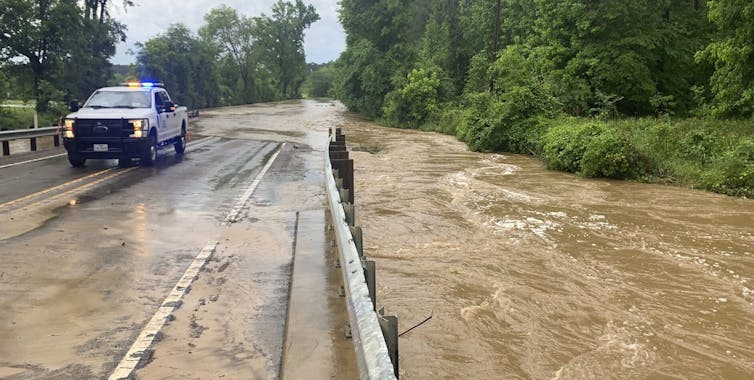
A truck is parked at the edge of a road to alert drivers of an area where muddy water is washing over the bridge beyond.
Floodwaters rise over a bridge in Grapeland, Texas, on May 2, 2024. Texas Department of Transportation via AP

Storms like these are intensifying faster, weakening more slowly and producing more extreme precipitation that the land can’t absorb fast enough. While many coastal areas are becoming more prepared for hurricane and tidal flooding, inland flood risk is less understood or easily anticipated.

These disasters underscore the importance of fast, accurate flood warnings. They’re also a reminder that extensive gaps still exist in the systems that monitor U.S. stream levels.

Current coverage is less than 1% of waterways

The National Weather Service uses advanced models to issue flood warnings. These models rely on historical trends, land cover information and a network of over 11,800 streamgages – sensors that provide near-real-time data on precipitation, streamflow and water depth – to simulate water flow. Much of that data is available online in real time.

However, the streamgage network covers less than 1% of the nation’s rivers and streams.

Deploying a single sensor costs over US$25,000 for permanent federal gauges, and nearly 70% of these costs can fall on communities. These high upfront costs, combined with rising operational expenses, significantly limit sensor coverage — particularly in small and urban watersheds prone to flash floods.The U.S. Geological Survey acknowledges that these sensors alone do not provide enough data at fast enough intervals to fully address flood risk.

Without data, risk is often underestimated

Flood risk can be estimated in waterways without streamgages, but not as accurately.

In these areas, computers use data from similar waterways to estimate stream flow. However, these assumptions, along with limited data and the evolving effects of climate change, introduce uncertainty.

The resulting models often underestimate flow in smaller creeks and overlook the effects of urbanization. In particular, they can miss new risks in fast-developing areas, where changes to the landscape and more pavement can quickly funnel water in risky ways.

These flood models are used for more than warnings. They also guide risk assessments for development, insurance and decisions on building protective infrastructure, so accuracy is important.

A case study in Philadelphia

A July 2023 flash flood in Lower Makefield, a suburb of Philadelphia along the Delaware River, highlights the challenges of insufficient data coverage in urbanizing watersheds.

On July 15, heavy rain transformed Houghs Creek, a small tributary of the Delaware River, into a deadly torrent, washing out Washington Crossing Road and trapping multiple vehicles. Survivors recalled the chaos:

“All of a sudden, 3 inches of water, 4 inches of water, a foot of water just coming at us,” Chloe Weissman said.

“This huge gush of water just came down from … down a hill,” added Eli Weissman. “As it was coming down, cars were starting to float. [We] just tried to survive, laid on our back, feet heading down, grabbing trees, grabbing vines, grabbing whatever we could to stay afloat.”

A small stream running beside a road, with toppled trees and damage to the road from flooding.
This stream in the Philadelphia suburb of Lower Makefield flooded so quickly on July 15, 2023, that it toppled trees and caused cars on the road to float and crash into each other. Drivers and passengers tried desperately to grab hold of tree branches as they were swept away by the torrent. Google image
A map of the Philadelphia area shows where flooding occurred outside the warning zones
A map of rainfall totals and flash flood warnings shows how important locally targeted information can be. The flash flooding in Upper Makefield (pink) that washed away cars occurred outside the zones listed in the warning. Julie Arbit/University of Michigan

The National Weather Service issued a flash flood warning at 5:18 p.m., but a phone alert wasn’t triggered until 6:09 p.m. – after the flooding had begun. While the Delaware River has a nearby streamgage, flood models did not predict the rapid flooding along this small tributary.

Urbanization around Houghs Creek has made these events more dangerous and less predictable, as impervious surfaces quickly funnel the water into low-lying areas. The flash flood underscored the need for hyperlocal data to improve predictive models and allow earlier, more accurate warnings.

Expanding coverage of stream flood levels

Addressing data gaps is essential for improving weather forecasting and emergency management.

One promising solution is expanding the streamgage network through public-private partnerships and encouraging state and local governments, small businesses, academic institutions and nonprofits to build and operate their own sensors. Greater coverage enables more accurate and timely flood forecasts, leading to improved warnings, more prepared communities and more effective emergency responses when disasters strike.

Engineers at the University of Michigan Digital Water Lab created one example of a low-cost, easy-to-deploy solution for flood monitoring. At its core is a controller connected to an ultrasonic sensor that measures water levels in a way similar to how bats navigate using sound. The data can be transmitted in real time for fast analysis.

A person holds the controller in one image. A second image shows an open box with a circuit board.
Digital water sensors on bridges provide real-time, continuous water level monitoring, enhancing safety for drivers and supporting transportation agencies in assessing and maintaining infrastructure. Digital Water Lab/University of Michigan, CC BY-ND

The simplicity and affordability – around US$800 per sensor – of this system allows for widespread deployment, providing critical information to communities. Techniques such as validating readings against precipitation measurements, calibrating sensors with federal monitoring stations and using supervised machine learning can build confidence in the value of this third-party and citizen-generated data.

Eventually, nonfederal sensors like these may be integrated into federal flood models.

In the meantime, researchers have created open-source databases that consolidate all known gauge data and allow the public to supply information. These combined datasets allow more advanced and robust flood models, such as Google’s flood forecasting model, which covers large portions of the country.

Future of flood monitoring

Several universities are working together in a collaboration called FloodAware to develop a system that integrates “floodcams,” social media posts, smart city sensors and more to detect and warn residents of flash floods. Bringing these tools together could greatly expand the data available to meteorologists and emergency managers, improving flood risk assessments and warnings.

Combining diverse sources of data on a shared platform would establish a more comprehensive, accessible flood monitoring system. We believe that would empower communities with the information they need to advocate for protective measures, ultimately enhancing resilience in the face of climate change.The Conversation

Julie Arbit, Researcher at the Center for Social Solutions, University of Michigan; Brad Bottoms, Data Scientist at the Center for Social Solutions, University of Michigan, and Branko Kerkez, Associate Professor of Civil Engineering, University of Michigan

This article is republished from The Conversation under a Creative Commons license. Read the original article.

Flooding is one of the deadliest and costliest natural disasters in the U.S., causing billions of dollars in damage each year. In 2024 alone, floods destroyed homes in over a dozen states and claimed more than 165 lives.

Lakeport City Council bids farewell to mayor; new council sworn in

Outgoing Lakeport Mayor Michael Froio, at left, is presented with a congressional certificate of special congressional recognition by Luca Moretti, field representative for Congressman Mike Thompson, on Tuesday, Dec. 17, 2024, in Lakeport, Calif. Photo by Elizabeth Larson/Lake County News.

LAKE COUNTY, Calif. — The Lakeport City Council bid farewell to its mayor and held the swearing-in for its new members on Tuesday night, with the newly formed council composed of the first female majority in its history.

City Clerk Kelly Buendia presented the final results of the Nov. 5 election as part of the council reorganization.

“This is a very important event for the city of Lakeport,” said Buendia, noting it welcomes new leadership and marks a transition.

Councilmembers unanimously approved the election results before moving on to the formal changing of the guard.

Mayor Pro Tem Kim Costa led the honors for outgoing Mayor Michael Froio.

Froio, who has served one term on the council, narrowly missed being reelected in November.

Council members each offered Froio thanks for his work on the council, which followed a term on the Lakeport Planning Commission.

Councilman Brandon Disney, who ran unopposed for a two-year term, said Froio took the initiative to fix issues in the city.

Councilwoman Stacey Mattina thanked Froio for his years of service, noting she appreciated his time and effort.

Councilman Kenny Parlet noted Froio is all over town. “I’ve never seen a mayor who was so hands-on and involved in the community and showed that he really cared.”

Parlet said he was proud to have served with a guy who cared that much. “You just did a great job.”

He said that the year had been “a little shaky at the beginning,” but ended up being good, which Froio said was a reference to the way he ran meetings.

“I’m rough, and I’m admittedly rough,” Froio said, noting he had watched Mattina run meetings for years and no one was as smooth, effortless or as gracious.

“It was a good year. It was fun to be the mayor for a year,” Froio said.

City Manager Kevin Ingram, who had encouraged Froio to apply for the Lakeport Planning Commission, said it was a pleasure working with Froio for eight years. He said a lot of the projects Froio has been instrumental in putting in place will continue to come to fruition, such as beautification projects.

Outgoing District 4 Supervisor Michael Green, who served with Froio on the Planning Commission, said that while they didn’t agree on everything, he appreciated the way Froio could disagree in a gentlemanly way. He also credited Froio with doing good work in local government.

Brad Rasmussen, Lakeport’s retired police chief who will succeed Green as District 4 supervisor in January, also thanked Froio for his dedication to the city.

While they didn’t always agree on every issue, “He was always coming from a place where he cared about making the community better,” Rasmussen said of Froio.

Luca Moretti, field representative for Congressman Mike Thompson, presented Froio with a certificate of special congressional recognition for his work.

“Thank you for your commitment to public service,” and for making Lakeport a better place to live, said Moretti, adding that Froio’s work will impact people for years to come.

“You worked hard on behalf of the people,” whatever their need was, said Costa.

She also credited Froio with helping get resolution on the long-running issues with the dilapidated Vista Point property.

Froio also has been consistent in his concerns for the homeless population in Lake County, and he’s continued to look at establishing a low barrier navigation center. She added that she appreciated his encouragement when she was a new council member.

“Wow,” Froio said at the end of the accolades, offering his thanks. “I’m humbled.”

He acknowledged encouraging Costa to apply for an open seat. He said she “knocked it out of the park.”

Both Costa and Disney initially were appointed to the council two years ago, and he said both have jumped in and done the work.

Froio said Parlet and Mattina have been on the council a long time, anchoring it, and he told newly elected member Christina Price that they will be there to help her.

With that, he stepped down from the dais.

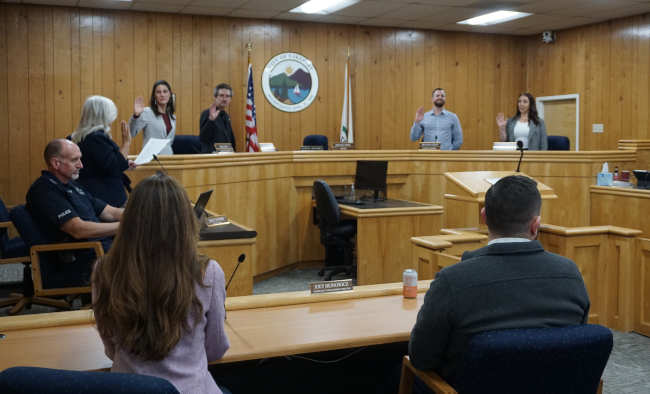
Buendia then administered the oath of office to Costa, Disney, Parlet and Price. Mattina temporarily stopped off the dais while the swearing-in took place.

During the council’s brief reorganization, Costa was elected mayor and Disney mayor pro tem, or vice mayor, for 2025.

Lakeport now has its first majority female council, a fact confirmed to Lake County News by Deputy City Clerk Hilary Britton.

This year, Clearlake also has a three-woman majority, but that council first had a female majority in 2012, continuing until 2016, according to Clearlake City Clerk Melissa Swanson.

During the remainder of the meeting, which ran just under an hour, the council’s other main item of business was the unanimous adoption of a resolution approving a memorandum of understanding between the county of Lake, city of Clearlake and city of Lakeport authorizing the formation of the Lake County Regional Housing Trust Fund.

Email Elizabeth Larson at This email address is being protected from spambots. You need JavaScript enabled to view it.. Follow her on Twitter, @ERLarson, and on Bluesky, @erlarson.bsky.social. Find Lake County News on the following platforms: Facebook, @LakeCoNews; X, @LakeCoNews; Threads, @lakeconews, and on Bluesky, @lakeconews.bsky.social.

City Clerk Kelly Buendia administers the oath of office to the newly elected and reelected council members during the Lakeport City Council meeting on Tuesday, Dec. 17, 2024, in Lakeport, Calif. Photo by Elizabeth Larson/Lake County News.

Rising home equity boosted household wealth during pandemic


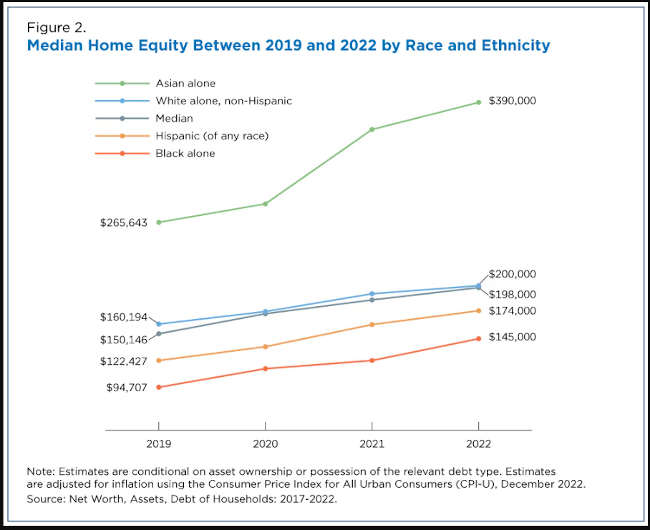
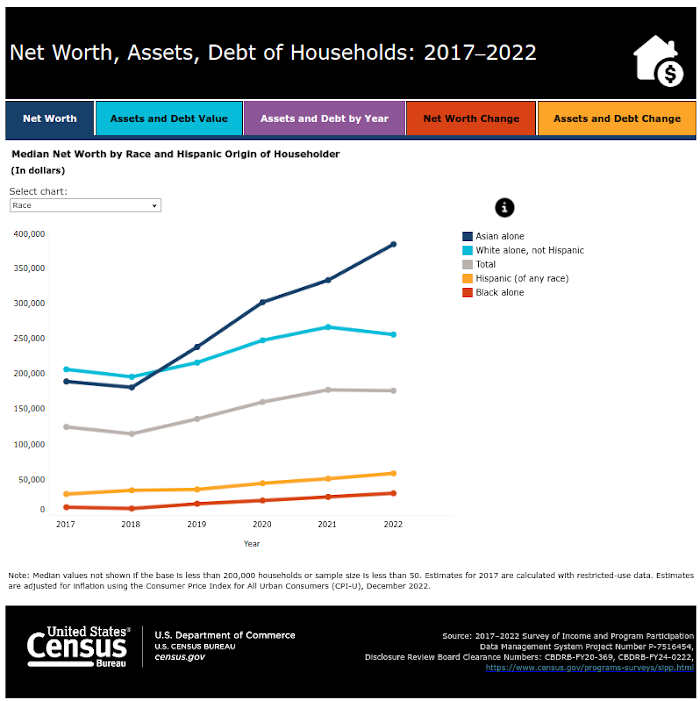
The median net worth of U.S. households increased about $40,000 from 2019 to 2022, primarily due to rising home equity during the COVID-19 pandemic.

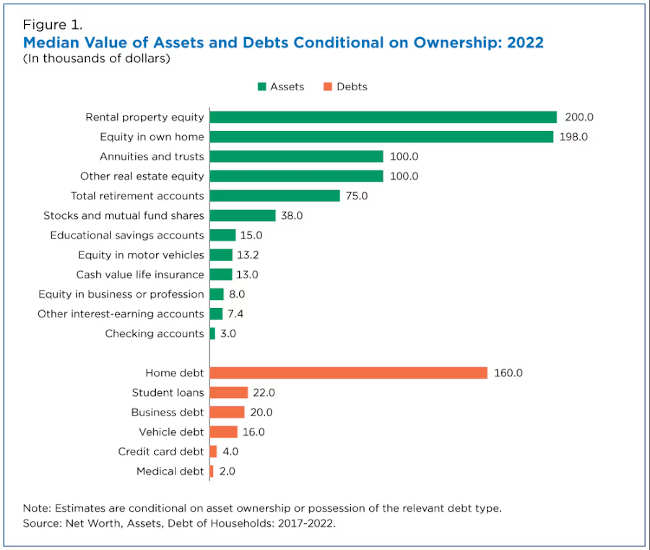
According to the U.S. Census Bureau’s Survey of Income and Program Participation, or SIPP, median household net worth was $176,500 in 2022, up from $136,500 in 2019. Among households that owned a home, median home equity increased by $47,900 during that time.

All estimates are adjusted for inflation to 2022 dollars.

A new data visualization explores changes in net worth, assets and debt across different demographic and economic characteristics from 2017 to 2022.

Among more commonly held assets, or assets held by at least half of all households, home equity had the largest value.

Equity is the value of an asset, minus any secured debts held against it. To calculate home equity, subtract any amount still owed on a mortgage from the value of a home.

In 2022, about 62.2% of households reported home equity with a median value of $198,000 and about 35.7% of households held home debt with a median value of $160,000.


Home equity by race and ethnicity

As home prices rose sharply throughout the country starting in 2020, home equity also increased for most income and demographic groups.

Among the groups with the largest home equity gains were households with an Asian householder. These households were more highly concentrated in the West and Northeast, regions with higher home prices and larger home price increases during this period.

A greater share of households reported having home equity, increasing from 61.3% in 2019 to 62.2% in 2022.

The share of households with home equity by race and ethnicity in 2022:

• About 70% of households with White alone, non-Hispanic householders.
• 59.3% of those with an Asian householder.
• 47.8% of those with Hispanic householders.
• 40.5% of those with Black householders.

The 2022 and 2019 estimates by race group were not statistically different.

Home equity by age

Home equity generally increases with age.

In 2022, younger householders and households with children were less likely to own a home and if they did their home debt was typically higher.

The youngest householders, under age 35, held twice as much home debt ($200,000) as those householders 75 and older ($100,000).

Households with children under 18 held $197,000 in home debt and those without children in the home held $140,000 in home debt.

Visualizing U.S. Households’ Assets and Debts


Christin Landivar is a senior researcher in the Census Bureau’s Social, Economic, and Housing Statistics Division.

State schools superintendent sponsors bill to keep immigration enforcement off school campuses

State Superintendent of Public Instruction Tony Thurmond said he is sponsoring Senate Bill 48, legislation that aims to keep U.S. Immigration and Customs Enforcement, or ICE, agents off California campuses by establishing a one-mile radius safe zone around schools, as well as protect against the use of school data for deportation efforts.

The bill, introduced by Senate Majority Leader Lena Gonzalez (D-33) on Monday, will prevent schools from experiencing a drop-off in student attendance due to immigration concerns, which would directly and negatively impact critical funding, officials said.

The bill also doubles down on the commitment by the California Department of Education to safeguard students and families, maintaining schools as spaces where everyone has the right to an education.

“SB 48 seeks to push back against threats of deportation that create fear in immigrant families. These practices suppress school attendance and rob schools of needed revenue,” said Superintendent Thurmond. “I am honored to partner with bill author Senator Lena Gonzalez, other legislators, and immigrant rights groups to support our families and keep ICE off our school campuses — period.”

The bill would prohibit school districts, county offices of education, charter schools, and their personnel from granting ICE officers and other federal immigration authorities access to campuses if they do not have a judicial warrant.

The legislation would also prohibit police cooperation with any immigration enforcement efforts within a one-mile radius of school to ensure a safe corridor for parents to bring their children to and from school.

SB 48 will also prohibit the sharing of any information about students, families, their households and school employees with ICE officers or other federal authorities.

“All California children deserve safe school environments that prioritize student learning, regardless of immigration status,” said Senate Majority Leader Lena Gonzalez. “As chair of the California Latino Legislative Caucus, I’m proud to be partnering with Superintendent Tony Thurmond to author this important legislation, which will prevent disruptions to student learning, keep children in school, and prevent families from being torn apart.”

In California, 93 percent of children who have one or more undocumented parents are U.S. citizens. Additionally, all children in the United States, regardless of immigration status, have a right to a free and appropriate public education, officials said.

Education officials said the proposed bill reflects California’s commitment to ensure that pandemic-era increases in chronic absenteeism do not recur and reiterates California’s commitment to make sure that schools are welcoming environments where all families can safely bring their children to learn.
  • 295
  • 296
  • 297
  • 298
  • 299
  • 300
  • 301
  • 302
  • 303
  • 304

Community

  • Lake County Wine Alliance offers sponsor update; beneficiary applications open 

  • Mendocino National Forest announces seasonal hiring for upcoming field season

Public Safety

  • Lakeport Police logs: Thursday, Jan. 15

  • Lakeport Police logs: Wednesday, Jan. 14

Education

  • Woodland Community College receives maximum eight-year reaffirmation of accreditation from ACCJC

  • SNHU announces Fall 2025 President's List

Health

  • California ranks 24th in America’s Health Rankings Annual Report from United Health Foundation

  • Healthy blood donors especially vital during active flu season

Business

  • Two Lake County Mediacom employees earn company’s top service awards

  • Redwood Credit Union launches holiday gift and porch-to-pantry food drives

Obituaries

  • Rufino ‘Ray’ Pato

  • Patty Lee Smith

Opinion & Letters

  • The benefits of music for students

  • How to ease the burden of high electric bills

Veterans

  • CalVet and CSU Long Beach team up to improve data collection related to veteran suicides

  • A ‘Big Step Forward’ for Gulf War Veterans

Recreation

  • Wet weather trail closure in effect on Upper Lake Ranger District

  • Mendocino National Forest seeking public input on OHV grant applications

  • State Parks announces 2026 Anderson Marsh nature walk schedule 

  • BLM lifts seasonal fire restrictions in central California

Religion

  • Kelseyville Presbyterian to host Ash Wednesday service and Lenten dinner Feb. 18

  • Kelseyville Presbyterian Church to hold ‘Longest Night’ service Dec. 21

Arts & Life

  • Auditions announced for original musical ‘Even In Shadow’ set for March 21 and 28

  • ‘The Rip’ action heist; ‘Steal’ grounded in a crime thriller

Government & Politics

  • Lake County Democrats issue endorsements in local races for the June California Primary

  • County negotiates money-saving power purchase agreement

Legals

  • March 3 hearing on ordinance amending code for commercial cannabis uses

  • Feb. 12 public hearing on resolution to establish standards for agricultural roads

How to resolve AdBlock issue?
Refresh this page