How to resolve AdBlock issue?
Refresh this page
How to resolve AdBlock issue?
Refresh this page
Lake County News,California
  • Home
    • Registration Form
  • News
    • Education
    • Veterans
    • Community
      • Obituaries
      • Letters
      • Commentary
    • Police Logs
    • Business
    • Recreation
    • Health
    • Religion
    • Legals
    • Arts & Life
    • Regional
  • Calendar
  • Contact us
    • FAQs
    • Phones, E-Mail
    • Subscribe
  • Advertise Here
  • Login

News

Helping Paws: Shepherds, terriers and puppies

LAKE COUNTY, Calif. — Lake County Animal Care and Control has a shelter filled with a variety of dogs.

The dogs available for adoption this week include mixes of Anatolian shepherd, Belgian malinois, boxer, bull terrier, cattle dog, Chihuahua, Doberman pinscher, German shepherd, German shorthaired pointer, husky, Labrador Retriever, pit bull terrier and terrier.

Dogs that are adopted from Lake County Animal Care and Control are either neutered or spayed, microchipped and, if old enough, given a rabies shot and county license before being released to their new owner. License fees do not apply to residents of the cities of Lakeport or Clearlake.

Those dogs and the others shown on this page at the Lake County Animal Care and Control shelter have been cleared for adoption.

Call Lake County Animal Care and Control at 707-263-0278 or visit the shelter online for information on visiting or adopting.

The shelter is located at 4949 Helbush in Lakeport.

Email Elizabeth Larson at This email address is being protected from spambots. You need JavaScript enabled to view it.. Follow her on Twitter, @ERLarson, and on Bluesky, @erlarson.bsky.social. Find Lake County News on the following platforms: Facebook, @LakeCoNews; X, @LakeCoNews; Threads, @lakeconews, and on Bluesky, @lakeconews.bsky.social.
 
Kennel#4a(pink collar)'s preview photo
Kennel#4a(pink collar)

Kennel#4c(Red Collar)'s preview photo
Kennel#4c(Red Collar)

Kennel#4d(Yellow Collar)'s preview photo
Kennel#4d(Yellow Collar)

Kennel#4e(Blue Collar)'s preview photo
Kennel#4e(Blue Collar)

Kennel#4f(Red collar)'s preview photo
Kennel#4f(Red collar)

Kennel#34's preview photo
Kennel#34

Kennel#27's preview photo
Kennel#27


Kennel#9's preview photo
Kennel#9

Kennel#6's preview photo
Kennel#6

Kennel#8(Buddy)'s preview photo
Kennel#8(Buddy)

Kennel#21's preview photo
Kennel#21

Kennel#30's preview photo
Kennel#30

Kennel#28's preview photo
Kennel#28

Kennel#2(Saint)'s preview photo
Kennel#2(Saint)

Kennel#18's preview photo
Kennel#18

Kennel#13's preview photo
Kennel#13

Kennel#7(Fonzi)'s preview photo
Kennel#7(Fonzi)

Kennel#11's preview photo
Kennel#11

Kennel#12's preview photo
Kennel#12

Kennel#19's preview photo
Kennel#19

Kennel#20's preview photo
Kennel#20

 
Kennel#29's preview photo
Kennel#29

Kennel#26's preview photo
Kennel#26

Kennel#31's preview photo
Kennel#31

Kennel#32's preview photo
Kennel#32

Kennel#25's preview photo
Kennel#25
Kennel#33b's preview photo
Kennel#33b
Kennel#17's preview photo
Kennel#17
Kennel#3(Lucky)'s preview photo
Kennel#3(Lucky)
Kennel#14's preview photo
Kennel#14
Kennel#16's preview photo
Kennel#16
Kennel#5's preview photo
Kennel#5

GR#130
Kennel#10's preview photo
Kennel#10
Kennel#22's preview photo
Kennel#22

Kennel#23's preview photo


Space News: What does the NASA administrator do? The agency’s leader reaches for the stars while navigating budgets and politics back on Earth


The head of NASA represents the agency to Congress and on the global stage. AP Photo/Patrick Semansky

Leaders of NASA sit in an awkward position. While they are the head of a widely recognized organization, they’re often not the most famous individual in the agency. More people probably know the names of Butch Wilmore and Suni Williams, the astronauts currently “stranded” on the International Space Station, than Bill Nelson, the current NASA administrator.

Astronauts might be the people most closely associated with NASA, but administrators are arguably more integral to getting programs off the ground.

As a space policy expert, I’ve seen the impact that individual NASA leaders can have on NASA’s success. They play a vital role in deciding what NASA does and how it does it, and they also help build political support for space exploration.

The role of the NASA administrator

NASA is an independent government bureaucracy, meaning that it does not fall under one of the cabinet departments – like the Department of State. As such, the leader of NASA is an administrator rather than a secretary.

Although the name differs, a NASA administrator has similar duties and responsibilities as a cabinet secretary. They help make decisions about which major programs and policies should be pursued and how they’re carried out. NASA administrators work with partners in industry, including the commercial space industry. They also represent NASA while presenting to Congress and during diplomatic relations with other countries.

NASA administrators are also accountable to elected officials. Administrators are appointed by the president but must be confirmed by the Senate. Congress has a great deal to say about the budget that NASA gets each year. They also must authorize major programs, like the Artemis program, which aims to return the U.S. and its partners to the Moon.

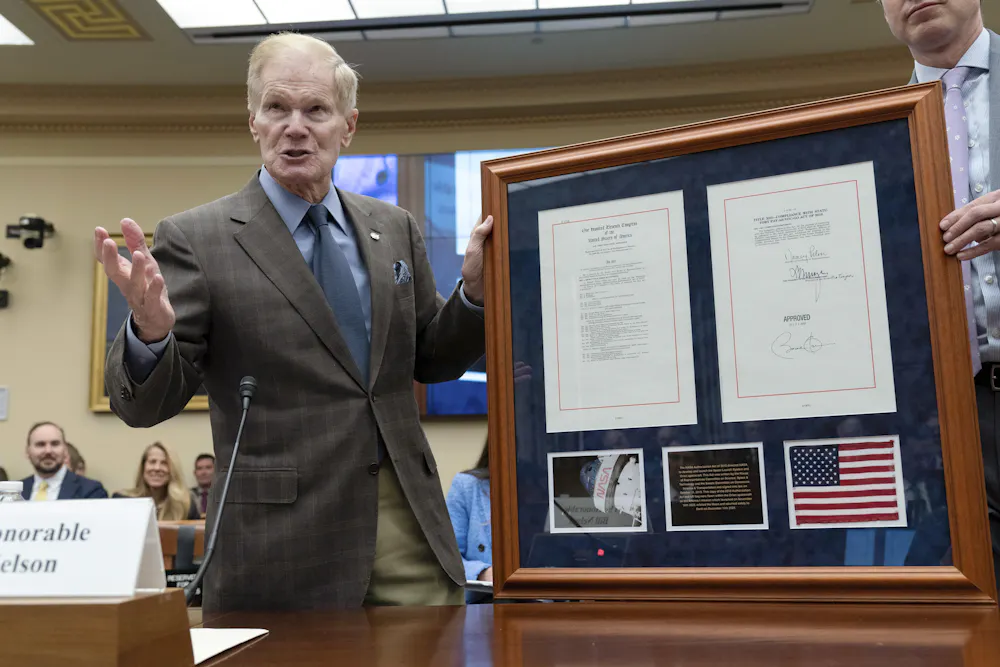
Bill Nelson, wearing a suit jacket and tie, holds a frame containing two documents, a photo of the lunar surface and the American flag.
NASA administrator Bill Nelson presents the agency’s budget to a congressional committee in 2023. AP Photo/Jose Luis Magana

Although major decisions like these are often out of their hands, NASA administrators still have a lot of influence behind the scenes. James Webb, NASA’s second administrator, who held the office between 1961 and 1968, is often credited as being integral in maintaining political support for the Apollo program.

Dan Goldin, the longest-serving NASA administrator, helped save the International Space Station from cancellation in the early 1990s by convincing the Clinton administration to invite Russia’s participation.

As administrator in the early 2000s, Mike Griffin helped jump-start the commercial space industry by instituting the Commercial Orbital Transportation Services program. This program provided funding to companies who would first send cargo to the International Space Station, and then later, astronauts.

However, not all administrators are as productive as Webb, Goldin or Griffin. Richard Truly was fired from the post by George H.W. Bush in 1992 after disagreeing with the administration’s 1989 proposal to return the U.S. to the Moon.

Charles Bolden found controversy when he told Al-Jazeera that President Barack Obama instructed him to make outreach to Muslim countries one of NASA’s priorities.

Both Truly and Bolden were astronauts before becoming administrator. But that doesn’t mean that former astronauts are somehow worse in the position than people coming from other backgrounds. NASA administrators have historically had a wide variety of backgrounds, including scientists, engineers and even former members of Congress.

The current NASA administrator, Bill Nelson, is both a former senator and a former astronaut, having gone to space on the shuttle Columbia in January 1986.

Major questions ahead

No matter the administrator, the coming years will bring big decisions for whoever is next.

With the recent announcement that the around-the-moon mission of Artemis II is delayed until spring of 2026, NASA still has much work to do in its Artemis program. Major issues remain to be addressed with the crew vehicle, including problems with the capsule’s heat shield and electronic systems.

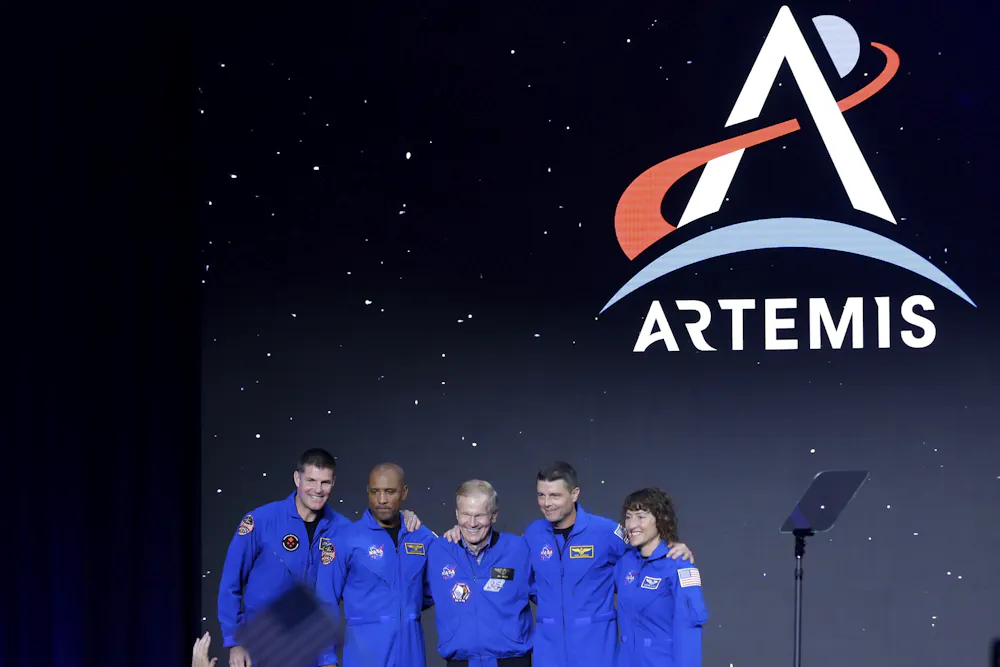
Five people in blue jumpsuits in front of a screen showing the Artemis logo.
NASA Administrator Bill Nelson, center, with the four astronauts planned to crew Artemis II. AP Photo/Michael Wyke

Further, the success of commercial space companies like SpaceX means there will be more pressure on NASA to find ways to reduce costs by leveraging the services of commercial companies.

More broadly, many other countries are looking to how the U.S. is operating in space. Aside from what some see as a new space race with China, questions about space debris, space traffic management and space resources will involve cooperation with other countries and will require administrator involvement.

Finally, the NASA administrator will have to contend with a recurring issue: fewer resources. Historically, NASA has been appropriated less money than necessary to carry out all the things it has been charged to do.

This situation leads to hard decisions about what kinds of missions to support. Space science and robotic exploration typically lose out to things like human spaceflight.

Even though the next administrator will need to make hard decisions, the next few years will be full of excitement as the U.S. and others pursue increasingly ambitious goals.The Conversation

Wendy Whitman Cobb, Professor of Strategy and Security Studies, Air University

This article is republished from The Conversation under a Creative Commons license. Read the original article.

Heavy rain leads to flood watch for Lake County

LAKE COUNTY, Calif. — The heavy rain that has drenched Lake County late this week has led to a countywide flood watch.

The National Weather Service issued the watch, which began Friday afternoon and will continue until 3 p.m. Saturday.

During that time, between 2 and 5 inches of rain are anticipated, forecasters said.

Over the past three days, Lake County has seen a large amount of rainfall.

Rainfall totals in inches for the 72-hour period ending at 2 a.m. Saturday are as follows:

— Hidden Valley Lake: 2.59.
— Indian Valley Reservoir: 1.50.
— Knoxville Creek: 2.32.
— Lake Pillsbury: 4.13.
— Lower Lake: 2.41.
— Lyons Valley: 2.87.
— Middletown: 1.21.
— Upper Lake: 2.95.
— Whispering Pines: 4.20.

In addition to rising water levels in creeks, streams and the lake, the flood watch warns of increased danger of rock and mudslides.

Due to the heavy weather, Pacific Gas and Electric reported that it had positioned crews and resources across its service area “to support the safe and swift response repair to damage and restore power outages that may result from the forecasted heavy rain and strong winds.”

PG&E Meteorologist Evan Duffey called it a “fast-moving storm that will also deliver significant precipitation and widespread damaging winds.”

The company has prestaged power poles, powerlines, transformers and other electric equipment at yards throughout its service area to make equipment repairs and restore power to affected areas safely and as quickly as possible.

The National Weather Service reported that high winds are expected along with rain through the weekend.

Temperatures this weekend will be in the 40s during the day and the 30s at night.

Email Elizabeth Larson at This email address is being protected from spambots. You need JavaScript enabled to view it.. Follow her on Twitter, @ERLarson, and on Bluesky, @erlarson.bsky.social. Find Lake County News on the following platforms: Facebook, @LakeCoNews; X, @LakeCoNews; Threads, @lakeconews, and on Bluesky, @lakeconews.bsky.social.

State insurance commissioner announces enforcement of regulation to expand insurance coverage across state

On Friday, California Insurance Commissioner Ricardo Lara enforced his “first of its kind” catastrophe modeling and ratemaking regulation, a central part of his Sustainable Insurance Strategy to increase coverage in wildfire-distressed areas of the state.

The Department of Insurance posted the final regulation after the Office of Administrative Law filed it with the Secretary of State, officially concluding a rulemaking process that saw strong public support over the past year.

“Giving people more choices to protect themselves is how we will solve California’s insurance crisis,” said Commissioner Lara. “For the first time in history we are requiring insurance companies to expand where people need help the most. With our changing climate we can no longer look to the past. We are being innovative and forward-looking to protect Californians’ access to insurance.”

Under the new regulation, major insurance companies must increase the writing of comprehensive policies in wildfire distressed areas equivalent to no less than 85% of their statewide market share, whereas there is no current legal requirement today for insurers to commit to providing any coverage in high-risk areas. Smaller and regional insurance companies must also increase their writing.

The new regulation is the result of expanded public engagement. The Department of Insurance held three workshops and hearings in 2024, which were attended by more than 1,000 interested parties, gathering input and receiving hundreds of public comments which helped shape this regulation. Commissioner Lara has met with tens of thousands of Californians since taking office as well as testifying at four legislative briefings about his Sustainable Insurance Strategy over the past year.

Building on Lara’s “Safer from Wildfires” initiative — the nation’s first wildfire safety discount program — the regulation requires catastrophe models to account for mitigation efforts by homeowners, businesses, and communities, something not currently possible under existing outdated regulations today.

As part of implementing the new regulation, Commissioner Lara announced the hiring of Kara Voss as model advisor — a newly created position at the Department — to oversee the process of examining model integrity and ensuring public review in accordance with the newly established regulation.

Voss has expertise in catastrophe modeling for wildfire and flooding events as a member of the Climate and Sustainability Branch. Under the regulation, once a model has undergone a pre-application required information determination, or PRID, insurance companies can utilize that model in a rate filing listing their commitments to write more policies.

The department will accept PRID petitions starting January 2, 2025 and expects the process to be complete within months.

The regulation supports the development of a public catastrophe model, currently being considered by a strategy group of researchers and education leaders led by Cal Poly Humboldt. Recommendations on how to create a public catastrophe model are due from the strategy group to Commissioner Lara by April 2025.

Fixing outdated rules that contribute to higher costs, fewer policies

For the past 30 years, California regulations have required insurance companies to apply a catastrophe factor to insurance rates based on historical wildfire losses. These outdated rules have contributed to rate spikes and balloon premiums following major wildfire disasters without fully accounting for the growing risk caused by climate change or risk mitigation measures taken by communities or regionally, as a result of local, state, and federal investments.

Commissioner Lara’s strategy addresses major limitations of Proposition 103, passed by voters in 1988. Under that law, insurance companies are free to propose rates at any level needed to cover future losses but, unlike public utilities, are not required to cover all residents. Major companies have increased rates while pulling back from higher-risk properties, resulting in areas where the FAIR Plan is now the only option for many consumers.

In June, the department released a first-ever map showing where FAIR Plan policies have grown and the traditional insurance market has retreated. This regulation focuses on reversing FAIR Plan growth as a result of insurance companies committing to write more in high risk areas through the use of wildfire catastrophe models in ratemaking.

“Solving our wildfire crisis requires bold action to protect our communities,” added Commissioner Lara. “Insurance rates now must account for the billions spent on wildfire mitigation, including community efforts and home hardening. This all-hands effort by my Department has achieved decades-overdue reforms in just one year, ensuring consumers benefit from more accurate rates and better risk assessment.”

“Formal adoption of the Department's regulation to allow Catastrophe Models to be used in setting property insurance rates in California means insurers have gotten one of the highest priority wish list items they've said they need in order to open back up for business in our state. That news, combined with the announcement by Farmers Insurance, should give consumers hope that competition and options will be returning," said Amy Bach on behalf of the nonprofit United Policyholders whose team is fanned out across the state helping people deal with home insurance non renewals and tough choices.

“Catastrophe models are essential for modeling perils like flood and wildfire that are now worsening as the planet warms. I am especially pleased to see the Department of Insurance requiring that these models incorporate the best scientific information on risk reduction from a property to landscape scale,” said Carolyn Kousky, associate vice president for economics and policy, Environmental Defense Fund. “Lowering risks is essential and models must reflect those investments so insurers can incorporate them into pricing and underwriting — and in a timely way.”

“The parcel- and community-level mitigations included in CDI's Safer from Wildfire Framework, and the very similar parcel level mitigations included in the IBHS Wildfire Prepared Home, represent a science-based approach to creating fire-adapted communities that can be in or adjacent to the inevitable wildfire perimeters without experiencing catastrophic loss,” said Dave Winnacker, fire chief, Moraga-Orinda Fire Protection District. “The science is crystal-clear, that at the community level we have agency to reduce wildfire risk using CDI's recommendations.”

Estate Planning: The new petition to determine succession to a decedent’s primary residence

Dennis Fordham. Courtesy photo.

Under new legislation (AB 2016), for decedents dying after March 31, 2025, the successors in interest to the decedent’s primary residence, if it has an appraised date of death value under $750,000, may use a new special court petition to determine succession to a decedent's primary residence and so avoid a full-fledged probate administration.

Strangely, the decedent’s primary residence does not have to be the decedent’s residence at time of death and the key term “primary residence” is undefined.

However, this only applies if the remainder of the decedent’s estate — excluding any non-probate assets that pass automatically to death beneficiaries (e.g., joint tenancy and death beneficiary accounts) — does not exceed the probate threshold (presently $184,500 in total gross value).

When it applies, the successors in interest to the decedent’s estate can use this special petition to take title to the primary residence as co-owners, and would also use the separate affidavit procedure to take title to the decedent’s personal property and other items, including bank accounts (without death beneficiaries).

Presently, the existing petition to determine succession to real and personal property of a decedent with a small estate applies only if the total gross value of the decedent’s real and personal property (altogether) held in the decedent’s name individually does not exceed the current $184,500 threshold for a probate.

Again, the foregoing does not include assets held in a living trust, in joint tenancy, or a transfer on death assets (such as, “TOD” deeds) which each avoid probate.

Moreover, the current petition can include succession to both real and personal property and is not limited to the decedent’s “primary residence” and can include other non-primary real property.

However, as the value of most California real property well exceeds the $184,500 probate threshold the current petition has very limited application. It typically applies to vacant lots or lots associated with manufactured homes. The new petition replaces the old petition entirely.

Nevertheless, a probate is still required if the decedent’s other assets exceed the threshold for probate (presently $184,500) even if the decedent’s primary residence is under $750,000. This typically happens because the decedent also owns other real property (e.g., rentals) and/or financial assets (without pay on death or transfer on death beneficiaries).

When a probate applies, the special petition to determine succession to a decedent’s primary residence is not permissible, unless the court appointed personal representative consents to such a petition.

Also, now that the petition to determine succession to real property in a small estate is narrowly applicable only to the decedent’s primary residence alone, what happens if the decedent’s small estate also includes real property (e.g., an undeveloped lot)? The affidavit procedure for real property of small value only applies if the gross value of such real property is under $61,500.

The new laws abolish the existing petition to determine succession to real property in a small estate. Thus, when the current petition is replaced, probates may be required for small estates where the value of the decedent’s other real property (besides the primary residence) exceeds $61,500 even if such real property is part of a small estate. Clearly some follow up legislation is needed.

When there are multiple successors in interest to the decedent’s primary residence they will each have to sign as a petitioner, the same as now. If the petition is granted, the successors in interest will then co-own the primary residence. Thus, to sell the residence they will all have to agree. Otherwise, as co-owners they will want a tenants in common agreement that allocates the shared use and responsibilities associated with co-ownership.

The new law does not end the need for living trusts or transfer on death deeds. One advantage of using a living trust, or transfer on death deed, is that it does not require a court petition. Also, with a trust, one person (the trustee) is in control and the primary residence can be sold, distributed, or held in further trust as provided in the trust.

Also, a trust provides for contingency planning in the event of unforeseen circumstances. None of which is achieved by reliance on the new law.

The foregoing discussion is not legal advice. Anyone confronting such estate planning issues should consult with a qualified attorney.

Dennis A. Fordham, attorney, is a State Bar-Certified Specialist in estate planning, probate and trust law. His office is at 870 S. Main St., Lakeport, Calif. He can be reached at This email address is being protected from spambots. You need JavaScript enabled to view it. and 707-263-3235.

Space News: NASA’s crew capsule had heat shield issues during Artemis I − an aerospace expert on these critical spacecraft components


Off the coast of Baja California in December 2022, sun sparkled over the rippling sea as waves sloshed around the USS Portland dock ship. Navy officials on the deck scrutinized the sky in search of a sign. The glow appeared suddenly.

A tiny spot at first, it gradually grew to a round circle falling at a great speed from the fringes of space. It was NASA’s Orion capsule, which would soon end the 25-day Artemis I mission around and beyond the Moon with a fiery splashdown into the ocean.

Orion’s reentry followed a sharply angled trajectory, during which the capsule fell at an incredible speed before deploying three red and white parachutes. As the mission finished its trip of over 270,000 miles (435,000 kilometers), it looked to those on the deck of the USS Portland like the capsule had made it home in a single piece.

As the recovery crew lifted Orion to the carrier’s deck, shock waves ruffled across the capsule’s surface. That’s when crew members started to spot big cracks on Orion’s lower surface, where the capsule’s exterior bonds to its heat shield.

The Orion spacecraft splashed down in December 2022, marking the end of the Artemis I mission.

But why wouldn’t a shield that has endured temperatures of about 5,000 degrees Fahrenheit (2,760 degrees Celsius) sustain damage? Seems only natural, right?

This mission, Artemis I, was uncrewed. But NASA’s ultimate objective is to send humans to the Moon in 2026. So, NASA needed to make sure that any damage to the capsule– even its heat shield, which is meant to take some damage – wouldn’t risk the lives of a future crew.

On Dec. 11, 2022 – the time of the Artemis I reentry – this shield took severe damage, which delayed the next two Artemis missions. While engineers are now working to prevent the same issues from happening again, the new launch date targets April 2026, and it is coming up fast.

As a professor of aerospace technology, I enjoy researching how objects interact with the atmosphere. Artemis I offers one particularly interesting case – and an argument for why having a functional heat shield is critical to a space exploration mission.

A conical spacecraft with the NASA worm logo in space, with Earth and the Moon shown in the background.
NASA’s Orion spacecraft had a view of both Earth and the Moon during the Artemis I mission. NASA via AP

Taking the heat

To understand what exactly happened to Orion, let’s rewind the story. As the capsule reentered Earth’s atmosphere, it started skimming its higher layers, which acts a bit like a trampoline and absorbs part of the approaching spacecraft’s kinetic energy. This maneuver was carefully designed to gradually decrease Orion’s velocity and reduce the heat stress on the inner layers of the shield.

After the first dive, Orion bounced back into space in a calculated maneuver, losing some of its energy before diving again. This second dive would take it to lower layers with denser air as it neared the ocean, decreasing its velocity even more.

While falling, the drag from the force of the air particles against the capsule helped reduced its velocity from about 27,000 miles per hour (43,000 kilometers per hour) down to about 20 mph (32 kph). But this slowdown came at a cost – the friction of the air was so great that temperatures on the bottom surface of the capsule facing the airflow reached 5,000 degrees Fahrenheit (2,760 degrees Celsius).

At these scorching temperatures, the air molecules started splitting and a hot blend of charged particles, called plasma, formed. This plasma radiated energy, which you could see as red and yellow inflamed air surrounding the front of the vehicle, wrapping around it backward in the shape of a candle.

No material on Earth can stand this hellish environment without being seriously damaged. So, the engineers behind these capsules designed a layer of material called a heat shield to be sacrificed through melting and evaporation, thus saving the compartment that would eventually house astronauts.

By protecting anyone who might one day be inside the capsule, the heat shield is a critical component.

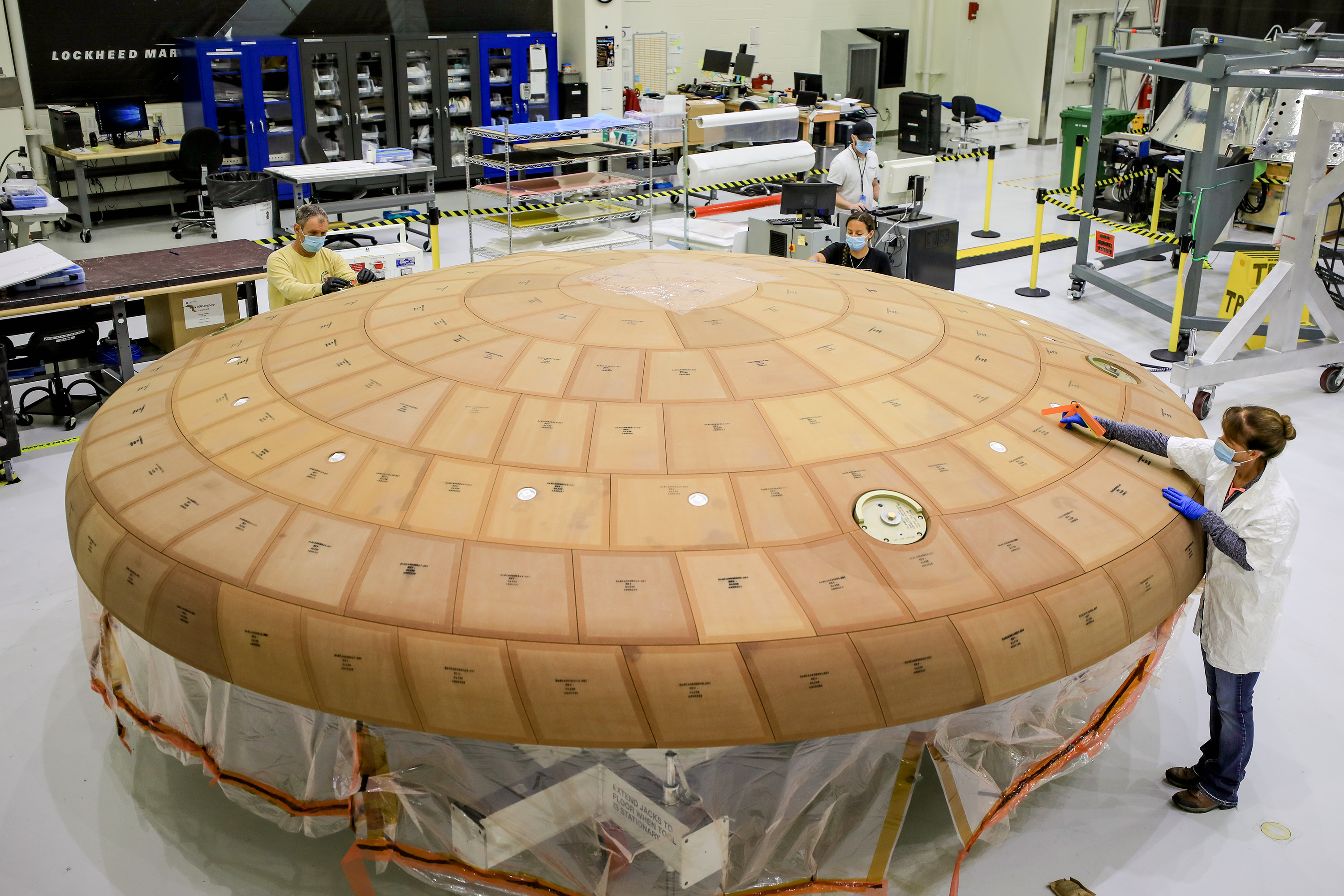
A large round shield covered in small tiles sitting in a laboratory.
The Orion heat shield is covered in tiles made of a material that will burn up when exposed to extreme heat. NASA/Isaac Watson

In the form of a shell, it is this shield that encapsulates the wide end of the spacecraft, facing the incoming airflow – the hottest part of the vehicle. It is made of a material that is designed to evaporate and absorb the energy produced by the friction of the air against the vehicle.

The case of Orion

But what really happened with Orion’s heat shield during that 2022 descent?

In the case of Orion, the heat shield material is a composite of a resin called Novolac – a relative to the Bakelite which some firearms are made of – absorbed in a honeycomb structure of fiberglass threads.

A molecule made up of atoms arranged in linked hexagons.
Novolac, the material that makes up Orion’s heat shield, is made up of atoms arranged in linked hexagons. Smokefoot/Wikimedia Commons, CC BY-SA

As the surface is exposed to the heat and airflow, the resin melts and recedes, exposing the fiberglass. The fiberglass reacts with the surrounding hot air, producing a black structure called char. This char then acts as a second heat barrier.

NASA used the same heat shield design for Orion as the Apollo capsule. But during the Apollo missions, the char structure didn’t break like it did on Orion.

After nearly two years spent analyzing samples of the charred material, NASA concluded that the Orion project team had overestimated the heat flow as the craft skimmed the atmosphere upon reentry.

As Orion approached the upper layers of the atmosphere, the shield started melting and produced gases that may have escaped through pores in the material. Then, when the capsule gained altitude again, the outer layers of the resin froze, trapping the heat from the first dive inside. This heat vaporized the resin.

When the capsule dipped into the atmosphere the second time, the gas expanded before finding a way out as it heated again – kind of like how a frozen lake thaws upward from the bottom – and its escape produced cracks in the capsule’s surface where the char structure got damaged. These were the cracks the recovery crew saw on the capsule after it splashed down.

In a Dec. 5, 2024, press conference, NASA officials announced that the Artemis II mission will be designed with a modified reentry trajectory to prevent heat from accumulating.

For Artemis III, which is planned to launch in 2027, NASA intends to use new manufacturing methods for the shield, making it more permeable. The outside of the capsule will still get very hot during reentry, and the heat shield will still evaporate. But these new methods will help keep the astronauts cozy in the capsule all the way through splashdown.

Chonglin Zhang, assistant professor of mechanical engineering at the University of North Dakota, assisted in researching this article.The Conversation

Marcos Fernandez Tous, Assistant Professor of Space Studies, University of North Dakota

This article is republished from The Conversation under a Creative Commons license. Read the original article.

  • 298
  • 299
  • 300
  • 301
  • 302
  • 303
  • 304
  • 305
  • 306
  • 307

Community

  • Lake County Wine Alliance offers sponsor update; beneficiary applications open 

  • Mendocino National Forest announces seasonal hiring for upcoming field season

Public Safety

  • Lakeport Police logs: Thursday, Jan. 15

  • Lakeport Police logs: Wednesday, Jan. 14

Education

  • Woodland Community College receives maximum eight-year reaffirmation of accreditation from ACCJC

  • SNHU announces Fall 2025 President's List

Health

  • California ranks 24th in America’s Health Rankings Annual Report from United Health Foundation

  • Healthy blood donors especially vital during active flu season

Business

  • Two Lake County Mediacom employees earn company’s top service awards

  • Redwood Credit Union launches holiday gift and porch-to-pantry food drives

Obituaries

  • Rufino ‘Ray’ Pato

  • Patty Lee Smith

Opinion & Letters

  • The benefits of music for students

  • How to ease the burden of high electric bills

Veterans

  • CalVet and CSU Long Beach team up to improve data collection related to veteran suicides

  • A ‘Big Step Forward’ for Gulf War Veterans

Recreation

  • Wet weather trail closure in effect on Upper Lake Ranger District

  • Mendocino National Forest seeking public input on OHV grant applications

  • State Parks announces 2026 Anderson Marsh nature walk schedule 

  • BLM lifts seasonal fire restrictions in central California

Religion

  • Kelseyville Presbyterian to host Ash Wednesday service and Lenten dinner Feb. 18

  • Kelseyville Presbyterian Church to hold ‘Longest Night’ service Dec. 21

Arts & Life

  • Auditions announced for original musical ‘Even In Shadow’ set for March 21 and 28

  • ‘The Rip’ action heist; ‘Steal’ grounded in a crime thriller

Government & Politics

  • Lake County Democrats issue endorsements in local races for the June California Primary

  • County negotiates money-saving power purchase agreement

Legals

  • March 3 hearing on ordinance amending code for commercial cannabis uses

  • Feb. 12 public hearing on resolution to establish standards for agricultural roads

How to resolve AdBlock issue?
Refresh this page