How to resolve AdBlock issue?
Refresh this page
How to resolve AdBlock issue?
Refresh this page
Lake County News,California
  • Home
    • Registration Form
  • News
    • Education
    • Veterans
    • Community
      • Obituaries
      • Letters
      • Commentary
    • Police Logs
    • Business
    • Recreation
    • Health
    • Religion
    • Legals
    • Arts & Life
    • Regional
  • Calendar
  • Contact us
    • FAQs
    • Phones, E-Mail
    • Subscribe
  • Advertise Here
  • Login

News

Space News: The Moon might be older than scientists previously thought − a new study shines light on its history


Rock samples from the lunar surface are important tools for scientists studying how old the Moon is. AP Photo/NASA

The three of us were all interested in the Moon, but from different perspectives: As a geophysicist, I thought about its interior; Thorsten Kleine studied its chemistry; and Alessandro Morbidelli wanted to know what the Moon’s formation could tell us about how the planets were assembled 4.5 billion years ago.

When we got together to discuss how old the Moon really was, having those multiple perspectives turned out to be crucial.

How did the Moon form?

At a conference in Hawaii in the late 1980s, a group of scientists solved the problem of how the Moon formed. Their research suggested that a Mars-size object crashed into the early Earth, jettisoning molten material into space. That glowing material coalesced into the body now called the Moon.

This story explained many things. For one, the Moon has very little material that evaporates easily, such as water, because it began life molten. It has only a tiny iron core, because it was mostly formed from the outer part of the Earth, which has very little iron. And it has a buoyant, white-colored crust made from minerals that floated to the surface as the molten Moon solidified.

The glowing, newly formed Moon was initially very close to the Earth, at roughly the distance that TV satellites orbit. The early Moon would have raised gigantic tides on the early Earth, which itself was mostly molten and spinning rapidly.

These tides took energy from the Earth’s spin and transferred some to the Moon’s orbit, slowly pushing the Moon away from the Earth and slowing the Earth’s spin as they did so. This motion continues today – the Moon still recedes from the Earth about 2 inches per year.
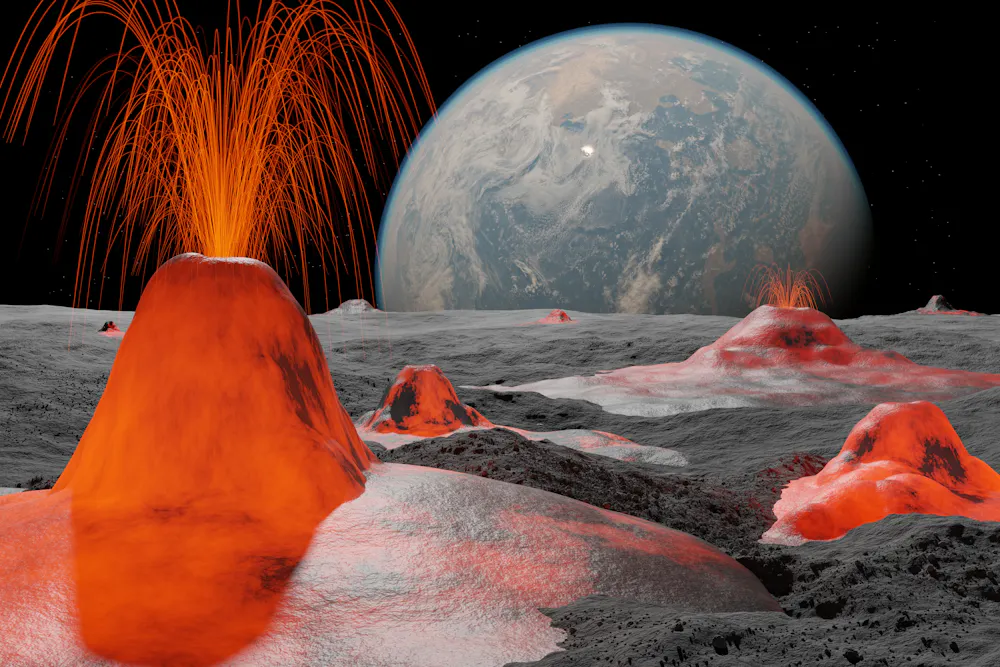
An illustration showing the Moon's surface, covered with volcanoes, with the Earth floating large in the background.
An artist’s impression of what the Moon looked like during the tidal heating event. There would have been intense volcanism everywhere. The early Earth would have loomed much larger in the sky because it was closer. MPS/Alexey Chizhik

As the Moon moved away, it passed through particular points where its orbit temporarily became disturbed. These orbital disturbances were an important component of its history and are a key part of our hypothesis.

When did the Moon form?

When the Moon actually formed and receded away from the Earth is a thorny issue.

Thanks to the Apollo astronauts, scientists have a collection of Moon rocks, which they can measure the age of. The oldest rocks are all about 4.35 billion years old, which is roughly 200 million years after the birth of the solar system.

Many geochemists, like my colleague Thorsten Kleine, suggested (not unreasonably) that the age of these rocks is the same as the age of the Moon.

But people like Alessandro Morbidelli, who study planet formation, didn’t like this answer very much. In their models, planets swept up most of the material floating around the early solar system long before 200 million years had elapsed. A giant, Moon-forming impact as late as the rock samples suggested seemed pretty unlikely.

What did we suggest?

This is where Kleine, Morbidelli and I came in. We followed up on a suggestion from a 2016 study that found the Moon might occasionally experience extreme heating events during its slow outward journey from Earth.

This heating happens the same way that heating does on Jupiter’s hyperactively volcanic moon Io. The smaller body’s shape gets squeezed and stretched by tides from the big body. And just like a rubber ball warms up if you squeeze it enough, so too do the rocks on Io and the Moon.

All rocks contain little internal clocks – radioactive elements that decay and allow researchers to tell how old the rock is. But here’s the key point: If the Moon warmed up enough, its clocks would lose their memory and would start recording time only once the Moon cooled down again.

So in this picture, the pileup of rocks aged around 4.35 billion years isn’t telling us when the Moon formed, but just when it went through this tidal heating event. That means the Moon’s formation must have happened earlier.

An early formation date satisfies the physicists studying planet formation, while explaining that the later dating recorded from the rocks is due to the tidal reheating.

A diagram showing the Moon's interior from molten to forming a crust, to solidifying, with a tidal heating event with made the interior partly molten again.
The Moon started out molten and then cooled down, only to be reheated roughly 100 million years later. This heating event could have reset most of the ages recorded by lunar rocks. Francis Nimmo

What next?

As often happens in science, two groups simultaneously came up with a similar idea. Our group focused on a tidal heating event that happened when the Moon was quite distant from the Earth, while research from Steve Desch at Arizona State University points to an event that happened when the Moon was closer. Sorting out which of these two hypotheses is right will take some time – and maybe neither is correct.

Testing these hypotheses will require more samples from the Moon. Fortunately, China’s Chang’e 6 mission just returned samples from the dark side of the Moon in June 2024. If these samples also show a lot of rocks all having ages of around 4.35 billion years ago, that would be consistent with our story. If the ages are much older, we’ll have to figure out a new story.

Very often in earth and planetary sciences, geochemists and geophysicists end up with different and contradictory hypotheses. This happens partly because these fields use different kinds of measurements, but also because they speak very different scientific languages. Overcoming this language barrier is hard.

Our study is an example of how – sometimes – bridging that linguistic and scientific divide can benefit researchers on both sides.The Conversation

Francis Nimmo, Professor of Earth and Planetary Sciences, University of California, Santa Cruz

This article is republished from The Conversation under a Creative Commons license. Read the original article.

A physicist, a chemist and a mathematician walk into a bar. It sounds like the start of a bad joke, but in my case, it was the start of an idea that could reshape how scientists think about the history of the Moon.
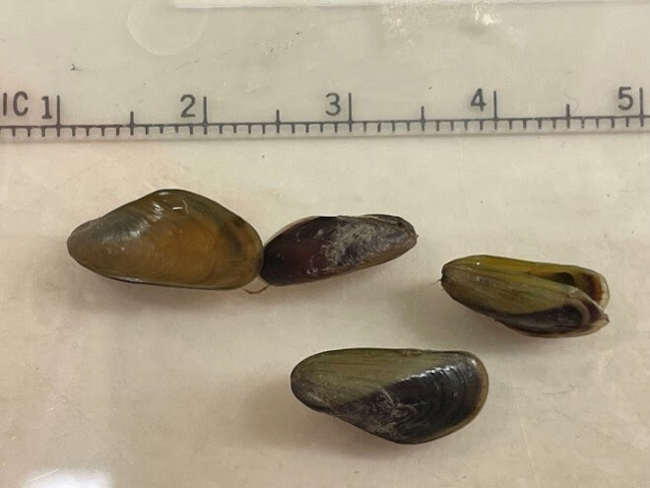

California Fish and Game Commission guards state waters against golden mussels

Golden mussels. Photo courtesy of the California Department of Fish and Wildlife.


The California Fish and Game Commission has taken emergency action to protect state waters against an invasive mussel that’s been discovered in Northern California.

The actions to address the discovery of the golden mussel came at the commission’s meeting in Sacramento on Dec. 11 and 12.

To protect California against the spread of the invasive golden mussel (Limnoperna fortunei) discovered Oct. 17 at the Port of Stockton, and in the days following as far south as San Luis Reservoir’s O'Neill Forebay, the commission added the golden mussel to the list of species restricted from live importation, transportation and possession.

This discovery is North America’s first; the golden mussel is native to China and Southeast Asia and was likely transported across the ocean on large ships.

The discovery is a concern for Lake County officials.

Angela DePalma-Dow, invasive mussel coordinator for Lake County Water Resources, told Lake County News this fall that golden mussels are similar in shape and size as quagga and zebra mussels, and have potential to cause just as much damage if introduced into freshwater lakes and streams.

DePalma-Dow updated the Lake County Board of Supervisors about the discovery of the mussels in Northern California at the board’s Dec. 10 meeting.

“Golden mussels are a bigger threat to California waters than quagga and zebra mussels because they can thrive in a wider range of water quality conditions,” said Jay Rowan, chief of the California Department of Fish and Wildlife’s Fisheries Branch. “Putting golden mussels on the restricted species list is an important first step toward containment and prevention of spread of this non-native species.”

The emergency listing will reduce the potential for people to introduce the bivalves to other waters of the state, officials said.

The species poses an immediate threat to the ecological health of the Delta — into which the waters of Clear Lake flow — and all waters of the state, water conveyance systems, infrastructure and water quality.

The commission’s action makes it illegal to be in possession or transport golden mussels in California.

Northern California pump prices stay low for holiday season; Lake County prices fall mid-range statewide

LAKE COUNTY, Calif. — Thanks to dropping gas prices, drivers in Northern California have something to be extra cheerful about this holiday season.

The average price of gasoline in the Golden State has continued to drop for a sixth straight week, according to AAA.

The average price for self-serve regular gasoline in California is $4.31, which is three cents lower than a week ago and 28 cents lower than a year ago, AAA reported.

But AAA said that trend may not stick around for long, as fuel prices are starting to rise nationally.

The average national price per gallon this week is $3.04, two cents higher than a week ago.

“Lower gas prices are great news for those planning year-end holiday travel,” said AAA Northern California spokesperson Doug Johnson. “With nearly 90 percent of travelers driving to their holiday destinations, that’s a lot of fuel — and a lot of savings.”

Here’s what the average price of self-serve regular gasoline is in each city:

San Francisco: $4.46.
Oakland: $4.30.
San Jose: $4.26.
Sacramento: $4.21.
Fresno: $4.21.
Stockton: $4.09.

AAA’s records show Lake County’s prices are falling about the middle range of prices in the state, coming in around $4.385 to $4.266 per gallon.

Meanwhile, the national average per kilowatt hour of electricity at a public EV charging station remained at 34 cents. In California, that average cost is 37 cents, AAA reported.

Drivers can find current gas and electric charging prices along their route using AAA Mobile.

Microplastics in the air may be leading to lung and colon cancers

Tires and degrading garbage shed tiny pieces of plastic into the air, creating a form of air pollution that UC San Francisco researchers suspect may be causing respiratory and other illnesses.

A review of some 3,000 studies implicates these particles in a variety of serious health problems. These include male and female infertility, colon cancer and poor lung function. The particles also may contribute to chronic pulmonary inflammation, which can increase the risk of lung cancer.

“These microplastics are basically particulate matter air pollution, and we know this type of air pollution is harmful,” said Tracey J. Woodruff, PhD, MPH, a professor of obstetrics, gynecology and reproductive sciences at UCSF.

Woodruff directs the Program on Reproductive Health & the Environment (PRHE) and is the senior author of the study, which appears Dec. 18 in the journal Environmental Science & Technology.

Small particles, big problem

Microplastics are less than 5 millimeters – smaller than a grain of rice – and they are ubiquitous in the environment. Each year, companies around the world produce nearly 460 million metric tons of plastic. That is projected to reach 1.1 billion by 2050.

A major source of plastic in the air is driving. Friction wears down tires along with the road surface, sending plastic fragments into the air.

Major sources of microplastics

Plastic pellets: Pellets are used in the manufacturing of other plastic products.

Personal care products: Products often contain plastic microbeads used for abrasion.

Paint: Paints and resins use polymers that are difficult to recycle.

Synthetic textiles: Fibers from synthetic textiles can be inhaled when they become airborne.

Tires: Wear and tear from tires releases airborne particles that are inhaled.

Macroplastics: Items like plastic bags and single-use containers eventually fragment into microplastics.

Animal studies believed to apply to humans, too

The paper is the first systematic review of microplastics using gold standard methods approved by the National Academy of Sciences.

Most of the studies in the review were based on animals. But the researchers said the conclusions likely also apply to humans since they share many of the same exposures.

The study expands on a report the researchers worked on last year with the California State Policy Evidence Consortium (CalSPEC). The Consortium includes experts across the UC system and provides evidence for policymakers in the California State Legislature.

“We urge regulatory agencies and policy leaders to consider the growing evidence of health harms from microplastics, including colon and lung cancer,” said Nicholas Chartres, PhD.

Chartres, the study’s first author, led the science and policy team at PRHE and is now at the University of Sydney. “We hope state leaders will take immediate action to prevent further exposures.”

Authors: Additional authors include Sheiphali Gandhi, MD, MPH, Abena BakenRa, MPH, Courtney B. Cooper, MPH, Katherine E. Pelch, PhD, and Garret Bland, PhD.

Funding: The CalSPEC pilot was funded through the University of California Office of the President Major Projects and Initiatives Fund (UCOP proposal number 202110-121-AA) and a grant from the JPB Foundation (G-2022-3608).

Clearlake Animal Control: ‘Marty’ and the dogs

"Marty." Photo courtesy of Clearlake Animal Control.

CLEARLAKE, Calif. — Clearlake Animal Control has dozens of dogs waiting for their new homes for the holidays.

The shelter has 45 adoptable dogs listed on its website.

This week’s dogs include “Marty,” a male pit bull terrier mix that is a year and nine months old, with a chocolate and copper coat.

The shelter is located at 6820 Old Highway 53. It’s open from 9 a.m. to 6 p.m. Tuesday through Saturday.

For more information, call the shelter at 707-762-6227, email This email address is being protected from spambots. You need JavaScript enabled to view it., visit Clearlake Animal Control on Facebook or on the city’s website.

This week’s adoptable dogs are featured below.

Email Elizabeth Larson at This email address is being protected from spambots. You need JavaScript enabled to view it.. Follow her on Twitter, @ERLarson, and on Bluesky, @erlarson.bsky.social. Find Lake County News on the following platforms: Facebook, @LakeCoNews; X, @LakeCoNews; Threads, @lakeconews, and on Bluesky, @lakeconews.bsky.social.


Habematolel Pomo of Upper Lake receives $2.4 million Safe Streets and Roads for All grant to improve public safety

LAKE COUNTY, Calif. — The Habematolel Pomo of Upper Lake received a $2.4 million Safe Streets and Roads for All Grant to enhance public safety measures in collaboration with the Northshore Fire Protection District.

The grant will support the Tribe's Responder, Patient and Pedestrian Safety Project, which focuses on improving the safety of emergency responders, patients, and pedestrians in Upper Lake and surrounding areas.

“This project will not only provide life-saving improvements in safety for our community but will also help us implement cutting-edge technology to support our emergency responders in their mission to protect and save lives. The collaboration with Northshore Fire Protection District exemplifies our commitment to a safer future for all in Upper Lake,” said Chairperson Danielle Cirelli of the Habematolel Pomo of Upper Lake.

“This grant is a game-changer for the safety and efficiency of emergency response in our community,” said Mike Ciancio, fire chief of the Northshore Fire Protection District. “By integrating innovative technologies and improving coordination between responders and the public, this project will enable us to respond faster, better, and more safely. We are proud to partner with the Habematolel Pomo of Upper Lake to make Upper Lake and the surrounding areas safer for everyone.”

The grant will be used to develop a comprehensive safety action plan centered around the needs of emergency responders.

This initiative will include several key components, such as an action plan focused on post-crash care and critical demonstration activities.

Among these activities are the piloting of an emergency vehicle transponder system to alert drivers to the proximity of emergency vehicles, and the testing of a platform that interfaces with specialized care registries to deliver critical health information to first responders at the scene.

Other project initiatives include investigating advanced vehicle location and vehicle informatics systems to improve monitoring and safety reporting enroute to emergency calls and performing outreach and research to build a prehospital health and safety information exchange and structured data warehouse.
  • 294
  • 295
  • 296
  • 297
  • 298
  • 299
  • 300
  • 301
  • 302
  • 303

Community

  • Lake County Wine Alliance offers sponsor update; beneficiary applications open 

  • Mendocino National Forest announces seasonal hiring for upcoming field season

Public Safety

  • Lakeport Police logs: Thursday, Jan. 15

  • Lakeport Police logs: Wednesday, Jan. 14

Education

  • Woodland Community College receives maximum eight-year reaffirmation of accreditation from ACCJC

  • SNHU announces Fall 2025 President's List

Health

  • California ranks 24th in America’s Health Rankings Annual Report from United Health Foundation

  • Healthy blood donors especially vital during active flu season

Business

  • Two Lake County Mediacom employees earn company’s top service awards

  • Redwood Credit Union launches holiday gift and porch-to-pantry food drives

Obituaries

  • Rufino ‘Ray’ Pato

  • Patty Lee Smith

Opinion & Letters

  • The benefits of music for students

  • How to ease the burden of high electric bills

Veterans

  • CalVet and CSU Long Beach team up to improve data collection related to veteran suicides

  • A ‘Big Step Forward’ for Gulf War Veterans

Recreation

  • Wet weather trail closure in effect on Upper Lake Ranger District

  • Mendocino National Forest seeking public input on OHV grant applications

  • State Parks announces 2026 Anderson Marsh nature walk schedule 

  • BLM lifts seasonal fire restrictions in central California

Religion

  • Kelseyville Presbyterian to host Ash Wednesday service and Lenten dinner Feb. 18

  • Kelseyville Presbyterian Church to hold ‘Longest Night’ service Dec. 21

Arts & Life

  • Auditions announced for original musical ‘Even In Shadow’ set for March 21 and 28

  • ‘The Rip’ action heist; ‘Steal’ grounded in a crime thriller

Government & Politics

  • Lake County Democrats issue endorsements in local races for the June California Primary

  • County negotiates money-saving power purchase agreement

Legals

  • March 3 hearing on ordinance amending code for commercial cannabis uses

  • Feb. 12 public hearing on resolution to establish standards for agricultural roads

How to resolve AdBlock issue?
Refresh this page
