How to resolve AdBlock issue?
Refresh this page
How to resolve AdBlock issue?
Refresh this page
Lake County News,California
  • Home
    • Registration Form
  • News
    • Education
    • Veterans
    • Community
      • Obituaries
      • Letters
      • Commentary
    • Police Logs
    • Business
    • Recreation
    • Health
    • Religion
    • Legals
    • Arts & Life
    • Regional
  • Calendar
  • Contact us
    • FAQs
    • Phones, E-Mail
    • Subscribe
  • Advertise Here
  • Login

News

Covered California reports hitting record enrollment

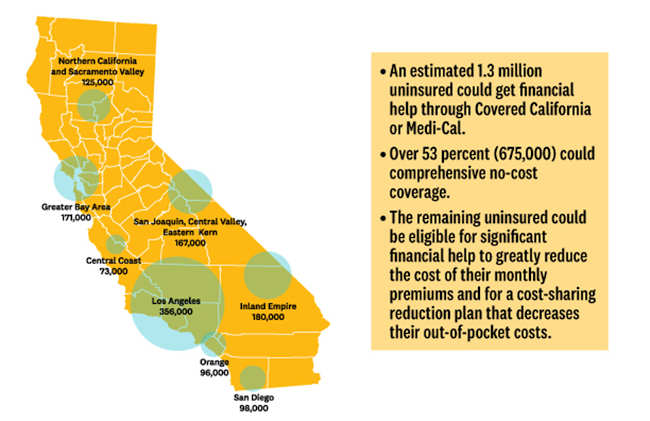
Figure 1: Nearly 1.3 Million Uninsured Californians Are Eligible for Financial Help


Covered California has surpassed 1.8 million enrollees, reaching its record-high enrollment with over a week until the first open enrollment deadline on Dec. 31.

During this open enrollment, 143,686 Californians have signed up for 2025 coverage as of Dec. 14, marking a 3 percent increase over the same period last year.

Another 1,647,162 Californians have renewed their coverage so far, a 4 percent increase over the same period last year.

“We have a record 1.8 million Californians already enrolled for 2025 coverage, but history teaches us the next week will be our busiest for new sign ups,” Covered California Executive Director Jessica Altman said. “We want to make sure every uninsured Californian understands that the most financial assistance ever offered through the Affordable Care Act is available here in California for 2025. Now is the time to take advantage of this financial assistance to start the New Year with affordable, name-brand health coverage and peace of mind for you and your family.”

With the first open-enrollment deadline of Dec. 31 quickly approaching, Covered California is urging consumers to sign up now so they can have their health care coverage for all of 2025, beginning on Jan. 1. Open enrollment will end on Jan. 31.

Nearly half of the new enrollees have come from four Southern California (Los Angeles, Orange, Riverside and San Bernardino) counties with 68,095 sign-ups.

Also, nearly 39,000 new enrollees identified as Latino, while nearly 28,000 Asian Americans have signed up for coverage so far.

Over 33,000 White Californians and over 4,000 Black Californians have enrolled, and over 28,000 Californians did not disclose their Race/Ethnicity.

Despite the continued progress, the latest data from the California Simulation of Insurance Markets, or CalSIM, a model created by the UCLA Center for Health Policy Research, shows that there are nearly 1.3 million uninsured Californians who either qualify for subsidies through Covered California (591,000) or are eligible for Medi-Cal coverage (675,000), and they reside all over the state.

California’s cost-sharing reduction program highlights assistance

In 2025, Covered California is offering more financial help for Californians than ever before.

Building on the existing federal subsidies to help pay for health insurance premiums, Covered California is enhancing its cost-sharing reduction program that reduces the cost of accessing health care for consumers by lowering out-of-pocket costs when they seek medical care, including eliminating deductibles in all three Silver cost-sharing reduction plans.

The cost-sharing reduction program for out-of-pocket costs is available to all Californians with incomes above 200 percent of the federal poverty level (which is $30,120 for a single person and $62,400 for a family of four), while those under 200 percent of the federal poverty level will continue to have access to higher levels of benefits.

In 2024, nearly 800,000 existing Covered California enrollees are taking advantage of this program, and over 100,000 of our new enrollees have qualified for these cost savings and richer benefits for 2025. That means nearly 1.1 million enrollees have already enrolled in enhanced Silver plans for 2025.

Nearly 90 percent of Covered California’s enrollees receive financial help. Two-thirds of those enrollees are eligible for health insurance for $10 or less per month, and nearly half could get a comprehensive Silver plan for that price.

Signing up for coverage is easy

Consumers can learn more about their options by visiting CoveredCA.com, where they can easily find out if they qualify for financial help and see the coverage options in their area.

Those interested in learning more about their coverage options can also:

• Get free and confidential assistance over the phone, in a variety of languages, from one of more than 14,000 certified agents and community-based organizations throughout the state that provide free, confidential help in whatever language or dialect consumers prefer.
• Have a certified enroller call them and help them for free.
• Use Covered California’s online calculator tool.
• Call Covered California at 800-300-1506.

Californians who forgo health coverage will be subject to a tax penalty administered by the State Franchise Tax Board. The penalty for not having coverage the entire year will be at least $900 per adult and $450 per dependent child under 18 in the household.

A family of four that goes uninsured for the whole year would face a penalty of at least $2,700.

Why there’s no place like home for the holidays


While Christmas playlists often include cheesy favorites like “Rockin Around the Christmas Tree” and “I Saw Mommy Kissing Santa Claus,” there are also a handful of wistful tracks that go a little bit deeper.

Listen closely to “I’ll be Home for Christmas” or “White Christmas,” and you’ll hear a deep yearning for home, and sorrow at having to spend the holidays somewhere else.

Strip away the cursory Christmas rituals – the TV specials, the lights, the gifts, the music – and what remains is home. It is the beating heart of the holiday, and its importance reflects our primal need to have a meaningful relationship with a setting – a place that transcends the boundary between the self and the physical world.

Can you love a place like a person?

Most of us can probably name at least one place we feel an emotional connection to. But you probably don’t realize just how much a place can influence your sense of who you are, or how essential it is for your psychological well-being.

Psychologists even possess an entire vocabulary for the affectionate bonds between people and places: There’s “topophilia,” “rootedness” and “attachment to place,” which are all used to describe the feelings of comfort and security that bind us to a place.

Your fondness for a place – whether it’s the house where you lived your whole life, or the fields and woods where you played as a child – can even mimic the affection you feel for other people.

Studies have shown that a forced relocation can elicit heartbreak and distress every bit as intense as the loss of a loved one. Another study found that if you feel a strong attachment to your town or city, you’ll be more satisfied with your house and you’ll also be less anxious about your future.

Gusztáv Magyar Mannheimer’s ‘Factory Site at the Outskirts of Budapest’ (1893). Hungarian National Gallery

Our physical surroundings play an important role in creating meaning and organization in our lives; much of how we view our lives and what we have become depends on where we’ve lived, and the experiences we’ve had there.

So it’s no surprise that architecture professor Kim Dovey, who has studied the concept of home and the experience of homelessness, confirmed that where we live is closely tied to our sense of who we are.

An anchor of order and comfort

At the same time, the concept of home can be slippery.

One of the first questions we ask when we meet someone new is “Where are you from?” But we seldom pause to consider how complicated that question is. Does it mean where you currently live? Where you were born? Where you grew up?

Environmental psychologists have long understood that the word “home” clearly connotes more than just a house. It encompasses people, places, objects and memories.

So what or where, exactly, do people consider “home”?

A 2008 Pew study asked people to identify “the place in your heart you consider to be home.” Twenty-six percent reported that home was where they were born or raised; only 22 percent said that it was where they currently lived. Eighteen percent identified home as the place that they had lived the longest, and 15 percent felt that it was where most of their extended family had come from.

Matsumoto Shunsuke’s ‘Suburban Landscape’ (1938). Wikimedia Commons

But if you look at different cultures across time, a common thread emerges.

No matter where they come from, people tend to think about home as a central place that represents order, a counterbalance to the chaos that exists elsewhere. This might explain why, when asked to draw a picture of “where you live,” children and adolescents around the world invariably place their house in the center of the sheet of paper. In short, it’s what everything else revolves around.

Anthropologists Charles Hart and Arnold Pilling lived among the the Tiwi People of Bathurst Island off the coast of Northern Australia during the 1920s. They noted that the Tiwi thought their island was the only habitable place in the world; to them, everywhere else was the “land of the dead.”

The Zuni of the American Southwest, meanwhile, have long viewed the house as a living thing. It’s where they raise their kids and communicate with spirits, and there’s an annual ritual – called the Shalako – in which homes are blessed and consecrated as part of the year-end winter solstice celebration.

The ceremony strengthens bonds to the community, to the family (including dead ancestors), and to the spirits and gods by dramatizing the connection each party has to the home.

During the holidays, we might not officially bless our home like the Zuni. But our holiday traditions probably sound familiar: eating with family, exchanging gifts, catching up with old friends and visiting old haunts. These homecoming rituals affirm and renew a person’s place in the family and often are a key way to strengthen the family’s social fabric.

Home, therefore, is a predictable and secure place where you feel in control and properly oriented in space and time; it is a bridge between your past and your present, an enduring tether to your family and friends.

It is a place where, as the poet Robert Frost aptly wrote, “when you have to go there, they have to take you in.”The Conversation

Frank T. McAndrew, Cornelia H. Dudley Professor of Psychology, Knox College

This article is republished from The Conversation under a Creative Commons license. Read the original article.

Anderson Marsh State Historic Park to hold New Year’s Day hikes

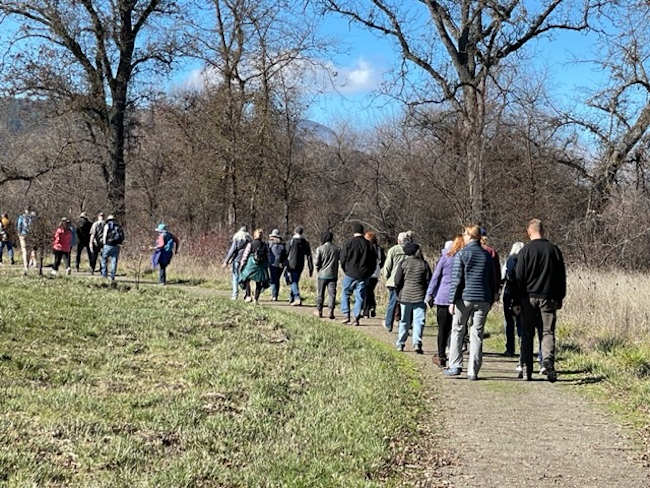
Hikers on the Cache Creek Nature Trail during last year’s New Year’s Day hike at Anderson Marsh State Historic Park in Lower Lake, California. Photo credit: Roberta Lyons.

LOWER LAKE, Calif. – Anderson Marsh State Historic Park will again offer free, community hikes beginning at noon on New Year’s Day.

The hikes are part of America's State Parks First Day Hikes program. The nationwide First Day Hikes program offers individuals and families an opportunity to begin the New Year by taking a healthy hike on Jan. 1 at a state park close to home.

Participants can choose between two routes this year. The first hike will be a leisurely trip to the end of the Dawa Qanoq’ana trail. Formerly known as the McVicar trail, “Dawa Qanoq’ana” means “south way in front of me” in the Pomo language.

This hike will go from the parking lot to the shores of Clear Lake across from Indian Island. This is a round-trip of about 7½ miles of mainly flat terrain, with the first about 0.3 miles being accessible.

This hike should take about three hours, depending on how many times we stop to admire what we see along the way.

The second shorter hike covers a three and a half mile loop over the Cache Creek, Marsh and Ridge trails, with the first about 0.5 miles being accessible. This hike should take between two and two and a half hours.

The New Year’s Day hikes will be led by State Parks volunteers associated with the Anderson Marsh Interpretive Association, or AMIA.

“The event offers a wonderful opportunity to begin the New Year right by getting outside, enjoying nature and welcoming the New Year with friends and family on Jan. 1,” said Henry Bornstein, an AMIA board member who is one of this year’s hike leaders.

Hikers will experience grasslands, oak woodlands, willow and cottonwood riparian habitats, and the tule marsh habitat of the Anderson Marsh Natural Preserve, and may encounter a variety of migrating and resident birds and other wildlife.

Both hikes begin at noon at the park off Highway 53, between Lower Lake and Clearlake.

Children of all ages are welcome when accompanied by an adult. Hikers should bring water and snacks, binoculars if they have them, and a hat for protection against the weather. Sturdy shoes that can handle a little mud are recommended.

Participants on both hikes are welcome to walk part way and make an early return at their own pace.

No dogs are allowed on these trails, which pass through the Anderson Marsh Natural Preserve.

Heavy rain will cancel the walks.

For further information, the public is asked to contact AMIA at 707-995-2658 or This email address is being protected from spambots. You need JavaScript enabled to view it..

Operation Holiday Watch: CHP announces results of statewide retail theft campaign

This stolen vehicle was among three recovered by the California Highway Patrol. Image courtesy of the CHP.
In the final shopping days before Christmas, the California Highway Patrol conducted a successful enforcement operation targeting organized retail crime, promoting safe shopping experiences for communities throughout California.

The collaborative statewide retail theft crackdown on Friday, Dec. 20, resulted in 117 arrests, the recovery of over $38,000 in stolen merchandise, the seizure of two illegal firearms, and the recovery of three stolen vehicles.

Charges range from petty theft, grand theft, organized retail crime, felon in possession of a firearm and auto theft.

“Through proactive enforcement operations and strong partnerships with local law enforcement and retailers, we were able to protect the state’s businesses and consumers during one of the busiest times of the year,” said CHP Commissioner Sean Duryee. “Our efforts send a clear message that retail theft in California will not be tolerated.”

Key results of the operation:

• 117 arrests made for organized retail theft and related offenses.

• Recovery of 767 stolen items, valued at $38,290.70, including clothing, shoes and fragrances.

• Enhanced collaboration among 10 California law enforcement agencies and 56 different retail partners to improve in-store security and reporting.

• Increased law enforcement visibility in high-traffic shopping areas, deterring additional crimes.

The daylong operation was conducted in collaboration with the Hemet Police Department, Los Angeles Sheriff’s Department, Los Angeles Police Department, Glendale Police Department, Bakersfield Police Department, Woodland Police Department, Walnut Creek Police Department, Livermore Police Department and San Ramon Police Department.

As the holiday season winds down, the CHP will continue working with businesses and communities to prevent retail theft year-round. Anyone with information about organized retail theft operations is encouraged to contact the CHP.

Since the Organized Retail Crime Task Force’s inception in 2019, the CHP has been involved in over 3,200 investigations, leading to the arrest of more than 3,500 suspects and the recovery of nearly 1.3 million stolen goods valued at $51.3 million.

Why ‘A Charlie Brown Christmas’ almost didn’t air − and why it endures


In 2024, the beloved special is streaming on Apple TV+. Apple TV+

It’s hard to imagine a holiday season without “A Charlie Brown Christmas.” The 1965 broadcast has become a staple – etched into traditions across generations like decorating the tree or sipping hot cocoa.

But this beloved TV special almost didn’t make it to air. CBS executives thought the 25-minute program was too slow, too serious and too different from the upbeat spectacles they imagined audiences wanted. A cartoon about a depressed kid seeking psychiatric advice? No laugh track? Humble, lo-fi animation? And was that a Bible verse? It seemed destined to fail – if not scrapped outright.

And yet, against all the odds, it became a classic. The program turned “Peanuts” from a popular comic strip into a multimedia empire – not because it was flashy or followed the rules, but because it was sincere.

As a business professor who has studied the “Peanuts” franchise, I see “A Charlie Brown Christmas” as a fascinating historical moment. It’s the true story of an unassuming comic strip character who crossed over into television and managed to voice hefty, thought-provoking ideas – without getting booted off the air.

Call from the blue

The “Peanuts” special came together out of a last-minute scramble. Somewhat out of the blue, producer Lee Mendelson got a call from advertising agency McCann-Erickson: Coca-Cola wanted to sponsor an animated Christmas special.

Mendelson had previously failed to convince the agency to sponsor a “Peanuts” documentary. This time, though, he assured McCann-Erickson that the characters would be a perfect fit.

Mendelson called up “Peanuts” comic strip creator Charles “Sparky” Schulz and told him he had just sold “A Charlie Brown Christmas” – and they would have mere months to write, animate and bring the special to air.

A black and white photo of a man in a white suit and dark tie, seated at a drawing table with a cartoon of a boy in front of him.
Schulz drawing in the 1950s. Roger Higgins/World Telegram & Sun via Library of Congress

Schulz, Mendelson and animator Bill Melendez worked fast to piece together a storyline. The cartoonist wanted to tell a story that cut through the glitz of holiday commercialism and brought the focus back to something deeper.

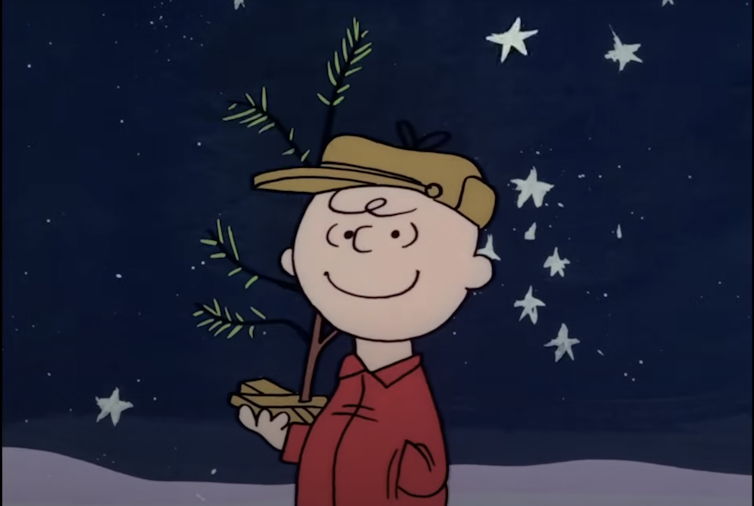
While Snoopy tries to win a Christmas lights contest, and Lucy names herself “Christmas queen” in the neighborhood play, a forlorn Charlie Brown searches for “the real meaning of Christmas.” He makes his way to the local lot of aluminum trees, a fad at the time. But he’s drawn to the one real tree – a humble, scraggly little thing – inspired by Hans Christian Andersen’s fairy tale “The Fir Tree.”

Jazz – and the Bible

Those plot points would likely delight the network, but other choices Schulz made were proving controversial.

The show would use real children’s voices instead of adult actors’, giving the characters an authentic, simple charm. And Schulz refused to add a laugh track, a standard in animated TV at the time. He wanted the sincerity of the story to stand on its own, without artificial prompts for laughter.

Meanwhile, Mendelson brought in jazz musician Vince Guaraldi to compose a sophisticated soundtrack. The music was unlike anything typically heard in animated programming, blending provocative depth with the innocence of childhood.

Most alarming to the executives was Schulz’s insistence on including the heart of the Nativity story in arguably the special’s most pivotal scene.

When Charlie Brown joyfully returns to his friends with the spindly little tree, the rest of the “Peanuts” gang ridicule his choice. “I guess I really don’t know what Christmas is all about,” the utterly defeated Charlie Brown sighs.

Gently but confidently, Linus assures him, “I can tell you what Christmas is all about.” Calling for “Lights, please,” he quietly walks to the center of the stage.

In the stillness, Linus recites the Gospel of Luke, Chapter 2, with its story of an angel appearing to trembling shepherds:

And the angel said unto them, Fear not: for, behold, I bring you tidings of great joy, which shall be to all people.

For unto you is born this day in the city of David a savior, which is Christ the Lord.

Leave it to Linus to deliver the ‘true meaning’ of Christmas.

“Glory to God in the highest, and on earth peace, good will toward men,” he concludes, picking up his security blanket and walking into the wings. The rest of the gang soon concludes Charlie Brown’s scrawny tree isn’t so bad, after all – it just “needs a little love.”

When Schulz discussed this idea with Mendelson and Melendez, they were hesitant. For much of U.S. history, Protestant Christianity was the default in American culture, but in the years since World War II, society had grown somewhat more mindful of making room for Catholic and Jewish Americans. Unsure how to handle the shifting norms, many mainstream entertainment companies in the 1960s tended to avoid religious topics.

“The Bible thing scares us,” CBS executives said when they saw the proofs of the special. But there was simply no time to redo the entire dramatic arc of the special, and pulling it was not an option, given that advertisements had already run.

Fun and philosophy

Fortunately for the “Peanuts” franchise, when the special aired on Dec. 9, 1965, it was an instant success. Nearly half of American households tuned in, and the program won both an Emmy and a Peabody Award. Schulz had tapped into something audiences were craving: an honest, heartfelt message that cut through the commercialism.

A black and white photo of children on stage, many of them standing on chorus risers.
Students at the Cure D'Ars School in Denver put on their own production of the ‘Peanuts’ Christmas special in 1966. Denver Post via Getty Images

Millions of viewers have continued to tune in to the show’s annual rebroadcast for over 50 years on CBS and then ABC – and now Apple TV+.

When I was researching my spiritual biography of Schulz, “A Charlie Brown Religion,” one of my favorite finds was a 1965 letter from a Florida viewer, Betty Knorr. She praised the show for stressing “the true meaning of the Christmas season” at a time when “the mention of God in general (is) being hush hushed.”

The magic of Schulz’s work, though, is that it resonates across demographics and ideologies. Some fans find comfort in the show’s gentle message of faith, while others embrace it in a purely secular way.

Simple but poignant, Schulz’s art and gentle humor can do two things. They can act as safe entry points for some pretty hefty thoughts – be they psychiatric, cultural or theological. Or “Peanuts” cartoons can simply be heartwarming, festive entertainment, if that’s what you want.

Today, both the “Peanuts” empire and the Christmas industry are thriving. Back in the 1960s, commercial realities almost derailed Schulz’s special, yet those same forces ultimately ensured its broadcast. The result is a lasting touchstone of innocence, hope and belief.The Conversation

Stephen Lind, Associate Professor of Clinical Business Communication, University of Southern California

This article is republished from The Conversation under a Creative Commons license. Read the original article.
Space News: NASA’s Webb reveals smallest asteroids yet found in main asteroid belt

Illustration of the main asteroid belt, orbiting the Sun between Mars and Jupiter. Image courtesy of NASA.

NASA’s powerful James Webb Space Telescope includes asteroids on its list of objects studied and secrets revealed.

A team led by researchers at the Massachusetts Institute of Technology in Cambridge repurposed Webb’s observations of a distant star to reveal a population of small asteroids — smaller than astronomers had ever detected orbiting the Sun in the main asteroid belt between Mars and Jupiter.

The 138 new asteroids range from the size of a bus to the size of a stadium — a size range in the main belt that has not been observable with ground-based telescopes.

Knowing how many main belt asteroids are in different size ranges can tell us something about how asteroids have been changed over time by collisions.

That process is related to how some of them have escaped the main belt over the solar system’s history, and even how meteorites end up on Earth.

“We now understand more about how small objects in the asteroid belt are formed and how many there could be,” said Tom Greene, an astrophysicist at NASA’s Ames Research Center in California’s Silicon Valley and co-author on the paper presenting the results. “Asteroids this size likely formed from collisions between larger ones in the main belt and are likely to drift towards the vicinity of Earth and the Sun.”

Insights from this research could inform the work of the Asteroid Threat Assessment Project at Ames. ATAP works across disciplines to support NASA’s Planetary Defense Coordination Office by studying what would happen in the case of an Earth impact and modeling the associated risks.

“It’s exciting that Webb’s capabilities can be used to glean insights into asteroids,” said Jessie Dotson, an astrophysicist at Ames and member of ATAP. “Understanding the sizes, numbers, and evolutionary history of smaller main belt asteroids provides important background about the near-Earth asteroids we study for planetary defense.”

The team that made the asteroid detections, led by research scientist Artem Burdanov and professor of planetary science Julien de Wit, both of MIT, developed a method to analyze existing Webb images for the presence of asteroids that may have been inadvertently “caught on film” as they passed in front of the telescope.

Using the new image processing technique, they studied more than 10,000 images of the star TRAPPIST-1, originally taken to search for atmospheres around planets orbiting the star, in the search for life beyond Earth.

Asteroids shine more brightly in infrared light, the wavelength Webb is tuned to detect, than in visible light, helping reveal the population of main belt asteroids that had gone unnoticed until now.

NASA will also take advantage of that infrared glow with an upcoming mission, the Near-Earth Object, or NEO, Surveyor. NEO Surveyor is the first space telescope specifically designed to hunt for near-Earth asteroids and comets that may be potential hazards to Earth.

The paper presenting this research, “Detections of decameter main-belt asteroids with JWST,” was published Dec. 9 in Nature.

The James Webb Space Telescope is the world’s premier space science observatory. Webb is solving mysteries in our solar system, looking beyond to distant worlds around other stars, and probing the mysterious structures and origins of our universe and our place in it. Webb is an international program led by NASA with its partners, ESA (European Space Agency) and CSA (Canadian Space Agency).

Illustration of the James Webb Space Telescope. Image courtesy of NASA.
  • 290
  • 291
  • 292
  • 293
  • 294
  • 295
  • 296
  • 297
  • 298
  • 299

Community

  • Lake County Wine Alliance offers sponsor update; beneficiary applications open 

  • Mendocino National Forest announces seasonal hiring for upcoming field season

Public Safety

  • Lakeport Police logs: Thursday, Jan. 15

  • Lakeport Police logs: Wednesday, Jan. 14

Education

  • Woodland Community College receives maximum eight-year reaffirmation of accreditation from ACCJC

  • SNHU announces Fall 2025 President's List

Health

  • California ranks 24th in America’s Health Rankings Annual Report from United Health Foundation

  • Healthy blood donors especially vital during active flu season

Business

  • Two Lake County Mediacom employees earn company’s top service awards

  • Redwood Credit Union launches holiday gift and porch-to-pantry food drives

Obituaries

  • Rufino ‘Ray’ Pato

  • Patty Lee Smith

Opinion & Letters

  • The benefits of music for students

  • How to ease the burden of high electric bills

Veterans

  • CalVet and CSU Long Beach team up to improve data collection related to veteran suicides

  • A ‘Big Step Forward’ for Gulf War Veterans

Recreation

  • Wet weather trail closure in effect on Upper Lake Ranger District

  • Mendocino National Forest seeking public input on OHV grant applications

  • State Parks announces 2026 Anderson Marsh nature walk schedule 

  • BLM lifts seasonal fire restrictions in central California

Religion

  • Kelseyville Presbyterian to host Ash Wednesday service and Lenten dinner Feb. 18

  • Kelseyville Presbyterian Church to hold ‘Longest Night’ service Dec. 21

Arts & Life

  • Auditions announced for original musical ‘Even In Shadow’ set for March 21 and 28

  • ‘The Rip’ action heist; ‘Steal’ grounded in a crime thriller

Government & Politics

  • Lake County Democrats issue endorsements in local races for the June California Primary

  • County negotiates money-saving power purchase agreement

Legals

  • March 3 hearing on ordinance amending code for commercial cannabis uses

  • Feb. 12 public hearing on resolution to establish standards for agricultural roads

How to resolve AdBlock issue?
Refresh this page