How to resolve AdBlock issue?
Refresh this page
How to resolve AdBlock issue?
Refresh this page
Lake County News,California
  • Home
    • Registration Form
  • News
    • Education
    • Veterans
    • Community
      • Obituaries
      • Letters
      • Commentary
    • Police Logs
    • Business
    • Recreation
    • Health
    • Religion
    • Legals
    • Arts & Life
    • Regional
  • Calendar
  • Contact us
    • FAQs
    • Phones, E-Mail
    • Subscribe
  • Advertise Here
  • Login

News

Third annual Lake County Restaurant Expo planned Jan. 27

LAKE COUNTY, Calif. — Supporting the local food service and restaurant industry is the goal of an upcoming series of events presented by the Lake County Economic Development Corp.

The Restaurant Expo is a one-day training and networking event focused on providing expert support to new and existing owners of restaurants, food trucks, catering companies and other food industry businesses.

Lake County food industry business owners and their staff are invited to attend the expo on Jan. 27 at the Lake County Campus of Woodland Community College.

The event will start with registration and a no-host lunch at noon, sessions will begin at 1 p.m. and conclude with a networking mixer at 5 p.m.

Food industry business owners, managers, chefs and staff will be treated to presentations from industry experts.

Maria Martinson from Testa Ranch in Redwood Valley will share her inspirational story of her family’s business transitions from grape growing to winemaking and now opening a coffee shop, tasting room, restaurant and antique store.

Participants will learn how to engage with millennials and Gen Z customers, and a representative from US Foods will discuss how popularity and profitability are not the same and how businesses can work towards both.

Additional sessions will include changes in regulations presented by Lake County Environmental Health, how to start your own food industry business, industry experts will explain how to make the most of Restaurant Week, and learn about local hospitality training opportunities.

After the classroom event, Lake County Economic Development Corp., in partnership with the Lake County Winery Association and the Lake County Blue Zones Project, will host a networking event for participants to mingle and network with presenters and industry collaborators.

In addition, the third annual Lake County Restaurant Week will span the week of Feb. 24 to March 2. Restaurants from every corner of the county will participate to show off their best dishes and try new recipes.

To learn more about the Restaurant Expo and networking event or to sign up to attend, visit https://lakecountycaedc.org/restaurant2025/.

Helping Paws: This week’s dogs

LAKE COUNTY, Calif. — Lake County Animal Care and Control has a kennel full of dogs needing to find their new homes.

The dogs available for adoption this week include mixes of Anatolian shepherd, Belgian malinois, boxer, cattle dog, Chihuahua, German shepherd, German shorthaired pointer, husky, Labrador Retriever, pit bull terrier and terrier.

Dogs that are adopted from Lake County Animal Care and Control are either neutered or spayed, microchipped and, if old enough, given a rabies shot and county license before being released to their new owner. License fees do not apply to residents of the cities of Lakeport or Clearlake.

Those dogs and the others shown on this page at the Lake County Animal Care and Control shelter have been cleared for adoption.

Call Lake County Animal Care and Control at 707-263-0278 or visit the shelter online for information on visiting or adopting.

The shelter is located at 4949 Helbush in Lakeport.

Email Elizabeth Larson at This email address is being protected from spambots. You need JavaScript enabled to view it.. Follow her on Twitter, @ERLarson, and on Bluesky, @erlarson.bsky.social. Find Lake County News on the following platforms: Facebook, @LakeCoNews; X, @LakeCoNews; Threads, @lakeconews, and on Bluesky, @lakeconews.bsky.social.


Kennel#4a(pink collar)'s preview photo
Kennel#4a(pink collar)

Kennel#4c(Red Collar)'s preview photo
Kennel#4c(Red Collar)

Kennel#4d(Yellow Collar)'s preview photo
Kennel#4d(Yellow Collar)

Kennel#4e(Blue Collar)'s preview photo
Kennel#4e(Blue Collar)

Kennel#4f(Red collar)'s preview photo
Kennel#4f(Red collar)

Kennel#34's preview photo
Kennel#34


Pepper's preview photo
Pepper

Kennel#28's preview photo
Kennel#28

Kennel#18's preview photo
Kennel#18

Kennel#13a's preview photo
Kennel#13a

Kennel#7(Fonzi)'s preview photo
Kennel#7(Fonzi)

 
Kennel#13b's preview photo
Kennel#13b

Cedar 's preview photo
Cedar

Kennel#20(Griselda)'s preview photo
Kennel#20(Griselda)

Kennel#32b's preview photo
Kennel#32b

Jasper 's preview photo
Jasper

Kennel#32a's preview photo
Kennel#32a

Kennel#25's preview photo
Kennel#25

Kennel#17's preview photo
Kennel#17

Kennel#14a's preview photo
Kennel#14a

Kennel#14b's preview photo
Kennel#14b

Kennel#5's preview photo
Kennel#5

Kennel#22's preview photo
Kennel#22

Kennel#23's preview photo
Kennel#23

Kennel#27's preview photo
Kennel#27

Kennel#21's preview photo
Kennel#21

Foster#9888's preview photo
Foster#9888

Kennel#24's preview photo
Kennel#24


Kennel#30's preview photo
Kennel#30

Kennel#9's preview photo
Kennel#9

Kennel#15's preview photo
Kennel#15


Kennel#33's preview photo
Kennel#33

Kennel#10's preview photo
Kennel#10

Kennel#2a's preview photo
Kennel#2a
Kennel#2b's preview photo
Kennel#2b

Kennel#12a's preview photo
Kennel#12a

Kennel#12b's preview photo
Kennel#12b

Kennel#3's preview photo
Kennel#3

Kennel#8's preview photo
Kennel#8

Kennel#16's preview photo
Kennel#16

Kennel#29's preview photo
Kennel#29


Kennel#31a's preview photo
Kennel#31a

Kennel#31b's preview photo
Kennel#31b

 
Kennel#11's preview photo
Kennel#11

Kennel#22b's preview photo
Kennel#22b


Kennel#22a's preview photo
Kennel#22a

CHP urges community to drive safely into 2025


As 2025 approaches, the California Highway Patrol is taking action to promote safe travel and prevent tragic crashes on California’s roadways.

Starting at 6:01 p.m. on Tuesday, Dec. 31, the CHP will begin a statewide maximum enforcement period, or MEP, to crack down on dangerous driving behaviors and protect all road users.

This heightened enforcement will run through 11:59 p.m. on Wednesday, Jan. 1, 2025.

This year’s Christmas MEP highlighted the risks drivers face.

In just 30 hours, crashes claimed the lives of five people within CHP jurisdiction, and CHP officers arrested more than 300 individuals for driving under the influence, or DUI — an average of one DUI arrest every six minutes.

“Our officers are committed to working through the holidays to ensure everyone can reach their destinations safely,” said CHP Commissioner Sean Duryee. “Safe roads are possible when every driver makes responsible decisions behind the wheel.”

During the New Year’s MEP, CHP officers will target speeding, distracted driving, seatbelt violations and impaired driving.

Last year, during the 78-hour New Year’s enforcement effort, CHP officers made 892 DUI arrests statewide.

If you see a driver who appears impaired, call 9-1-1 immediately. Provide the dispatcher with key details like the vehicle’s description, license plate number, location and direction of travel. Acting quickly could save lives.

“Let’s welcome 2025 responsibly. Drive sober, stay focused and help make the new year safe for everyone on the road,” the CHP said in its announcement on the MEP.

What if you could rank food by ‘healthiness’ as you shopped? Nutrient profiling systems use algorithms to simplify picking healthy groceries


Certain amounts and types of food processing can diminish the nutritional value of the original ingredients. Deanna Kelly/Moment via Getty Images

Imagine a world where food on grocery store shelves is ranked by its healthiness, with simple, research-backed scores. In some countries, that world already exists.

Nutrient profiling systems, or NPSs, support clear front-of-package labels that assess food quality based on nutrient content. Nutri-Score in France is a rainbow-colored system grading foods from A to E. Health Star Rating in Australia is a five-star system rating foods in half-star increments. And the Traffic Light System in the U.K. labels nutrient levels as green, yellow or red.

In contrast, the U.S. lacks a front-of-package ranking system for food. Food Compass was recently developed out of Tufts University to help address this gap and shortcomings in other systems. But it uses nutritional information not currently available for most foods and consumers.

As a gastroenterologist and physician-scientist, I focus on making the latest microbiome and nutrition data more accessible to the public. Drawing on this research, I developed Nutrient Consume Score, or NCS, which rates foods from 1 to 100 using nutritional information available for all foods and incorporates factors important for a healthy microbiome.

But how do nutrient profiling systems work? And how do they compare to other nutrition guides for consumers?

Nutrient cyphers

Each nutrient profiling system uses different scoring algorithms, but most assign positive points to nutrients and foods that are typically underconsumed, such as fiber, fruits and vegetables. Conversely, negative points are given to overconsumed nutrients like sugar, saturated fat and sodium, which are often added to processed foods. These points are combined into a single score: higher scores indicate healthier foods, while lower scores indicate less healthy options.

For example, kale – rich in fiber, potassium and unsaturated fats, while low in sugar, sodium and saturated fats – would earn a high score. In contrast, Twinkies, which are high in sugar, sodium and saturated fats, but low in fiber, potassium and unsaturated fats, would receive a low score. A food like black olives, high in fiber but also high in sodium, would fall somewhere in between.

Person looking at nutrition label of nut butter product in grocery store
Clear nutritional information can help inform healthy food choices. chabybucko/E+ via Getty Images

Nutrient profiling systems work similarly to the Nutrition Facts labels on the back or sides of food packages in helping consumers make informed choices. These labels provide information about a food’s nutrient content, including calories, macronutrients, and key vitamins and minerals. The values are determined through laboratory analysis and nutrient databases based on standardized serving sizes regulated by the Food and Drug Administration.

But NPSs differ in that they combine nutrition information into a single actionable score. This means you don’t have to spend time deciphering Nutrition Facts labels, which are often in small print and can be confusing to interpret.

Ultraprocessed profiling

Nutrient profiling system algorithms are all quite similar in their high ranking of unprocessed foods – beans, nuts, seeds, fruits, vegetables and whole grains – and low ranking of processed foods like hot dogs, soft drinks, cakes and cookies. They help people rebalance their diets that have been skewed by food processing, or the degree to which the ingredients have been altered.

They complement the NOVA classification system developed by researchers at the University of São Paulo, which categorizes foods based on their level of processing. This system introduced the term “ultra-processed foods,” which are foods that have undergone significant industrial processing and contain ingredients not typically found in home cooking.

While NOVA has linked ultra-processed foods to poor health outcomes like obesity, worse mental health, cancer and early death, it treats all such foods equally, overlooking differences like amount of sugar, sodium and other additives.

Sign hanging off shelf of grocery store with letters A to E assigned green to red, the sign reading '5 couleurs pour vous réperer sur les emballages'
France’s Nutri-Score rates the nutritional value of foods from A to E. Laurie Dieffembacq/Belga/AFP via Getty Images

Nutrient profile systems help provide nuance by identifying healthier options within the ultra-processed category. For example, plant-based milks, such as almond or soy milk, may be classified as ultra-processed under the NOVA system, but they can have relatively higher NPS scores if they contain minimal added sugars and salt.

Ratios and bioactives in balance

While nutrient profiling systems can be useful for choosing healthier options, current systems have limitations. They don’t always align perfectly with other research, often overlook the bioactive chemicals that regulate microbiome and body processes, and may rely on incomplete data. Current systems also don’t account for the caloric and health effects of alcohol.

The Nutrient Consume Score I designed aims to address these gaps by incorporating these neglected components of food. For example, it uses food categories as proxies for areas with limited data, including bioactive compounds like polyphenols, omega-3 fats and fermentable fibers. Proxies for bioactive compounds found in unprocessed foods – such as fruits, vegetables, grains, beans, nuts and seeds – are integrated into the score’s core algorithm, which uses nutrient ratios to measure the degree of food processing.

Nutrient ratios – including carbohydrate-to-fiber, saturated fat-to-unsaturated fat and sodium-to-potassium – reflect the natural balance of nutritional content of the cells in unprocessed foods, which research has shown correlate with cardiometabolic health.

Assorted vegetables stacked on top of each other
Whole foods often have their nutrients in balance. Halfdark/fStop via Getty Images

For example, the cell walls of plants provide structural strength and are rich in fiber, while their energy vesicles store carbohydrates. Fiber reduces sugar absorption and is fermented into the compound butyrate, which maintains blood sugar and regulates appetite.

The fat profiles of unprocessed foods are similar to the fat composition in cell membranes. Saturated fat-to-unsaturated fat ratios capture how different types of fat, affect inflammation and weight.

Finally, the potassium-to-sodium ratio reflects the natural function of cell membrane pumps, which concentrate potassium inside cells while transporting sodium out. This affects blood pressure as well as microbiome and metabolic health.

Research currently under peer review shows that the Nutrient Consume Score compares favorably with other systems. Derived from nutrition data from nearly 5,000 Americans, NCS sores are linked to blood pressure, waist circumference and weight. NCS has also been incorporated into a smartphone app intended for public use, currently in beta testing.

Empowering smart choices

While nutrient profiling systems are a promising tool for healthier food choices, they come with important caveats. Most studies testing how well they work focus on how two factors relate to each other rather than whether one directly causes the other. Correlation doesn’t prove causation.

Further studies are needed to assess whether these systems influence buying habits, consumption trends, and health outcomes like weight and blood pressure. Additionally, individual dietary needs can vary, and personalized algorithms could help refine these scores for tailored recommendations.

Despite these considerations, nutrient profiling systems are promising tools to combat rising rates of metabolic disease. Their use in Europe demonstrates their potential to shift consumer purchasing habits and inspire food companies to create healthier products.

Americans may one day see similar front-of-package labels in the U.S. Until then, smartphone technologies can offer a practical way to help consumers make smarter choices today.The Conversation

Christopher Damman, Associate Professor of Gastroenterology, School of Medicine, University of Washington

This article is republished from The Conversation under a Creative Commons license. Read the original article.

Tuleyome Tales: Merry, merry Christmas berry!

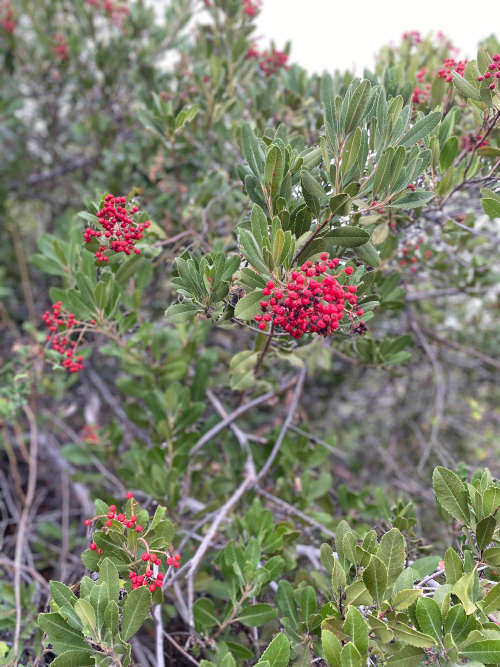
The shiny green leaves and clusters of red berries make Christmas berry (Hetermoleles arbutifolia) easy to spot this time of year. Photo by Kristie Ehrhardt.

NORTHERN CALIFORNIA — On a recent hike through Molok Luyuk, the newest addition to the Berryessa Snow Mountain National Monument, one couldn’t help but notice the dark green shrub with the shouty red berries from across the canyon.

You didn’t really have to search for it, all you needed to do was lift your eyes from the toes of your boots and glance across the landscape.

There, in a sea of gray-green foliage, “Christmas berry” conspicuously stood out like the one (delicious) black-licorice jellybean in a bowl of brightly colored fruity flavors. The entire shrub is quite showy with large, shiny leaves and chunky clusters of splashy red berries.

Christmas berry, also known as Christmas holly and toyon, are all common names for Hetermoleles arbutifolia.

Toyon belongs to the very diverse rose family (Roseaceae) but is the sole constituent of the genus Hetermoleles.

Other members of the rose family include cultivated crops such as apples, peaches, plums and strawberries as well as native species such as California rose (Rosa californica) and chamise (Adenostoma fasciculatum), and many, many others.

Christmas berry is a woody shrub that occurs along the foothills of Central California and in the Coastal Ranges from Humboldt County south to Baja California.

It is commonly, but not always, found on north-facing slopes usually below 4,000 feet in woodlands, forest and chaparral habitats alongside a variety of other species such as coyote bush, coffee berry and live oaks.

The name “toyon” is believed to have been used by the indigenous Ohlone people of historic Central California. It is also thought that the name toyon could have come from an old Spanish word meaning “canyon,” which is where it frequently occurs.

In fact, the striking presence of Christmas holly among the adjacent foothills is thought to have been the namesake for the famed Southern California neighborhood now called “Hollywood.”

Native to California, Christmas berry has adaptations that help it not only survive but thrive in our Mediterranean climate. The thick leaves are leathery and waxy which helps them retain moisture during our scorching summers. It also remains green all year long, which makes the plant less flammable than neighboring chaparral species that readily combust.

Underground, the roots are thoroughly branched and sprawling to help it acquire moisture from the surrounding soil.

The wood is very hard and was used to make tools and weapons while the leaves were used for wound care by Native Californians.

Although the leaves and unripe berries contain a cyanide compound which can cause sickness or even death, as the fruit matures it becomes concentrated only in the seed. This aids in plant dispersal as birds and small mammals eat berries and distribute seeds elsewhere without harming them.

The cyanide compounds remain in the leaves which may help deter browsing by deer and elk. The ripe berries are described as sweet to spicy and bitter.

Native Americans used them as a food source after roasting or drying to remove the bitterness and rarely ate them raw.

Pioneers used the berries in custards, jams, pies and fermented them as a type of cider beverage; the process of fermentation or cooking deactivates the cyanide compound - seems like kind of a tough trial and error lesson.

Sprigs of Christmas berry were often used commercially in place of English holly for Christmas decorations.

By the 1920s Christmas berry was harvested so severely that it was nearly extirpated from within Southern California prompting the state to pass a law making collection of the plant illegal.

In 2012, Christmas berry was adopted as the official native plant of Los Angeles by the Los Angeles City Council. It can be cultivated and grown in domestic gardens in well-drained soil and has even gotten popular as an ornamental in Southern England.

Butterflies love the flowers and the berries are an important winter food source for many resident bird species including California quail, northern mockingbirds, scrub jays as well as migrating species such as cedar waxwings.

Kristie Ehrhardt is Land Conservation and Stewardship Program director for Tuleyome, a 501(c)(3) nonprofit conservation organization based in Woodland, California. For more information go to www.tuleyome.org.

Christmas berry (Hetermoleles arbutifolia) is also called toyon and Christmas holly — the namesake of Hollywood! Photo by Nate Lillge.

Lake County officials report on tobacco program community education successes

LAKE COUNTY, Calif. — Officials working on the reduction of tobacco use in Lake County say they have had several years of successes in their effort.

Since 2020, the Communities Addressing Nicotine, or CAN, Project has made significant progress in Lake County to educate and inform residents, healthcare agencies, decision makers, community stakeholders, and educational representatives about the dangers of breathing Second-Hand Smoke and toxic aerosol from vaping, according to a report on the program.

This project educates and seeks input from the public about general tobacco regulations and supports and provides technical assistance to other tobacco and health education programs.

The Health and Social Policy Institute, or HASPI, which sponsors the CAN project, has been working in rural California communities for the past 20 years and has sponsored projects in Tehama, Humboldt, Amador and Plumas counties.

During the past five years, CAN has worked to engage the public in Lake County, most recently under the direction of Gina Lyle-Griffin, advocacy consultant and public health educator.

Lyle-Griffin has been with the program since 2022, is a longtime resident, and brings decades of local experience in early childhood education, public health practice and tobacco policy knowledge to this work.

Lake County was selected as one of the CAN project’s focus counties beginning in 2020.

The Health and Social Policy Institute and its CAN project in Lake County is dedicated to promoting public health and clean indoor and outdoor air.

Their goals are accomplished through community activities such as working towards encouraging jurisdictional policies for protecting local families from cancer-causing secondhand and thirdhand smoke and aerosol residue in multi-family housing.

HASPI aims to create positive change and promote awareness of health and social policy issues in our rural California communities.

Smoke-free multi-unit housing, apartments, and condominiums sharing common walls have become one of the centerpieces of the project in Lake County. Secondhand smoke and aerosol poses serious health threats to children, seniors, adults and pets.

For residents of multi-family housing, secondhand smoke, including secondhand tobacco smoke and secondhand vape aerosol can be a major concern. Polluted indoor air can flow from unit to unit and travel through doorways, cracks in walls, electrical lines, and ventilation systems.

This secondhand smoke and vape aerosol can cause or increase cases of asthma in children and COPD in adults.

Everyone deserves healthy indoor air at home that promotes their well-being and that will also make it easier to try to quit tobacco use if they wish.

Over the past five years, Lake County has provided educational programs and forums with opportunities for citizen interaction with policymakers and local public officials regarding tobacco and clean air issues.

Lake County residents needing additional information about the health benefits of smoke and aerosol-free air can contact Lyle-Griffin at This email address is being protected from spambots. You need JavaScript enabled to view it. or learn more at https://www.undo.org/secondhand-dangers.
  • 287
  • 288
  • 289
  • 290
  • 291
  • 292
  • 293
  • 294
  • 295
  • 296

Community

  • Lake County Wine Alliance offers sponsor update; beneficiary applications open 

  • Mendocino National Forest announces seasonal hiring for upcoming field season

Public Safety

  • Lakeport Police logs: Thursday, Jan. 15

  • Lakeport Police logs: Wednesday, Jan. 14

Education

  • Woodland Community College receives maximum eight-year reaffirmation of accreditation from ACCJC

  • SNHU announces Fall 2025 President's List

Health

  • California ranks 24th in America’s Health Rankings Annual Report from United Health Foundation

  • Healthy blood donors especially vital during active flu season

Business

  • Two Lake County Mediacom employees earn company’s top service awards

  • Redwood Credit Union launches holiday gift and porch-to-pantry food drives

Obituaries

  • Rufino ‘Ray’ Pato

  • Patty Lee Smith

Opinion & Letters

  • The benefits of music for students

  • How to ease the burden of high electric bills

Veterans

  • CalVet and CSU Long Beach team up to improve data collection related to veteran suicides

  • A ‘Big Step Forward’ for Gulf War Veterans

Recreation

  • Wet weather trail closure in effect on Upper Lake Ranger District

  • Mendocino National Forest seeking public input on OHV grant applications

  • State Parks announces 2026 Anderson Marsh nature walk schedule 

  • BLM lifts seasonal fire restrictions in central California

Religion

  • Kelseyville Presbyterian to host Ash Wednesday service and Lenten dinner Feb. 18

  • Kelseyville Presbyterian Church to hold ‘Longest Night’ service Dec. 21

Arts & Life

  • Auditions announced for original musical ‘Even In Shadow’ set for March 21 and 28

  • ‘The Rip’ action heist; ‘Steal’ grounded in a crime thriller

Government & Politics

  • Lake County Democrats issue endorsements in local races for the June California Primary

  • County negotiates money-saving power purchase agreement

Legals

  • March 3 hearing on ordinance amending code for commercial cannabis uses

  • Feb. 12 public hearing on resolution to establish standards for agricultural roads

How to resolve AdBlock issue?
Refresh this page