How to resolve AdBlock issue?
Refresh this page
How to resolve AdBlock issue?
Refresh this page
Lake County News,California
  • Home
    • Registration Form
  • News
    • Education
    • Veterans
    • Community
      • Obituaries
      • Letters
      • Commentary
    • Police Logs
    • Business
    • Recreation
    • Health
    • Religion
    • Legals
    • Arts & Life
    • Regional
  • Calendar
  • Contact us
    • FAQs
    • Phones, E-Mail
    • Subscribe
  • Advertise Here
  • Login

News

Estate Planning: Enabling advisors to control the administration of a trust

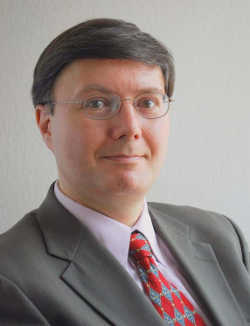
Dennis Fordham. Courtesy photo.

Under California’s new Uniform Directed Trust Act, trusted advisors can be granted control of certain aspects of the trust administration as trust directors.

Also, settlors now can allow co-trustees to divide (compartmentalize) the trust administration between themselves such that co-trustees are no longer responsible for each other’s administration.

Thus, California now allows the trustee’s duties and powers to be segmented and allocated amongst two or more fiduciaries (legal representatives of the trust) who collectively administer the trust.

Until recently, the administration of the trust was always controlled and managed by one or more trustees with full authority and powers over the trust in their hands alone.

Trustees can still hire agents and delegate certain functions. Nonetheless, under Probate Code Section 16012 (a), “The trustee [still] has a duty not to delegate to others the performance of acts that the trustee can reasonably be required personally to perform and may not transfer the office of trustee to another person nor delegate the entire administration of the trust to a co-trustee or other person.”

That is, the trustee has certain non-delegable duties and even if there is a co-trustee involved, neither co-trustee could transfer all responsibility to the other co-trustee.

Now, however, a settlor can establish a trust that divides the trust administration across two or more fiduciaries and diminishes the trustee’s role; perhaps even reducing the trustee to simply holding title to trust assets and performing ministerial duties.

That is, advisors whom the trustee once might have appointed as agents under the trustee’s supervision may now be nominated by the settlor when establishing the trust as “trust directors” to oversee aspects of the trust administration.

As implied, the trust director directs (tells) the trustee to take action within the scope of the trust director’s authority. The directed trustee, as implied, is a trustee whose actions are directed (governed) by one or more trust directors, provided such directions are given within the trust director’s authorized scope of authority.

A trusted financial advisor might be appointed by the settlor as trust director for Investments. The financial advisor might be allowed to make certain investment choices that a trustee would otherwise not be allowed to perform such as investments that would violate the duty to diversify and/or not to invest in speculative / risky assets.

For example, the settlor may want the trust director for Investments to invest in certain possibly high gain / high risk assets (e.g., crypto currency) that the trustee could not do. Naturally, the trust instrument would need to waive California’s statutory diversification and risky asset rules that prohibit such trust investments.

Importantly, the directed trustee has no duty to supervise or to second guess the trust director’s own judgment in either using or not using the trust director’s authority and powers. Nonetheless, the directed trustee still cannot implement a direction given by the trust director if doing so would be a willful breach of the trustee’s fiduciary duty.

Furthermore, the directed trust act also allows co-trustees to control different aspects of a trust’s administration separately.

For example, a special co-trustee with a professional license may be given exclusive authority to control and to manage the settlor’s professional (licensed) practice (e.g., a dentistry), if the professional settlor became incapacitated or died.

The settlor’s spouse might be the other co-trustee with general control over all other trust assets. The settlor’s spouse still has authority to receive assets from the co-trustee managing the settlor’s professional practice (such as money if the practice were sold).

The spouse as general co-trustee would administer the trust for the benefit of the settlor’s family while the special co-trustee winds up the professional practice.

In sum, California law allows for responsibilities for a trust administration to be segmented amongst a variety of fiduciaries (representatives), with unequal and compartmentalized powers, in order to achieve more desired results.

The foregoing discussion is not legal advice. Anyone confronting such estate planning issues should consult with a qualified attorney.

Dennis A. Fordham, attorney, is a State Bar-Certified Specialist in estate planning, probate and trust law. His office is at 870 S. Main St., Lakeport, Calif. He can be reached at This email address is being protected from spambots. You need JavaScript enabled to view it. and 707-263-3235.

Space News: NASA’s micro-mission Lunar Trailblazer will make macro-measurements of the lunar surface in 2025


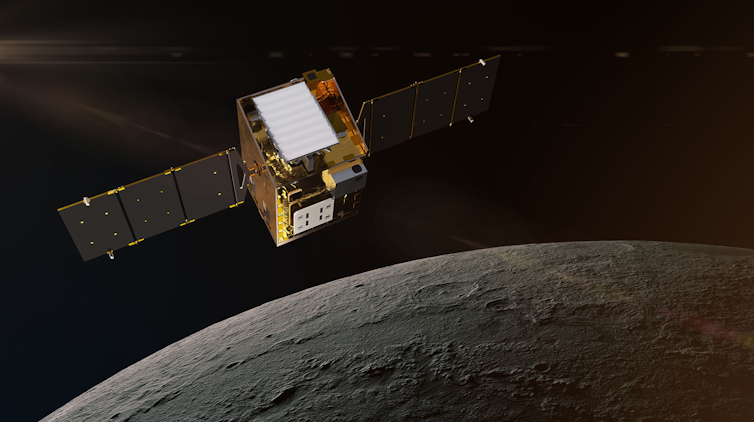
Lunar Trailblazer is planned to launch in early 2025. Lockheed Martin Space
César León Jr., Washington University in St. Louis

NASA’s upcoming Artemis II mission is slated to return astronauts to the Moon no sooner than April 2026. Astronauts were last on the Moon in 1972 during the Apollo 17 mission.

Artemis II will utilize NASA’s Space Launch System, which is an extremely powerful rocket that will enable human space exploration beyond Earth’s atmosphere. The crew of four will travel in an Orion spacecraft, which the agency launched around the Moon and successfully returned during the Artemis I mission.

But before Artemis II, NASA will send two missions to scout the surface of the lunar south pole for resources that could sustain human space travel and enable new scientific discoveries.

Planetary geologists like me are interested in data from Lunar Trailblazer, one of these two scouting missions. The data from this mission will help us understand how water forms and behaves on rocky planets and moons.

Starting with scientific exploration

PRIME-1, or the Polar Resources Ice Mining Experiment, will be mounted on a lunar lander. It’s scheduled for launch in January 2025.

Aboard the lander are two instruments: The Regolith and Ice Drill for Exploring New Terrain, TRIDENT, and the Mass Spectrometer for Observing Lunar Operations, MSOLO. TRIDENT will dig down up to 3 feet (1 meter) and extract samples of lunar soil, and MSOLO will evaluate the soil’s chemical composition and water content.

Joining the lunar mining experiment is Lunar Trailblazer, a satellite launching on the same Falcon 9 rocket.

Think of this setup as a multimillion-dollar satellite Uber pool, or a rideshare where multiple missions share a rocket and minimize fuel usage while escaping Earth’s gravitational pull.

Bethany Ehlmann, a planetary scientist, is the principal investigator of Lunar Trailblazer and is leading an operating team of scientists and students from Caltech’s campus. Trailblazer is a NASA Small, Innovative Mission for PLanetary Exploration, or SIMPLEx.

These missions intend to provide practical operations experience at a lower cost. Each SIMPLEx mission is capped at a budget of US$55 million – Trailblazer is slightly over budget at $80 million. Even over budget, this mission will cost around a quarter of a typical robotic mission from NASA’s Discovery Program. Discovery Program missions typically cost around $300 million, with a maximum budget of $500 million.

Building small but mighty satellites

Decades of research and development into small satellites, or SmallSats, opened the possibility for Trailblazer. SmallSats take highly specific measurements and complement data sourced from other instruments.

A diagram showing four small satellites scanning Earth's science and taking layers of science data.
Missions like NASA’s TROPICS use a network of small satellites to take more data than one satellite would be able to do alone. NASA Applied Sciences

Multiple SmallSats working together in a constellation can take various measurements simultaneously for a high-resolution view of the Earth’s or Moon’s surface.

SIMPLEx missions can use these SmallSats. Because they’re small and more affordable, they allow researchers to study questions that come with a higher technical risk. Lunar Trailblazer, for example, uses commercial off-the-shelf parts to keep the cost down.

These low-cost, high-risk experimental missions may help geologists further understand the origin of the solar system, as well as what it’s made of and how it has changed over time. Lunar Trailblazer will focus specifically on mapping the Moon.

A brief timeline of water discoveries on the Moon

Scientists have long been fascinated by the surface of our closest celestial neighbor, the Moon. As early as the mid-17th century, astronomers mischaracterized ancient volcanic eruptions as lunar mare, derived from the Latin word for “seas.”

Nearly two centuries later, astronomer William Pickering’s calculations suggested that the Moon had no atmosphere. This led him to conclude the Moon could not have water on its surface, as that water would vaporize.

However, in the 1990s, NASA’s Clementine mission detected water on the Moon. Clementine was the first mission to completely map the surface of the Moon, including the lunar poles. This data detected the presence of ice within permanently shadowed regions on the Moon in low resolution.

Scientists’ first water detection prompted further exploration. NASA launched the Lunar Prospector in 1998 and the Lunar Reconnaissance Orbiter in 2009. The India Space Research Organization launched its Chandrayaan-1 mission with the Moon Mineralogy Mapper, M3, instrument in 2008. M3, although not designed to detected liquid water, unexpectedly did find it in sunlit areas on the Moon.

These missions collectively provided maps showing how hydrous minerals – minerals containing water molecules in their chemical makeup – and ice water are distributed on the lunar surface, particularly in the cold, dark, permanently shadowed regions.

Novel mission, novel science

But how does the temperature and physical state of water on the Moon change from variations in sunlight and crater shadows?

Lunar Trailblazer will host two instruments, the Lunar Thermal Mapper, LTM, and an evolution of the M3 instrument, the High-resolution Volatiles and Minerals Moon Mapper, HVM3.

The LTM instrument will map surface temperature, while the HVM3 will measure how lunar rocks absorb light. These measurements will allow it to detect and distinguish between water in liquid and ice forms.

In tandem, these instruments will provide thermal and chemical measurements of hydrous lunar rock. They’ll measure water during various times of the lunar day, which is about 29.5 Earth days, to try to show how the chemical composition of water varies depending on the time of day and where it is on the Moon.

These results will tell researchers what phase – solid or liquid – the water is found in.

Scientific significance and what’s next

There are three leading theories for where lunar water came from. It could be water that’s been stored inside the Moon since its formation, in its mantle layer. Some geologic processes may have allowed it to slowly escape to the surface over time.

Or, the water may have arrived on asteroids and comets that collided with the lunar surface. It may even have been created by interactions with the solar wind, which is a stream of particles that comes from the Sun.

Lunar Trailblazer may shed light on these theories and help researchers make progress on several other big science questions, including how water behaves on rocky bodies like the Moon and whether future astronauts will be able to use it.The Conversation

César León Jr., Ph.D. Student of Planetary Geology, Washington University in St. Louis

This article is republished from The Conversation under a Creative Commons license. Read the original article.
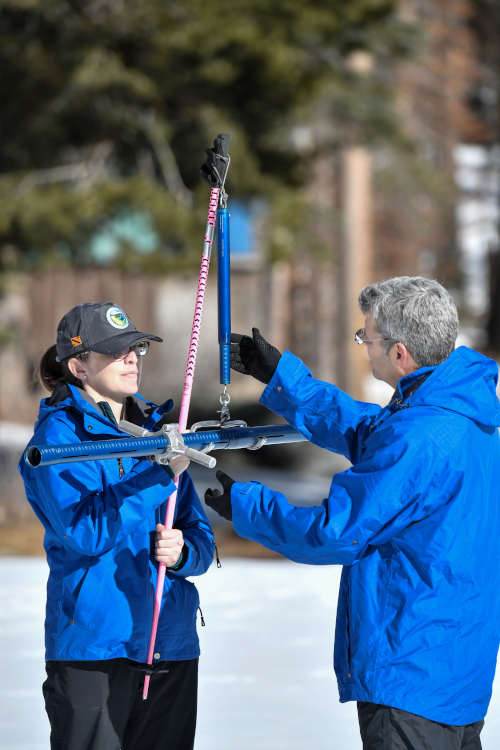
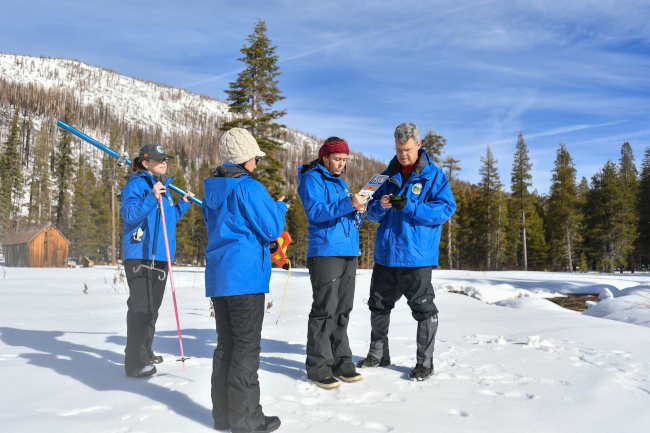
First snow survey of the season shows snowpack near average for California

California Department of Water Resources staff members Jordan Thoennes (left), Water Resources engineer, and Andy Reising, Snow Surveys and Water Supply Forecasting Unit manager, conduct the first media snow survey of the 2025 season at Phillips Station in the Sierra Nevada. The survey is held approximately 90 miles east of Sacramento off Highway 50 in El Dorado County. Photo taken Thursday, Jan. 2, 2025. Photo by Nick Shockey/California Department of Water Resources.

NORTHERN CALIFORNIA — Recent storms have boosted California’s snowpack following a hot summer and fall.

The Department of Water Resources, or DWR, on Thursday conducted the first snow survey of the season at Phillips Station.

The manual survey recorded 24 inches of snow depth and a snow water equivalent of 9 inches, which is 91% of average for this location, DWR reported.

The snow water equivalent measures the amount of water contained in the snowpack and is a key component of DWR’s water supply forecast. Statewide, DWR said the snowpack is 108% of average for this date.

Recent years in California have been marked by extremely hot and dry conditions broken up by periods of intense rain and snow. So far, this water year has been no different, according to DWR’s report.

A record-breaking hot and dry summer continued well into the fall, but a powerful atmospheric river in November broke several rainfall records in Northern California. DWR said a series of storms in late December provided another boost.

“While our snowpack looks good now, we have a long way until April when our water supply picture will be more complete,” said DWR Director Karla Nemeth. “Extreme shifts between dry and wet conditions are continuing this winter and if the past several years are any indication, anything could happen between now and April and we need to be prepared.”

DWR’s electronic readings from 130 stations placed throughout the Sierra Nevada indicate that the statewide snowpack’s snow water equivalent is 10.7 inches, or 108% of average for this date, compared to 28% on this date last year.

California has seen this pattern before. In both 2013 and 2022, the January snowpack was well above average thanks to December storm activity, only for dry conditions to take over the rest of the winter, quickly erasing early season snow totals and continuing existing drought conditions across the state.

California Department of Water Resources staff members (from right) Andy Reising, Snow Surveys and Water Supply Forecasting Unit manager; Manon von Kaenel, Water Resources engineer; Angelique Fabbiani-Leon, state hydrometeorologist; and Jordan Thoennes, Water Resources engineer, conduct the first media snow survey of the 2025 season at Phillips Station in the Sierra Nevada. The survey is held approximately 90 miles east of Sacramento off Highway 50 in El Dorado County.  Photo taken January 2, 2025. Photo taken Thursday, Jan. 2, 2025. Photo by Nick Shockey/California Department of Water Resources.


“We are fortunate to have had several solid snow-producing atmospheric river systems so far this season,” said DWR’s Snow Surveys and Water Supply Forecasting Unit Manager Andy Reising. “The fall was extremely dry, so our healthy snow totals are thanks to a handful of big storm systems in November and late December. But to finish the year where we need to be, we will still need additional snow building at a regular pace throughout the winter.”

Major reservoirs statewide are currently 121% of average thanks to two consecutive years of above average snowpack conditions, which occurred after the driest three-year period on record in California.

DWR is preparing for these swings between extreme conditions by investing in climate resilience, including the use of Forecast Informed Reservoir Operations, floodplain and flood infrastructure improvements and groundwater recharge efforts that will ensure California is able to capture and use as much water during flood conditions as possible.

On average, the Sierra snowpack supplies about 30%t of California’s water needs. Its natural ability to store water is why the Sierra snowpack is often referred to as California's “frozen reservoir.”

Data from these snow surveys and forecasts produced by DWR’s Snow Surveys and Water Supply Forecasting Unit are important factors in determining how DWR manages the state’s water resources.

In other hydrology news, in the Mendocino National Forest, the season’s first snow measurements show below-average conditions.

At Anthony Peak in the Covelo Ranger District and Stony Creek river basin, the December snow measurement showed a depth of 21 inches with 8 inches of water content and 38 % density.

No available measurement at that site was available in December 2023, but in December 2022, the density at that site also was 38%

At Plaskett Meadows, in the Eel River basin, measurements are not expected until April.

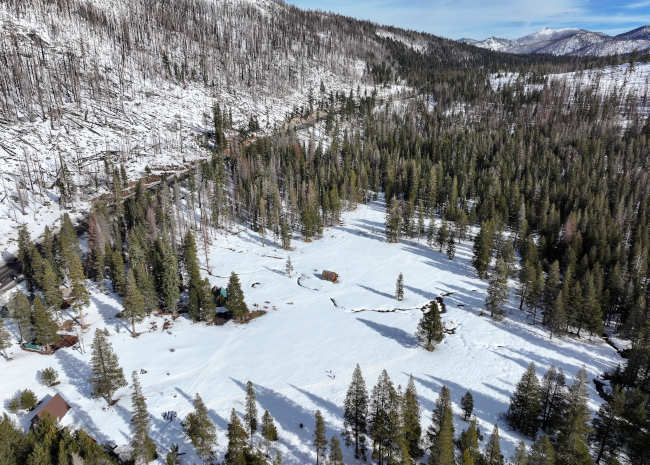
A drone view of the course after the California Department of Water Resources conducted the first media snow survey of the 2025 season at Phillips Station in the Sierra Nevada. The survey is held approximately 90 miles east of Sacramento off Highway 50 in El Dorado County.  Photo taken Thursday, Jan. 2, 2025. Photo by Nick Shockey/California Department of Water Resources.

Authorities identify woman killed in crash with semi truck

LAKE COUNTY, Calif. — The Lake County Sheriff’s Office has identified the Clearlake Oaks woman killed in a Christmas Eve crash with a semi truck.

Frances Cline Novak, 76, died in the wreck, said sheriff’s spokesperson Lauren Berlinn.

The California Highway Patrol’s Clear Lake Area office said Novak was traveling on state Route 53, south of state Route 20 near Clearlake Oaks in a a 2000 Lexus RX3 when she made a U-turn from the southbound shoulder ahead of a 2015 Peterbilt truck tractor driven by Javier Gomez Jimenez, 57, of Williams.

As a result, Novak’s Lexus was hit broadside by the semi truck, and she died of her injuries at the scene, the CHP said. Gomez Jimenez was not injured.

The crash remains under investigation.

Email Elizabeth Larson at This email address is being protected from spambots. You need JavaScript enabled to view it.. Follow her on Twitter, @ERLarson, and on Bluesky, @erlarson.bsky.social. Find Lake County News on the following platforms: Facebook, @LakeCoNews; X, @LakeCoNews; Threads, @lakeconews, and on Bluesky, @lakeconews.bsky.social.

California boosts paid family leave and disability benefits to record levels for new claims

On Thursday, California’s Employment Development Department announced a major boost in Paid Family Leave and disability benefits for workers — up to 90% of pay for workers earning less than $63,000 per year, and 70% for higher income workers.

“Expanded Paid Family Leave benefits are about making it easier for Californians to care for themselves, bond with a new child, and care for their families without worrying about how they’ll pay the bills,” said Governor Gavin Newsom. “This is another example of California leading the way in supporting workers, creating a more affordable California, and building more opportunity for all.”

“This benefit boost makes it more affordable to take time off work and care for an ill family member, bond with a child, or recover from illness or injury,” said EDD Director Nancy Farias. “These investments strengthen California’s workforce and improve the lives of millions of Californians.”

California’s benefit boost will help workers take time off work for pregnancy, childbirth, or recovery from illness or injury.

It will also help people care for seriously ill family members, bond with new children, or support family during military deployment abroad.

The new law that increases these benefits, Senate Bill 951 (SB 951), went into effect Jan. 1, 2025, and is not retroactive — meaning claims from 2024 continue payment at 2024 rates (which paid 60 to 70% of weekly wages).

Information about this transition period is posted on the 2025 Benefit Payment FAQs webpage.

Paid Family Leave and Disability Insurance are insurance plans that cover more than 18 million California workers. Workers pay into these insurance plans through payroll contributions and then draw benefits when needed. Eligible workers receiving disability can get up to 52 weeks of benefits and workers taking Paid Family Leave are eligible for up to 8 weeks of benefits, plus 4 weeks before birth for expecting mothers. On average, workers last year received over $870 per week in Paid Family Leave and over $780 per week for disability.

"SB 951 will ensure every California worker can afford to care for their family and themselves during life’s most important moments," said Sen. Maria Elena Durazo, author of SB 951. "I applaud Governor Newsom for signing my bill into law, which will allow middle and low paid workers to receive up to 90 percent of their wages when out on leave. This change will benefit millions of workers who have contributed to the program during their careers. This bill, which I was proud to introduce, is part of the historic work California is doing to expand equitable access to paid leave."

"SB 951 will make a huge difference to California parents and caregivers who will now be able to afford to take the time to bond with their children, care for their family members, or to heal from their own serious health condition,” said Jenya Cassidy, director of the California Work & Family Coalition. "I'm really proud to have been part of the huge effort that made this possible. Now we need to spread the word to make sure everyone knows about it!"

"We are thrilled to see SB 951 go into effect," said Sharon Terman, director of the Work & Family Program at Legal Aid at Work. "By raising benefit rates to 90 percent for low-paid workers, this landmark law makes Paid Family Leave and State Disability Insurance accessible to Californians with low incomes who previously could not afford to take a massive pay cut when dealing with a family medical crisis or welcoming a new child. Thanks to SB 951, millions more workers will be able to afford to take the leave they need to take care of themselves and their families, without having to risk their economic stability."

For more information and updates visit EDD’s State Disability Insurance webpage.

Clearlake Animal Control: ‘Sahara’ and the dogs

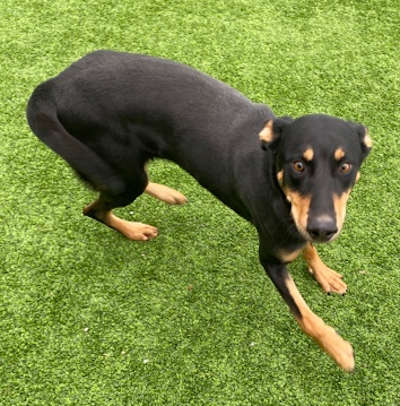
"Sahara." Photo courtesy of Clearlake Animal Control.
CLEARLAKE, Calif. — It’s a new year and Clearlake Animal Control has many dogs ready to start off 2025 with new families.

The shelter has 44 adoptable dogs listed on its website.

This week’s dogs include “Sahara,” a female Doberman pinscher mix with a short black and tan coat.

The shelter is located at 6820 Old Highway 53. It’s open from 9 a.m. to 6 p.m. Tuesday through Saturday.

For more information, call the shelter at 707-762-6227, email This email address is being protected from spambots. You need JavaScript enabled to view it., visit Clearlake Animal Control on Facebook or on the city’s website.

This week’s adoptable dogs are featured below.

Email Elizabeth Larson at This email address is being protected from spambots. You need JavaScript enabled to view it.. Follow her on Twitter, @ERLarson, and on Bluesky, @erlarson.bsky.social. Find Lake County News on the following platforms: Facebook, @LakeCoNews; X, @LakeCoNews; Threads, @lakeconews, and on Bluesky, @lakeconews.bsky.social.


  • 284
  • 285
  • 286
  • 287
  • 288
  • 289
  • 290
  • 291
  • 292
  • 293

Community

  • Lake County Wine Alliance offers sponsor update; beneficiary applications open 

  • Mendocino National Forest announces seasonal hiring for upcoming field season

Public Safety

  • Lakeport Police logs: Thursday, Jan. 15

  • Lakeport Police logs: Wednesday, Jan. 14

Education

  • Woodland Community College receives maximum eight-year reaffirmation of accreditation from ACCJC

  • SNHU announces Fall 2025 President's List

Health

  • California ranks 24th in America’s Health Rankings Annual Report from United Health Foundation

  • Healthy blood donors especially vital during active flu season

Business

  • Two Lake County Mediacom employees earn company’s top service awards

  • Redwood Credit Union launches holiday gift and porch-to-pantry food drives

Obituaries

  • Rufino ‘Ray’ Pato

  • Patty Lee Smith

Opinion & Letters

  • The benefits of music for students

  • How to ease the burden of high electric bills

Veterans

  • CalVet and CSU Long Beach team up to improve data collection related to veteran suicides

  • A ‘Big Step Forward’ for Gulf War Veterans

Recreation

  • Wet weather trail closure in effect on Upper Lake Ranger District

  • Mendocino National Forest seeking public input on OHV grant applications

  • State Parks announces 2026 Anderson Marsh nature walk schedule 

  • BLM lifts seasonal fire restrictions in central California

Religion

  • Kelseyville Presbyterian to host Ash Wednesday service and Lenten dinner Feb. 18

  • Kelseyville Presbyterian Church to hold ‘Longest Night’ service Dec. 21

Arts & Life

  • Auditions announced for original musical ‘Even In Shadow’ set for March 21 and 28

  • ‘The Rip’ action heist; ‘Steal’ grounded in a crime thriller

Government & Politics

  • Lake County Democrats issue endorsements in local races for the June California Primary

  • County negotiates money-saving power purchase agreement

Legals

  • March 3 hearing on ordinance amending code for commercial cannabis uses

  • Feb. 12 public hearing on resolution to establish standards for agricultural roads

How to resolve AdBlock issue?
Refresh this page