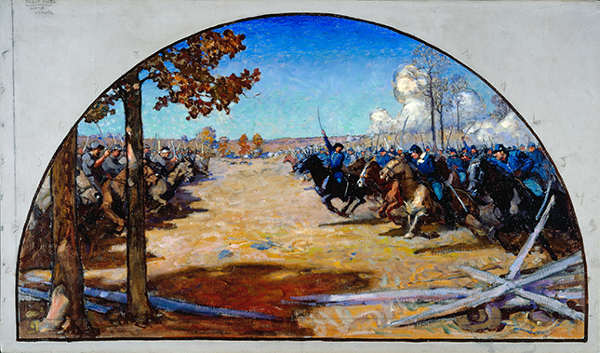
The Battle of Westport on October 23, 1864, by Newell Convers Wyeth. Image courtesy of the University of Missouri Museum of Art and Archaeology.
It was the largest cavalry raid of the American Civil War – it was the largest cavalry raid ever conducted on American soil. And it was a spectacular failure.
By the summer of 1864, things were looking rather grim for the survival of the Confederacy. General Grant had General Lee backed up against Richmond and General Sherman besieged Atlanta. On all fronts, the Union forces had the Confederacy in retreat. Well, almost all fronts.
The Trans-Mississippi Theater is quite possibly the most overlooked theater of the Civil War. Encompassing the region of, you guessed it, Mississippi along with Missouri, Louisiana, Arkansas, Kansas, Texas and the Indian Territory (modern day Nebraska), this region early in the war had had the potential to become quite contested.
After all, whoever gained control in this area, gained control of the Mississippi River, the greatest waterway in America. Early Union victories, however, clinched the region for the Federals, and it had remained this way ever since.
Things changed in 1864. While the rest of the Confederacy was getting walloped, the Confederate forces in the Trans-Mississippi battered the Union forces over the course of what has since become known as the Red River Campaign.
At the end of the campaign, the Confederacy once more held control of large swathes of northeast Arkansas and had beat back a significant Union incursion into Louisiana along the Red River.
Riding high on his success in the recent campaign, Confederate general Kirby Smith, overall commander of the theater for the Confederacy, decided to follow this up with a bold move.
Ever since 1861, the state of Missouri had been under the control of the Union, although vicious guerilla warfare by Confederate sympathizers made it clear to the Federals that not everyone was content with how things stood.
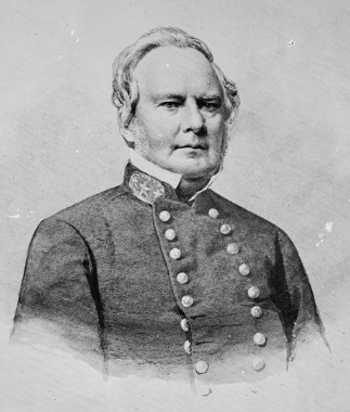
Hoping to wrestle the state back from the Union, and divert Union troops away from the fighting in the east, General Kirby Smith placed Missouri general Sterling Price in control of the expedition to invade Missouri.
Throughout the war, the southern troops in the Trans-Mississippi theater had been chronically under-supplied. The already hard-pressed Confederate government in Richmond sent its generals in the west only enough supplies to keep men in the field – and hardly even that much.
The result was that while the Federal troops were well provisioned – and had recently been sporting new repeating rifles – the men they opposed in the field often made do with torn britches and squirrel guns. So poorly supplied were they, that many Confederate regiments had begun wearing Union blue – uniforms they had stolen from their dead and captured enemy.
Nevertheless, General Price made preparations. He was a Missourian himself and he itched to take back control of his state. He had on hand some 12,000 men, mostly cavalry and the rest mounted riflemen – only 8,000 of these were armed.
Although poorly supplied, Price intended to enter Missouri and pilfer what supplies he could on his way to St. Louis. The capture of St. Louis was the first objective of the campaign. If the general found the city too well fortified, he was to proceed rapidly westward to capture the capital city and, from there, continue west to Kansas City and Fort Leavenworth with its massive stockpile of arms and ammunition.
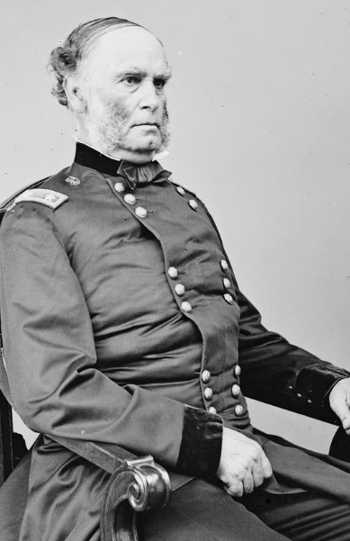
General Samuel Curtis. Library of Congress Prints and Photographs Division Washington, D.C. 20540 USA https://hdl.loc.gov/loc.pnp/pp.print . With his rag-tag mounted army, General Price entered Missouri on Sept. 19, 1864.
A month into the campaign found General Price despondent, if only secretly. His army had won some individual victories on its way to St. Louis, but had faced debilitating losses, thanks in large part to his own foolish decisions – like choosing to attack Fort Davidson, which held no strategic importance, and losing 800 men in the gamble.
By the time Price got within range of St. Louis, he found the city too well defended to risk an engagement, so he moved westward toward the capital of Jefferson City – only to find that city also too well defended.
As his army bypassed Jefferson City, some 5,500 Union cavalrymen under Major General Alfred Pleasonton pursued them westward. Hoping now to achieve at least one objective in this raid, Price rushed his army westward towards Kansas City, where Union General Samuel Ryan Curtis’ Army of the Border awaited him, some 15,000 men strong. If he didn’t smash his way through the Army of the Border, Price would find himself crushed in a vise, with one enemy force to the east and another to the west.
Under these circumstances, Price’s army took the first moves in what would become known as the Battle of Westport on Oct. 23, 1864.
General Curtis’ Army of the Border made a stand along the banks of the Big Blue River and its tributaries. Early in the morning, the bulk of Prices’ army charged across and forced the Federals back.
Their advantage, however, was quickly nullified when they had to halt their advance to replenish their ammunition – once more cursing their inadequate supplies. The delay at the Big Blue allowed General Pleasonton time to bring his army up from the east, and General Price soon realized his worst nightmare: his army was about to be surrounded.
Ferocious fighting on all fronts broke out as the Union army attempted to crush its opponents and Price’s men fought for their lives. A gallant stand by Confederate General Shelby stopped both Union forces long enough for the bulk of Price’s army to flee southward towards Little Santa Fe along the Missouri-Kansas border.
At the end of the Battle of Westport, the Confederate Army had given up on its final objective of taking Kansas City and the fort nearby. Now all it could think about was escaping back to Arkansas.
The following day, however, weighed down by some 500 wagons full of loot stolen along their ill-fated raid, the Confederate forces were once again confronted by Pleasonton and Curtis.
This time, with the help of their new repeating rifles and fresh men, the Union forces utterly crushed the Confederates at the Battle of Mine Creek on Oct. 25, thereby effectively bringing an end to the fighting in that theater.
Antone Pierucci is curator of history at the Riverside County Park and Open Space District and a freelance writer whose work has been featured in such magazines as Archaeology and Wild West as well as regional California newspapers.
General Sterling Price. Library of Congress Prints and Photographs Division Washington, D.C. 20540 USA https://hdl.loc.gov/loc.pnp/pp.print
The Benzinger Family Winery is a diversified vineyard in Sonoma County. Corey Luthringer photo.
BERKELEY, Calif. – With a body the size of a fist and wings that span more than a foot, the big brown bat must gorge on 6,000 to 8,000 bugs a night to maintain its stature. This mighty appetite can be a boon to farmers battling crop-eating pests.
But few types of bats live on American farms. That’s because the current practice of monoculture – dedicating large swathes of land to a single crop – doesn’t give the bats many places to land or to nest.
Retaining a bit of the wild in our working lands – including farmland, rangeland and forests – may be key to preserving biodiversity in the face of climate change, says a new review paper published this week in Science by conservation biologists at the University of California, Berkeley.
The paper synthesizes more than 100 studies on conservation and landscape management published over the past 20 years.
Diversification could be as simple as adding trees or hedgerows along the edges of fields, giving animals like birds, bats and insects places to live, or as complex as incorporating a patchwork of fields, orchards, pasture and flowers into a single working farm.
These changes could extend the habitat of critters like bats, but also much larger creatures like bears, elk and other wildlife, outside the boundaries of parks and other protected areas, while creating more sustainable, and potentially more productive, working lands.
“Protected areas are extremely important, but we can’t rely on those on their own to prevent the pending sixth mass extinction,” said study co-author Adina Merenlender, a Cooperative Extension Specialist in the Department of Environmental Science, Policy and Management at UC Berkeley. “This is even more true in the face of climate change, because species will need to move around to adapt to shifts in temperature and climate.”
A win-win for wildlife and for farms
Maintaining even small pieces of the original landscape – even a single tree– can help conserve the original diversity of species, Merenlender said. Clearing oak woodlands and shrublands to establish large vineyards hits many native species hard.
Animals that are well adapted to urban and agricultural areas, such as mockingbirds, house finches and free-tail bats, continue to flourish, while animals that are more sensitive to disturbance, like acorn woodpeckers, orange-crowned warblers and big brown bats, begin to drop away.
“If you can leave shrubs, trees and flowering plants, the habitat suitability -- not just for sensitive birds but also for other vertebrates – goes way up,” Merenlender said. This is true not only in California’s vineyards, but on working lands around the world.
Incorporating natural vegetation makes the farm more hospitable to more creatures, while reducing the use of environmentally degrading chemicals like herbicides, pesticides and man-made fertilizer.
The ideal farming landscape includes woodland pastures and vegetable plots bumping up against orchards and small fields, said Claire Kremen, a professor in the Department of Environmental Science, Policy and Management.
Integrating livestock produces manure which can fertilize the crops, while those same crops produce feed for livestock. Birds and bats provide pest control, and bees boost crop production by pollinating plants.
“It is possible for these working landscapes to support biodiversity but also be productive and profitable,” Kremen said. “And ultimately, this is where we have to go. We just can’t keep mining our soils for their fertility and polluting our streams – in the end, this will diminish our capacity to continue producing the food that we need. Instead, we must pay attention to the species, from microbes to mammals, that supply us with critical services, like pollination, pest control and nutrient cycling”
“We have some amazing diversified farms, sustainably managed forests and species-rich rangelands here in California that exemplify working lands for conservation around the world,” Merenlender said. “We are calling for a scaling up of this approach around the world, and to do that we champion community-based action and more supportive policies,” Kremen concludes.
Kara Manke writes for the UC Berkeley News Center .
CLEARLAKE, Calif. – A Clearlake man was arrested Friday after police found him to be illegally in possession of firearms along with drug paraphernalia.
Kristian Roath, 37, was arrested in the case, according to Sgt. Rodd Joseph of the Clearlake Police Department.
Just before 8:30 a.m. Friday Clearlake Police officers responded to a possible residential burglary in progress in the 3100 block of 10th Street, Joseph said.
Joseph said a neighbor had called police after seeing suspicious activity at the home. Officers found a person in the backyard and an opened door at the back of the residence. Several additional persons were located inside the residence.
During the investigation officers located several items inside the home including an illegally possessed .22-caliber rifle with a loaded high capacity magazine, a short-barreled sawed-off .22-caliber rifle, a .22-caliber revolver, several boxes of .22-caliber ammunition and a glass smoking pipe commonly used for methamphetamine use, Joseph said.
Joseph said that Roath, a resident of the home and a self-admitted narcotic addict, was charged with possession of a high capacity magazine, possession of a firearm by a prohibited person, possession of ammunition by a prohibited person and willful cruelty to child.
The unsecure loaded firearms were immediately accessible by children who also reside in the home, Joseph said.
Roath was later booked into the Lake County Jail, according to Joseph.
Joseph said the initial residential burglary was determined to be unfounded.
The Clearlake Police Department will continue to remove illegally possessed firearms from those prohibited from possessing them and hold those individuals responsible, Joseph said. If you own firearms in your home, please keep them locked up to prevent children from access to them.
LAKE COUNTY, Calif. – Lake County Animal Control has a big selection of dogs of different breeds available to new homes this week.
Dogs available for adoption this week include mixes of American Bulldog, Australian Shepherd, cattle dog, Chihuahua, German Shepherd, hound, Labrador Retriever, McNab, pit bull, poodle, Rottweiler, terrier and Shiba Inu.
Winston, the last of the dogs taken in during the Mendocino Complex, also continues to look for a new home.
Dogs that are adopted from Lake County Animal Care and Control are either neutered or spayed, microchipped and, if old enough, given a rabies shot and county license before being released to their new owner. License fees do not apply to residents of the cities of Lakeport or Clearlake.
If you're looking for a new companion, visit the shelter. There are many great pets hoping you'll choose them.
The following dogs at the Lake County Animal Care and Control shelter have been cleared for adoption (additional dogs on the animal control Web site not listed are still “on hold”).
“Shakira” is as female Chihuahua-poodle mix in kennel No. 3, ID No. 11284. Photo courtesy of Lake County Animal Care and Control. ‘Shakira’
“Shakira” is as female Chihuahua-poodle mix with a curly cream and brown coat.
She’s in kennel No. 3, ID No. 11284.
This male pit bull is in kennel No. 6, ID No. 11224. Photo courtesy of Lake County Animal Care and Control.Male pit bull
This male pit bull has a short brindle coat.
He already has been neutered.
He’s in kennel No. 6, ID No. 11224.
“Crow” is a male pit bull terrier in kennel No. 7, ID No. 11275. Photo courtesy of Lake County Animal Care and Control. ‘Crow’
“Crow” is a male pit bull terrier with a short black and white coat.
He already has been neutered.
He’s in kennel No. 7, ID No. 11275.
This male pit bull terrier is in kennel No. 9, ID No. 11269. Photo courtesy of Lake County Animal Care and Control. Male pit bull terrier
This male pit bull terrier has a short black and white coat.
He’s in kennel No. 9, ID No. 11269.
“Winston” is a male pit bull terrier and Rottweiler mix in kennel No. 10, ID No. 10970. Photo courtesy of Lake County Animal Care and Control. ‘Winston’
“Winston” is a male pit bull terrier and Rottweiler mix with a short black and brown coat.
He was taken in during the Mendocino Complex in the city of Lakeport.
He’s good with people and other dogs, and is high energy.
He’s in kennel No. 10, ID No. 10970.
This male Labrador Retriever is in kennel No. 11, ID No. 11257. Photo courtesy of Lake County Animal Care and Control. Male Labrador Retriever
This male Labrador Retriever has a short black coat with white markings.
He’s in kennel No. 11, ID No. 11257.
This female shepherd is in kennel No. 14, ID No. 11231. Photo courtesy of Lake County Animal Care and Control. Female shepherd
This female shepherd has a short tri-color coat.
She’s in kennel No. 14, ID No. 11231.
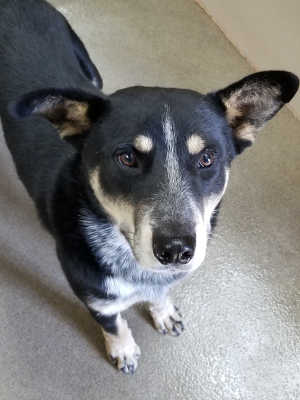
This male cattle dog is in kennel No. 15, ID No. 11230. Photo courtesy of Lake County Animal Care and Control. Male cattle dog
This male cattle dog has a short black and brown coat.
He’s in kennel No. 15, ID No. 11230.
This male cattle dog is in kennel No. 16, ID No. 11229. Photo courtesy of Lake County Animal Care and Control. Male cattle dog
This male cattle dog has a short black and tan coat.
He’s in kennel No. 16, ID No. 11229.
This male cattle dog is in kennel No. 17, ID No. 11228. Photo courtesy of Lake County Animal Care and Control. Male cattle dog
This male cattle dog has a short tricolor coat.
He’s in kennel No. 17, ID No. 11228.
This female Shiba Inu mix is in kennel No. 19, ID No. 11198. Photo courtesy of Lake County Animal Care and Control. Shiba Inu mix
This female Shiba Inu mix has a short red and brown coat.
She already has been spayed.
She’s in kennel No. 19, ID No. 11198.
This female pit bull terrier is in kennel No. 22, ID No. 11192. Photo courtesy of Lake County Animal Care and Control. Female pit bull terrier
This female pit bull terrier has a short brown coat.
She’s in kennel No. 22, ID No. 11192.
“Saint” is a male American Bulldog-pit bull terrier mix in kennel No. 24, ID No. 11236. Photo courtesy of Lake County Animal Care and Control. ‘Saint’
“Saint” is a male American Bulldog-pit bull terrier mix.
He has a short blue and brindle coat.
He’s in kennel No. 24, ID No. 11236.
This female hound is in kennel No. 26, ID No. 11116. Photo courtesy of Lake County Animal Care and Control. Female hound
This female hound has a brown and white coat.
She already has been spayed.
She’s in kennel No. 26, ID No. 11116.
This male German Shepherd mix is in kennel No. 28, ID No. 11223. Photo courtesy of Lake County Animal Care and Control. Male German Shepherd mix
This male German Shepherd mix has a short brown and black coat.
He already has been neutered.
He’s in kennel No. 28, ID No. 11223.
This female Australian Shepherd is in kennel No. 30, ID No. 11152. Photo courtesy of Lake County Animal Care and Control. Female Australian Shepherd
This female Australian Shepherd has a short brindle and white coat.
She has already been spayed.
She’s in kennel No. 30, ID No. 11152.
This male terrier-McNab mix is in kennel No. 33, ID No. 11211. Photo courtesy of Lake County Animal Care and Control. Male terrier-McNab mix
This male terrier-McNab mix has a short black coat.
He’s in kennel No. 33, ID No. 11211.
This female terrier-McNab mix is in kennel No. 34, ID No. 11210. Photo courtesy of Lake County Animal Care and Control. Female terrier-McNab mix
This female terrier-McNab mix has a short black coat.
She’s in kennel No. 34, ID No. 11210.
Lake County Animal Care and Control is located at 4949 Helbush in Lakeport, next to the Hill Road Correctional Facility.
Office hours are Monday through Friday, 11 a.m. to 5 p.m., and 11 a.m. to 3 p.m., Saturday. The shelter is open from 11 a.m. to 4 p.m. Monday through Friday and on Saturday from 11 a.m. to 3 p.m.
For more information call Lake County Animal Care and Control at 707-263-0278.
Email Elizabeth Larson at This email address is being protected from spambots. You need JavaScript enabled to view it.. Follow her on Twitter, @ERLarson, or Lake County News, @LakeCoNews.
LAKEPORT, Calif. – A sixth candidate has joined the race for a seat on the Lakeport Unified School District Board of Trustees.
Business owner Dan Camacho said that on Monday he completed the necessary paperwork to be a write-in candidate for one of the two four-year terms up for election in the race.
“I guess I'm looking to be part of the solution and not part of the problem. Being on the school board is one way to do that,” Camacho said.
“He is a legally qualified write-in candidate,” Lake County Registrar of Voters Diane Fridley confirmed to Lake County News.
Fridley said there is a process to follow to be a write-in candidate for school district, but it only requires completion of a form, not gathering signatures.
She said write-in candidates have to educate the public about how the voting process works for write-ins.
Voters must write in the candidate’s name and then check the box next to it so it’s counted, she said.
Alvord, Camacho, Hanson and Powers are running for two four-year seats, while Buffalo and Darling are running for a seat with an unexpired term of two years.
The race this year has become particularly heated, beginning with questions about the Measure T bond funds and how they’ve been spent, with a key project for the community – a new swimming pool – not completed and not enough bond funds remaining for that project.
Then, earlier this month, the school board removed from her job Rachel Paarsch, the Terrace Middle School principal, reported to be a supporter of Alvard, Buffalo and Hanson.
Camacho said he’s not running in affiliation with any of the other candidates in the election.
Asked about why he was joining the race, Camacho said, “I was asked by a lot of people,” including parents, to do it.
Camacho, who owns an ice water company, has been involved with the schools for many years, including youth sports activities. He said he’s at the school almost every day on various errands.
Camacho also is a county planning commissioner for the Lakeport area.
He had applied to the district to fill Tina Scott’s seat on the board when she was elected to the Board of Supervisors.
Camacho said he has not specific campaign platform. “The school in general needs help,” he said.
He added, “I think we need to start with the kids first.”
Fridley, who has worked in the county elections office for 41 years, said this is only the second write-in candidate she’s seen in that time.
The only other was in 1982, when Betty Irwin ran for justice court judge as a write-in candidate, and won.
Email Elizabeth Larson at This email address is being protected from spambots. You need JavaScript enabled to view it.. Follow her on Twitter, @ERLarson, or Lake County News, @LakeCoNews.
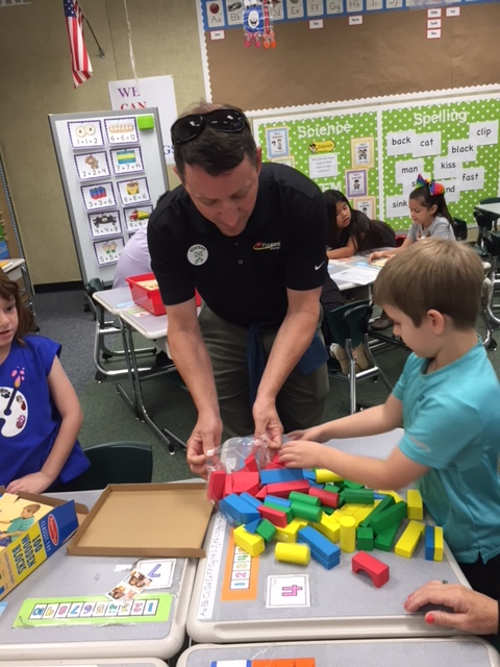
Students at Lakeport Elementary School in Lakeport, Calif., on Thursday, October 18, 2018, try out new STEM-challenge building kits. Courtesy photo. LAKEPORT, Calif. – First-grade students at Lakeport Elementary School received a big surprise on Thursday.
Chevron and local marketers – Redwood Oil Co., Flyers Energy and Colonial Oil – delivered several STEM-Challenge building kits and a “Botley the Coding Robot” set to the class as part of Chevron’s Fuel Your School program.
The new building materials and coding robot will help make learning about designing and engineering functional, as well as coding to electronics to perform specific functions, fun and engaging for Mrs. Swanson’s students.
This month, public school teachers from Del Norte, Humboldt, Lake and Mendocino counties who submit project requests on www.DonorsChoose.org could be funded by Chevron’s Fuel Your School program.
Chevron’s Fuel Your School program made a surprise delivery to Lakeport Elementary School in Lakeport, Calif., on Thursday, October 18, 2018, with multiple STEM-challenge building kits and a “Botley the Coding Robot” set for Mrs. Swanson’s students. Courtesy photo. This year, in an effort to assist in the recovery of the region following the California wildfires, Chevron will not base its North Coast program funding on fuel sales in the area.
Instead, Chevron, with the help of Redwood Oil Company, Flyers Energy, and Colonial Oil, donated $100,000 to fund eligible classroom projects in Del Norte, Humboldt, Lake and Mendocino counties posted www.DonorsChoose.org .
To date, Fuel Your School has helped fund 579 classroom projects at 96 schools in Del Norte, Humboldt, Lake, and Mendocino counties.
 How to resolve AdBlock issue?