 How to resolve AdBlock issue?
News

NORTHERN CALIFORNIA – There’s a common joke that goes around among local birders: “If you don’t see any other birds when you’re out and about, you’ll still see a black phoebe.”
And that’s often true. These little dusky and white, in-their-tuxedo birds seem to be everywhere and that’s because they are so adaptable.
Black phoebes (Sayornis nigricans) can always be found around water sources, where they have ready access to mud, all along the western side of California (and into Oregon and South America).
Because of their adaptability, they can be found in wild areas, around farmsteads and in urban areas. They just need a supply of water, mud for their nests, and insects for their diets.
Usually, they’re exclusively insectivorous, but they have been known to occasionally eat berries when insect supplies are low or minnows when they need the extra protein.
Because they’re not seed-eaters, they won’t come to your bird feeders, but you can still attract them if you plant pollinator gardens on your property.
They like bees and wasps, hoverflies, spiders, grasshoppers, damselflies and dragonflies, and basically any kind of caterpillar, bug or beetle.
In wild landscapes or in town, black phoebes are easy to spot partly because of their penchant to pump their tails up and down when they’re sitting on branches watching for insects, and also by listening for their distinct call which is usually a repeated dee-he, dee-ho; dee-he, dee-ho. Both sexes sing, but it’s usually the male who does most of it.
The black phoebe is a kind of flycatcher and one that doesn’t migrate much from its home territory. They’re generally considered solitary birds outside of their breeding periods, but they can have up to three breeding seasons in a single year, so that’s a lot of together-time. The bonded pairs are monogamous and will usually nest in or around the same place each time every year.
It’s during this time of year, March through April, when the nest selection and building processes begin. The males fly around in front of potential nesting sites, and then the female will choose which one she likes best. She’s also the one who does the actual nest construction.

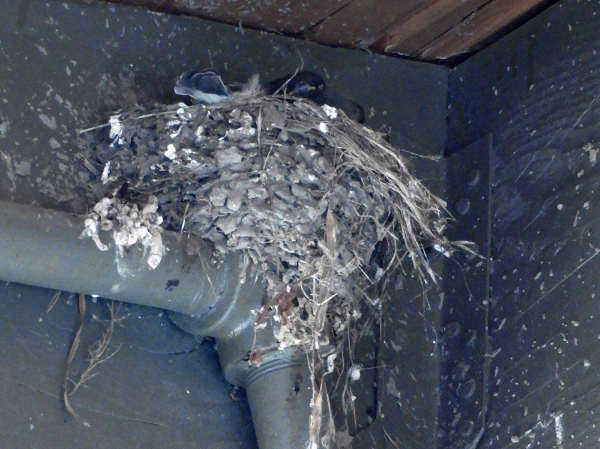
The nests are mud cups filled with fine grasses, and are usually built on walls, posts or cliff-faces under some kind of overhang or eave. The space between the top of the nest and the overhang is usually quite narrow, allowing only the small birds to get inside of it. This helps to protect defenseless offspring from predators like foxes, snakes and cats.
The black phoebe’s eggs are glossy white (sometimes with spots at the larger end) and there are usually up to six in a clutch. The chicks are fuzzy gray when they hatch, but they’ll fledge out in about eighteen days. Adult males and females have identical coloring so it’s hard to tell them apart, but the juveniles are recognizable by the buff-colored bars on the feathers of their wing-caps.
Although they’re small, the black phoebes are notorious for their aggressive territorialism. They seldom allow other birds of any kind to come within 100 feet of their chosen nesting sites.
But there was an odd short-lived exception to this rule noted by Cornell University’s “All About Birds” Web site which recounted the story of a pair of house finches who laid eggs in the nest of a pair of black phoebes, even though the phoebes had already laid six of their own eggs in the nest. The female birds took turns incubating the eggs for about a week before they all lost tolerance of one another and abandoned the site.
There are six subspecies of black phoebe, and the one we see most often in our region is Sayornis nigricans semiatra. It’s distinguished from some of the other subspecies by the peak of feathers on the top of its head. (The white-winged black phoebe found further south has a smooth head with no peak.) They can live for up to 10 years in the wild.
Mary K. Hanson is a Certified California Naturalist, author and nature photographer, who developed and helps to teach the naturalist program at Tuleyome, a 501(c)(3) nonprofit conservation organization based in Woodland. For more information, visit http://tuleyome.org/projects/calnat/.
LAKEPORT, Calif. – The Lake County Library is celebrating several milestones with the Zip Books program, which delivers library books from Amazon to library patrons’ home.
Since Lake County joined the Zip Books program in 2015 the library has received 1,500 requests from the public and added 1,000 books to the library collection.
The Zip Books program has supplemented the library’s book budget by about $5,000 per year.
Library patrons like the innovative service. In a recent anonymous survey, one patron said, “I love the Zip Books! I use it when I find an interesting review of a book that I can't get at the library.” Another said, "I wish Zip Books were available 50 years ago!"
In the Zip Books program, library patrons request regular print books, large print books and audiobooks that the Lake County Library doesn’t own.
If the library already owns the title as a printed book, the library can still order a audiobook or a large print book through the Zip Books program.
The Zip Books request form is on the Lake County Library’s Web site under the “Books and More.”
Requested books that meet the Zip Books program criteria are ordered by the library and shipped to the patrons’ mailing addresses. Each book is checked out to the borrower and has a due date. The patrons are expected to return the books to the library.
Upon return, most Zip Books are accessioned into the library catalog and receive a special Zip Books bookplate.
Zip Books patrons have diverse tastes and interests, all of which contributes to the diverse mix of titles for adults and children that have been added to the library.
In nonfiction, subjects include history, religion, fishing, woman suffrage, cooking, knitting, science and current events. In fiction, the library has added mysteries, science fiction, graphic novels, romance novels and general fiction.
Carolyn Brooks, California State Library Project monitor said, “The goal of the Zip Books Project is to expand the use of an alternative model for interlibrary loan service that, over time, has proved cost effective, easy to use, and extremely popular with the public. The project started in 2013 with 15 libraries; currently over 68 library jurisdictions across the state are participating, with more being added all the time.”
Brooks continues, “Zip Books is a partnership between the California State Library and the NorthNet Library System. It is supported with California Library Services Act funds.”
The California Library Services Board recently approved an additional allocation of $1 million for libraries across California to support and expand the Zip Books program through June 2022.
The Lake County Library is on the Internet at http://library.lakecountyca.gov and Facebook at www.Facebook.com/LakeCountyLibrary. For more information about Zip Books or the library, call 707-263-8817.
Jan Cook is a library technician at the Lake County Library.
Since Lake County joined the Zip Books program in 2015 the library has received 1,500 requests from the public and added 1,000 books to the library collection.
The Zip Books program has supplemented the library’s book budget by about $5,000 per year.
Library patrons like the innovative service. In a recent anonymous survey, one patron said, “I love the Zip Books! I use it when I find an interesting review of a book that I can't get at the library.” Another said, "I wish Zip Books were available 50 years ago!"
In the Zip Books program, library patrons request regular print books, large print books and audiobooks that the Lake County Library doesn’t own.
If the library already owns the title as a printed book, the library can still order a audiobook or a large print book through the Zip Books program.
The Zip Books request form is on the Lake County Library’s Web site under the “Books and More.”
Requested books that meet the Zip Books program criteria are ordered by the library and shipped to the patrons’ mailing addresses. Each book is checked out to the borrower and has a due date. The patrons are expected to return the books to the library.
Upon return, most Zip Books are accessioned into the library catalog and receive a special Zip Books bookplate.
Zip Books patrons have diverse tastes and interests, all of which contributes to the diverse mix of titles for adults and children that have been added to the library.
In nonfiction, subjects include history, religion, fishing, woman suffrage, cooking, knitting, science and current events. In fiction, the library has added mysteries, science fiction, graphic novels, romance novels and general fiction.
Carolyn Brooks, California State Library Project monitor said, “The goal of the Zip Books Project is to expand the use of an alternative model for interlibrary loan service that, over time, has proved cost effective, easy to use, and extremely popular with the public. The project started in 2013 with 15 libraries; currently over 68 library jurisdictions across the state are participating, with more being added all the time.”
Brooks continues, “Zip Books is a partnership between the California State Library and the NorthNet Library System. It is supported with California Library Services Act funds.”
The California Library Services Board recently approved an additional allocation of $1 million for libraries across California to support and expand the Zip Books program through June 2022.
The Lake County Library is on the Internet at http://library.lakecountyca.gov and Facebook at www.Facebook.com/LakeCountyLibrary. For more information about Zip Books or the library, call 707-263-8817.
Jan Cook is a library technician at the Lake County Library.
SACRAMENTO – Sen. Bill Dodd, D-Napa, introduced legislation that would place an independent third party such as Cal Fire in charge of overseeing electric utility corporations’ compliance with tree and vegetation-trimming requirements to reduce wildfires.
“It’s clear that the current standard is not working,” Sen. Dodd said. “We need to make sure appropriate tree trimming and line maintenance occurs. The well-being of California communities and our very lives depend on it.”
Under existing law, utilities decide what trees should be trimmed or removed to comply with standards set by the California Public Utilities Commission.
However, in numerous instances in recent years, wildfire investigations have determined that vegetation was not adequately cleared from lines and was the cause of destructive fires.
Senate Bill 247 would require Cal Fire to direct utilities on trees and vegetation to be removed and later inspect the work, ensuring it meets requirements. Utilities would have to correct any issues identified by Cal Fire in a timely manner.
Separate provisions in the bill would prohibit utilities from diverting maintenance revenue to other purposes and require the utilities to cover the cost of the work performed by Cal Fire.
The bill was amended Thursday and will be set for its first policy committee hearing in the coming weeks.
It is one of four wildfire or disaster-related bills Sen. Dodd has introduced so far this year.
"The public needs to know that there is real, independent oversight, not just someone in an office reviewing paperwork submitted by utilities," said Sen. Dodd. "This bill will help prevent future wildfires and ultimately reduce costs ratepayers."
Dodd, who formerly represented Lake County in the State Assembly, now represents the Third Senate District, which includes all or portions of Napa, Yolo, Sonoma, Solano, Sacramento and Contra Costa counties. Visit his Web site at www.senate.ca.gov/dodd.
“It’s clear that the current standard is not working,” Sen. Dodd said. “We need to make sure appropriate tree trimming and line maintenance occurs. The well-being of California communities and our very lives depend on it.”
Under existing law, utilities decide what trees should be trimmed or removed to comply with standards set by the California Public Utilities Commission.
However, in numerous instances in recent years, wildfire investigations have determined that vegetation was not adequately cleared from lines and was the cause of destructive fires.
Senate Bill 247 would require Cal Fire to direct utilities on trees and vegetation to be removed and later inspect the work, ensuring it meets requirements. Utilities would have to correct any issues identified by Cal Fire in a timely manner.
Separate provisions in the bill would prohibit utilities from diverting maintenance revenue to other purposes and require the utilities to cover the cost of the work performed by Cal Fire.
The bill was amended Thursday and will be set for its first policy committee hearing in the coming weeks.
It is one of four wildfire or disaster-related bills Sen. Dodd has introduced so far this year.
"The public needs to know that there is real, independent oversight, not just someone in an office reviewing paperwork submitted by utilities," said Sen. Dodd. "This bill will help prevent future wildfires and ultimately reduce costs ratepayers."
Dodd, who formerly represented Lake County in the State Assembly, now represents the Third Senate District, which includes all or portions of Napa, Yolo, Sonoma, Solano, Sacramento and Contra Costa counties. Visit his Web site at www.senate.ca.gov/dodd.
LAKE COUNTY, Calif. – The celebrations and parties that may highlight St. Patrick’s Day often lead to tragedy, when impaired drivers take to the roads.
The California Highway Patrol and California Office of Traffic Safety urge people to make planning safe rides as much a part of St. Patrick’s Day celebrations as wearing green.
On March 17, 2018, one person was killed and 48 were injured in collisions caused by driving under the influence in California.
Statewide, 131 people were involved in DUI collisions on St. Patrick’s Day in 2018. The CHP also made 285 arrests for DUI that day.
“When you are celebrating St. Patrick’s Day, remember the other people on the road and in your vehicle,” CHP Commissioner Warren Stanley said. “Do not let alcohol or drugs cause you to become a risk to yourself and others.”
The National Highway Traffic Safety Administration describes March 17 as one of the deadliest holidays on America’s roads. During the 2017 St. Patrick’s Day holiday period, 37 percent of all crash fatalities involved drunken drivers.
“Drinking and driving don’t mix,” OTS Director Rhonda Craft said. “We want people to enjoy the holiday, but be responsible about how they get home once the celebrations end.”
Plan a sober ride in advance if a celebration will include alcohol. The alternative could change your life, not to mention the lives of your passengers, pedestrians, or other drivers and passengers nearby.
The financial impact alone of a DUI can be sobering. Attorneys’ fees, fines, court costs, lost time at work, higher insurance rates, and car repairs can reach $15,000 or more in California. If you plan on drinking, plan on not driving.
The mission of the CHP is to provide the highest level of safety, service and security. The OTS administers traffic safety programs with the goal of reducing deaths, injuries, and economic losses.
The California Highway Patrol and California Office of Traffic Safety urge people to make planning safe rides as much a part of St. Patrick’s Day celebrations as wearing green.
On March 17, 2018, one person was killed and 48 were injured in collisions caused by driving under the influence in California.
Statewide, 131 people were involved in DUI collisions on St. Patrick’s Day in 2018. The CHP also made 285 arrests for DUI that day.
“When you are celebrating St. Patrick’s Day, remember the other people on the road and in your vehicle,” CHP Commissioner Warren Stanley said. “Do not let alcohol or drugs cause you to become a risk to yourself and others.”
The National Highway Traffic Safety Administration describes March 17 as one of the deadliest holidays on America’s roads. During the 2017 St. Patrick’s Day holiday period, 37 percent of all crash fatalities involved drunken drivers.
“Drinking and driving don’t mix,” OTS Director Rhonda Craft said. “We want people to enjoy the holiday, but be responsible about how they get home once the celebrations end.”
Plan a sober ride in advance if a celebration will include alcohol. The alternative could change your life, not to mention the lives of your passengers, pedestrians, or other drivers and passengers nearby.
The financial impact alone of a DUI can be sobering. Attorneys’ fees, fines, court costs, lost time at work, higher insurance rates, and car repairs can reach $15,000 or more in California. If you plan on drinking, plan on not driving.
The mission of the CHP is to provide the highest level of safety, service and security. The OTS administers traffic safety programs with the goal of reducing deaths, injuries, and economic losses.

Researchers at NASA's Jet Propulsion Laboratory in Pasadena, California, are cooking up an alien atmosphere right here on Earth.
In a new study, JPL scientists used a high-temperature "oven" to heat a mixture of hydrogen and carbon monoxide to more than 2,000 degrees Fahrenheit (1,100 Celsius), about the temperature of molten lava.
The aim was to simulate conditions that might be found in the atmospheres of a special class of exoplanets (planets outside our solar system) called "hot Jupiters."
Hot Jupiters are gas giants that orbit very close to their parent star, unlike any of the planets in our solar system. While Earth takes 365 days to orbit the Sun, hot Jupiters orbit their stars in less than 10 days.
Their close proximity to a star means their temperatures can range from 1,000 to 5,000 degrees Fahrenheit (530 to 2,800 degrees Celsius) or even hotter.
By comparison, a hot day on the surface of Mercury (which takes 88 days to orbit the Sun) reaches about 800 degrees Fahrenheit (430 degrees Celsius).
"Though it is impossible to exactly simulate in the laboratory these harsh exoplanet environments, we can come very close," said JPL principal scientist Murthy Gudipati, who leads the group that conducted the new study, published last month in the Astrophysical Journal.
The team started with a simple chemical mixture of mostly hydrogen gas and 0.3 percent carbon monoxide gas. These molecules are extremely common in the universe and in early solar systems, and they could reasonably compose the atmosphere of a hot Jupiter. Then the team heated the mixture to between 620 and 2,240 degrees Fahrenheit (330 and 1,230 Celsius).
The team also exposed the laboratory brew to a high dose of ultraviolet radiation — similar to what a hot Jupiter would experience orbiting so close to its parent star.
The UV light proved to be a potent ingredient. It was largely responsible for some of the study's more surprising results about the chemistry that might be taking place in these toasty atmospheres.
Hot Jupiters are large by planet standards, and they radiate more light than cooler planets. Such factors have allowed astronomers to gather more information about their atmospheres than most other types of exoplanets.
Those observations reveal that many hot Jupiter atmospheres are opaque at high altitudes. Although clouds might explain the opacity, they become less and less sustainable as the pressure decreases, and the opacity has been observed where the atmospheric pressure is very low.

Scientists have been looking for potential explanations other than clouds, and aerosols – solid particles suspended in the atmosphere – could be one.
However, according to the JPL researchers, scientists were previously unaware of how aerosols might develop in hot Jupiter atmospheres. In the new experiment, adding UV light to the hot chemical mix did the trick.
"This result changes the way we interpret those hazy hot Jupiter atmospheres," said Benjamin Fleury, a JPL research scientist and lead author of the study. "Going forward, we want to study the properties of these aerosols. We want to better understand how they form, how they absorb light and how they respond to changes in the environment. All that information can help astronomers understand what they're seeing when they observe these planets."
The study yielded another surprise: The chemical reactions produced significant amounts of carbon dioxide and water. While water vapor has been found in hot Jupiter atmospheres, scientists for the most part expect this precious molecule to form only when there is more oxygen than carbon.
The new study shows that water can form when carbon and oxygen are present in equal amounts. (Carbon monoxide contains one carbon atom and one oxygen atom.) And while some carbon dioxide (one carbon and two oxygen atoms) formed without the addition of UV radiation, the reactions accelerated with the addition of simulated starlight.
"These new results are immediately useful for interpreting what we see in hot Jupiter atmospheres," said JPL exoplanet scientist Mark Swain, a study coauthor. "We've assumed that temperature dominates the chemistry in these atmospheres, but this shows we need to look at how radiation plays a role."
With next-generation tools like NASA's James Webb Space Telescope, set to launch in 2021, scientists might produce the first detailed chemical profiles of exoplanet atmospheres, and it’s possible that some of those first subjects will be hot Jupiters. These studies will help scientists learn how other solar systems form and how similar or different they are to our own.
For the JPL researchers, the work has just begun. Unlike a typical oven, theirs seals the gas in tightly to prevent leaks or contamination, and it allows the researchers to control the pressure of the gas as the temperature rises. With this hardware, they can now simulate exoplanet atmospheres at even higher temperatures: close to 3,000 degrees Fahrenheit (1,600 degrees Celsius).
"It's been an ongoing challenge figuring out how to design and operate this system successfully, since most standard components such as glass or aluminum melt at these temperatures," said JPL research scientist Bryana Henderson, a coauthor of the study. "We're still learning how to push these boundaries while safely handling these chemical processes in the lab. But at the end of the day, the exciting results that come out of these experiments is worth all the extra effort.”
Calla Cofield works for NASA’s Jet Propulsion Laboratory, Pasadena, Calif. The editor is Tony Greicius.

CLEARLAKE, Calif. – The Clearlake City Council and community members gathered on Thursday to bid farewell to City Manager Greg Folsom, with the council voting later in the evening to appoint Folsom’s assistant city manager as his successor.
Alan Flora received the council’s unanimous vote to become the next Clearlake city manager, effective March 28.
Flora, who has held both the city’s assistant manager and finance director job this past year, is a former county of Lake deputy administrative officer and also worked for the county of Mendocino as its assistant chief executive officer. He recently was appointed to the Lakeport Fire Protection District Board of Directors.
Folsom, who joined the city in June 2015, begins his new job as city manager of Suisun City on April 2.
“While I am going to miss being city manager of Clearlake, I can’t think of a better successor than Alan Flora,” Folsom said following the meeting. “Alan has been a leader in this county for many years and I believe he will continue the positive momentum that we have built in Clearlake over the last few years.”
Honors for popular city manager
Ahead of Thursday’s council meeting, an hour-long farewell reception for Folsom – complete with a big cake featuring the city of Clearlake logo – was held at City Hall.
Folsom – wearing one of his signature colorful ties, a bright green one for St. Patrick’s Day – received well wishers including business and nonprofit leaders, residents, other local officials and friends.
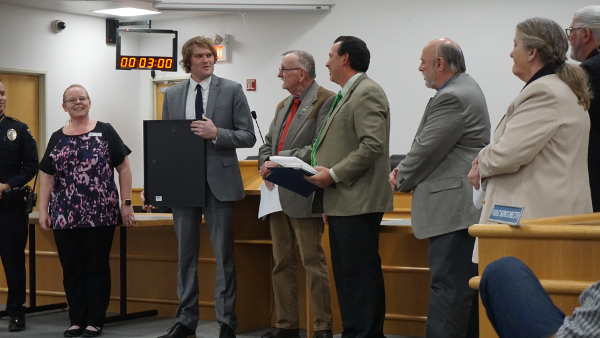
When the meeting got under way, the council presented a farewell proclamation to Folsom. The entire council came down off the dais to stand with Folsom in front of the audience for the reading.
Mayor Nick Bennett started off by reading a message from Ed Robey, a former city council member and county supervisor. In his congratulatory message, Robey said he’s observed every city manager since the city incorporated in 1980. “Greg Folsom is without a doubt the best city manager we've ever had.”
Bennett then read a proclamation that noted Folsom’s many achievements, poked playful fun at his “infamous red pen” and recognized his work to diligently spearhead projects – some of which he didn’t take credit for due to his humility.
A representative from Sen. Mike McGuire’s office also presented a proclamation honoring Folsom on behalf of both McGuire and Assemblywoman Cecilia Aguiar-Curry.
Bennett also offered appreciation to Folsom’s wife, Georgianna, for her support of her husband in his work for the city.
Folsom recounted he and his wife coming to their first council meeting nearly four years ago, when his contract was being considered, and listening as a community member asked what was wrong with Folsom and why would he want to come to Clearlake.
But Folsom came anyway, a decision he indicated was a good one. “The last four years were just the best of my life being city manager here,” he said, choking up.
He lauded his staff and said he’s had the best city councils; he said those councils are the reason the city is doing so much better. Folsom said he was the right guy, at the right place, at the right time with the right council.
It was a year ago that Folsom hired Flora, who initially served as finance director, later adding assistant city manager to his title.
“One of the best decisions I've made as city manager has been bringing Alan on,” said Folsom, adding that Police Chief Andrew White was another great hire.
Flora came forward with another presentation. He said the staff had given Folsom a big red pen they had all signed. “We just appreciate everything you've done for this city.”
He then gave Folsom a large framed portrait of himself. “I hope you get the recognition that you deserve because of what you’ve done here,” Flora said, adding, “Don’t forget about us.”
Folsom hugged his staff and then, after a pause, said, “All right, go away,” with everyone returning to their seats.
During public comment, former mayors Russ Perdock and Denise Loustalot both praised Folsom for his leadership, noting that he had gotten to the city just before the series of devastating fires that hit the county began.
Even so, Folsom rose to the challenge. Loustalot said he led the city, staff and community calmly and safely, and is leaving the city in a much better place.

Council approves Flora’s proposed contract
Attorney Paul Coble of the firm Jones and Mayer, which provides city attorney services to Clearlake, filled in at Thursday night’s meeting for City Attorney Ryan Jones.
Coble went over the basics of Flora’s proposed employment contract, which gives Flora a beginning monthly salary of $11,808.33 per month – which totals $141,699.96 annually – plus $400 per month for vehicle and cell phone expenses.
The contract’s other provisions follow Folsom's city manager contract, Coble said.
Flora’s contract is for a three-year term, with two additional years possible. Coble said that with Flora starting at a lower salary that Folsom – whose salary is $151,000 annually – there would be an overall net savings annually to the city's general fund plus short-term savings since he’s continuing as city finance director.
Loustalot, speaking to the council as the Clear Lake Chamber president, former mayor and a business owner, said that when she was on the council they didn’t have the luxury of having someone in the assistant city manager position, ready to step in.
She said she’s worked with Flora. “Knowing the direction the city is going, he's already in place, he's an easy fit” – and a good fit, she added.
Councilman Dirk Slooten, who is a neighbor of Folsom’s, recounted a conversation with him some time ago about needing to have his replacement ready if he left. And he did just that.
“I'm sure Alan is going to be a heck of a city manager, too,” Slooten said.
Councilman Russell Cremer said Flora “has certainly proven himself over the past year,” and that he and Chief White have brought the city into the 21st century with their knowledge of technology.
Councilwoman Joyce Overton said Flora was also lucky to have been trained by now-retired Lake County Administrative Officer Kelly Cox, who was well known for his budgeting acumen.
Overton said she expects more out of Flora than Folsom. “He set the bar high and I expect you to jump over it,” she said, adding, “I think you're going to do a fabulous job.”
Bennett said the sum total of Flora’s experience is impressive, that he has brought new information and technology to the city, and creates the best financial reports he’s seen in decades of working in government.
Councilman Phil Harris told Flora that the entire council and staff will support him and be there to make him successful. He added that he’s excited to see where the city is going.
“You’ve got big, big shoes to fill,” Harris said.
“I’m definitely the young, improved version of Greg,” Flora joked.
Cremer moved to approve the contract, with multiple council members offering the second. The vote was 5-0.
“Thank you for your support,” Flora said after the vote.
Folsom commended the council on a fine choice in making Flora the next city manager.
“You've done just a fantastic job for us over the last four years,” Cremer told Folsom, adding that he’s been the face of Clearlake.
Cremer also credited Folsom for giving the city back its credibility.
Email Elizabeth Larson at
031419 Clearlake City Council - Proposed city manager contract by LakeCoNews on Scribd