 How to resolve AdBlock issue?
News
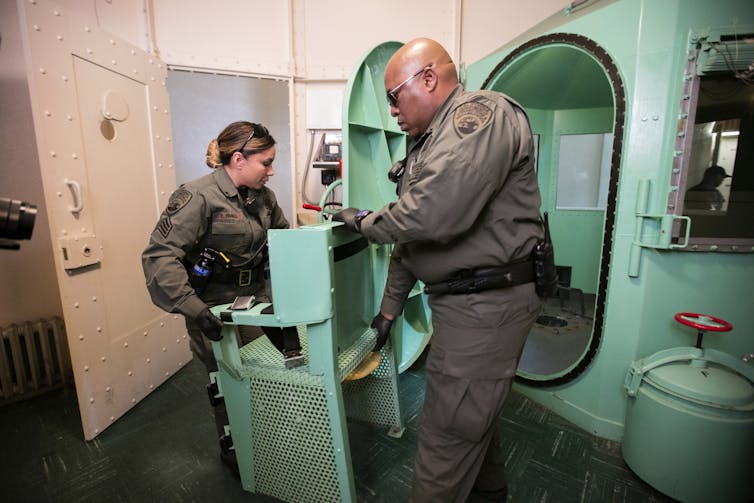 Guards take apart the death penalty chamber at San Quentin State Prison on Wednesday, March 13, 2019. California Department of Corrections and Rehabilitation via AP
Both celebration – and ire – followed Gov. Gavin Newsom’s announcement of a moratorium on the death penalty in California.
California’s 737 death row inmates constitute more than a quarter of the national number. Keeping them on death row costs US$150 million a year more than sentencing them to life without parole.
California’s death penalty has been at an impasse for decades. The state has not put anyone to death since Clarence Ray Allen’s execution in 2006.
The state’s use of lethal injections was fiercely debated for years. Twice – once in 2012 and again in 2016 – Californians voted on measures to repeal the death penalty, and rejected them. Newsom’s step, which in many ways echoes his historical move as then-San Francisco mayor to marry same-sex couples in 2004, pushes the state in a new direction.
As a criminal justice scholar interested in death and life sentences in California and in criminal justice policy generally, I see Newsom’s order as a sign that the death penalty may soon end nationwide.
Let me explain.
Losing public support
While the United States Supreme Court found the death penalty constitutional in 1976, nationwide support for the death penalty is at its lowest point since the 1960s. With this moratorium, California joins a growing list of states who moved away from putting people to death.
Twenty states have abolished the death penalty – eight of them recently. Four more, including California, have placed a moratorium on its use.
Most of these states were already refraining from executing anyone when they abolished the death penalty. In addition to this wave of abolitionism, the death penalty is used less frequently in the 26 states that still have it, partly because drug companies increasingly refused to provide their drugs for use in executions.
This shift matters because attempts to challenge the legality of the death penalty rely on the Eighth Amendment, which prohibits cruel and unusual punishment. What counts as cruel and unusual punishment, the Supreme Court ruled in 1958, changes over time with our evolving standards of decency.
A good example of this evolution is the gradual change in approach toward extreme punishment for juveniles.
In 2004, the Supreme Court abolished the death penalty for juveniles. Five years later, it abolished life without parole for offenses other than homicide by juveniles. It then dismantled mandatory life without parole schemes for juveniles – even those who had committed murder. Subsequently it declared these policies retroactive – meaning that even people who were sentenced decades ago, when they were juveniles, can still benefit from these new rules.
The Supreme Court has also wavered over extreme punishment for adults. It ruled the death penalty unconstitutional for most non-homicide crimes in 2007, and Justices Stephen Breyer and Ruth Bader Ginsburg have recently expressed the view that the death penalty’s constitutionality should be reconsidered. When examining “evolving standards of decency,” the Supreme Court looks at state policies. In this respect, Newsom’s announcement may be of huge importance.
First mover
California holds a unique position as a criminal justice pioneer. Because of the sheer size of its prison population, any policy change that increases – or decreases – incarceration in California can have dramatic effects nationwide.
In 1976, California moved from sentences set by the legislature to “indeterminate sentences” that allow judges to choose from a sentencing range. The state adopted the Three Strikes law in 1994. These two changes were among the important factors leading to a nearly 900 percent spike in the California prison population between 1976 and 2006.

During the Great Recession, California’s lawmakers began to doubt the state could afford such a large prison population. The Criminal Justice Realignment, a law passed in 2011, resulted in a reduction of approximately 40,000 inmates in California’s prisons. In fact, it is estimated that California’s recession-era reforms have accounted for much of the total nationwide decline in prison population.
California is also unique in its political makeup. The contrast between its vehemently progressive coast and deeply conservative center makes for big differences in policies from county to county – and for surprising support for punitive policies in a state that is widely seen as liberal.
It also means that legislating is often conducted by voter initiatives, which are notoriously vulnerable to manipulation through misleading appeals to anger and fear.
California’s mercurial political climate and the size of its death row mean it might influence other states and, possibly, the Supreme Court in the future.
What might happen next
Several important questions loom.
First, would the more conservative makeup of the Supreme Court affect its willingness to reexamine the constitutionality of the death penalty?
Justice Kennedy, who was especially sensitive to punishment questions and skeptical of the death penalty, has retired. Justice Gorsuch seems to support the death penalty. The jury is still out on Justice Kavanaugh’s position.
Second, how might the moratorium impact the strategy of death penalty abolitionists in the state seeking to reform the two other types of extreme punishment – life with and without parole?
On one hand, the distinction between the death penalty and life without parole, which was already tenuous, becomes even more blurred now that no one on California’s death row will be executed. Because policy is made incrementally, it is arguably time for abolitionist states to take a hard look at their other draconian sentencing practices.
On the other hand, in many cases abolition and moratoria are palatable to people who are on the fence about the death penalty precisely because of the existence of an alternative punitive sentence.
Third, there is plenty of work to be done in California. The powerful image of the death chamber being dismantled is a reminder that behind the death penalty lies a giant machine of lengthy and expensive litigation, dilapidated housing conditions and arcane regulations, which must now be considered. With less need to fund representation in these expensive cases, there might be room for other criminal justice reform.
Fourth, while Newsom’s announcement provoked anger and frustration in some victims, it brought relief to others. In an abolitionist era, reformers should come up with solutions that treat victims with respect and award them solace and closure – albeit not necessarily through harsh punishment.
And finally, careful analysis of homicide rates in the next few years should be conducted in order to learn whether, as many have come to assume, capital punishment does not deter crime.
The dismantlement of the death chamber is not the official end of the death penalty in California. But it could be the harbinger of abolition.
Hadar Aviram, Professor of Criminal Justice and Corrections, University of California, Hastings
This article is republished from The Conversation under a Creative Commons license. Read the original article.
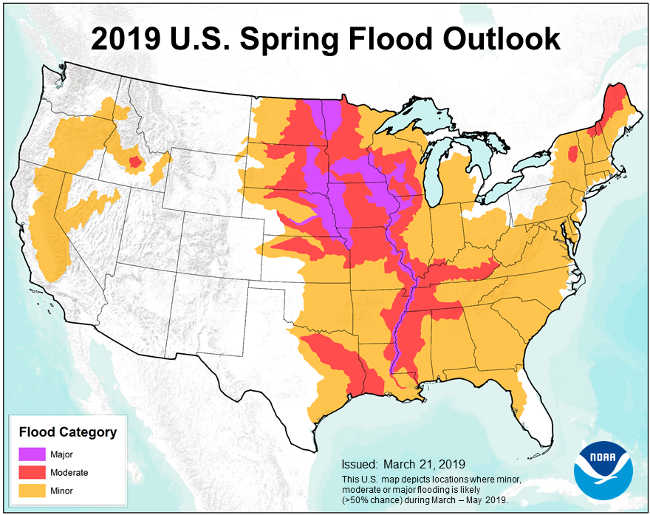
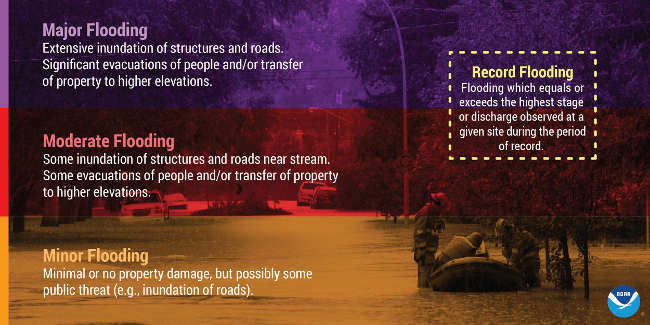
Nearly two-thirds of the Lower 48 states face an elevated risk for flooding through May, with the potential for major or moderate flooding in 25 states, according to NOAA’s U.S. Spring Outlook.
The majority of the country is favored to experience above-average precipitation this spring, increasing the flood risk.
Portions of the United States – especially in the upper Mississippi and Missouri River basins including Nebraska, Minnesota and Iowa – have already experienced record flooding this year.
This early flooding was caused by rapid snow melt combined with heavy spring rain and late season snowfall in areas where soil moisture is high. In some areas, ice jams are exacerbating the flooding.
Offices across the National Weather Service have been working with local communities, providing decision-support services and special briefings to emergency managers and other leaders in local, state and federal government to ensure the highest level of readiness before the flooding began.
Additional spring rain and melting snow will prolong and expand flooding, especially in the central and southern U.S. As this excess water flows downstream through the river basins, the flood threat will become worse and geographically more widespread.
“This outlook will help emergency managers and community decision-makers all along the nation’s major waterways prepare people and businesses for the flood threat,” said Neil Jacobs, Ph.D., NOAA’s acting administrator. “In addition to the safety aspects, our rivers are critical to the economic vitality of the nation, supporting commerce, recreation and transportation. NOAA forecasts and outlooks help people navigate extreme seasonal weather and water events to keep the country safe and moving forward.”
Spring flood risk
Record winter precipitation across a large swath of the country has set the stage for the elevated flood risk. The upper Mississippi and Red River of the North basins have received rain and snow this spring up to 200 percent above normal.
The areas of greatest risk for moderate to major flooding include the upper, middle, and lower Mississippi River basins including the mainstem Mississippi River, Red River of the North, the Great Lakes, eastern Missouri River, lower Ohio, lower Cumberland, and Tennessee River basins.
Additionally, much of the U.S. east of the Mississippi River and portions of California and Nevada are at risk for minor flooding.
“The extensive flooding we’ve seen in the past two weeks will continue through May and become more dire and may be exacerbated in the coming weeks as the water flows downstream,” said Ed Clark, director of NOAA’s National Water Center in Tuscaloosa, Alabama. “This is shaping up to be a potentially unprecedented flood season, with more than 200 million people at risk for flooding in their communities.”
The flood risk outlook is based on a number of factors, including current conditions of snowpack, drought, soil moisture, frost depth, streamflow and precipitation. Local heavy rainfall, especially associated with thunderstorms, can occur throughout the spring and lead to flooding even in areas where overall risk is considered low. In the western U.S., snowpacks at higher elevations may continue to build over the next month, and the flood risk will depend on future precipitation and temperatures.
Spring outlook for temperature, precipitation and drought
Above-average rain and snow in California this winter has pulled the entire state out of its seven-year drought. Scattered areas of the Southwest, Southeast and Pacific Northwest are abnormally dry, but the worst drought conditions in the U.S. are in northern New Mexico.
Springtime rain and melting of deep snowpack are favored to slightly improve the drought there. Drought will persist through spring in southern Alaska and Oregon, and may develop in Hawaii.
Above-average precipitation is favored from the Central Great Basin to the East Coast and in Alaska, compounding the flood risk for many states, especially in the Central and Northern Rockies and in the Southeast.
Warmer-than-average temperatures are forecast to extend from the Pacific Northwest to the Central Rockies, and from southern Texas, northward through the Great Lakes and eastward to encompass the entire East Coast.
The greatest chance for above-average temperatures exist in Alaska, the Northeast and mid-Atlantic. The interior of the U.S. from the Dakotas southward to northern Texas are favored to have below-average temperatures this spring.
“Severe weather and flooding can strike anywhere, whether or not you are in a high risk area,” said Daniel Kaniewski, Ph.D., deputy administrator, Federal Emergency Management Agency. “Insurance is the first and best line of defense. Act now to make sure you have the right coverage for a flood by visiting floodsmart.gov, and don’t forget to download the FEMA mobile app to get real time weather alerts in your area.”
NOAA produces seasonal outlooks to help communities prepare for weather and environmental conditions that are likely during the coming months. Heavy rainfall at any time can lead to flooding, even in areas where overall risk is considered low.
The latest information for a specific area, including official watches and warnings are available at http://water.weather.gov. Empowering people with information to prepare and take action is key to NOAA’s effort to build a Weather-Ready Nation.
Lifetime events relating to a person’s assets and family situation can materially affect how their estate is distributed when they die.
Consider lifetime gifts and loans by a parent to a child. A person’s trust or will may say that lifetime gifts and/or unpaid loans to a child shall be counted as advances against the child’s eventual inheritance. If the document is silent, however, lifetime gifts are not advances.
If they count, however, lifetime advances are first added back into the undistributed estate to compute the entire estate and determine each child’s proportionate share. The advance is then subtracted from the share of the enlarged estate of the child who received the advance.
While the explanation is straightforward, administration is more complicated. Disputes can arise over the amount and terms of such lifetime gifting and/or loans to be repaid. Records of each lifetime gift or loan should exist to avoid, or to limit, the dispute. The trust can refer to the lifetime gifts or loans and the type of ongoing record keeping.
For example, a trust may say that the parent loaned the child $100,000 at 4% compound annual interest and say that the parent is keeping ongoing repayment records.
Sometimes a child loans a parent money to cover the parent’s necessary household expenses. If so, the child and parent should sign a written agreement detailing the terms of repayment. The loan might also be secured against the residence to give the child priority over unsecured creditors (e.g., credit card companies).
Again, ongoing record keeping is important. Like all other debts, any unpaid balance is first repaid before the remaining balance of the estate is distributed amongst the beneficiaries.
Generally, if a specifically gifted asset – like real property -- is sold while the owner is alive, and the owner’s trust (or will) is not updated to remove the gift, then the specific gift is, “adeemed”, i.e., revoked.
Any unspent sale proceeds left in the decedent’s estate – after paying the decedent’s personal debts, taxes and the expenses of settling the decedent’s estate – is distributed with the balance of the estate.
The distribution of the balance of the estate – called the residue – may or may not mirror how the specific gift was to be distributed.
However, when specifically gifted property is sold on behalf of an incapacitated person while alive – by an agent under a power of attorney, a conservator, or the trustee of the person’s trust – then, generally, the death beneficiary is entitled to a gift of money equal to the net sale price of the property sold unreduced by any encumbrance to be paid off (e.g., mortgage).
Next, if the property being specifically gifted was destroyed, condemned, sold, or foreclosed, as relevant, then the beneficiary is entitled to receive the undistributed insurance proceeds, condemnation award, the sales payment, or any property acquired as a result (or in lieu of) foreclosure, as relevant, still owed to the decedent.
For example, if the decedent’s residence was destroyed by fire then the intended death beneficiary is entitled to the unpaid insurance proceeds.
Also, intervening births, marriages, deaths and divorces can affect the distribution of a person’s estate generally, and specific gifts too. Thus, an estate plan is then revisited to address major lifetime events if existing documents did not address these eventualities.
Staying current with one’s estate planning is necessary. Events between when one signed one’s living trust and when one dies may affect the planned distribution of assets in unintended and unforeseen ways.
As a rule of thumb, it is good practice to review one’s estate plan every five years, and sooner when major events occur.
Dennis A. Fordham, Attorney, is a State Bar-Certified Specialist in estate planning, probate and trust law. His office is at 870 S. Main St., Lakeport, Calif. He can be reached at
According to the 1958 law that established NASA, where the first “A” in NASA stands for aeronautics, the agency is charged with solving the problems of flight within the atmosphere.
But the law doesn’t say which planet’s atmosphere.
In that spirit, when the decision was made to add a small helicopter to the Mars 2020 rover mission to the Red Planet, experts at NASA’s Jet Propulsion Laboratory in California looked to the agency’s finest aeronautical innovators on this planet for help.
“Flying a heavier-than-air vehicle within Mars’ thin atmosphere has never been done before, and we’re excited our aeronautics experts could help with this important space mission,” said Susan Gorton, NASA’s manager for the Revolutionary Vertical Lift Technology (RVLT) project.
This first Mars Helicopter will serve as a technology demonstrator that, if successful, will enable future scientists to remotely explore regions of the planet’s surface far from its mothership’s landing site.
“The Mars Helicopter’s initial flight will represent that planet’s version of the Wright Brothers’ achievement at Kitty Hawk and the opening of a new era,” Gorton said. “For those of us whose research revolves around all things related to flight, that would be a remarkable, historic moment.”
Still, there are no guarantees.
Cleared for takeoff
The problems facing the Mars Helicopter design team were and are daunting. The vehicle must fly in Mars’ thin atmosphere, survive brutally cold nights, and operate essentially on its own since it’s millions of miles from the nearest pilot on Earth.
Nevertheless, the engineers at JPL came up with a design that can deal with those concerns, and more.
For example, take the Martian atmosphere. At the surface where the Mars 2020 rover is targeted to land, the atmospheric pressure is equivalent to about 100,000 feet above the Earth’s surface. No helicopter has ever reached even half that distance above Earth.
Yet the Mars Helicopter will be able to fly as high as about 15 feet above the Red Planet thanks to its two sets of rotor blades – each four feet long, tip-to-tip – spinning at 2,400 rotations per minute, which is about 10 times faster than an Earth helicopter.
The smallness of the main helicopter body helps too. It’s only about the size of a softball and will weigh just under four pounds.
The plan at Mars is to attempt up to five flights, each one flying just a little farther and each lasting up to 90 seconds. A solar array on the top of the vehicle will recharge the batteries, which will be used both to rotate the blades and to keep the vehicle warm, especially at night.
And while just the act of flying the helicopter at Mars is the main goal, a small camera nearly identical in capability to the average smart phone will take pictures of the surface below for transmission back to Earth.
A little help
It was just after the overall Mars Helicopter concept was defined that JPL sought out the experts at NASA’s Langley Research Center in Virginia and Ames Research Center in California to help refine and test the vehicle’s design and operation.
“When JPL asked for our expertise, we put together a small but very effective team to help them with configuration, sizing and aerodynamic performance; along with testing and simulation work,” Gorton said.
To do this the team used some of its workhorse computer tools to characterize and better understand how well the Mars Helicopter would fly in the Red Planet’s atmosphere. These included codes used to analyze conceptual design and vehicle sizing called the NASA Design and Analysis of Rotorcraft tool, as well as a more detailed computational fluid dynamics analysis tool known as OVERFLOW.
Their work began in late 2013 and has continued to the present, Gorton said, noting that even during the recent government shutdown, one of the RVLT research engineers was called to duty to help assess the data from a round of final testing.
“When a vehicle goes to Mars it’s going to have to operate autonomously. When it gets there the whole control system and everything that makes it fly must be tuned so that it can fly on its own, which this final round of testing addressed,” Gorton said.
Back on Earth
Although not directly linked to the Mars Helicopter in terms of the technology used, the work NASA Aeronautics is doing with Urban Air Mobility (UAM) also requires many of the same kind of autonomous operational considerations, Gorton said.
One of the most important elements required for UAM to work is for the unmanned vehicle – whether it is carrying cargo or passengers in or around a large city – to be able to make immediate decisions on its own when something unexpected happens.
That could be correcting for a sudden wind shear as it flies between buildings, maneuvering away from another vehicle flying too close, or detecting a technical problem requiring a safe landing as soon as possible.
While the Mars Helicopter isn’t expected to run into any other vehicles flying about, a technical problem or unpredicted change in atmospheric conditions could require the vehicle to immediately cut power and gently drop to the surface.
“That’s what autonomous operations is all about,” Gorton said.
Looking to the future, if the Mars Helicopter works as planned, JPL scientists say future missions to the Red Planet could carry and deploy even more helicopters to extend the scientific reach of the landers they arrived on.
Should that happen, and the skies of Mars start to get a little busy with autonomous helicopters flying about, parts of a drone-related traffic management system descended from work being done today by NASA Aeronautics also could find a home on the Red Planet.
“Whatever the future holds for flight in our atmosphere, the skies above Mars, or over any other planet that’s out there, we’re ready to share the skills and expertise we’ve gained over decades of aeronautics research,” Gorton said.
Jim Banke works for the Aeronautics Research Mission Directorate. The editor is Lillian Gipson.

LUCERNE, Calif. – On Thursday evening a sheriff’s deputy arrested a Lucerne man who had a loaded firearm, was wearing a badge and had a light bar on his vehicle and who claimed to be patrolling the community.
Christopher John Sorenson Jr., 28, was taken into custody in the case, according to Lt. Corey Paulich of the Lake County Sheriff’s Office.
At 7:30 p.m. Thursday a deputy was patrolling in the Lucerne area when he observed a white Dodge Neon car travelling towards him with activated flashing emergency lights on top of the car, in the windshield and in the grill, Paulich said.
Paulich said the Neon’s driver, identified as Sorenson, stopped next to the deputy, who noticed the vehicle had the words “security patrol” displayed on the driver’s door.
Sorenson was wearing a black knit hat that had “security officer” on the front and a brown tactical vest with a star-shaped badge on it also labeled with “security officer,” according to Paulich.

Paulich said Sorenson told the deputy that he was patrolling. The deputy asked Sorenson if he had a firearm and he said he did.
Sorenson got out of his vehicle and the deputy saw he had a semi-automatic pistol in a holster on his tactical vest. Sorenson was also wearing a duty belt with extra magazines, pepper spray, handcuffs, and flashlight, Paulich said.
The deputy took the pistol from Sorenson and found it to be loaded. Paulich said Sorenson provided the deputy with a Bureau of Security and Investigative Services permit for carrying an exposed firearm.
However, Paulich said the permit was only valid when Sorenson was employed performing duties related to the permit. Sorenson told the deputy he was not currently employed.

Sorenson was placed under arrest for misdemeanor charges of carrying a firearm in a vehicle and carrying a loaded firearm in public. He was transported to the Lake County Jail where he was later released after posting bail, Paulich said.
Paulich said Sorenson was not acting on behalf of any community patrol organizations, and he added that the sheriff’s office reminds citizens that it is illegal to carry a firearm even if you are part of a community patrol organization.
The community’s assistance with identifying potential suspects and crimes is greatly appreciated, but Paulich said authorities ask that citizens only observe and report and not take action.
Anyone who may have been contacted or detained by Sorenson is asked to contact the Lake County Sheriff’s Office at 707-263-2690.

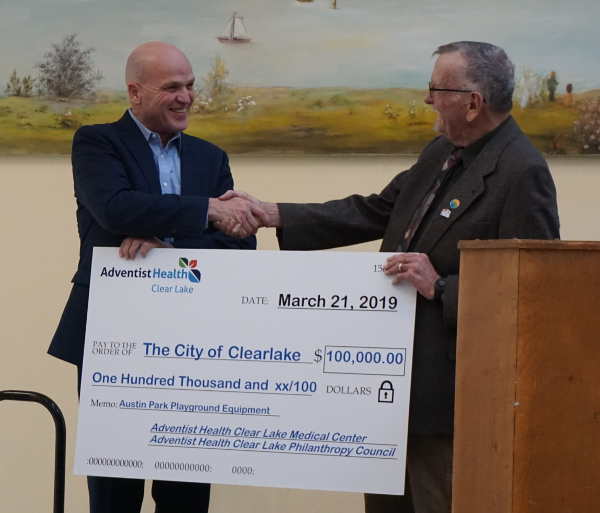
CLEARLAKE, Calif. – Adventist Health Clear Lake leaders joined with city of Clearlake officials on Thursday evening to celebrate their partnership to improve quality of life in the community.
In a special joint meeting of the Clearlake City Council and Clearlake Planning Commission, David Santos, the president and chief executive officer of Adventist Health Clear Lake, presented a check for $100,000 to Mayor Nick Bennett.
The funds, raised through the hospital’s inaugural November gala, are intended to go to park and gym equipment for youth in the city’s Austin Park, which is slated for a major redesign that will create a new community cultural and recreational venue.
Picture boards with design concepts for the park were posted at the building. Planned amenities include a bandshell for outdoor concerts, a new pier, relocation of the playground equipment and a dog park.
“This is a momentous occasion,” Bennett said at the start of the meeting, held at the Clearlake Senior and Community Center.
In introducing Santos, Russell Perdock, a former Clearlake mayor who now works for the hospital with its community wellness program, noted, “His heart is here.”
During his comments, Santos addressed the hospital’s changing approach to health care, community wellness and dreaming big.
Santos said that, five years ago, the hospital’s leadership decided to pursue a number of ambitious goals, among them, to become the preeminent critical access hospital in the country. At the same time, the hospital had the system’s lowest patient experience and was losing money.
Today, Santos said the hospital’s ratings are among the best in the country, they are successfully recruiting more health care providers and they are expanding clinics, with 11 such facilities now around the county. The goal is to have a clinic is every one of Lake County’s communities.
“We are excited about the progress we have made,” he said, pointing to a new emergency room, state-of-the-art MRI and 3D mammography equipment, the clinics and an employee force pushing 600 – up from 370 five years ago.
Santos said they want to improve the county’s overall health status, which he said includes the happiness barometer and quality of life.
He said he has appreciated the opportunity to work with City Manager Greg Folsom and his team, and also lauded members of Rotary for their support.
Over the past four years, Adventist Health Clear Lake has contributed $2 million to improving community wellness and brought in another $2 million in grants. However, Santos noted, “It feels like a drop in the bucket.”
In describing the hospital’s first-ever fall gala fundraiser – the 50th Anniversary Golden Gala Celebration on Nov. 10, which launched a new program aligned with the city of Clearlake – Santos said they are committed to holding a similar event every year in order to make contributions to other communities.
He said that’s a commitment through the development council, which will soon be a foundation to support not just the hospital but to support efforts around improving the health of the county’s communities.
“We just simply want to participate in the revitalization and transformation of Lake County,” as they have tried – and are continuing – to do with the hospital, Santos said.
Santos said the hospital also wants to eradicate homelessness in Lake County. While it may seem difficult, “The plan is falling into place.”
“We can’t thank Adventist Health enough,” Folsom said, noting they’re very excited about the Austin Park project, the master plan for which they’ve been working on for awhile.
“It looks like it’s coming to fruition this year,” Folsom said, with construction bids to come in shortly.
Email Elizabeth Larson at