 How to resolve AdBlock issue?
News
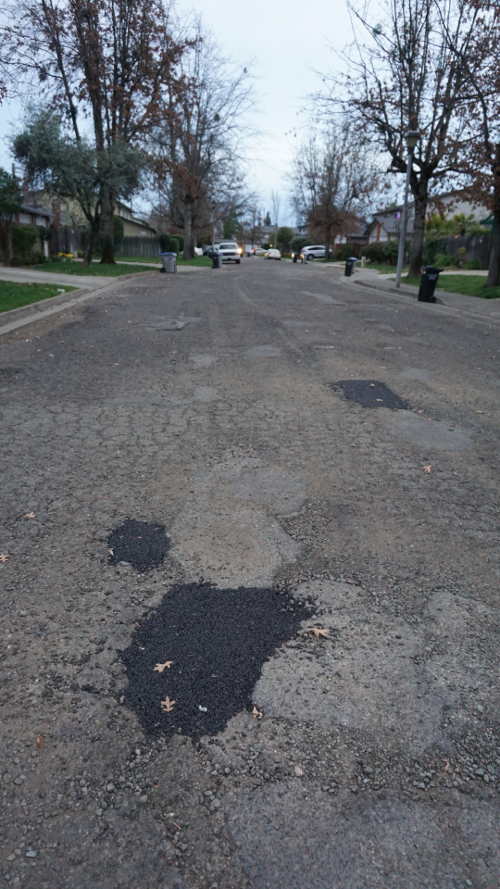
LAKEPORT, Calif. – Residents of the Del Lago Homeowners Association went to the Lakeport City Council meeting this week to ask for immediate attention for their neighborhood’s deteriorating roads, a matter expected to come up in a Friday council goal-setting session.
Several association members attended the Tuesday evening council meeting to speak on the topic during public comment.
In a letter to the council dated March 10, the association’s board of directors noted that homeowners have waited for critical repairs for several years to streets including Via del Lago, Montana Vista, Via del Cabana, Mariah and North Main.
“For over 40 years, nothing has been done to maintain the City streets running through Del Lago except pothole filling,” the letter explains.
“After reporting numerous times that many of the potholes have now eroded to dirt, we have been told by city officials that tax funds have been earmarked for these streets and that we would be in line to receive relief for their dangerous conditions. So far, he only ‘repairs’ made have been to fill the deep potholes with loose material which disappears after a couple of days. This leaves our residents back where we started, facing many conditions which could cause pedestrian falls, etc. (all of which opens to possible lawsuits) and our city spending more money on ‘lost’ materials and staff-power,” the letter said.
The letter concluded, “As Del Lago residents and Board members, we petition the City to repair/possibly replace the City streets that run through Del Lago.” It was signed by the association’s board of directors.
Meg Harper, the association president and one of the letter’s signatories, read the letter to the council. “We have 80 homes in our association,” she said, noting it's a very large tax base.
Harper said the city is spending a lot of time and money filling potholes, adding that the roads aren’t just for residents but for walkers who make their way through the neighborhood. She asked the council to put Del Lago on the priority list.
Dave Stimmel said he’s owned a home in Del Lago for 20 years. All of the streets have a sidewalk on one side of the street.
He and other residents shared photos of the conditions.
Val Schweifler also shared photos of the situation. She said she appreciated staff coming to fill the potholes, but said the patches are gone in just a few days.
Lakeport resident and business owner Nancy Ruzicka said that 45 years ago Del Lago was created as a “planned unit development,” which allowed for higher residential densities and recreation facilities such as a playground, swimming pool and marina.
At the time she said it was built to the highest quality standards, and noted that several parties were involved in its development, including her company, Ruzicka Engineering.
She suggested an assessment district could help address the pavement situation, but asked the city to come up with a solution soon.
Del Lago residents had asked for the discussion to be on the Tuesday agenda and, when it wasn’t, instead decided to speak during public comment.
City Manager Margaret Silveira said it will be a topic at a special goal setting workshop for the council, which takes place beginning at 9 a.m. Friday at Lakeport City Hall.
Mayor Tim Barnes said he had recently driven the association’s streets on his motorcycle, “and my back still hurts.”
A drive through the neighborhood later that night confirmed very rough pavement and resulted in a tooth-rattling ride.
Schweifler told Lake County News in a followup interview this week that the association members knew the city’s budget process is coming up – Friday’s goal-setting meeting helps set priorities for the annual budget – and so they had wanted to get their request before the council ahead of that in order to be considered.
Schweifler said that many potholes have been down to dirt, not even baserock, for a decade.
Tracing development’s record
Public Works Director Doug Grider told Lake County News that he and city Building Official Tom Carlton spent time this week trying to track down a record of when the city took Del Lago’s streets into its road system.
While the record is kind of vague, he said they found documents from the early 1970s indicating that the city accepted Del Lago’s improvement plans. “If the city accepts their improvement plans, then basically they’re accepting their design,” he said.
There also was a letter that stated that the city was going to take Del Lago into the city road system, but Grider said they hadn’t actually been able to find the recorded acceptance.
“I guess we really have to put this in perspective,” Grider said, explaining that when Del Lago was built, there were not nearly so many regulations on streets and sidewalks – including Americans with Disabilities Act requirements – as there are now.
“If you go back to when this was all done, I’m sure that they were doing it for what was the standard at that time,” Grider said. “Unfortunately, that’s nowhere near the standard of today.”
Going back to that time frame, Grider said it wasn’t particularly unusual to take such roads into the city system. However, practices have changed in some areas. Grider – a former county of Lake construction engineer – said the county hasn’t accepted any new roads into its system for about 20 years, taking the position that developments have to have mechanisms in place to cover their own infrastructure.
“I’m pushing for that here,” he said of the city of Lakeport, where they have continued to take in new streets. “But that really needs to stop, just because we can’t afford to maintain what we’ve got.”
Paving and budgeting challenges
The Del Lago neighborhood’s concerns illustrate the city’s challenges with balancing limited funding sources with safety needs and residents’ expectations of better infrastructure.
Grider said he is sympathetic. “I completely understand where they’re coming from and their frustration because it’s mine, too,” he said, explaining it’s hard to look at deteriorating road conditions and not know when he can fix them.
Grider and his staff are known for doing a lot with a little, and have been aided by the city’s sales tax measures.
Even so, with costs going up every year – and a challenge in getting contractors to bid on local jobs due to competition – he said they can do less every year with the combination of city funds and grants, which usually require a substantial match.
“We go after all the money we can. It’s not free money,” he said, explaining that local matching funds are required, the competition for the funds, the amount of paperwork and management, and the cost benefit analysis, which makes it hard for smaller communities like Lakeport – with fewer residents and daily trips – to compete with bigger jurisdictions.
“Is there an easy solution? No,” Grider said.
He said the city’s pavement condition index, which has a scale like school grades, hovers in the “D+” or “D-” range. To bring the entire city’s road conditions up to the “C” category is estimated to cost about $40 million, which he said, realistically, is probably never going to happen.
However, because of innovative approaches the city has taken to its roads, “our road index has been defying the odds,” and is holding steady in condition while other areas are noting declines. “For me, that’s huge,” he said.
Regarding what could be done for Del Lago’s streets, Grider said he thinks they could mill and overlay them. He’ll be getting together with Paul Curren, the city’s enginer, next week to look at the situation.
Grider said he thinks it will require some new pavement. “I don’t have any costs at my fingertips yet. We’re still working on that.”
In the current fiscal year, the city also will be doing a paving project on Lakeshore Boulevard from Lange Street to the city limit, Grider said.
At the same time, the city has some other big projects coming up that will draw on the available funds, including a full reconstruction of South Main Street from Peckham Court to the city limits, a project in next year’s road budget. He said that road, an important entry point into town, gets 15,000 trips a day and if it’s not fixed, people will soon be driving in the mud.
They also starting to assess Forbes Street, repaved from Clear Lake Avenue to Martin Street about 10 years ago as a $1 million federal stimulus project. Grider said it’s starting to show duress and could requires as much as $500,000 in road surface treatment work.
Email Elizabeth Larson at
LAKE COUNTY, Calif. – The California Highway Patrol’s investigators are continuing their exhaustive efforts to solve a homicide that occurred along Highway 20 last month.
Patrick Michael Weber, 41, of Santa Clarita was found dead in his white 2014 sprinter van on the morning of Feb. 21.
The van, which was traveling eastbound, had gone off the south edge of the highway and into a ditch, crashing into a tree, about a mile west of Walker Ridge Road, east of Clearlake Oaks, as Lake County News has reported.
Earlier this month, the CHP’s Clear Lake Area office reported that Weber’s autopsy showed that he had been shot.
Weber’s van had a large quantity of marijuana in the cargo area, and investigators confirmed with the California Department of Cannabis Control that he was not legally licensed to transport marijuana.
CHP Officer Jake Slates, the case’s lead investigator, said the work to solve the crime is ongoing.
“We are continuing to follow up on every lead as they come in and we are still combing through massive amounts of information,” Slates said in a statement released to Lake County News.
“Due to the location of the crime and various locations of witness spread throughout California, it is taking a greater amount of time to conduct interviews and follow up,” Slates said.
Early on, the CHP brought in its Northern Division Multidisciplinary Accident Investigation Team, or MAIT, to work on the case, in cooperation with the Northern Division Investigation Service Unit, Clear Lake CHP officers, the California Department of Justice and Lake County Sheriff’s Office Major Crimes Investigation.
Anyone with information regarding the incident is encouraged to contact Officer Slates through the CHP’s Ukiah Communication Center at 707-467-4000, or to call the Clear Lake CHP Office at 707-279-0103 during business hours.
Email Elizabeth Larson atThis email address is being protected from spambots. You need JavaScript enabled to view it. . Follow her on Twitter, @ERLarson, or Lake County News, @LakeCoNews.
Patrick Michael Weber, 41, of Santa Clarita was found dead in his white 2014 sprinter van on the morning of Feb. 21.
The van, which was traveling eastbound, had gone off the south edge of the highway and into a ditch, crashing into a tree, about a mile west of Walker Ridge Road, east of Clearlake Oaks, as Lake County News has reported.
Earlier this month, the CHP’s Clear Lake Area office reported that Weber’s autopsy showed that he had been shot.
Weber’s van had a large quantity of marijuana in the cargo area, and investigators confirmed with the California Department of Cannabis Control that he was not legally licensed to transport marijuana.
CHP Officer Jake Slates, the case’s lead investigator, said the work to solve the crime is ongoing.
“We are continuing to follow up on every lead as they come in and we are still combing through massive amounts of information,” Slates said in a statement released to Lake County News.
“Due to the location of the crime and various locations of witness spread throughout California, it is taking a greater amount of time to conduct interviews and follow up,” Slates said.
Early on, the CHP brought in its Northern Division Multidisciplinary Accident Investigation Team, or MAIT, to work on the case, in cooperation with the Northern Division Investigation Service Unit, Clear Lake CHP officers, the California Department of Justice and Lake County Sheriff’s Office Major Crimes Investigation.
Anyone with information regarding the incident is encouraged to contact Officer Slates through the CHP’s Ukiah Communication Center at 707-467-4000, or to call the Clear Lake CHP Office at 707-279-0103 during business hours.
Email Elizabeth Larson at
LOWER LAKE, Calif. – The Anderson Marsh Interpretive Association is planning an April fundraiser to benefit its operations and events at Anderson Marsh State Historic Park.
Join the association at DJs Pizza in Lower Lake on Wednesday, April 3, from 5 to 8 p.m. for a fundraising pizza party for the whole family.
The cost is $8 per person for all-you-can-eat pizza. Buy your own drinks and salads at the counter.
“Proceeds from the event will help AMIA’s campaign to keep Anderson Marsh State Historic Park open and available to the public, and will pay for school field trips, guided nature walks, educational exhibits and park improvements,” said AMIA Treasurer Henry Bornstein. “We’re grateful to DJ’s Pizza for this opportunity to raise some needed funds while meeting with supporters and enjoying DJ’s delicious pizza. Come join us.”
DJ’s Pizza is located at 16135 Main St. in Lower Lake. Advance tickets are available at Catfish Coffee House in Clearlake and online at www.andersonmarsh.org. Tickets also can be purchased at DJ’s Pizza on the evening of the event.
For more information about Anderson Marsh State Historic Park or AMIA, visit www.andersonmarsh.org or contact AMIA at eitherThis email address is being protected from spambots. You need JavaScript enabled to view it. or 707-995-2658.
Join the association at DJs Pizza in Lower Lake on Wednesday, April 3, from 5 to 8 p.m. for a fundraising pizza party for the whole family.
The cost is $8 per person for all-you-can-eat pizza. Buy your own drinks and salads at the counter.
“Proceeds from the event will help AMIA’s campaign to keep Anderson Marsh State Historic Park open and available to the public, and will pay for school field trips, guided nature walks, educational exhibits and park improvements,” said AMIA Treasurer Henry Bornstein. “We’re grateful to DJ’s Pizza for this opportunity to raise some needed funds while meeting with supporters and enjoying DJ’s delicious pizza. Come join us.”
DJ’s Pizza is located at 16135 Main St. in Lower Lake. Advance tickets are available at Catfish Coffee House in Clearlake and online at www.andersonmarsh.org. Tickets also can be purchased at DJ’s Pizza on the evening of the event.
For more information about Anderson Marsh State Historic Park or AMIA, visit www.andersonmarsh.org or contact AMIA at either
LAKEPORT, Calif. – With the Secretary of State’s Office having set a deadline of later this year to decertify old voting equipment – including the system used for more than 35 years by Lake County – the Board of Supervisors this week approved the purchase of new equipment that will be in place for a May special election.
Last month, Secretary of State Alex Padilla began the process of withdrawing certification or conditional approval of voting systems that were not tested or certified under the most recent state security standards.
Padilla’s action requires county elections officials to implement voting systems that meet the state’s newest testing and certification standards in time for the March 3, 2020, Presidential Primary Election.
The current fiscal year’s state budget includes $134.3 million for counties to upgrade or replace aging voting systems, with counties required to provide a dollar-for-dollar match. Padilla said the funding can only be used by counties to purchase or lease a California Voting System Standards compliant system.
On Feb. 12, the Board of Supervisors accepted a resolution approving the county’s application to the state for $246,000 for the voting system, $10,000 for cyber security and $10,000 for polling place accessibility.
Financial support also is available from the final appropriation of funds to states from the 2002 Help America Vote Act, which Congress approved last year. Padilla designated $20 million of these funds to help counties purchase new voting equipment as they transition to the Voter’s Choice Act.
The California Voting System Standards were updated in 2015. Padilla’s office reported that, since then, 20 of California’s 58 counties have purchased voting systems that meet these higher standards, while several other counties have started the process of upgrading their systems.
Many counties, like Lake, have continued to use what are known as “legacy systems” that were not tested to the latest California Voting System Standards.
The Secretary of State’s Office confirmed that Lake County has continued to use the DFM Mark-A-Vote, an optical scan paper ballot voting system. Lake and Sonoma counties are the last two counties to use the system. Lake has used it since 1983.
Under the current California Voting System Standards, three voting systems have been tested and certified: Dominion Voting Inc.’s Democracy Suite 5.2 Voting System, the county of Los Angeles’ Voting Solutions for All People Tally 1.0 System and Hart InterCivic’s Verity Voting 3.0.1 Voting System.
Padilla said all other systems previously certified or conditionally approved – including Mark-A-Vote – will no longer be certified or conditionally approved effective August 27, 2019, as provided in California Elections Code section 19232. However, Padilla has made it possible for counties to request an extension for conditional use of legacy systems, which have to be submitted by April 5 with a plan and schedule for how to move to a certified system.
With funds available, on Tuesday the Board of Supervisors approved the purchase of Hart InterCivic’s Verity Voting 3.0.1 Voting System in order to meet the state deadline.
Hart was the lowest bidder of two who responded to a request for proposals the Registrar of Voters Office and County Administrative Office issued Jan. 22. The RFP closed on Feb. 14.
The much-needed updating of Lake County’s election equipment is set against a backdrop of uncertainty in who will be running the Registrar of Voters Office.
Longtime Registrar Diane Fridley retired and her expected successor, Deputy Registrar Maria Valadez – who had been appointed to serve as interim registrar upon Fridley’s retirement – took another job in Mendocino County, with their separate departures occurring in less than two months and resulting in the county losing nearly 70 years of experience and institutional knowledge.
County Administrative Officer Carol Huchingson, who the board appointed interim registrar after Valadez’s department, attempted to keep Valadez from being appointed on a permanent basis. Her tactic was an unsuccessful attempt in October to get the board to require a bachelor’s degree for the job.
After only being appointed on an interim basis in December, and with a better job offer with the county of Mendocino, Valadez left on Feb. 22.
With the board having given Huchingson control of the Human Resources Department last year – at her request – questions have been raised about the influence she will attempt to exert over the choice of a new registrar.
The job application period had been reopened through March 31 after a shorter previous recruitment yielded onto two qualified candidates, neither of which the board chose to hire, as Lake County News has reported.
Hart InterCivic representative explains new system
On Tuesday, Huchingson presented the equipment purchase to the Board of Supervisors, explaining her office worked with the Registrar of Voters on the request for proposals. She said Hart’s proposal was “considerably less” than the competing proposal, although the precise numbers have not been given in county documents or at meetings.
She said of Hart InterCivic’s proposal, “It is also the proposal that our outgoing registrar of voters staff preferred and thought was the best option for the county, and we very much value their opinion on that.”
Huchingson said that the county’s portion of the purchase is $275,252, with the remainder to be covered by the state. The county’s portion is to be paid out of one-time monies, a fund balance carryover from salary savings.
Later in the meeting, Deputy County Administrative Officer Stephen Carter clarified that $275,252 is the total purchase cost to be split by the county and state equally, so the county will pay less than $140,000.
At its Feb. 12 meeting, the Board of Supervisors had approved midyear budget adjustments that included $492,000 for the new voter equipment.
Karen Clakeley, Hart InterCivic’s director of sales and strategic accounts, spoke about the state-of-the-art equipment and explained how it works, emphasizing that it cannot be hacked, that attempts to tamper with it result in notifications and that it has a lifespan of 15 to 20 years.
She said Lake County has been a customer of Hart since 2006, and it was one of four counties in the state that has had a hybrid system that is a combination of the DFM Mark-A-Vote and Hart accessible units for the disabled.
“For me the most exciting thing for Lake County right now is you will be streamlining your elections procedures and processes,” she said, explaining that the county will now use a single system rather than having to be duplicative in its procedures.
“Elections are very process-oriented,” Clakeley said, noting that the state of California has certified certain procedures and processes that everyone must follow, and Lake County has had to do repetitive processes in its two systems.
Clakeley said the system’s components include an accessible marking device, the Verity Touch Writer, which will be at every voting location.
She said the county can be assured that the system meets not just current requirements but upcoming ones on the federal and state levels.
The Touch Writer device is “kind of an electronic pencil,” said Clakeley. “Any voter can have access to this device.”
With the state now requiring a shift to all paper ballots, the device – which creates paper ballots for every voter – will be a required element as well as having paper ballots for hand marking at all precincts and locations.
Clakeley, who is based in the Sacramento area, said Hart is based in Austin, and has been doing work in elections for more than 100 years. It started off printing ballots for Travis County, Texas, and is now serving 18 states. The Verity system is used in 11 states. It was the first system to be federally certified in 2015 and has been proven in presidential, gubernatorial and local races.
She said the system’s benefits are ease of use, performance, security and auditability.
Voter and public education will be important, and Clakeley said Hart will assist the county with that outreach as well as work with county leadership on how to speak to the media about the new election system.
Clakeley said the company will offer around-the-clock support not just during elections but year-round.
The county’s next election is May 7, a mail ballot for the Lakeport Fire Protection District’s Measure M fire tax.
Clakeley said the company will have a team of three people on site in the Lake County Registrar of Voters Office for that election to assist, coach, mentor and observe as county staff use the equipment for its first local election.
She said that election presents “kind of special circumstances,” an apparent reference to Lake County losing its two most senior registrar’s staffers in less than two months, leaving only part-time staff and staff pulled in from the County Administrative Office to cover on a temporary basis while the recruitment for the new registrar takes place.
Answering questions about new equipment
During a question and answer session with the board, Clakeley explained that the machinery is not networked on either the Internet or an intranet. It uses a secure proprietary USB drive and a lock and encrypted key to prevent tampering.
It also has a secure direct connection with a specific printer and secure encrypted cable. There is no bluetooth accessibility, she said.
She said nothing is stored on the device other than the ballots and election styles. The ballots will be centrally scanned together and the results can be automatically exported to the California Secretary of State’s Office, rather than requiring staff to retype results on an ongoing basis. Hart is the only company to offer that export capability, which is a huge time saver, she said.
“Voting is not the issue, it’s the count afterwards,” said Supervisor Rob Brown, explaining that Lake is always the last county to have its votes counted and finalized.
“You will have your results more quickly,” Clakeley said.
She explained that 10 days before the election, staff can begin scanning ballots, which will speed up the count. With its antiquated system, Lake County hasn’t been able to take advantage of such features that speed up the process.
Additionally, Clakeley said the county can encourage voters to turn in ballots early through education and outreach, which also can help it complete its election counts sooner.
During public comment, Cobb resident Lance Williams questioned the system’s security. “I don’t care how long it takes, I just want my vote to count.”
In response to such questions, Clakeley said, “The voting system is very secure.”
Supervisor Bruno Sabatier moved to approve the purchase, with Supervisor Moke Simon seconding and the board voting 5-0.
Email Elizabeth Larson atThis email address is being protected from spambots. You need JavaScript enabled to view it. . Follow her on Twitter, @ERLarson, or Lake County News, @LakeCoNews.
Last month, Secretary of State Alex Padilla began the process of withdrawing certification or conditional approval of voting systems that were not tested or certified under the most recent state security standards.
Padilla’s action requires county elections officials to implement voting systems that meet the state’s newest testing and certification standards in time for the March 3, 2020, Presidential Primary Election.
The current fiscal year’s state budget includes $134.3 million for counties to upgrade or replace aging voting systems, with counties required to provide a dollar-for-dollar match. Padilla said the funding can only be used by counties to purchase or lease a California Voting System Standards compliant system.
On Feb. 12, the Board of Supervisors accepted a resolution approving the county’s application to the state for $246,000 for the voting system, $10,000 for cyber security and $10,000 for polling place accessibility.
Financial support also is available from the final appropriation of funds to states from the 2002 Help America Vote Act, which Congress approved last year. Padilla designated $20 million of these funds to help counties purchase new voting equipment as they transition to the Voter’s Choice Act.
The California Voting System Standards were updated in 2015. Padilla’s office reported that, since then, 20 of California’s 58 counties have purchased voting systems that meet these higher standards, while several other counties have started the process of upgrading their systems.
Many counties, like Lake, have continued to use what are known as “legacy systems” that were not tested to the latest California Voting System Standards.
The Secretary of State’s Office confirmed that Lake County has continued to use the DFM Mark-A-Vote, an optical scan paper ballot voting system. Lake and Sonoma counties are the last two counties to use the system. Lake has used it since 1983.
Under the current California Voting System Standards, three voting systems have been tested and certified: Dominion Voting Inc.’s Democracy Suite 5.2 Voting System, the county of Los Angeles’ Voting Solutions for All People Tally 1.0 System and Hart InterCivic’s Verity Voting 3.0.1 Voting System.
Padilla said all other systems previously certified or conditionally approved – including Mark-A-Vote – will no longer be certified or conditionally approved effective August 27, 2019, as provided in California Elections Code section 19232. However, Padilla has made it possible for counties to request an extension for conditional use of legacy systems, which have to be submitted by April 5 with a plan and schedule for how to move to a certified system.
With funds available, on Tuesday the Board of Supervisors approved the purchase of Hart InterCivic’s Verity Voting 3.0.1 Voting System in order to meet the state deadline.
Hart was the lowest bidder of two who responded to a request for proposals the Registrar of Voters Office and County Administrative Office issued Jan. 22. The RFP closed on Feb. 14.
The much-needed updating of Lake County’s election equipment is set against a backdrop of uncertainty in who will be running the Registrar of Voters Office.
Longtime Registrar Diane Fridley retired and her expected successor, Deputy Registrar Maria Valadez – who had been appointed to serve as interim registrar upon Fridley’s retirement – took another job in Mendocino County, with their separate departures occurring in less than two months and resulting in the county losing nearly 70 years of experience and institutional knowledge.
County Administrative Officer Carol Huchingson, who the board appointed interim registrar after Valadez’s department, attempted to keep Valadez from being appointed on a permanent basis. Her tactic was an unsuccessful attempt in October to get the board to require a bachelor’s degree for the job.
After only being appointed on an interim basis in December, and with a better job offer with the county of Mendocino, Valadez left on Feb. 22.
With the board having given Huchingson control of the Human Resources Department last year – at her request – questions have been raised about the influence she will attempt to exert over the choice of a new registrar.
The job application period had been reopened through March 31 after a shorter previous recruitment yielded onto two qualified candidates, neither of which the board chose to hire, as Lake County News has reported.
Hart InterCivic representative explains new system
On Tuesday, Huchingson presented the equipment purchase to the Board of Supervisors, explaining her office worked with the Registrar of Voters on the request for proposals. She said Hart’s proposal was “considerably less” than the competing proposal, although the precise numbers have not been given in county documents or at meetings.
She said of Hart InterCivic’s proposal, “It is also the proposal that our outgoing registrar of voters staff preferred and thought was the best option for the county, and we very much value their opinion on that.”
Huchingson said that the county’s portion of the purchase is $275,252, with the remainder to be covered by the state. The county’s portion is to be paid out of one-time monies, a fund balance carryover from salary savings.
Later in the meeting, Deputy County Administrative Officer Stephen Carter clarified that $275,252 is the total purchase cost to be split by the county and state equally, so the county will pay less than $140,000.
At its Feb. 12 meeting, the Board of Supervisors had approved midyear budget adjustments that included $492,000 for the new voter equipment.
Karen Clakeley, Hart InterCivic’s director of sales and strategic accounts, spoke about the state-of-the-art equipment and explained how it works, emphasizing that it cannot be hacked, that attempts to tamper with it result in notifications and that it has a lifespan of 15 to 20 years.
She said Lake County has been a customer of Hart since 2006, and it was one of four counties in the state that has had a hybrid system that is a combination of the DFM Mark-A-Vote and Hart accessible units for the disabled.
“For me the most exciting thing for Lake County right now is you will be streamlining your elections procedures and processes,” she said, explaining that the county will now use a single system rather than having to be duplicative in its procedures.
“Elections are very process-oriented,” Clakeley said, noting that the state of California has certified certain procedures and processes that everyone must follow, and Lake County has had to do repetitive processes in its two systems.
Clakeley said the system’s components include an accessible marking device, the Verity Touch Writer, which will be at every voting location.
She said the county can be assured that the system meets not just current requirements but upcoming ones on the federal and state levels.
The Touch Writer device is “kind of an electronic pencil,” said Clakeley. “Any voter can have access to this device.”
With the state now requiring a shift to all paper ballots, the device – which creates paper ballots for every voter – will be a required element as well as having paper ballots for hand marking at all precincts and locations.
Clakeley, who is based in the Sacramento area, said Hart is based in Austin, and has been doing work in elections for more than 100 years. It started off printing ballots for Travis County, Texas, and is now serving 18 states. The Verity system is used in 11 states. It was the first system to be federally certified in 2015 and has been proven in presidential, gubernatorial and local races.
She said the system’s benefits are ease of use, performance, security and auditability.
Voter and public education will be important, and Clakeley said Hart will assist the county with that outreach as well as work with county leadership on how to speak to the media about the new election system.
Clakeley said the company will offer around-the-clock support not just during elections but year-round.
The county’s next election is May 7, a mail ballot for the Lakeport Fire Protection District’s Measure M fire tax.
Clakeley said the company will have a team of three people on site in the Lake County Registrar of Voters Office for that election to assist, coach, mentor and observe as county staff use the equipment for its first local election.
She said that election presents “kind of special circumstances,” an apparent reference to Lake County losing its two most senior registrar’s staffers in less than two months, leaving only part-time staff and staff pulled in from the County Administrative Office to cover on a temporary basis while the recruitment for the new registrar takes place.
Answering questions about new equipment
During a question and answer session with the board, Clakeley explained that the machinery is not networked on either the Internet or an intranet. It uses a secure proprietary USB drive and a lock and encrypted key to prevent tampering.
It also has a secure direct connection with a specific printer and secure encrypted cable. There is no bluetooth accessibility, she said.
She said nothing is stored on the device other than the ballots and election styles. The ballots will be centrally scanned together and the results can be automatically exported to the California Secretary of State’s Office, rather than requiring staff to retype results on an ongoing basis. Hart is the only company to offer that export capability, which is a huge time saver, she said.
“Voting is not the issue, it’s the count afterwards,” said Supervisor Rob Brown, explaining that Lake is always the last county to have its votes counted and finalized.
“You will have your results more quickly,” Clakeley said.
She explained that 10 days before the election, staff can begin scanning ballots, which will speed up the count. With its antiquated system, Lake County hasn’t been able to take advantage of such features that speed up the process.
Additionally, Clakeley said the county can encourage voters to turn in ballots early through education and outreach, which also can help it complete its election counts sooner.
During public comment, Cobb resident Lance Williams questioned the system’s security. “I don’t care how long it takes, I just want my vote to count.”
In response to such questions, Clakeley said, “The voting system is very secure.”
Supervisor Bruno Sabatier moved to approve the purchase, with Supervisor Moke Simon seconding and the board voting 5-0.
Email Elizabeth Larson at
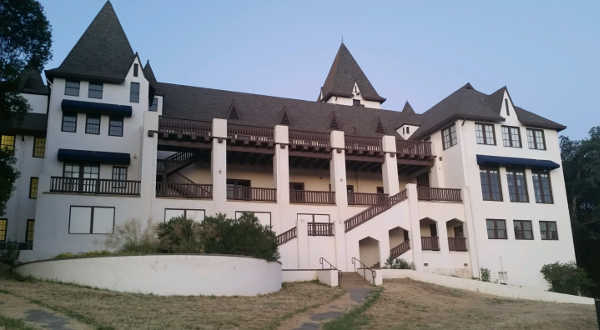
LUCERNE, Calif. – The Lucerne Area Town Hall plans a discussion on Thursday about what steps it can take after county leadership disregarded a resolution the group passed in January requesting that some of the funds from the sale of the Lucerne Hotel be used to benefit the community.
The meeting will take place at 7 p.m. Thursday, March 21, in the Rose Room at the Lucerne Alpine Senior Center, located at 10th and Country Club Drive in Lucerne.
Last month, the county finalized its sale of the Lucerne Hotel to the Earthways Foundation, an organization working with the Romero Institute to locate New Paradigm College at the historic, 90-year-old Lucerne Hotel. The sale price was $2.5 million.
The Lake County Redevelopment Agency purchased the Lucerne Hotel in 2010. A mix of county and redevelopment funds were used to buy and renovate the building.
Redevelopment funds came from tax increment revenue, drawn specifically from a portion of property tax in each of the areas where redevelopment took place, including the Northshore communities of Clearlake Oaks, Lucerne, Nice and Upper Lake.
The Lucerne Hotel had long been seen as a key Northshore asset. After its purchase, then-County Administrative Officer Kelly Cox had emphasized the desire to have the building's renovations be an economic engine for the area, and as a result it hired many local contractors – roofers, electricians including Bach Electric and a local window company to work on the building.
One of those was Lucerne Roofing & Supply, which reroofed the historic building. The company’s founder, Paul Parlee – who died earlier this year – told Lake County News in a late 2011 interview that he was grateful that county leaders agreed to keep the work in the county. He said he had 15 families depending on him, and the job helped keep local people employed in a time when he was down in job volume by 60 percent in the aftermath of the Great Recession.
The Lucerne Hotel and Holiday Harbor in Nice were the redevelopment agency’s key assets, and in early 2012, after the state dissolved redevelopment, the oversight board for the successor agency to the former Lake County Redevelopment Agency voted to transfer those properties to the county’s ownership, as Lake County News reported.
The county’s own Comprehensive Economics Development Strategy for the year 2016 identified the Lucerne Hotel as key to economic development on the Northshore. That plan laid out a goal of assisting “in the development of 13th Avenue into the commercial center of town with the historic Lucerne Hotel as the ‘anchor’ within the former Northshore Redevelopment Project
Area.”
However, that strategy appears to have largely been ignored since Carol Huchingson took over as county administrative officer in the spring of 2016.
Marymount California University left the Lucerne Hotel – its Lakeside Campus – abruptly in June 2017. After that, Huchingson pushed for the sale of the building – despite its importance to the town and over objections from the community – citing the county’s financial situation.
Town hall requests funds to help community
Hoping to at least recover some of the proceeds for needed improvements to Lucerne Harbor Park – which is serious need of dredging due to the build up of lakebed sediment – in January, the Lucerne Area Town Hall passed a resolution on Jan. 9, asking for some funds to be directed to benefit Lucerne.
Town Hall acting Chair Kurt Mckelvey said he first proposed the resolution at the June 2018 meeting, “and it took months working on it and advocating for it before it was passed by the council in January.”
The resolution cited as justifications “The will and the property tax increment dollars from Lucerne taxpayers paid to fund the former redevelopment agency which purchased the
Lucerne Hotel,” and pointed out that budgeted funds for dredging and improvements at Lucerne Harbor Park had been redirected to repair Holiday Harbor in Nice.
The town hall’s resolution noted, “Lucerne Harbor Park is among the county’s busiest boating parks,” and that “dredging the harbor would remove an impediment to the town’s
economic development, increase visitor use, and support the county’s economic engine of Lucerne.”
District 3 Supervisor EJ Crandell, who took office in January, was at the town hall meeting when the resolution was passed, and he was aware of the community’s concerns.
Mckelvey said he sent the resolution to Carolyn Purdy, the assistant clerk to the board, who said that she had forwarded the resolution to the Board of Supervisors for consideration.
“Beyond that, I haven't seen any formal acknowledgement or action by the County in response to the LATH resolution,” he said.
Town hall members said the goal was to have the request in front of the board before the Lucerne Hotel sale was finalized. The sale was completed at the end of February.
County Administrative Office, supervisors ignore request
Crandell told Lake County News he is advocating for the funds to be used for Lucerne.
However, Crandell appears to be getting pushback from the County Administrative Office.
Crandell said he told Huchingson that he had wanted $250,000 from the sale to go toward docks and dredging the harbor at Lucerne Harbor Park.
He said he knew he was going to be absent from the Feb. 12 board meeting and told Huchingson that.
Nevertheless, despite Crandell registering his concerns, Huchingson and her staff presented to the board a midyear budget review and associated adjustments at the Feb. 12 meeting that called for all $2.5 million from the purchase to be put into a reserve budget stabilization in Crandell’s absence.
The paragraph about the hotel sale proceeds included in the midyear budget review stated: “As your Board is aware, closure of escrow on the $2,500,000 sale of the Lucerne Castle is scheduled to take place soon. With this in mind, staff proposes placing proceeds from the sale into your Budget Stabilization Reserve and the adjustments you are considering today reflect that recommendation. You may recall that said reserve established by your Board for the purpose of incrementally reducing reliance on one-time funds to balance the budget. This reserve will be essential, as we weather the financial crisis we are facing in the years to come.”
“The reason for that would be to stabilize the upcoming budget deficits,” Deputy County Administrative Officer Stephen Carter told the board at that Feb. 12 meeting.
During the same midyear budget adjustment item, the board accepted Huchingson’s requested changes including an additional $60,000 for a building remodel including new cubicles and another $60,000 for two new vehicles for the Building and Safety Department, $40,000 for the recruitment of two executive staff members, $27,000 for leadership training for department heads and the supervisors, a $30,000 remodel for the Human Resources Department – which is under Huchingson’s management – and $50,042 for solar and parking lot seal coat for the Air Quality Management District.
With Crandell not there to advocate against the action to sweep the money into a reserve fund, the board accepted it.
Earlier in the same meeting, also at Huchingson’s urging, the board approved Sheriff Brian Martin’s proposal to restructure his administrative staff but denied his request for the salary adjustments to go with it, which would have cost an additional $2,000 a month, as Lake County News has reported.
Crandell said he was “a little upset” about how the budget matter was handled, especially since he said he had been forthcoming with Huchingson about his concerns.
“I’m still going to advocate for that,” he said of giving the community some of the funds for dredging, adding, “I do want them to have it.”
Lake County News asked Huchingson about the board’s action, and she confirmed that “as per board direction” at the Feb. 12 meeting “all of these one-time funds are being placed in our Budget Stabilization Reserve.”
When pressed further about the fact that the board ignored the Lucerne community’s request – at Huchingson’s own recommendation – Huchingson did not respond.
The Lucerne Hotel sale was the third major property sale on the Northshore since November 2017. In that month, the county sold off the former visitor information center in Lucerne for $263,500 and Holiday Harbor in Nice for $759,500.
As with the hotel sale funds, the county also refused to use any of those proceeds from the visitor center or Holiday Harbor for Northshore projects, instead absorbing the proceeds into the general fund.
The town hall’s leadership intends to discuss on Thursday what action it can take to ensure this recent request about the hotel sale proceeds and future requests are heard by the Board of Supervisors.
Email Elizabeth Larson at
LATH Resolution - A0001 by LakeCoNews on Scribd
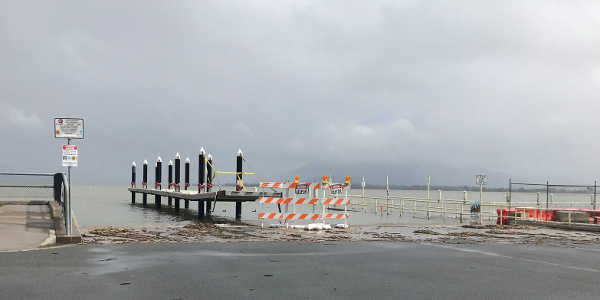
LAKE COUNTY, Calif. – The flooding over the past month has resulted in numerous ongoing closures of park and ramp facilities, with some locations now reopened.
The lake fell below the 9-foot Rumsey flood stage on Tuesday. By early Thursday, the lake was in “monitor” stage – the range between 8 feet Rumsey and 9 feet Rumsey – and was hovering at around 8.83 feet Rumsey.
In the city of Clearlake, Thompson Harbor at Redbud Park was closed on Feb. 26 due to the high water, with city Public Works crews detaching the floating docks from the concrete ramps to keep the docks from being damaged by the rising water level, as Lake County News has reported.
City officials said the ramps aren’t safe to be used when the docks are detached, and the docks will be reattached when the water level recedes back to 8 feet Rumsey.
In Lakeport, city officials said the First Street boat ramp is closed while the Third and Fifth street boat ramps are open.
Library Park proper – the area between First and Third streets which includes the playgrounds, gazebo and grassy area – remain closed and are not expected to be fully reopened until Memorial Day weekend due to floodwater and the need for repairs, Lakeport Public Works Director Doug Grider told the Lakeport City Council on Tuesday.
In the county jurisdiction, several boat ramp and launching facilities remain closed, according to Lake County Public Services.
In Clearlake Oaks, the county boat ramp remains closed due to flooding, the county said.
Officials said the boat ramp at Lucerne Harbor Park also is still closed because of high water levels.
At Lakeside County Park between Lakeport and Kelseyville, the main boat ramp is now open, but boaters are urged to use caution when launching. Some areas of the park remain closed until further notice due to flooding, Public Services reported.
Email Elizabeth Larson at