 How to resolve AdBlock issue?
News
NORTH COAST, Calif. – A strong Saturday night earthquake in Humboldt County was felt by thousands of North Coast residents – including some in Lake County – and followed by several hours a cluster of quakes that occurred off the Oregon coast.
The 5.6-magnitude quake occurred at 8:57 p.m. Saturday 17 miles southwest of Scotia and 36 miles south of Eureka at a depth of five and a half miles, according to the United States Geological Survey.
As of 2 a.m. Sunday, the survey had received more than 2,500 shake reports, the majority from around the North Coast but also some from Clearlake Oaks and Lakeport, and some from further south in California.
The 5.6-magnitude quake occurred approximately 30 minutes after a 3.3-magnitude quake that the US Geological Survey said also was located 17 miles southwest of Scotia at a depth of five and a half miles.
From 6 to 7:30 a.m. Saturday, nine quakes occurred off the Oregon coast and were centered about 200 miles west of Bandon, the US Geological Survey said.
That cluster of ocean quakes included two magnitude 5.4 quakes, one 5-magnitude quake, and six others measuring between 3.1 and 4.7 on the Richter Scale, based on survey records.
US Geological Survey mapping showed that the Humboldt County quakes appeared to be on the edge of the North American Plate. Most of the Oregon quakes – including the three largest – were in the Blanco Fracture Zone on the Juan De Fuca Plate, with three of the smaller quakes on the other size of the fracture zone on the Pacific Plate.
The Juan De Fuca Plate is moving east-northeast and under the North American continent. The subduction between that plate and the continent has the potential to generate huge earthquakes and tsunamis, according to a 2017 report from UC Santa Barbara.
The report explains that Juan De Fuca plate’s region “represents the single greatest geophysical hazard to the continental United States; quakes centered here could register as hundreds of times more damaging than even a big temblor on the San Andreas Fault.”
Email Elizabeth Larson atThis email address is being protected from spambots. You need JavaScript enabled to view it. . Follow her on Twitter, @ERLarson, or Lake County News, @LakeCoNews.
The 5.6-magnitude quake occurred at 8:57 p.m. Saturday 17 miles southwest of Scotia and 36 miles south of Eureka at a depth of five and a half miles, according to the United States Geological Survey.
As of 2 a.m. Sunday, the survey had received more than 2,500 shake reports, the majority from around the North Coast but also some from Clearlake Oaks and Lakeport, and some from further south in California.
The 5.6-magnitude quake occurred approximately 30 minutes after a 3.3-magnitude quake that the US Geological Survey said also was located 17 miles southwest of Scotia at a depth of five and a half miles.
From 6 to 7:30 a.m. Saturday, nine quakes occurred off the Oregon coast and were centered about 200 miles west of Bandon, the US Geological Survey said.
That cluster of ocean quakes included two magnitude 5.4 quakes, one 5-magnitude quake, and six others measuring between 3.1 and 4.7 on the Richter Scale, based on survey records.
US Geological Survey mapping showed that the Humboldt County quakes appeared to be on the edge of the North American Plate. Most of the Oregon quakes – including the three largest – were in the Blanco Fracture Zone on the Juan De Fuca Plate, with three of the smaller quakes on the other size of the fracture zone on the Pacific Plate.
The Juan De Fuca Plate is moving east-northeast and under the North American continent. The subduction between that plate and the continent has the potential to generate huge earthquakes and tsunamis, according to a 2017 report from UC Santa Barbara.
The report explains that Juan De Fuca plate’s region “represents the single greatest geophysical hazard to the continental United States; quakes centered here could register as hundreds of times more damaging than even a big temblor on the San Andreas Fault.”
Email Elizabeth Larson at
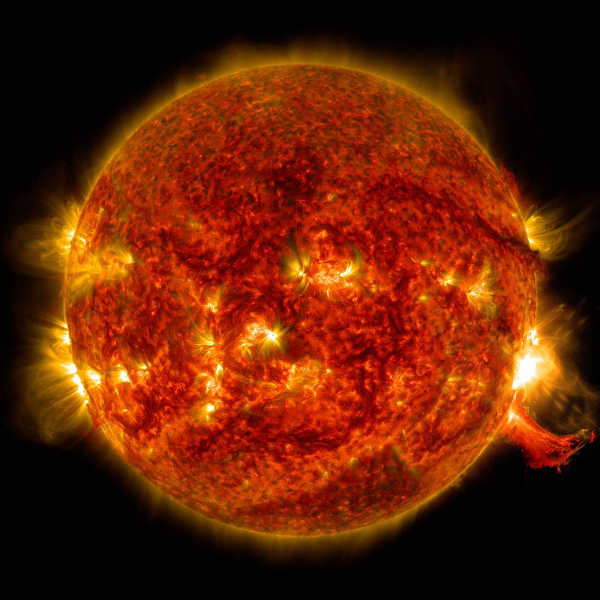
The sun is why we’re here. It’s also why Martians or Venusians are not.
When the sun was just a baby four billion years ago, it went through violent outbursts of intense radiation, spewing scorching, high-energy clouds and particles across the solar system.
These growing pains helped seed life on early Earth by igniting chemical reactions that kept Earth warm and wet.
Yet, these solar tantrums also may have prevented life from emerging on other worlds by stripping them of atmospheres and zapping nourishing chemicals.
Just how destructive these primordial outbursts were to other worlds would have depended on how quickly the baby sun rotated on its axis. The faster the sun turned, the quicker it would have destroyed conditions for habitability.
This critical piece of the sun’s history, though, has bedeviled scientists, said Prabal Saxena, an astrophysicist at NASA’s Goddard Space Flight Center in Greenbelt, Maryland.
Saxena studies how space weather, the variations in solar activity and other radiation conditions in space, interacts with the surfaces of planets and moons.
Now, he and other scientists are realizing that the moon, where NASA will be sending astronauts by 2024, contains clues to the ancient mysteries of the sun, which are crucial to understanding the development of life.
“We didn’t know what the sun looked like in its first billion years, and it’s super important because it likely changed how Venus’ atmosphere evolved and how quickly it lost water. It also probably changed how quickly Mars lost its atmosphere, and it changed the atmospheric chemistry of Earth,” Saxena said.
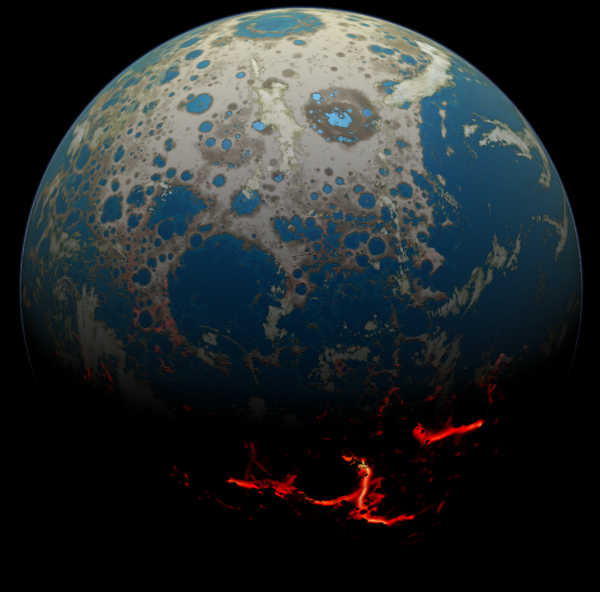
The sun-moon connection
Saxena stumbled into investigating the early sun’s rotation mystery while contemplating a seemingly unrelated one: Why, when the Moon and Earth are made of largely the same stuff, is there significantly less sodium and potassium in lunar regolith, or moon soil, than in Earth soil?
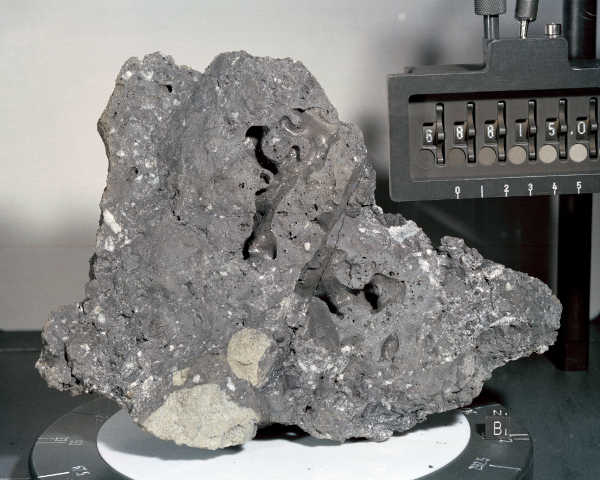
This question, too, revealed through analyses of Apollo-era moon samples and lunar meteorites found on Earth, has puzzled scientists for decades – and it has challenged the leading theory of how the moon formed.
Our natural satellite took shape, the theory goes, when a Mars-sized object smashed into Earth about 4.5 billion years ago. The force of this crash sent materials spewing into orbit, where they coalesced into the moon.
“The Earth and moon would have formed with similar materials, so the question is, why was the moon depleted in these elements?” said Rosemary Killen, a planetary scientist at NASA Goddard who researches the effect of space weather on planetary atmospheres and exospheres.
The two scientists suspected that one big question informed the other – that the history of the sun is buried in the moon’s crust.
Killen’s earlier work laid the foundation for the team’s investigation. In 2012, she helped simulate the effect solar activity has on the amount of sodium and potassium that is either delivered to the moon’s surface or knocked off by a stream of charged particles from the sun, known as the solar wind, or by powerful eruptions known as coronal mass ejections.
Saxena incorporated the mathematical relationship between a star’s rotation rate and its flare activity. This insight was derived by scientists who studied the activity of thousands of stars discovered by NASA’s Kepler space telescope: The faster a star spins, they found, the more violent its ejections.
“As you learn about other stars and planets, especially stars like our Sun, you start to get a bigger picture of how the Sun evolved over time,” Saxena said.
Using sophisticated computer models, Saxena, Killen and colleagues think they may have finally solved both mysteries. Their computer simulations, which they described on May 3 in The Astrophysical Journal Letters, show that the early sun rotated slower than 50 percent of baby stars.
According to their estimates, within its first billion years, the Sun took at least 9 to 10 days to complete one rotation.
They determined this by simulating the evolution of our solar system under a slow, medium, and then a fast-rotating star. And they found that just one version – the slow-rotating star – was able to blast the right amount of charged particles into the moon’s surface to knock enough sodium and potassium into space over time to leave the amounts we see in moon rocks today.
“Space weather was probably one of the major influences for how all the planets of the solar system evolved,” Saxena said, “so any study of habitability of planets needs to consider it.”
Life under the early sun
The rotation rate of the early Sun is partly responsible for life on Earth. But for Venus and Mars – both rocky planets similar to Earth – it may have precluded it. (Mercury, the closest rocky planet to the sun, never had a chance.)
Earth’s atmosphere was once very different from the oxygen-dominated one we find today. When Earth formed 4.6 billion years ago, a thin envelope of hydrogen and helium clung to our molten planet. But outbursts from the young sun stripped away that primordial haze within 200 million years.
As Earth’s crust solidified, volcanoes gradually coughed up a new atmosphere, filling the air with carbon dioxide, water and nitrogen.
Over the next billion years, the earliest bacterial life consumed that carbon dioxide and, in exchange, released methane and oxygen into the atmosphere.
Earth also developed a magnetic field, which helped protect it from the sun, allowing our atmosphere to transform into the oxygen- and nitrogen-rich air we breathe today.
“We were lucky that Earth’s atmosphere survived the terrible times,” said Vladimir Airapetian, a senior Goddard heliophysicist and astrobiologist who studies how space weather affects the habitability of terrestrial planets. Airapetian worked with Saxena and Killen on the early sun study.
Had our Sun been a fast rotator, it would have erupted with super flares 10 times stronger than any in recorded history, at least 10 times a day. Even Earth's magnetic field wouldn't have been enough to protect it.
The Sun's blasts would have decimated the atmosphere, reducing air pressure so much that Earth wouldn’t retain liquid water. “It could have been a much harsher environment,” Saxena noted.
But the Sun rotated at an ideal pace for Earth, which thrived under the early star. Venus and Mars weren’t so lucky.
Venus was once covered in water oceans and may have been habitable. But due to many factors, including solar activity and the lack of an internally generated magnetic field, Venus lost its hydrogen – a critical component of water.
As a result, its oceans evaporated within its first 600 million years, according to estimates. The planet’s atmosphere became thick with carbon dioxide, a heavy molecule that's harder to blow away. These forces led to a runaway greenhouse effect that keeps Venus a sizzling 864 degrees Fahrenheit (462 degrees Celsius), far too hot for life.
Mars, farther from the Sun than Earth is, would seem to be safer from stellar outbursts. Yet, it had less protection than did Earth. Due partly to the Red Planet’s weak magnetic field and low gravity, the early Sun gradually was able to blow away its air and water.
By about 3.7 billion years ago, the Martian atmosphere had become so thin that liquid water immediately evaporated into space. (Water still exists on the planet, frozen in the polar caps and in the soil.)
After influencing the course for life (or lack thereof) on the inner planets, the aging Sun gradually slowed its pace and continues to do so. Today, it revolves once every 27 days, three times slower than it did in its infancy. The slower spin renders it much less active, though the Sun still has violent outbursts occasionally.
Exploring the moon, witness of solar system evolution
To learn about the early sun, Saxena said, you need to look no further than the moon, one of the most well-preserved artifacts from the young solar system.
“The reason the moon ends up being a really useful calibrator and window into the past is that it has no annoying atmosphere and no plate tectonics resurfacing the crust,” he said. “So as a result, you can say, ‘Hey, if solar particles or anything else hit it, the moon’s soil should show evidence of that.’”
Apollo samples and lunar meteorites are a great starting point for probing the early solar system, but they are only small pieces in a large and mysterious puzzle. The samples are from a small region near the lunar equator, and scientists can’t tell with complete certainty where on the moon the meteorites came from, which makes it hard to place them into geological context.
Since the South Pole is home to the permanently shadowed craters where we expect to find the best-preserved material on the moon, including frozen water, NASA is aiming to send a human expedition to the region by 2024.
If astronauts can get samples of lunar soil from the Moon’s southernmost region, it could offer more physical evidence of the baby sun’s rotation rate, said Airapetian, who suspects that solar particles would have been deflected by the Moon’s erstwhile magnetic field 4 billion years ago and deposited at the poles: “So you would expect — though we’ve never looked at it — that the chemistry of that part of the Moon, the one exposed to the young Sun, would be much more altered than the equatorial regions. So there’s a lot of science to be done there."
Lonnie Shekhtman and Miles Hatfield work for NASA’s Goddard Space Flight Center in Greenbelt, Maryland.
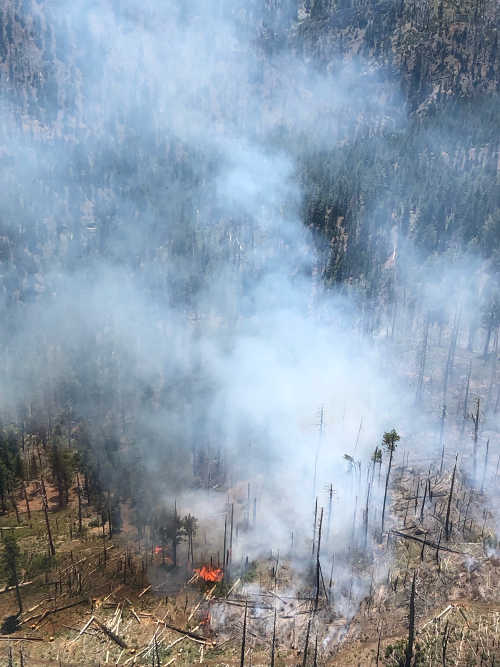
MENDOCINO NATIONAL FOREST, Calif. – Mendocino National Forest officials said the growth rate on the East fire in the Yolla Bolly Wilderness has picked up.
On Saturday, the fire had grown to 325 acres, with zero containment, forest officials reported. The fire has grown by more than 100 acres since Friday.
Forest officials said moderate north winds Friday night kept the East fire fairly active until 2 a.m.
To the southeast, the Haynes fire is estimated at 23 acres and 90 percent contained.
The fires started June 17 approximately 23 miles northeast of Covelo in Trinity County.
There are 145 personnel working on these fires including smokejumpers, hotshot crews, wildland fire modules, helicopters and support personnel.
On the East fire, crews are working to guide the fire southward toward the Middle Fork Eel River inside the designated confinement area.
The confinement area is between East Ridge, Buck Ridge and Wrights Ridge and totals about 1,000 acres in size.
On the Haynes fire, crews plan to extinguish burning logs and vegetation near the containment lines. As the work needed on this fire diminishes, personnel will be released to be available for other assignments.
Incident Commander Trainee Terry Nickerson said after Friday’s helicopter flight, “We observed low to moderate activity on the fire which is helping reduce snags and debris in the wilderness in a natural way. We feel this is a great opportunity to manage this incident, at this time and in this location to improve forest health and reduce exposure and risk to fire personnel.”
Nickerson added, “The fire is burning exactly as we want it to.”
The weather forecast shows north winds from 7 to 12 miles per hour and temperatures in the 70s with a cooling trend early next week.
Wilderness hikers are asked to avoid travel near Buck Ridge and Wrights Ridge.

NORTH COAST, Calif. – Spirits were high on Friday at the Sonoma-Marin Fair in Petaluma where thousands gathered to cheer for the next pup to win the World’s Ugliest Dog Contest.
It was a close call as the judges called upon the crowd to help them decide and Scamp The Tramp prevailed.
“Scamp defines ugly with cute, winning all of our hearts. Let’s all paws for a moment and celebrate the World’s Ugliest Dog: Scamp!” shared long-time returning judge Kerry Sanders, NBC News correspondent.
Scamp The Tramp was rescued by his fur mommy, Yvonne Morones back in 2014. This is a story of an online swipe right and love at first sight.
Morones discovered Scamp on Pet Finder and immediately melted. It was near his last hour when she pulled in and saved his life.
“It was on the way home that I knew I made the right choice. There we were, two strangers in a car on the way home to a new start. Bob Marley was playing ‘One Love’ and I looked over and little Scamp was bobbing his head. It was like he knew he had found his forever home,” said Morones.
Scamp and Morones are being flown to New York for a live appearance on NBC's Today Show scheduled to air Monday, June 24, during the 8 a.m. hour.
Her prize included a very large trophy, $1,500 and a donated prize match which will be split between the Humane Society of Sonoma County, Angels Fund and Compassion Without Borders.
This is just one of the amazing stories shared with the world at Friday night’s event.
Scamp competed against 18 other dogs, most of which were also adopted or rescued.
The red carpet runners up included second place winner Wild Thang, owned by Ann Lewis and third place winner Tostito, owned by Molly Horgan who also won the Spirit Award.
This year’s People’s Choice Award went to Meatloaf, owned by Denae Pruner.
This year’s presenting sponsor, Amica Insurance was very excited to be involved and provide the funds for the matching gift to support non-profits important to the contestant winners.

CLEARLAKE, Calif. – The Clearlake Police Department reported that its officers rescued a young woman who was the victim of human trafficking, arrested one of the men who held her captive and are seeking the second.
Javier Alvarez, 38, Hopland, was arrested on Thursday, police said.
At 9:50 a.m. Thursday Clearlake Police officers responded to the 15700 block of 41st Avenue on a report of a person being held against their will, and located a 21-year-old female with minor injuries.
While officers were speaking with the victim, the suspect vehicle was spotted by officers. The two men in the vehicle abandoned it and fled on foot.
Police said that, after an extensive search by officers, they found Alvarez hiding in a backyard in the 15800 block of 45th Avenue and took him into custody.
The second man was not located and remains outstanding.
Police said the second subject has not yet been positively identified but may have the first name of "Armondo."
He is described as an older Hispanic male adult, approximately 6 feet tall, with salt and pepper gray hair and having a thin build. He was last seen wearing a tan and brown flannel type shirt.
Based on the information known at this time, it appears the victim was lured to the area under false pretenses for work.
Police said that, once in the area, the victim was held against her will and physically abused by the suspects over the past week. She was able to contact law enforcement when she was left alone briefly.
Alvarez was arrested on probable cause for numerous felony charges including human trafficking, robbery, false imprisonment and assault.
He is being held on $150,000 bail and is set to be arraigned in Lake County Superior Court on Monday, according to Lake County Jail booking records.
This case is still under investigation. Anyone with information is urged to contact Officer Daniel Eagle at 707-994-8251, Extension 518.
If you or someone you know is a victim of human trafficking, help is available. If you are in immediate danger, call 911, otherwise, call the National Human Trafficking Hotline at 888-373-7888. For more information, visit https://humantraffickinghotline.org .

LAKEPORT, Calif. – The Ladies of the Lake Quilt Guild invites entries for its 18th annual Falling Leaves Quilt Show.
The show will be held Saturday, Oct. 5, and Sunday, Oct. 6.
Entry forms are now available online at http://www.llqg.org/quilt-show.html .
The Web site includes all the information needed to enter quilts and other items in the show.
The deadline for submitting entries is Aug. 10. There is no limit on the number of items you may enter but each quilt or other item entered must have it's own entry form.
Now is the time to get those unfinished pieces completed for the show. Perhaps they need to be quilted or have a binding or a sleeve attached.
With more than 20 categories, there is a place for that special item you have waiting to be displayed.
One does not need to be a member of the guild to enter quilts. There is a need for quilts of all sizes as well as vignettes. Vignettes are small items such as baby quilts, doll quilts, table runners, placemats, garments, totes/purses or small wall hangings.
Quilters may choose to have their quilts or vignettes judged or enter quilts and vignettes without judging. Many quilters find it beneficial to have their quilts judged, learning much from an impartial evaluation. The judges are very positive and will award ribbons in every category.
The 18th annual Falling Leaves Quilt Show will be held at the Lake County Fairgrounds in Lakeport. The hours on Saturday are 10 a.m. to 5 p.m. and on Sunday 10 a.m. to 4 p.m.
The guild welcomes all quilters, prospective quilters, and quilt lovers to its meetings and events.
For more information about the quilt guild, contact Terry Phelps at 707-274-1855 or visit the Ladies of the Lake Quilt Guild Web site at www.LLQG.org .