 How to resolve AdBlock issue?
News
NORTH COAST, Calif. – A Potter Valley man convicted by plea of shooting his neighbor's two dogs while the dogs were inside of a fenced pen was placed on supervised felony probation Friday in Mendocino County Superior Court.
Defendant Benjamin Hanna Meyer, age 67, a local Ukiah physician, was convicted by plea in April of two counts of felony animal abuse. He also admitted his personal use of a firearm in the commission of those felonies.
As part of his probation, Meyer on Friday was ordered to serve 180 days in the county jail, with a surrender date of Aug. 29. He will also be prohibited for the remainder of his life from possessing firearms and ammunition.
The prosecutor who has been handling the Meyer case is Assistant District Attorney Dale P. Trigg.
The law enforcement agencies responsible for gathering the evidence in support of the prosecution were the Mendocino County Sheriff's Office, including the Sheriff's Animal Control Division, and the District Attorney's own investigators.
The sentencing judge was Mendocino County Superior Court Judge John Behnke.
Defendant Benjamin Hanna Meyer, age 67, a local Ukiah physician, was convicted by plea in April of two counts of felony animal abuse. He also admitted his personal use of a firearm in the commission of those felonies.
As part of his probation, Meyer on Friday was ordered to serve 180 days in the county jail, with a surrender date of Aug. 29. He will also be prohibited for the remainder of his life from possessing firearms and ammunition.
The prosecutor who has been handling the Meyer case is Assistant District Attorney Dale P. Trigg.
The law enforcement agencies responsible for gathering the evidence in support of the prosecution were the Mendocino County Sheriff's Office, including the Sheriff's Animal Control Division, and the District Attorney's own investigators.
The sentencing judge was Mendocino County Superior Court Judge John Behnke.

NASA has partnered with the Exploratorium in San Francisco to bring live views to people across the world of a total solar eclipse, occurring Tuesday, July 2, over South America.
The eclipse will only be visible directly to observers within the path of totality, which stretches across parts of Chile and Argentina.
NASA will livestream three Exploratorium views via separate players on the agency’s Web site (all times EDT):
– Live views from telescopes in Vicuna, Chile, presented without audio, from 3 to 6 p.m.
– A one-hour program with live commentary in English, from 4 to 5 p.m.
– A one-hour program with live commentary in Spanish, from 4 to 5 p.m.
NASA Television will also carry the English-language program on its public channel.
Both programs will feature updates from NASA’s Parker Solar Probe and Magnetospheric Multiscale missions.
Studying the Sun during total solar eclipses helps scientists understand the source and behavior of solar radiation that drives space weather near Earth, which can affect the health of astronauts in space and the durability of materials used to build spacecraft.
Similar data will be important in planning NASA’s return of astronauts to the Moon in 2024 and eventual crewed missions to Mars.

CLEARLAKE, Calif. – Police have arrested one man and are seeking his brother in connection to a June 17 drive-by shooting that killed a Clearlake man.
On Thursday evening, officers arrested 37-year-old Miguel Becerra, who has ties to both Clearlake and Southern California, for the shooting of Steven Stone, according to Clearlake Police Chief Andrew White.
White said they’re still seeking Becerra’s younger brother, Christian Becerra, 26, who also has ties to Clearlake and the Indio area.
On Thursday night, White said the case was continuing to develop, as detectives served a search warrant at the scene of Becerra’s arrest on Sonoma Way.
Police say the men were responsible for the fatal shooting of Stone, 40, early on the morning of June 17 at Trombetta’s Resort, located at 5865 Old Highway 53.
Officers who arrived at the scene shortly after 12:30 a.m. that day found Stone on the ground with a gunshot wound.
Despite efforts to resuscitate him at the scene and the hospital, Stone was declared dead.
During the subsequent investigation, detectives determined that shots were fired at Stone from a vehicle that drove on the main driveway of the resort. The vehicle then fled in an unknown direction on Old Highway 53.
Since the murder, the Clearlake Police Department Investigations Bureau has been conducting extensive followup investigation, in the course of which they obtained information identifying Miguel and Christian Becerra as the suspects, White said.
Police said Christian Becerra was involved in an altercation on Jones Avenue hours before the homicide. When Stone was shot, he was accompanied by another person who had been present at the earlier altercation.
On Thursday, Clearlake Police, Code Enforcement, Animal Control and Lake County Probation conducted a citywide sweep, making arrests for drugs, weapons and people living in red-tagged homes, White said.
It was during that sweep – at about 4:40 p.m. – that White said police received information that Miguel Becerra was at a residence located in the 3500 block of Sonoma Way.
Clearlake Police and Lake County Probation personnel responded to the residence, where they located Miguel Becerra, who fought with officers as they tried to take him into custody, White said.
As officers were arresting Miguel Becerra, 37-year-old Amber Williams of Clearlake, who originally answered the door at the residence, charged towards officers and then resisted their efforts to control her, White said.
White said Miguel Becerra was arrested on probable cause for the murder of Steven Stone while Williams was arrested on probable cause for obstruction and battery on a peace officer.
In April, Clearlake Police Officer Mauricio Barreto had arrested Miguel Becerra and Williams following a traffic stop, after finding Williams – a convicted felon – in possession of a stolen handgun. At the time, Miguel Becerra gave Barreto a false name as he had a warrant for his arrest and a suspended driver’s license.
On Thursday, detectives obtained a search warrant for the residence where Miguel Becerra was located and completed executing that warrant late Thursday night, White said.
A firearm – a rifle – was located at the residence but it is not believed to be the murder weapon. White said they believe a handgun was used to kill Stone.
White said detectives are seeking to locate Christian Becerra, who is described as a Hispanic male, approximately 5 feet, 10 inches tall, 165 pounds, with brown hair and brown eyes.
Christian Becerra may be driving a 2005 Legend Lime Ford Mustang, California License No. 8KCS533, police said.
White said the vehicle hasn’t been seen in Clearlake since the shooting, and detectives have been reaching out to law enforcement agencies throughout the state to see if any of them have run the vehicle.
He said they’re also in contact with the Federal Bureau of Investigation as they attempt to locate Christian Becerra and the car.
Christian Becerra is considered armed and dangerous and police said neither he nor the vehicle should be approached. Rather, if he is seen, contact the nearest law enforcement agency immediately.
“The information presented as it is known to us today, but there is extensive additional investigation to be done and the information may change as new information is learned and additional evidence is gathered,” according to the statement released by the Clearlake Police Department on Thursday night.
Anyone with information is asked to call Clearlake Police Det. Leo Flores at 707-994-8251, Extension 315.
Email Elizabeth Larson at

LAKEPORT, Calif. – Facing a July 1 deadline, the Lakeport Unified School District approved its fiscal year 2019-20 budget on Wednesday, a document that is likely facing revision in the months ahead due to dropping revenue and student enrollment, and rising costs.
The board came into the four-hour meeting equipped with a report from Business Manager Jacque Eischens that warned of the district’s inability to meet its reserve and other budgetary requirements over the coming three years, which could trigger a disapproval by the Lake County Office of Education and action by the state.
The budget totals $18,982,792 in expenditures and $17,530,386 in revenue.
Eischens, a former Lake County Office of Education staffer who interim Superintendent Patrick Iaccino hired earlier this year, told the board that she wasn’t suggesting cuts. “I don’t make those final decisions,” she said, adding that she wanted to give the district, community and board sound numbers.
The board approved the new budget, which is required to be in place by July 1.
Lake County Superintendent of Schools Brock Falkenberg and members of his staff were at the Wednesday night meeting, during which a letter he wrote to the district on June 3 about the acceptance of its second amended budget for the 2018-19 was mentioned.
He told Lake County News in a Thursday interview that, as of Jan. 31, the district had looked OK based on its average daily attendance, although his June letter noted concerns with the district’s ADA and enrollment projections.
However, changes to expenses and revenue Eischens noted during the Wednesday night meeting have become the problem, Falkenberg said.
During the meeting and in a subsequent Thursday interview with Lake County News, Eischens explained that a combination of factors – primarily, drops in attendance, expenditure increases and the end of one-time funds from state and federal sources – have led to a $400,000 deficit.
Referring to Falkenberg’s letter about the budget situation earlier this year, Eischens noted, “At that time, everything looked fine.”
At that point, the district board also hadn’t granted a 5.25 percent two-year pay increase for district employees – 2.75 percent retroactive for 2018-19 and an additional 2.75 for 2019-20, Eischens said.
Over the last few years, there have been significant amounts of one-time funds from state and federal governments for the district, but Eischens said there is no indication there will be more, which accounts for the large decrease in revenue.
“The majority of it is is our enrollment and attendance,” which affect many funding sources, she said.
Falkenberg explained that over a six-year period, the state has been generous in restoring districts’ funding following state cuts. That gave schools a lot more resources.
Now that schools are fully funded, they’re only seeing a 3.26-percent cost of living increase for the new year, at the same time as both state and teacher pensions are expected to be rising by 3 percent in future years; pensions are lower in the near term due to a government payout, he said.
A drop in attendance, all by itself, is a “huge chunk” of the problem, Eischens told Lake County News.
A large source of revenue for school districts is “average daily attendance,” or ADA, an enrollment-based calculation which can fall or rise depending on student population.
Lakeport Unified’s 2015-16 enrollment increased by two students, or 19.95 ADA. That has been followed by three straight years of decline, according to Eischens:
– 2016-17, enrollment decrease of 24, ADA decrease of 21.19;
– 2017-18, enrollment decrease of 25, ADA decrease of 30.35;
– 2018-19, enrollment decrease of 37, ADA decrease of 44.
Despite the downward trend in enrollment, Eischens said Lakeport Unified previously had an actuarial study that determined district enrollment was going to increase significantly, and their budget assumptions were based on that study.
Now, with enrollment being less than anticipated, the district is having to adjust its budget accordingly. Eischens said ADA averages about $11,000 per student, and is dependent on a number of factors, from grade level to the school’s free and reduced lunch program. Total budgeted ADA for the new fiscal year is 1,380.
Another factor is that schools only receive payment for as much of the time as children are present. They don’t receive credit for excused absences, and if a child is only there a certain percentage of the time, that’s how much reimbursement the district receives, Eischens said.
“Once they’re here, we have to keep them coming,” she said.
Eischens said she doesn’t know the reason for the drop in enrollment, and other district officials and staff on Wednesday night discussed ways of reaching out to families who have left.
Whatever the reason, it appears unique to Lakeport.
“We’re seeing all of our other districts increase enrollment,” with Konocti Unified showing the most rapid growth, Falkenberg told Lake County News in the Thursday interview.
“Lakeport is the only one that hasn’t shown some growth,” Falkenberg said.
At a recent Kelseyville Unified School District Board meeting, Superintendent Dave McQueen noted an enrollment increase for his district this past year.
Falkenberg’s letter to the Lakeport Unified School District for its second amended 2018-19 budget had noted his agency’s concerns over enrollment numbers.
“We’ve warned the district for the last several years that their enrollment and ADA projects have been high,” said Falkdenbeg.
He commended Eischens, Iaccino and the Lakeport Unified Board for now putting up realistic enrollment numbers.
Falling short on reserves
One of the sections of the school district’s budget that shows where the shortfall is building is the reserve for economic uncertainty, an emergency emergency savings account the district is required to have.
The 3-percent state required reserve for 2019-20 is $568,000, while the district wants a 5-percent reserve, totaling $948,140, which would cover payroll for one month. Eischens said the district can cover that in the new budget.
The district is ending 2018-19 with a healthy ending fund balance of $3.3 million, but Eischens said that starts to change in 2019-20, with revenues down by $991,820 and expenditures up by $603,000.
By the start of 2020-21, the ending fund balance is forecast to drop to $1.9 million and to $703,000 at the start of 2021-22, ending that year with a deficit of $459,729. If no changes are made Eischens said the district would not be able to meet the required 3-percent economic uncertainty reserves for 2020-21 and 2021-22, with a possible deficit of $2.6 million by the end of the latter year.
Eischens said there are three full-time positions being added in the new school year – one each for administrator, certificated and pupil services – with another previously grant-funded position being dropped. There also will be annual increases for retirement – 0.82 percent for the California State Teachers' Retirement System and 2.67 percent for the California Public Employees' Retirement System.
She said the district either needs to cut its costs or raise its revenue by $400,000 to meet its 5-percent reserve. If it does that, it can avoid a deficit in its unassigned fund balance by the end of 2021-22.
Eischens also told the board on Wednesday that it’s just short of the state requirement that classroom compensation must equal or exceed 55 percent of the total costs of education. The district is at 53.57 percent now and is in a “warning phase,” and has this next year to meet the 55 percent mark otherwise it could face a $251,899 penalty.
Eischens now will send the budget to the Lake County Office of Education; Falkenberg said she has five days from its approval or July 1, whichever comes first, to submit it.
Together, the district and the Office of Education will work on solutions to get the Lakeport Unified budget to meet its requirements. “They’re going to provide us guidance. They’re going to provide us the help we need,” Eischens said, noting the Lake County Office of Education has been very supportive, and that it has been hard to get the necessary decisions made with a new superintendent and business manager.
Falkenberg said he has until Sept. 15 to approve, conditionally approve or disapprove Lakeport Unified’s budget, based on state education code.
“At that point, it kicks off some official timelines for them to correct them budget” and call in other agencies to help support them. Falkenberg also would have to notify the state superintendent that “we have a district that may be of concern.”
However, Falkenberg said his office plans to work with Lakeport Unified to have a budget that can be approved by that September deadline.
While the Lake County Office of Education hasn’t received the final budgets for all of the county’s districts, “We’re not aware of any other districts in this situation,” Falkenberg said.
“During the fiscal downtown it was more common to see this,” he said.
Now, however, on a statewide basis, he said it’s becoming more common to see districts falling into fiscally unstable situations because of the reduction in funding from the state government.
Email Elizabeth Larson atThis email address is being protected from spambots. You need JavaScript enabled to view it. . Follow her on Twitter, @ERLarson, or Lake County News, @LakeCoNews.
The board came into the four-hour meeting equipped with a report from Business Manager Jacque Eischens that warned of the district’s inability to meet its reserve and other budgetary requirements over the coming three years, which could trigger a disapproval by the Lake County Office of Education and action by the state.
The budget totals $18,982,792 in expenditures and $17,530,386 in revenue.
Eischens, a former Lake County Office of Education staffer who interim Superintendent Patrick Iaccino hired earlier this year, told the board that she wasn’t suggesting cuts. “I don’t make those final decisions,” she said, adding that she wanted to give the district, community and board sound numbers.
The board approved the new budget, which is required to be in place by July 1.
Lake County Superintendent of Schools Brock Falkenberg and members of his staff were at the Wednesday night meeting, during which a letter he wrote to the district on June 3 about the acceptance of its second amended budget for the 2018-19 was mentioned.
He told Lake County News in a Thursday interview that, as of Jan. 31, the district had looked OK based on its average daily attendance, although his June letter noted concerns with the district’s ADA and enrollment projections.
However, changes to expenses and revenue Eischens noted during the Wednesday night meeting have become the problem, Falkenberg said.
During the meeting and in a subsequent Thursday interview with Lake County News, Eischens explained that a combination of factors – primarily, drops in attendance, expenditure increases and the end of one-time funds from state and federal sources – have led to a $400,000 deficit.
Referring to Falkenberg’s letter about the budget situation earlier this year, Eischens noted, “At that time, everything looked fine.”
At that point, the district board also hadn’t granted a 5.25 percent two-year pay increase for district employees – 2.75 percent retroactive for 2018-19 and an additional 2.75 for 2019-20, Eischens said.
Over the last few years, there have been significant amounts of one-time funds from state and federal governments for the district, but Eischens said there is no indication there will be more, which accounts for the large decrease in revenue.
“The majority of it is is our enrollment and attendance,” which affect many funding sources, she said.
Falkenberg explained that over a six-year period, the state has been generous in restoring districts’ funding following state cuts. That gave schools a lot more resources.
Now that schools are fully funded, they’re only seeing a 3.26-percent cost of living increase for the new year, at the same time as both state and teacher pensions are expected to be rising by 3 percent in future years; pensions are lower in the near term due to a government payout, he said.
A drop in attendance, all by itself, is a “huge chunk” of the problem, Eischens told Lake County News.
A large source of revenue for school districts is “average daily attendance,” or ADA, an enrollment-based calculation which can fall or rise depending on student population.
Lakeport Unified’s 2015-16 enrollment increased by two students, or 19.95 ADA. That has been followed by three straight years of decline, according to Eischens:
– 2016-17, enrollment decrease of 24, ADA decrease of 21.19;
– 2017-18, enrollment decrease of 25, ADA decrease of 30.35;
– 2018-19, enrollment decrease of 37, ADA decrease of 44.
Despite the downward trend in enrollment, Eischens said Lakeport Unified previously had an actuarial study that determined district enrollment was going to increase significantly, and their budget assumptions were based on that study.
Now, with enrollment being less than anticipated, the district is having to adjust its budget accordingly. Eischens said ADA averages about $11,000 per student, and is dependent on a number of factors, from grade level to the school’s free and reduced lunch program. Total budgeted ADA for the new fiscal year is 1,380.
Another factor is that schools only receive payment for as much of the time as children are present. They don’t receive credit for excused absences, and if a child is only there a certain percentage of the time, that’s how much reimbursement the district receives, Eischens said.
“Once they’re here, we have to keep them coming,” she said.
Eischens said she doesn’t know the reason for the drop in enrollment, and other district officials and staff on Wednesday night discussed ways of reaching out to families who have left.
Whatever the reason, it appears unique to Lakeport.
“We’re seeing all of our other districts increase enrollment,” with Konocti Unified showing the most rapid growth, Falkenberg told Lake County News in the Thursday interview.
“Lakeport is the only one that hasn’t shown some growth,” Falkenberg said.
At a recent Kelseyville Unified School District Board meeting, Superintendent Dave McQueen noted an enrollment increase for his district this past year.
Falkenberg’s letter to the Lakeport Unified School District for its second amended 2018-19 budget had noted his agency’s concerns over enrollment numbers.
“We’ve warned the district for the last several years that their enrollment and ADA projects have been high,” said Falkdenbeg.
He commended Eischens, Iaccino and the Lakeport Unified Board for now putting up realistic enrollment numbers.
Falling short on reserves
One of the sections of the school district’s budget that shows where the shortfall is building is the reserve for economic uncertainty, an emergency emergency savings account the district is required to have.
The 3-percent state required reserve for 2019-20 is $568,000, while the district wants a 5-percent reserve, totaling $948,140, which would cover payroll for one month. Eischens said the district can cover that in the new budget.
The district is ending 2018-19 with a healthy ending fund balance of $3.3 million, but Eischens said that starts to change in 2019-20, with revenues down by $991,820 and expenditures up by $603,000.
By the start of 2020-21, the ending fund balance is forecast to drop to $1.9 million and to $703,000 at the start of 2021-22, ending that year with a deficit of $459,729. If no changes are made Eischens said the district would not be able to meet the required 3-percent economic uncertainty reserves for 2020-21 and 2021-22, with a possible deficit of $2.6 million by the end of the latter year.
Eischens said there are three full-time positions being added in the new school year – one each for administrator, certificated and pupil services – with another previously grant-funded position being dropped. There also will be annual increases for retirement – 0.82 percent for the California State Teachers' Retirement System and 2.67 percent for the California Public Employees' Retirement System.
She said the district either needs to cut its costs or raise its revenue by $400,000 to meet its 5-percent reserve. If it does that, it can avoid a deficit in its unassigned fund balance by the end of 2021-22.
Eischens also told the board on Wednesday that it’s just short of the state requirement that classroom compensation must equal or exceed 55 percent of the total costs of education. The district is at 53.57 percent now and is in a “warning phase,” and has this next year to meet the 55 percent mark otherwise it could face a $251,899 penalty.
Eischens now will send the budget to the Lake County Office of Education; Falkenberg said she has five days from its approval or July 1, whichever comes first, to submit it.
Together, the district and the Office of Education will work on solutions to get the Lakeport Unified budget to meet its requirements. “They’re going to provide us guidance. They’re going to provide us the help we need,” Eischens said, noting the Lake County Office of Education has been very supportive, and that it has been hard to get the necessary decisions made with a new superintendent and business manager.
Falkenberg said he has until Sept. 15 to approve, conditionally approve or disapprove Lakeport Unified’s budget, based on state education code.
“At that point, it kicks off some official timelines for them to correct them budget” and call in other agencies to help support them. Falkenberg also would have to notify the state superintendent that “we have a district that may be of concern.”
However, Falkenberg said his office plans to work with Lakeport Unified to have a budget that can be approved by that September deadline.
While the Lake County Office of Education hasn’t received the final budgets for all of the county’s districts, “We’re not aware of any other districts in this situation,” Falkenberg said.
“During the fiscal downtown it was more common to see this,” he said.
Now, however, on a statewide basis, he said it’s becoming more common to see districts falling into fiscally unstable situations because of the reduction in funding from the state government.
Email Elizabeth Larson at
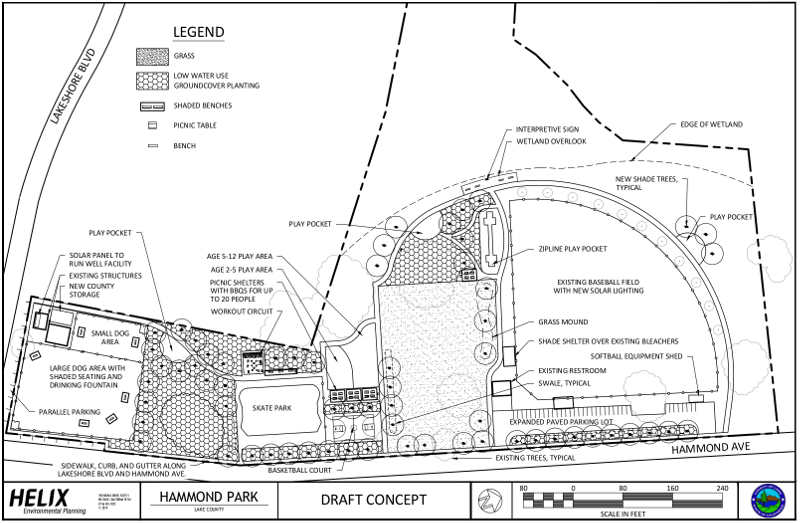
LAKE COUNTY, Calif. – Community members are invited to take part in reviewing draft plans for three county parks in preparation for the county’s application for state grant funds.
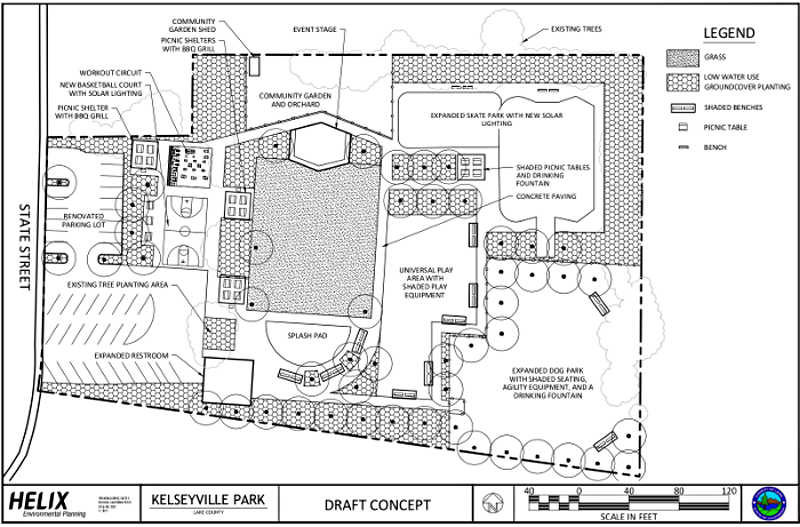
The Lake County Parks and Recreation Department will hold three upcoming meetings in which it will present the final draft conceptual design plans prepared for Hammond Park in Nice, Kelseyville Community Park in Kelseyville and Trailside Park in Middletown for a potential state grant funding opportunity through Proposition 68.
The upcoming meetings are scheduled as follows:
– Hammond Park, 2490 Lakeshore Blvd., Nice: Monday, July 1, 10 to 11 a.m.
– Trailside Park, 21044 Dry Creek Cutoff, Middletown: Tuesday, July 2, 10 to 11 a.m.
– Kelseyville Community Park, 5270 State St.: Wednesday, July 3, 10 to 11 a.m.
The county began holding meetings on the park plans in March, as Lake County News has reported.
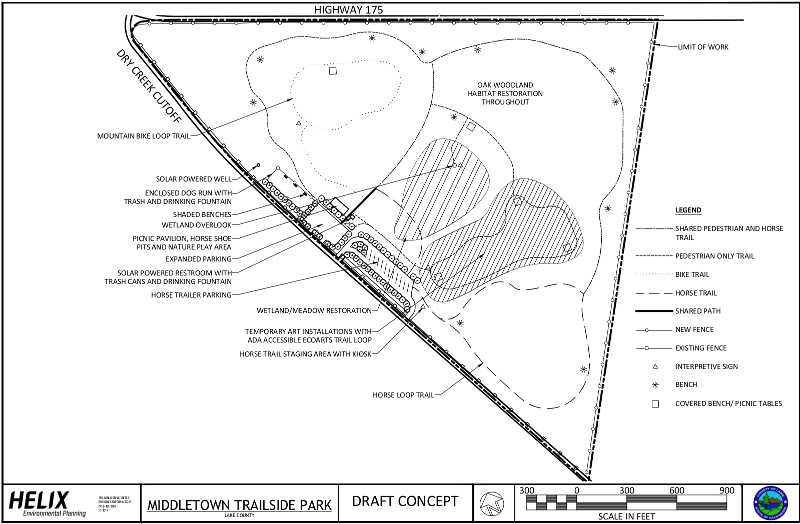
Lake County Parks and Recreation is proposing to submit grant applications to the state this summer for funding through Proposition 68, the Parks and Water Bond Act of 2018, passed by California voters last year.
Proposition 68 authorizes $4 billion in general obligation bonds meant for a variety of projects, including local and state parks.
The county’s deadline to apply is Aug. 5.
For more information, call the Lake County Parks and Recreation Department at 707-262-1618.
Email Elizabeth Larson at
On Thursday, Gov. Gavin Newsom signed his first state budget, which his office said is a balanced, on-time state budget that builds a strong fiscal foundation and makes significant progress toward combatting the affordability crisis that impacts too many Californians.
“The driving idea behind this budget – and my first year in office – is to combat the cost crisis and maintain fiscal discipline,” said Newsom. “This is a responsible budget that saves for challenging times ahead while investing in the present-day needs of working Californians.”
The $214.8 billion budget, of which $147.8 billion is general fund, creates the biggest reserve in state history – all while helping Californians tackle affordability challenges.
Significant details of the 2019-20 budget include the following.
Building a strong fiscal foundation
The budget will end the year with total reserves of $19.2 billion, of which $16.5 billion is in the Rainy Day Fund, $1.4 billion in the Special Fund for Economic Uncertainties, $900 million in the Safety Net Reserve, and nearly $400 million in the Public School System Stabilization Account.
It makes an extra payment of $9 billion over the next four years to pay down unfunded pension liabilities. This includes $3 billion to CalPERS and $2.9 billion to CalSTRS on behalf of the state, and $3.15 billion to CalSTRS and CalPERS on behalf of schools.
The budget invests $4.5 billion to eliminate the Wall of Debt and reverses the decade old deferral undertaken during the last recession.
In addition, the budget prioritizes one-time investments, with 88 percent of new expenditures being temporary rather than ongoing. This addresses the affordability crisis facing Californians while minimizing ongoing commitments to avoid putting the state at fiscal disadvantage in the future.
Confronting the cost crisis
The budget tackles affordability challenges and expands opportunity for all Californians. It supports Californians facing the cost crisis by expanding health care access, increasing housing production, making historic investments in education, expanding the Cal-EITC Working Families Tax Credit and investing in early childhood education and development.
Health care
The budget preserves health coverage protections for Californians and includes a series of proposals that leads the nation in reducing health care costs and increasing access for families.
The budget:
– Invests $1.45 billion over three years to increase Covered California health insurance premium support for low-income Californians – and provides premium support for the first time to qualified middle-income individuals earning up to $72,000 and families of four earning up to $150,000, partially funded by restoration of an enforceable individual mandate.
– Expands Medi-Cal coverage to all income-eligible undocumented young adults ages 19 through 25.
– Includes an increase of $1 billion, using Prop 56 funding, to support increased rates to Medi-Cal providers, expanded family planning services, and value-based payments that encourage more effective treatment of patients with chronic conditions.
– Invests in and supports California’s seniors by expanding health and other vital state services to this fast-growing part of California’s population.
– Ends the “senior penalty” in Medi-Cal by raising the income eligibility limit for older Californians.
– Expands eligibility to 138 percent of the federal poverty level for the Medi-Cal Aged, Blind and Disabled program, estimated to help 22,000 Californians.
– Invests boldly in responding to Alzheimer’s disease including $3 million for research grants with a focus on women and communities of color, and $5 million for Alzheimer’s disease local infrastructure.
– Establishes a pathway to transition Medi-Cal's drug benefit to a model where the state is directly bargaining for the lowest drug prices.
– Restores the 7 percent across the board reduction to IHSS service hours.
Housing affordability
The high cost of housing is a defining quality-of-life concern for people across California. In order to increase housing supply, the budget makes a historic investment to accelerate the production of new housing, and supports local governments to meet their required housing goals.
– The budget invests $1.75 billion in the production and planning of new housing. It includes support to local governments to increase housing production.
– The governor has taken measures to hold local jurisdictions accountable to meet housing demand.
– To assist renters, the budget includes $20 million to provide legal aid for renters and assist with landlord-tenant disputes, including legal assistance for counseling, renter education programs, and preventing evictions.
Working families tax cut
The Cal-EITC has helped put money back into the pockets of California’s working families, lifting some out of poverty.
The budget more than doubles the investment in the Cal-EITC to $1 billion, which will increase the number of participating households from 2 million to 3 million and:
– Help low-income families with young children through a new $1,000 credit for families with children under the age of 6;
– Significantly increase the average yearly amount individuals receive through the tax credit
Expand eligibility to include full-time workers making the 2022 minimum wage of $15/hour.
Parents agenda
The budget includes a parents agenda that addresses specific cost-of-living issues faced by young parents and parents of small children. The budget:
– Expands paid family leave from six to eight weeks for each parent or caretaker of a newborn child, potentially allowing a child to benefit from as much as four months of paid family leave. This will bring California closer to the goal of six months of paid family leave, helping more workers, especially lower-wage workers, who pay into the system take the benefits
– Puts California on the path to provide universal access to preschool for all four-year olds and full-day kindergarten, including funding for childcare workers, expanding state-subsidized facilities and increasing slots
– Provides resources for lower-income parents, including: home-visiting services, black infant health programs, developmental and trauma screenings, temporary cash assistance to families with children to meet basic needs, child savings accounts to support future higher education expenses and a sales tax exemption on diapers and menstrual products.
– Establishes or increases Cal Grant Access Awards for student parents attending the University of California, California State University, or California Community Colleges. This two-generation approach will help students complete their education, increase their future earning potential, and provide additional support to their children.
Education
The budget makes an historic investment in education for Californians, paving the path towards universal preschool, recruiting and retaining qualified educators and facilitating tuition freezes at the UC and CSU.
K-14
– Makes highest-ever investment in K-14 education, including approximately $5,000 more per K-12 pupil than eight years ago.
– Invests $90 million to recruit and retain qualified educators to teach in a high-need field at priority schools and address California’s teacher shortage, and invests $43.8 million to provide training and resources for classroom teachers and paraprofessionals to build capacity around key state priorities.
– Supports students with specialized needs by providing a 19.3-percent increase in funding for special education.
Higher ed
– Significantly increases funding for higher education, facilitating tuition freezes and increased enrollment slots at both the University of California and California State University systems for the 2019-20 school year.
– Provides support for community college students by funding two years of free community college tuition for first-time, full-time students.
– Provides $41.8 million to increase the number of competitive Cal Grant scholarships from 25,750 to 41,000 for income-eligible Californians.
– Provides $96.7 million to support the living expenses of student parents with dependent children to increase degree completion.
– Qualifying new or renewal Cal Grant A recipients will receive an access award of up to $6,000, qualifying new or renewal Cal Grant B recipients will see their access award increase from $1,648 to $6,000, and qualifying Cal Grant C recipients will see their book and supply award increase from $1,094 to $4,000.
– Provides $50 million for child savings accounts that aid families in managing future higher education expenses.
Preparing for emergencies
Climate change has created a new reality that impacts every Californian, in urban, suburban and rural communities. Gov. Newsom is taking aggressive actions to build resiliency, increase response and tackle recovery.
The budget invests nearly $1 billion:
– Includes $225.8 million to implement forest health and wildfire prevention efforts.
– Builds resilience to ensure every community is prepared in the face of a disaster with investments in community emergency preparedness, 9-1-1 system upgrades and earthquake warning system development.
– Funds new firefighting resources and technology so Cal FIRE has state-of-the-art tools at its disposal when responding to disasters, including $127.2 million for C-130 Air Tankers and 21st century firefighting helicopters; $130.3 million for better communication equipment for first responders.
– Supporting communities so they can get back on their feet after a disaster, including investment in local property tax backfill, Camp Fire Recovery and the California Disaster Assistance Act.
Advancing justice for all
Homelessness
California is facing a homelessness epidemic across the state. Recognizing the importance of mental health supports in the fight against homelessness, the budget includes an historic $1 billion investment, which will:
– Provide homelessness emergency aid to local governments for emergency housing vouchers, rapid rehousing programs and emergency shelter construction.
– Increase mental health supports, which includes expanding Whole Person Care services that provide wrap-around health, behavioral health and housing services, and building strategies to address the shortage of mental health professionals in the public mental health system.
– Fund rapid rehousing and basic needs initiatives for students in the University of California, California State University and California Community College systems.
Safe drinking water
The budget provides stable ongoing funding to assist disadvantaged communities in paying for the costs of obtaining access to safe and affordable drinking water. The proposal will:
– Initiate the Safe and Affordable Drinking Water Fund program one year earlier than previously planned by investing $100 million Greenhouse Gas Reduction Funds and $30 million General Fund in 2019-20; with $130 million continuously appropriated on an ongoing basis until 2030;
– Use the GGRF for safe drinking water to advance the state’s climate resiliency goals by helping to secure water resources statewide and advance the state’s climate change priorities by supporting and providing benefits to disadvantaged communities most impacted by climate change.
Criminal justice
The budget prioritizes public safety, while helping to make the state’s criminal system more humane and just – focusing on rehabilitation and successful reentry.
– Moves youth correctional facilities from the California Department of Corrections and Rehabilitation to a new department under the Health and Human Services Agency to enable the state to better provide youth offenders with services and support reentry.
– Provides local law enforcement training on use of force and de-escalation, while restoring funding to maintain training and improve competency for local correctional and law enforcement personnel.
– Overhauls the substance use disorder programs in prison, including integrating medically assisted treatment and reentry services as appropriate.
The budget and related acts signed by the governor today include the following.
AB 74 by Assemblymember Philip Ting – Budget Act of 2019. Line-item vetoes can be found here.
SB 78 by the Committee on Budget and Fiscal Review – Health.
SB 79 by the Committee on Budget and Fiscal Review – Mental health.
SB 80 by the Committee on Budget and Fiscal Review – Human services omnibus.
SB 81 by the Committee on Budget and Fiscal Review – Developmental services.
SB 82 by the Committee on Budget and Fiscal Review – State Government.
SB 83 by the Committee on Budget and Fiscal Review – Employment.
SB 84 by the Committee on Budget and Fiscal Review – Political Reform Act of 1974: online filing system.
SB 85 by the Committee on Budget and Fiscal Review – Public resources: omnibus trailer bill.
SB 87 by the Committee on Budget and Fiscal Review – Transportation.
SB 90 by the Committee on Budget and Fiscal Review – Public employees’ retirement.
SB 92 by the Committee on Budget and Fiscal Review – Taxation.
SB 93 by the Committee on Budget and Fiscal Review – Budget Act of 2018: augmentation.
SB 94 by the Committee on Budget and Fiscal Review – Public Safety: omnibus.
SB 95 by the Committee on Budget and Fiscal Review – Courts.
SB 105 by the Committee on Budget and Fiscal Review – Corrections facilities: financing.
For full text of these bills, visit www.leginfo.legislature.ca.gov.
“The driving idea behind this budget – and my first year in office – is to combat the cost crisis and maintain fiscal discipline,” said Newsom. “This is a responsible budget that saves for challenging times ahead while investing in the present-day needs of working Californians.”
The $214.8 billion budget, of which $147.8 billion is general fund, creates the biggest reserve in state history – all while helping Californians tackle affordability challenges.
Significant details of the 2019-20 budget include the following.
Building a strong fiscal foundation
The budget will end the year with total reserves of $19.2 billion, of which $16.5 billion is in the Rainy Day Fund, $1.4 billion in the Special Fund for Economic Uncertainties, $900 million in the Safety Net Reserve, and nearly $400 million in the Public School System Stabilization Account.
It makes an extra payment of $9 billion over the next four years to pay down unfunded pension liabilities. This includes $3 billion to CalPERS and $2.9 billion to CalSTRS on behalf of the state, and $3.15 billion to CalSTRS and CalPERS on behalf of schools.
The budget invests $4.5 billion to eliminate the Wall of Debt and reverses the decade old deferral undertaken during the last recession.
In addition, the budget prioritizes one-time investments, with 88 percent of new expenditures being temporary rather than ongoing. This addresses the affordability crisis facing Californians while minimizing ongoing commitments to avoid putting the state at fiscal disadvantage in the future.
Confronting the cost crisis
The budget tackles affordability challenges and expands opportunity for all Californians. It supports Californians facing the cost crisis by expanding health care access, increasing housing production, making historic investments in education, expanding the Cal-EITC Working Families Tax Credit and investing in early childhood education and development.
Health care
The budget preserves health coverage protections for Californians and includes a series of proposals that leads the nation in reducing health care costs and increasing access for families.
The budget:
– Invests $1.45 billion over three years to increase Covered California health insurance premium support for low-income Californians – and provides premium support for the first time to qualified middle-income individuals earning up to $72,000 and families of four earning up to $150,000, partially funded by restoration of an enforceable individual mandate.
– Expands Medi-Cal coverage to all income-eligible undocumented young adults ages 19 through 25.
– Includes an increase of $1 billion, using Prop 56 funding, to support increased rates to Medi-Cal providers, expanded family planning services, and value-based payments that encourage more effective treatment of patients with chronic conditions.
– Invests in and supports California’s seniors by expanding health and other vital state services to this fast-growing part of California’s population.
– Ends the “senior penalty” in Medi-Cal by raising the income eligibility limit for older Californians.
– Expands eligibility to 138 percent of the federal poverty level for the Medi-Cal Aged, Blind and Disabled program, estimated to help 22,000 Californians.
– Invests boldly in responding to Alzheimer’s disease including $3 million for research grants with a focus on women and communities of color, and $5 million for Alzheimer’s disease local infrastructure.
– Establishes a pathway to transition Medi-Cal's drug benefit to a model where the state is directly bargaining for the lowest drug prices.
– Restores the 7 percent across the board reduction to IHSS service hours.
Housing affordability
The high cost of housing is a defining quality-of-life concern for people across California. In order to increase housing supply, the budget makes a historic investment to accelerate the production of new housing, and supports local governments to meet their required housing goals.
– The budget invests $1.75 billion in the production and planning of new housing. It includes support to local governments to increase housing production.
– The governor has taken measures to hold local jurisdictions accountable to meet housing demand.
– To assist renters, the budget includes $20 million to provide legal aid for renters and assist with landlord-tenant disputes, including legal assistance for counseling, renter education programs, and preventing evictions.
Working families tax cut
The Cal-EITC has helped put money back into the pockets of California’s working families, lifting some out of poverty.
The budget more than doubles the investment in the Cal-EITC to $1 billion, which will increase the number of participating households from 2 million to 3 million and:
– Help low-income families with young children through a new $1,000 credit for families with children under the age of 6;
– Significantly increase the average yearly amount individuals receive through the tax credit
Expand eligibility to include full-time workers making the 2022 minimum wage of $15/hour.
Parents agenda
The budget includes a parents agenda that addresses specific cost-of-living issues faced by young parents and parents of small children. The budget:
– Expands paid family leave from six to eight weeks for each parent or caretaker of a newborn child, potentially allowing a child to benefit from as much as four months of paid family leave. This will bring California closer to the goal of six months of paid family leave, helping more workers, especially lower-wage workers, who pay into the system take the benefits
– Puts California on the path to provide universal access to preschool for all four-year olds and full-day kindergarten, including funding for childcare workers, expanding state-subsidized facilities and increasing slots
– Provides resources for lower-income parents, including: home-visiting services, black infant health programs, developmental and trauma screenings, temporary cash assistance to families with children to meet basic needs, child savings accounts to support future higher education expenses and a sales tax exemption on diapers and menstrual products.
– Establishes or increases Cal Grant Access Awards for student parents attending the University of California, California State University, or California Community Colleges. This two-generation approach will help students complete their education, increase their future earning potential, and provide additional support to their children.
Education
The budget makes an historic investment in education for Californians, paving the path towards universal preschool, recruiting and retaining qualified educators and facilitating tuition freezes at the UC and CSU.
K-14
– Makes highest-ever investment in K-14 education, including approximately $5,000 more per K-12 pupil than eight years ago.
– Invests $90 million to recruit and retain qualified educators to teach in a high-need field at priority schools and address California’s teacher shortage, and invests $43.8 million to provide training and resources for classroom teachers and paraprofessionals to build capacity around key state priorities.
– Supports students with specialized needs by providing a 19.3-percent increase in funding for special education.
Higher ed
– Significantly increases funding for higher education, facilitating tuition freezes and increased enrollment slots at both the University of California and California State University systems for the 2019-20 school year.
– Provides support for community college students by funding two years of free community college tuition for first-time, full-time students.
– Provides $41.8 million to increase the number of competitive Cal Grant scholarships from 25,750 to 41,000 for income-eligible Californians.
– Provides $96.7 million to support the living expenses of student parents with dependent children to increase degree completion.
– Qualifying new or renewal Cal Grant A recipients will receive an access award of up to $6,000, qualifying new or renewal Cal Grant B recipients will see their access award increase from $1,648 to $6,000, and qualifying Cal Grant C recipients will see their book and supply award increase from $1,094 to $4,000.
– Provides $50 million for child savings accounts that aid families in managing future higher education expenses.
Preparing for emergencies
Climate change has created a new reality that impacts every Californian, in urban, suburban and rural communities. Gov. Newsom is taking aggressive actions to build resiliency, increase response and tackle recovery.
The budget invests nearly $1 billion:
– Includes $225.8 million to implement forest health and wildfire prevention efforts.
– Builds resilience to ensure every community is prepared in the face of a disaster with investments in community emergency preparedness, 9-1-1 system upgrades and earthquake warning system development.
– Funds new firefighting resources and technology so Cal FIRE has state-of-the-art tools at its disposal when responding to disasters, including $127.2 million for C-130 Air Tankers and 21st century firefighting helicopters; $130.3 million for better communication equipment for first responders.
– Supporting communities so they can get back on their feet after a disaster, including investment in local property tax backfill, Camp Fire Recovery and the California Disaster Assistance Act.
Advancing justice for all
Homelessness
California is facing a homelessness epidemic across the state. Recognizing the importance of mental health supports in the fight against homelessness, the budget includes an historic $1 billion investment, which will:
– Provide homelessness emergency aid to local governments for emergency housing vouchers, rapid rehousing programs and emergency shelter construction.
– Increase mental health supports, which includes expanding Whole Person Care services that provide wrap-around health, behavioral health and housing services, and building strategies to address the shortage of mental health professionals in the public mental health system.
– Fund rapid rehousing and basic needs initiatives for students in the University of California, California State University and California Community College systems.
Safe drinking water
The budget provides stable ongoing funding to assist disadvantaged communities in paying for the costs of obtaining access to safe and affordable drinking water. The proposal will:
– Initiate the Safe and Affordable Drinking Water Fund program one year earlier than previously planned by investing $100 million Greenhouse Gas Reduction Funds and $30 million General Fund in 2019-20; with $130 million continuously appropriated on an ongoing basis until 2030;
– Use the GGRF for safe drinking water to advance the state’s climate resiliency goals by helping to secure water resources statewide and advance the state’s climate change priorities by supporting and providing benefits to disadvantaged communities most impacted by climate change.
Criminal justice
The budget prioritizes public safety, while helping to make the state’s criminal system more humane and just – focusing on rehabilitation and successful reentry.
– Moves youth correctional facilities from the California Department of Corrections and Rehabilitation to a new department under the Health and Human Services Agency to enable the state to better provide youth offenders with services and support reentry.
– Provides local law enforcement training on use of force and de-escalation, while restoring funding to maintain training and improve competency for local correctional and law enforcement personnel.
– Overhauls the substance use disorder programs in prison, including integrating medically assisted treatment and reentry services as appropriate.
The budget and related acts signed by the governor today include the following.
AB 74 by Assemblymember Philip Ting – Budget Act of 2019. Line-item vetoes can be found here.
SB 78 by the Committee on Budget and Fiscal Review – Health.
SB 79 by the Committee on Budget and Fiscal Review – Mental health.
SB 80 by the Committee on Budget and Fiscal Review – Human services omnibus.
SB 81 by the Committee on Budget and Fiscal Review – Developmental services.
SB 82 by the Committee on Budget and Fiscal Review – State Government.
SB 83 by the Committee on Budget and Fiscal Review – Employment.
SB 84 by the Committee on Budget and Fiscal Review – Political Reform Act of 1974: online filing system.
SB 85 by the Committee on Budget and Fiscal Review – Public resources: omnibus trailer bill.
SB 87 by the Committee on Budget and Fiscal Review – Transportation.
SB 90 by the Committee on Budget and Fiscal Review – Public employees’ retirement.
SB 92 by the Committee on Budget and Fiscal Review – Taxation.
SB 93 by the Committee on Budget and Fiscal Review – Budget Act of 2018: augmentation.
SB 94 by the Committee on Budget and Fiscal Review – Public Safety: omnibus.
SB 95 by the Committee on Budget and Fiscal Review – Courts.
SB 105 by the Committee on Budget and Fiscal Review – Corrections facilities: financing.
For full text of these bills, visit www.leginfo.legislature.ca.gov.