 How to resolve AdBlock issue?
News
As California continues to grapple with climate change and wildfires that are increasingly dangerous and destructive, Gov. Gavin Newsom on Friday released a progress report on recommendations laid out in his administration’s 60 Day Strike Force report.
In April, the Governor’s Strike Force charged with examining California’s catastrophic wildfires laid out five key areas where focus is needed:
– Catastrophic wildfire prevention and response;
– Mitigating climate change through clean energy policies;
– Fair allocation of catastrophic wildfire damages;
– A more effective California Public Utilities Commission with the tools to manage a changing utility market;
– Holding Pacific Gas and Electric accountable and building a utility that prioritizes safety.
The progress report released today shows the state’s progress in all of these areas and provides guidance on how the state can build a safe, reliable and affordable energy future – one that continues the state’s progress towards achieving its climate change goals.
“Climate change has created a new reality in the State of California. It’s not a question of ‘if’ wildfire will strike, but ‘when,’” said Gov. Newsom in the report’s introduction. “Our recent, terrifying history bears that out. Fifteen of the 20 most destructive wildfires in the state’s history have occurred since 2000 and 10 of the most destructive fires have occurred since 2015. Wildfires don’t discriminate – they are a rural, suburban and urban danger. We all have an individual responsibility to step up and step in for our communities as we confront new and growing threats.”
Newsom added, “My administration has welcomed support and guidance from the Legislature in crafting a framework around issues like power company accountability, wildfire safety investments and reform of the California Public Utilities Commission. In the coming days, I will continue working with the Legislature to turn this framework into a package of bills that make the changes we need.”
Gov. Newsom has made wildfire prevention and mitigation a top priority since taking office. The governor proactively declared a state of emergency to fast-track 35 critical forest-management projects to protect more than 200 of California’s highest-risk communities, redirected National Guard members from the border to undertake fire prevention activities throughout the state.
The governor also included $1 billion in additional funding in the state budget to enhance our state’s preparedness and expand our capacity to respond to emergencies.
During his State of the State Address, the governor announced the creation of a Strike Force to develop a comprehensive strategy within 60 days, to address the destabilizing effects of catastrophic wildfires on California’s energy future.
The full progress report can be seen below.
In April, the Governor’s Strike Force charged with examining California’s catastrophic wildfires laid out five key areas where focus is needed:
– Catastrophic wildfire prevention and response;
– Mitigating climate change through clean energy policies;
– Fair allocation of catastrophic wildfire damages;
– A more effective California Public Utilities Commission with the tools to manage a changing utility market;
– Holding Pacific Gas and Electric accountable and building a utility that prioritizes safety.
The progress report released today shows the state’s progress in all of these areas and provides guidance on how the state can build a safe, reliable and affordable energy future – one that continues the state’s progress towards achieving its climate change goals.
“Climate change has created a new reality in the State of California. It’s not a question of ‘if’ wildfire will strike, but ‘when,’” said Gov. Newsom in the report’s introduction. “Our recent, terrifying history bears that out. Fifteen of the 20 most destructive wildfires in the state’s history have occurred since 2000 and 10 of the most destructive fires have occurred since 2015. Wildfires don’t discriminate – they are a rural, suburban and urban danger. We all have an individual responsibility to step up and step in for our communities as we confront new and growing threats.”
Newsom added, “My administration has welcomed support and guidance from the Legislature in crafting a framework around issues like power company accountability, wildfire safety investments and reform of the California Public Utilities Commission. In the coming days, I will continue working with the Legislature to turn this framework into a package of bills that make the changes we need.”
Gov. Newsom has made wildfire prevention and mitigation a top priority since taking office. The governor proactively declared a state of emergency to fast-track 35 critical forest-management projects to protect more than 200 of California’s highest-risk communities, redirected National Guard members from the border to undertake fire prevention activities throughout the state.
The governor also included $1 billion in additional funding in the state budget to enhance our state’s preparedness and expand our capacity to respond to emergencies.
During his State of the State Address, the governor announced the creation of a Strike Force to develop a comprehensive strategy within 60 days, to address the destabilizing effects of catastrophic wildfires on California’s energy future.
The full progress report can be seen below.
062119 Strike Force Progress Report by LakeCoNews on Scribd

NASA has selected two new missions to advance our understanding of the sun and its dynamic effects on space.
One of the selected missions will study how the sun drives particles and energy into the solar system and a second will study Earth’s response.
The sun generates a vast outpouring of solar particles known as the solar wind, which can create a dynamic system of radiation in space called space weather.
Near Earth, where such particles interact with our planet’s magnetic field, the space weather system can lead to profound impacts on human interests, such as astronauts’ safety, radio communications, GPS signals, and utility grids on the ground.
The more we understand what drives space weather and its interaction with the Earth and lunar systems, the more we can mitigate its effects – including safeguarding astronauts and technology crucial to NASA’s Artemis program to the Moon.
“We carefully selected these two missions not only because of the high-class science they can do in their own right, but because they will work well together with the other heliophysics spacecraft advancing NASA’s mission to protect astronauts, space technology and life down here on Earth,” said Thomas Zurbuchen, associate administrator for the Science Mission Directorate at NASA Headquarters in Washington. “These missions will do big science, but they’re also special because they come in small packages, which means that we can launch them together and get more research for the price of a single launch.”
PUNCH
The Polarimeter to Unify the Corona and Heliosphere, or PUNCH, mission will focus directly on the Sun’s outer atmosphere, the corona, and how it generates the solar wind.
Composed of four suitcase-sized satellites, PUNCH will image and track the solar wind as it leaves the Sun.
The spacecraft also will track coronal mass ejections – large eruptions of solar material that can drive large space weather events near Earth – to better understand their evolution and develop new techniques for predicting such eruptions.
These observations will enhance national and international research by other NASA missions such as Parker Solar Probe, and the upcoming European Space Agency/NASA Solar Orbiter, due to launch in 2020.
PUNCH will be able to image, in real time, the structures in the solar atmosphere that these missions encounter by blocking out the bright light of the Sun and examining the much fainter atmosphere.
Together, these missions will investigate how the star we live with drives radiation in space. PUNCH is led by Craig DeForest at the Southwest Research Institute in Boulder, Colorado. Including launch costs, PUNCH is being funded for no more than $165 million.
TRACERS
The second mission is Tandem Reconnection and Cusp Electrodynamics Reconnaissance Satellites, or TRACERS.
The TRACERS investigation was partially selected as a NASA-launched rideshare mission, meaning it will be launched as a secondary payload with PUNCH.
NASA’s Science Mission Directorate is emphasizing secondary payload missions as a way to obtain greater science return.
TRACERS will observe particles and fields at the Earth’s northern magnetic cusp region – the region encircling Earth’s pole, where our planet’s magnetic field lines curve down toward Earth.
Here, the field lines guide particles from the boundary between Earth’s magnetic field and interplanetary space down into the atmosphere.
In the cusp area, with its easy access to our boundary with interplanetary space, TRACERS will study how magnetic fields around Earth interact with those from the sun.
In a process known as magnetic reconnection, the field lines explosively reconfigure, sending particles out at speeds that can approach the speed of light. Some of these particles will be guided by the Earth’s field into the region where TRACERS can observe them.
Magnetic reconnection drives energetic events all over the universe, including coronal mass ejections and solar flares on the Sun. It also allows particles from the solar wind to push into near-Earth space, driving space weather there.
TRACERS will be the first space mission to explore this process in the cusp with two spacecraft, providing observations of how processes change over both space and time.
The cusp vantage point also permits simultaneous observations of reconnection throughout near-Earth space. Thus, it can provide important context for NASA’s Magnetospheric Multiscale mission, which gathers detailed, high-speed observations as it flies through single reconnection events at a time.
TRACERS’ unique measurements will help with NASA’s mission to safeguard our technology and astronauts in space. The mission is led by Craig Kletzing at the University of Iowa in Iowa City. Not including rideshare costs, TRACERS is funded for no more than $115 million.
Launch date for the two missions is no later than August 2022. Both programs will be managed by the Explorers Program Office at NASA’s Goddard Space Flight Center in Greenbelt, Maryland.
The Explorers Program, the oldest continuous NASA program, is designed to provide frequent, low-cost access to space using principal investigator-led space science investigations relevant to the work of NASA’s Science Mission Directorate in astrophysics and heliophysics.
The program is managed by Goddard for the Science Mission Directorate, which conducts a wide variety of research and scientific exploration programs for Earth studies, space weather, the solar system and the universe.
For more information about the Explorers Program, visit https://explorers.gsfc.nasa.gov .
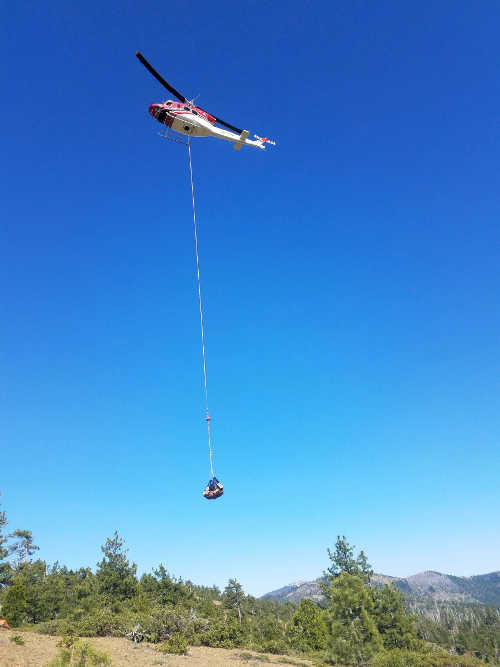
NORTHERN CALIFORNIA – Mendocino National Forest officials said growth is slowing on the lightning-caused East fire burning in the Yolla Bolly Wilderness.
As of late Friday morning, the East fire had burned 200 acres with little growth reported.
To the southeast, the Haynes fire is estimated at 23 acres and 80 percent contained, officials said.
The fires started June 17 approximately 23 miles northeast of Covelo in Trinity County.
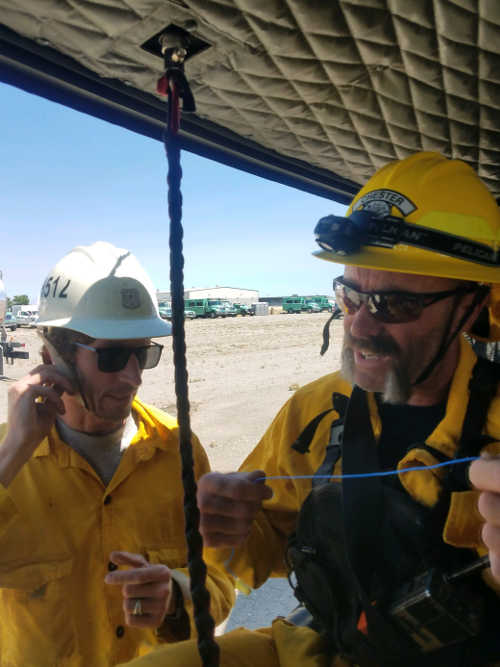
Forest officials said there are 145 personnel working on these fires including smokejumpers, hotshot crews, wildland fire modules, helicopters and support personnel.
On the East fire, crews will continue to reinforce a designated confinement area between East Ridge, Buck Ridge and Wrights Ridge as the fire moves southward. Officials said crews on the Haynes fire plan to extinguish burning logs and vegetation near the containment lines.
During the Friday morning briefing, Agency Administrator Frank Aebly thanked the crews for protecting wilderness values and having a light impact on the land while they work on the two fires.
Crews are using minimum impact suppression tactics or MIST such as using natural barriers where possible, moving or rolling material out of the intended confinement area, reducing the amount of trees cut and minimizing fireline construction.
The weather forecast for Friday into Saturday includes a red flag warning with strong winds for the northern Sacramento Valley below 2,000 feet.
The gusty winds in the valley are not expected to occur on the East and Haynes fires during this wind event.
For the fire area, the weather forecast shows temperatures in the mid-60s with north winds from 11 to 18 miles per hour.
Wilderness hikers are asked to avoid travel near Buck Ridge and Wrights Ridge.
Maps and photos are available at https://inciweb.nwcg.gov/incident/6394/ .

State Sen. Mike McGuire honored and celebrated Upper Lake High School student and state wrestling champion Adriana Lopez during a ceremony on the California State Senate Floor Thursday morning.
Lopez isn’t just the top female wrestler in her weight class in the Golden State – she is a trailblazer.
She made school history by being the first student to ever hold a state title across any sport from Upper Lake High and she is the first-ever student to hold a state title from the entire county of Lake.
“She’s fierce, wicked smart, crushes the competition and she has made California proud. We congratulate her on her success, and wish her the best as she heads to college this fall to continue to compete with the best,” Sen. McGuire said.
She was joined in the Senate ceremony by her father Joe Fernandez – who also is her wrestling coach – and her mother, Jamie.
This spring, Lopez won the California Interscholastic Federation Girls’ Wrestling State Championship in the 121-pound division, making her the top female wrestler in California in her weight class.
She was previously a state wrestling medalist, having placed third in the 2018 CIF Girls’ Wrestling State Championship, and she wasn’t going to accept anything but the top spot in her senior year.
Lopez was also the first Coastal Mountain Conference state champion in wrestling.
Lopez has received a combined athletic and academic scholarship to attend Campbellsville University in Campbellsville, Kentucky, where she will both wrestle and pursue a career in nursing.
LAKEPORT, Calif. – With Pacific Gas and Electric warning of the potential for public safety power shutoffs this summer, the Board of Supervisors this week discussed backup generators and power infrastructure upgrades needed to keep county facilities going.
As the board grappled with the likelihood of high costs and the possibility of months-long delays in getting facilities prepped for the outages, it became clear that, while some departments – such as the sheriff’s office – will not have their services interrupted, the county has not completed a comprehensive operational plan for what facilities will be able to operate if PG&E cuts power due to concerns about wildfires.
On June 11, the board directed staff to return with information for a discussion on backup power generators, and Public Services Director Lars Ewing on Tuesday said his staff has been “feverishly” trying to size up generators and options for purchases and leases of equipment.
Ewing emphasized that he wasn’t presenting a recommendation, only options. He said his staff has looked at county facilities, and dozens of them don’t have backup generation. One of the questions they’re trying to answer is how to ensure those facilities can maintain operations during a shutoff.
For the Lake County Courthouse, the county government’s headquarters, Ewing said it will require 750 kilowatts of power to keep it fully operational.
While figuring out how much power the county facilities will need is one consideration, there is another necessity that has to be addressed: Ewing said all of the facilities need electrical upgrades in order to use backup generators.
The costs for those upgrades can range from $10,000 for a smaller building up to $75,000 for a larger facility like the courthouse, he said.
A generator sized to run the courthouse is estimated to cost $190,000, plus the cost for the power upgrade, he said.
Not only is the cost high, but there also is a lead time of between three and five months just to purchase such a generator, according to Ewing.
For a more temporary solution, Ewing said the county can rent a large generator on contingency for $5,000 per month, with the equipment available within 48 hours. To rent it on standby would range between $10,000 and $12,000 per month.
“That powers the whole building,” he said.
The county has a cost-sharing agreement with the state for the Lake County Superior Court, housed on the building’s fourth floor. Ewing said that could provide a 30-percent share. Another cost-sharing option is to work with the cell carriers who have tower facilities on the building’s roof to get generators.
At most, Ewing said the county is looking at as much as $300,000 to keep the courthouse running in the event of a power shutoff. He said they could look at paring down certain circuits, running air conditioning less and turning off some lights to use less energy.
Ewing said his staff looked at every building on the courthouse campus, including Victim-Witness, Buildings and Grounds, and the Lake County Courthouse Museum, the latter which runs off the courthouse’s power. With the museum, he said they needed to consider if some artifacts will need power to protect them.
Other facilities reviewed included Special Districts, the Lakeport Library, Lake County Probation, the Agriculture Department, Animal Care and Control, Middletown Library and Senior Center, Behavioral’s Health’s Southshore office, Redbud Library and Child Support Services, he said.
Ewing said all of those facilities would be on propane. He estimated generators would range from $15,000 to $60,000, with installation from $10,000 to $25,000 each. At least a few months’ lead time will be required, and Ewing said both electricians and generator companies are facing high demand. One electrician he spoke to said he was scheduled six weeks out.
“It’s not something that we can pull the trigger on right now and have it done next week for any one building, much less all of them,” Ewing said, adding that his staff doesn’t have the capacity to address those needs right away.
Supervisor Rob Brown said the discussion was becoming much larger than originally intended. He asked about total fees for generators and installation.
Ewing said that, for all of the buildings – excluding the courthouse – it was $380,000 for generators and $160,000 for installation.
Brown said the county will need to let nonessential staff know at some point that if the power is shut off, they should stay home and not come to work. “It’s going to be a real hardship on everyone.”
Department heads report on capabilities, needs
Sheriff Brian Martin told the board that the jail has backup generation and his evidence facility should have a new generator installed soon. At its June 10 meeting, the board approved a $40,000 budget transfer for the sheriff’s office to purchase and install the propane-powered generator to keep evidence freezers and refrigerators operational during a power shutoff.
Martin said his administration office, the dispatch center and the emergency operations center all have generators, and work is under way to get a generator installed at a radio repeater site to back up communications. He said both the sheriff’s office and the Office of Emergency Services should continue operations uninterrupted.
Brown asked if they could start looking at permanent alternatives, spending more to get away from PG&E altogether by using solar, wind or other options. Ewing said they already are looking at solar power.
IT Director Shane French said his department has a backup generator and, to the extent that facilities are online, they will have services and the public will have access to the county’s Web site.
Ewing said he was stopping short of suggesting that certain facilities not have backup power, as he believed that isn’t his decision. Rather, the focus is on looking at what offices need to remain open. “That really is where we are.”
Supervisor Moke Simon said looking at rentals and leasing was the county’s most prudent route, and he suggested looking for US Department of Agriculture grants for help with addressing power alternatives.
Supervisor EJ Crandell said his tribe, Robinson Rancheria, has a generator for its casino that broke during last year’s fire. He asked about a maintenance package or someone on site to make repairs. “When it broke we were stuck.”
Ewing said all current backup generators are on a maintenance plan.
County Counsel Anita Grant told the supervisors that they needed to devise what the county’s operational plan is going to be.
Ewing said there is a lot that’s needed for planning at each location, which would allow him to refine costs.
Grant added that there is no problem having a large overarching plan that’s phased in, and it depends on where the board starts and where you want to end up. “Once you have a plan a lot of this will be easy to see,” as far as alternatives.
Board Chair Tina Scott asked for consensus to run the numbers on the backup generation measure. Brown suggested Ewing also take the consideration to the county’s space committee, which looks at issues surrounding facilities, and then bring back a recommendation to the board.
Offer of assistance
During public comment, Lake County Superintendent of Schools Brock Falkenberg said he appreciated the board’s discussion.
“School districts are dependent on the county treasurer, county auditor-controller, as well as IT for a lot of our business operations. I think the fire districts are in a similar boat,” he said, adding districts are dependent on power to make payroll and meet local accounts payable obligations.
He said the Lake County Office of Education is investing more than $100,000 for permanent backup generation, “and by July 1 I can assure you that we will have temporary generation in place so that we’re able to move forward.”
He said he wants to be able to assure our school employees they will get their paychecks on time. “This is a critical situation. It’s a unique situation.”
Falkenberg said the Office of Education is willing to step up to help offset some of the backup power costs – in particular, for the courthouse – so the county can move forward.
Crystal Markytan, director of Social Services, said her goal is to keep staff working in order for benefits to go out for foster parents, aid and CalFresh.
Markytan said the cost for backup generation at the Anderson Ranch offices in Lower Lake is $250,000. She wants to put forward a plan for working in the offices without power, which would be voluntary, adding her staff has some good ideas on how to do that.
Ewing said the generator for Anderson Ranch would be the same size as the generator needed for the courthouse. It would be noted later in the discussion that, since that is a leased building, the county should coordinate backup power generation upgrades with the building’s owners.
County Librarian Christopher Veach said he wants to do whatever possible to keep libraries open, even if the power is out, and he asked for guidelines from the board on how to operate if the power is out for a long period of time.
He said he has surveyed some libraries from around the state; some have backup generation and stay open, some don’t and close immediately.
As the discussion closed, Grant told the supervisors, “I think your board’s made it clear that there’s a lot of planning and work to do to come back to your board with some recommendations regarding short-term and long-term plans using solar, wind and any other alternatives.”
She added, “If that sums it up, we’ll get on it.”
Email Elizabeth Larson at
LAKE COUNTY, Calif. – The National Weather Service has placed Lake County and other parts of the region under a red flag warning through Saturday evening, but so far no power outages have been announced for the county.
The warning went into effect at 11 p.m. Thursday and will remain in effect until 6 p.m. Saturday.
A red flag warning means that critical fire weather conditions are either occurring now, or will shortly, the National Weather Service said.
The warning is triggered by a combination of strong winds, low relative humidity and warm temperatures that forecasters said can contribute to extreme fire behavior. The National Weather Service said wildland fuels below the 2,000 foot elevation mark are generally near or below the seasonal average and susceptible to rapid spread of fire.
Pacific Gas and Electric Co. has warned that such conditions can trigger public safety power shutoffs, but so far the company has not announced plans for any such action in Lake County – or in areas that would impact the county – as a result of this warning.
Northshore Fire Chief Mike Ciancio confirmed on Thursday that no power shutoff to the area is planned due to the weekend weather conditions.
The National Weather Service said a low pressure system is bringing breezy north winds behind the departing low pressure system, which in turn is resulting in elevated fire weather concerns through Saturday.
Conditions are forecast to be warmer than normal over the weekend with cooling again next week.
The specific Lake County forecast expects winds into the low teens on Friday, with gusts up to 20 miles per hour in the south county. Lighter winds are forecast for Saturday.
Temperatures on Friday are forecast to range into the high 80s and drop into the low 50s at night, with Saturday, Sunday and Monday having highs in the low 90s in the south county and high 80s elsewhere, and similar nighttime temperatures to Friday.
Conditions are forecast to cool next week, with daytime temperatures dropping into the 80s in Middletown and the high 70s in other parts of the county from Tuesday through Thursday. Nighttime temperatures will hover in the low 50s.
Email Elizabeth Larson atThis email address is being protected from spambots. You need JavaScript enabled to view it. . Follow her on Twitter, @ERLarson, or Lake County News, @LakeCoNews.
The warning went into effect at 11 p.m. Thursday and will remain in effect until 6 p.m. Saturday.
A red flag warning means that critical fire weather conditions are either occurring now, or will shortly, the National Weather Service said.
The warning is triggered by a combination of strong winds, low relative humidity and warm temperatures that forecasters said can contribute to extreme fire behavior. The National Weather Service said wildland fuels below the 2,000 foot elevation mark are generally near or below the seasonal average and susceptible to rapid spread of fire.
Pacific Gas and Electric Co. has warned that such conditions can trigger public safety power shutoffs, but so far the company has not announced plans for any such action in Lake County – or in areas that would impact the county – as a result of this warning.
Northshore Fire Chief Mike Ciancio confirmed on Thursday that no power shutoff to the area is planned due to the weekend weather conditions.
The National Weather Service said a low pressure system is bringing breezy north winds behind the departing low pressure system, which in turn is resulting in elevated fire weather concerns through Saturday.
Conditions are forecast to be warmer than normal over the weekend with cooling again next week.
The specific Lake County forecast expects winds into the low teens on Friday, with gusts up to 20 miles per hour in the south county. Lighter winds are forecast for Saturday.
Temperatures on Friday are forecast to range into the high 80s and drop into the low 50s at night, with Saturday, Sunday and Monday having highs in the low 90s in the south county and high 80s elsewhere, and similar nighttime temperatures to Friday.
Conditions are forecast to cool next week, with daytime temperatures dropping into the 80s in Middletown and the high 70s in other parts of the county from Tuesday through Thursday. Nighttime temperatures will hover in the low 50s.
Email Elizabeth Larson at