 How to resolve AdBlock issue?
News
KELSEYVILLE, Calif. – The Lake County Literacy Coalition’s major fundraiser, the Vineyard Run for Literacy, is right around the corner, on Sunday, Oct. 13, at Steele Wines in Kelseyville.
“A special medal was designed for our 30th annual event,” said Lake County Literacy Coalition Vice President Ginny Cholez. “It will be awarded to all first, second and third place finishers in the 5K and 10K events, in male and female age divisions ranging from youth through 70+.”
The walk and runs begin at 9 a.m.
Early registration for the Vineyard Run is strongly encouraged. Event fees are lower, and commemorative T-shirts are only available by pre-order. None will be sold the day of the event.
Register online at https://runsignup.com/, contact the Literacy office for a form, or stop by the Coalition booth at the Pear Festival.
Funds raised by the Literacy Coalition are used for books, training materials and tutor support for the Adult Literacy programs run by the Lake County Library.
The program recruits and trains volunteers from the community to work one-on-one with individuals who need help to improve basic reading, writing and comprehension skills.
“Over the years, the literacy program has trained well over 1,200 tutors who in turn helped more than 2,100 learners,” literacy coordinator Ginny DeVries said.
This tutoring is free to all Lake County residents, age 18 and older.
Many college students take advantage of this free tutoring service, especially first year students. They learn how to succeed in taking tests and improve note taking ability.
One client willing to share his story passionately wanted to be a chef. His reading and writing skills had been a problem when it came to passing the exams at the Culinary Arts class at Woodland Community College, Lake Campus in Clearlake.
He and his tutor met regularly for 17 weeks, and with that help, he received an “A” in his Culinary Arts class, and got his first job as full–time cook at Running Creek Casino.
Tutors are available to assist learners on an individual basis at the county library branches and other locations.
In addition, if an adult learner has young children, the whole family is eligible for services under the Families for Literacy Program.
Family story times are offered at the library branches and children’s educational materials are provided (at no cost to the families) to encourage a love of reading and to break the cycle of illiteracy.
For more information about the Literacy program and services, call the library literacy office at 707-263-7633.

NORTHERN CALIFORNIA – Special Agents from the Office of Correctional Safety and Special Services Unit have apprehended a minimum-security inmate who walked away from the California Correctional Center Chamberlain Creek Conservation Camp in Mendocino County on Friday.
At 5:35 p.m. Monday, agents took inmate Jonathan Washington into custody in Vallejo.
Washington will be transported to the California Correctional Center in Susanville, and will no longer be eligible to be housed in a Conservation Camp.
He was committed to the California Department of Corrections and Rehabilitation on Dec. 28, 2018, from Kings County to serve a three-year, eight-month term for vandalism and corporal injury on a specific persons resulting in traumatic condition. He was scheduled to parole in March 2020.
Since 1977, 99 percent of all offenders who have left an adult institution, camp or community-based program without permission have been apprehended.
Clearlake City Council approves request for new office assistant, Code Enforcement officer positions
Clearlake Police Chief Andrew White, whose department oversees Animal Control and Code Enforcement, asked the council to add an office assistant II and a limited-term Code Enforcement officer I/II to the position allocations in the current fiscal year.
White’s written report said the office assistant II will cost $42,000 for regular salary and benefits for the remainder of the fiscal year, with the funds to be spread between the general fund
and Community Development Block Grant funding for Code Enforcement.
The Code Enforcement officer job will cost $45,000 for regular salary and benefits for the rest of the fiscal year, and will be paid for by Community Development Block Grant funds in the Code Enforcement budget.
White said that they’re seeing an increase in lobby traffic, with the police department sharing a Code Enforcement staffer to work with the public.
“Based upon our looking at the issue, it seems to be primarily due to an increase in enforcement activity” – primary in Code Enforcement, Animal Control and citation issuance, White said.
He said he thinks that traffic will grow as efforts continue to modernize ordinances and clean up the city, citing ordinances regarding commercial property and abandoned vehicles, and planned updates to the city’s rental ordinance.
The office assistant’s primary job would be to handle lobby traffic, and when not busy there would also handle filing and answering calls. White said the new position would allow the department to reopen the lobby five days a week; currently it’s only open four.
The police department is now acting as a public safety answering point, and White said without the additional lobby staffing a dispatcher would have to leave their desk to open the lobby, which also presents a safety issue.
As for the new Code Enforcement officer job, White said it’s necessary due to the continuing effort to abate blight and nuisance vegetation, as well as ongoing and increased enforcement actions.
He said there are many more cases the division could open with additional staffing, which would improve the city. There is more money to deal with abandoned vehicles and additional money available through Community Development Block Grant funding.
White said a part-time, extra help Code Enforcement officer I position recently was filled on a trial basis. That individual currently is being trained and is helping with a backlog of clerical work; he said that officer will learn field work and will concentrate on abandoned vehicle removal.
He asked the council to update the position to a limited term for the current fiscal year, on a trial basis. Continuing it would require the approval of the city manager.
White said they wouldn’t make a permanent change to the staffing until they see if the trial program works out. He added that he asked for the position to be on a limited term due to its dependence on grant funding.
In both Animal Control and Code Enforcement, White said they are seeing significantly increased revenues.
Since May, they have issued 1,300 administrative citations through Code Enforcement, averaging 329 citations a month. White said they’ve created more than 950 new cases, averaging 237 new cases a month.
The city hadn’t previously had an effective animal licensing program, but they’ve renewed their efforts, with the revenue used to offset the tremendous expense of running Animal Control, White said.
Since May, they have sold 522 dog licenses, or 130 a month, he reported.
Councilwoman Joyce Overton said she and others have had problems getting return calls from Code Enforcement. In one case, Overton said she received no call back.
White said they are working to replace the phones and, in the meantime, are routing all calls through one staffer who directs and tracks them.
Councilman Phil Harris asked if they could add a digital kiosk to city hall to help with lobby traffic.
White said they are in the process of putting a kiosk in the lobby for filing reports and paying citations, which also can be paid online.
He said not everyone in the community is digitally connected and some prefer to talk to people; in those cases, if a staffer can explain the situation, they can get compliance.
Overton moved to approve the position allocations, and was joined by the rest of the council in voting for it.
In other business on Thursday, the council accepted staff’s proposal to reject the two bids for the double chip seal project in the Southwest Avenues, with the bids from two contractors coming in at $148,200 and $213,000 – while the city engineer’s estimate was $70,000. The project is to be funded by Measure V road tax funds.
The council also approved a memorandum of understanding between the city of Clearlake and the Middle Management Association for the period of July 1, 2019, to June 30, 2021, and directed Overton to vote for conference resolutions at the upcoming League of California Cities annual conference.
Email Elizabeth Larson at
091219 Clearlake City Council Agenda Packet by LakeCoNews on Scribd
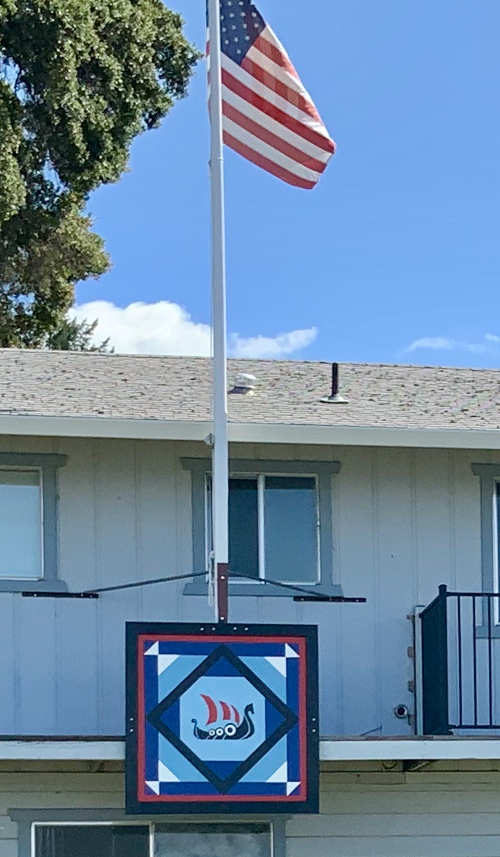
KELSEYVILLE, Calif. – “Viking Sommerhus” – Norwegian for “Viking summer house” – has been added to the Lake County Quilt Trail.
It has been installed on the summer home of the Dangel family.
The 4-foot by 4-foot block is facing the lake in Soda Bay at 3376 Live Oak Lane, Kelseyville.
The Dangel family has been on this property since 1959 when the senior Dangels – Bob and Thelma – built this summer home for their family.
Their children, Gene and Jackie, spent many summers in this home on Soda Bay boating and skiing.
Memories are still being made by the Dangel children, grandchildren and great-grandchildren at the “Viking Sommerhus” (pronounced veeking summerhoos).
The Dangel family is well known for their involvement in the Lake County community in many organizations particularly the Lake County Historical Society.
The Dangel grandparents were immigrants from Norway in 1912. Their Norwegian roots take the family back to Viking mariners in the North Sea and fishermen/boaters in San Francisco and Morro Bay.
The Lake County Quilt Trail is an agricultural and tourism project designed to promote community pride.
The 4-foot by 4-foot quilt block was drawn and painted by the Lake County Quilt Trail team, a group of dedicated volunteer quilters, graphic artists, painters, writers and carpenters.
The quilt trail is no longer taking applications.
For more information about the Lake County Quilt Trail visit www.lakecountyquilttrail.com or the group’s Facebook page.
This time of year, the number of wildlife-vehicle collisions typically peak as animals start migrating to winter habitat, mating season begins for deer and elk, and bears spend more time foraging before hibernation.
To help reduce collisions, Caltrans and the California Department of Fish and Wildlife remind motorists to be on the lookout during Watch Out for Wildlife Week, which runs Sept. 15 to 21.
Watch Out for Wildlife Week marks the beginning of the migration season for California's wildlife, particularly elk and deer. Many of California's roadways cut through these animals' routes.
It is vital that drivers be especially alert now through December to avoid collisions with wild animals. These crashes not only harm wildlife, but they can damage vehicles and cause injury and death to drivers and passengers.
"Caltrans is dedicated to improving the safety of California drivers, which includes being responsible when it comes to the environment," said Caltrans Acting Director Bob Franzoia. "This can mean installing flashing warning signs and building ramps and larger culverts for safer passage over and under our roads."
"From September through December, wildlife often exhibit natural behaviors that can increase their movements and activity nearer to humans and roadways," said CDFW Conflict Programs Coordinator Vicky Monroe. "That makes large animals such as deer, bears and mountain lions more likely to be killed or injured by wildlife-vehicle collisions."
According to the California Highway Patrol, 15 people died and 810 people were injured in 4,368 collisions with animals on state, county and local roadways throughout California between 2017 and 2018.
The UC Davis Road Ecology Center estimates the total annual cost of animal-vehicle conflicts in California to be at least $307 million in 2018.
Wildlife experts offer the following tips for motorists:
– Be extra alert when driving near areas wildlife frequent, such as streams and rivers, and reduce your speed especially around curves.
– Don't text and drive! Leave your phone alone; it can wait.
– Pay extra attention driving during the morning and evening hours when wildlife are often most active.
– If you see an animal on or near the road, know that others may be following.
– Don't litter. Trash and food odors can attract animals to roadways.
– Pay attention to road shoulders. Look for movement or reflecting eyes. Slow down and honk your horn if you see an animal on or near the road.
– Respect wildlife. California is their home too.
The Watch Out for Wildlife campaign is supported by Caltrans, CDFW, Defenders of Wildlife and the UC Davis Road Ecology Center.
The following are a few examples of what Caltrans, CDFW and their partners are doing to reduce wildlife-vehicle collisions, improve awareness of key issues and improve ecological sustainability.
Twin Gulches undercrossings provide safe passage for pacific fishers on State Route 299
Caltrans District 2 staff continue to monitor the Twin Gulches undercrossings that were constructed to provide safe passage for wildlife, including a rare species, the Pacific fisher.
These crossings were constructed as part of the Twin Gulches Curve Improvement Project, which was finished in 2016. Photos from four trail cameras currently in place at the inlets and outlets of the culverts have captured several species using these structures.
Construction of wildlife undercrossings scheduled near Placerville
The Camino Safety Project east of Placerville in El Dorado County will go to construction next year and will include a 12-foot by 12-foot box culvert as a wildlife undercrossing, eight-foot wildlife fence, and four wildlife escape ramps for animals that may become trapped in the right-of-way.
Camera monitoring and wildlife tracking show the project on U.S. Highway 50 will benefit deer, coyotes, foxes, and other species.
SR-68 wildlife crossing improvements planned in Monterey County
Caltrans has started environmental studies for the SR-68 Corridor Improvements Project that will include wildlife connectivity improvements near Monterey. The project follows recommendations from the Route 68 Scenic Highway Plan completed by the Transportation Agency of Monterey County (TAMC) in 2017. At TAMC's request, Pathways for Wildlife installed wildlife cameras at culverts that cross under the highway. Their data were used to identify locations along the corridor where future improvements will be made to promote safe passage for wildlife under SR-68.
Southern California's Liberty Canyon wildlife overpass
The storied Liberty Canyon Wildlife Overpass would be the largest stand-alone bridge built specifically for wildlife in the country once constructed. The overpass would reconnect the Santa Monica Mountains and the Simi Hills in Los Angeles County and span 10 lanes of traffic on U.S. Highway 101 and a frontage road.
Caltrans and its partners have recently entered the design phase for the bridge, which is a significant milestone in delivering a construction project. Fundraising efforts to raise $60 million for construction costs are ongoing.
Grant-funded work to improve wildlife connectivity under way in Ventura County
Thanks to an Environmental Enhancement and Mitigation Program grant from the California Natural Resources Agency, Caltrans District 7 is installing upgrades to a wildlife undercrossing on SR-118 in Ventura County.
These modifications include adding directional wildlife fencing and a ramp to better guide wildlife to the safe passageway. The National Park Service will help Caltrans monitor the success of this project after construction.
Partnering efforts under way
Caltrans continues to partner with external agencies and nongovernmental organizations around the state to identify solutions for reducing roadkill. Caltrans' District 2 office in Redding is a partner on the Elk Strike Prevention Team dedicated to identifying ways to reduce the number of elk-vehicle collisions on SR-97.
Other team members include the California Highway Patrol, the UC Davis Road Ecology Center, the California Department of Fish and Wildlife, the Rocky Mountain Elk Foundation and the California Deer Association.
The Caltrans' District 8 office in San Bernardino has teamed up with The Nature Conservancy, Cal Poly Pomona, and UC Davis mountain lion researcher Winston Vickers to conduct field work on assessing wildlife connectivity near Interstate 15 in Riverside and San Diego counties.
The team is particularly focused on studying the movement of mountain lions across the highway between the Temecula Creek Bridge and the Riverside/San Diego county line. Study results will help inform the development of conceptual design improvements for the wildlife corridor.
Wildlife-vehicle collision hotspot analysis and other research
In partnership with the Western Transportation Institute, Caltrans recently completed a hotspot analysis that identifies the stretches of California highways with the highest frequencies of deer-vehicle collisions.
This project will help determine where potential improvements may be needed to improve roadway safety. The report is available for download through the Western Transportation Institute's webpage.
Caltrans is funding research being completed by the U.S. Geological Survey and Western Transportation Institute to develop ways to help threatened and endangered amphibians and reptiles move around.
Researchers are also developing crossing designs for amphibians and reptiles, including a low-lying bridge concept being tested on a dirt road in the Sierra National Forest.
If adopted for use on California's state highways, such a bridge would provide more space than traditional small diameter culverts for small-bodied amphibians and reptiles to move beneath roadways.
Additionally, Caltrans is participating in a pooled fund study with several other state departments of transportation to investigate cost-effective measures for reducing wildlife-vehicle collisions.

Since the Flint drinking water crisis erupted five years ago, Americans have realized that many cities and towns struggle to ensure safe water. Currently residents of Newark, New Jersey are drinking bottled water after the city realized lead filters it handed out had failed.
While most water systems in the United States provide reliable, high-quality drinking water, our research has shown that as of a few years ago, 21 million people in the United States relied on water from utilities with health violations. Why? Infrastructures are aging, environmental hazards are evolving and cities lack the funds to make fixes.
No amount of lead in the body is safe, and children under age five are especially at risk. Lead poisoning can damage the central nervous system, reduce IQ, delay growth and cause behavior and learning problems. Nearly half a million children in the U.S. have elevated blood lead levels. Exposure comes primarily from lead paint, but lead in drinking water also contributes.
Our research group studies long-term trends in drinking-water quality and what factors cause unsafe water. Our studies have shown that this public health crisis can be corrected through better enforcement, stricter sampling protocols, revised federal regulations and more funding for state agencies.

Lead contamination in water is widespread
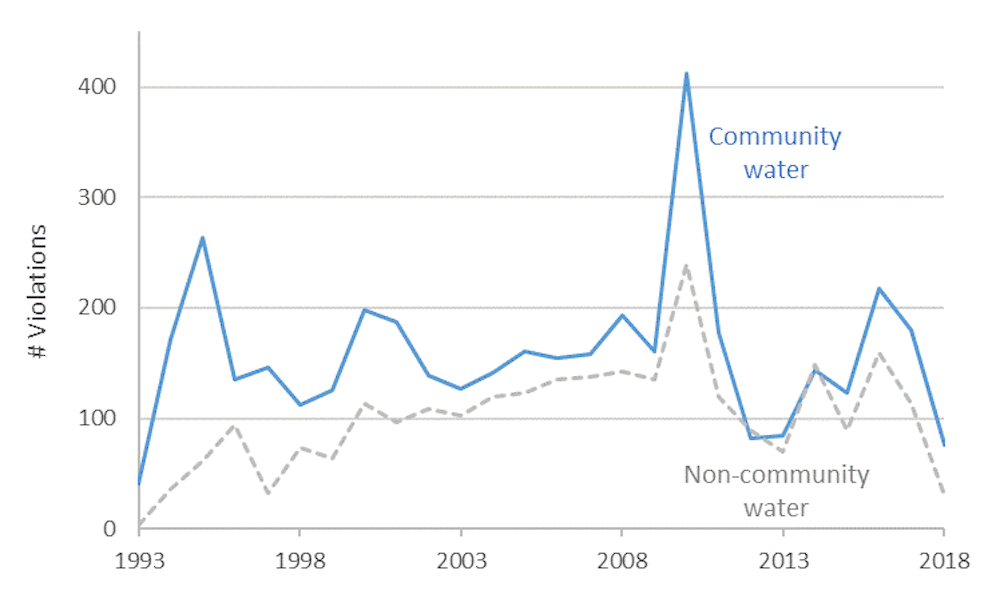
Since it began regulating lead in 1991, the Environmental Protection Agency has reported nearly 7,000 violations of the federal Lead and Copper Rule, which sets maximum levels of these metals in drinking water. Of these violations, 4,110 occurred in community water systems, which serve people year-round. Another 2,639 were recorded in noncommunity water systems that serve places like schools. The violations have fluctuated over two decades, showing no clear downward trend.
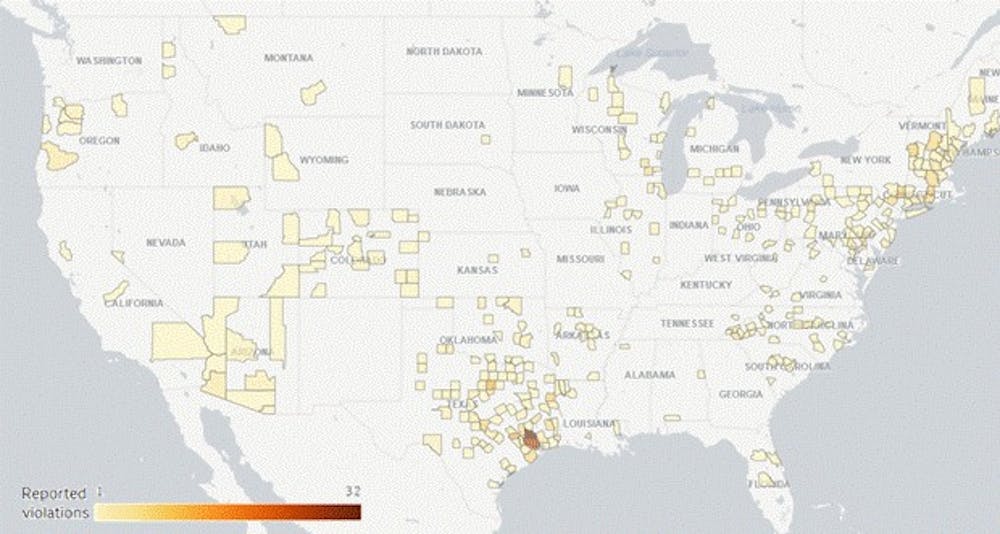
Between 2014 and 2018 the EPA reported 740 violations of the Lead and Copper Rule at community water systems. Montgomery and Harris counties in Texas had the highest number of violations. Several counties in the Northeast violated the rule multiple times, including Baltimore and Worcester, Massachusetts.
Although violations in cities are rare, six communities with populations of 100,000 people or more had water with too much lead and copper, including Portland, Oregon; Providence, Rhode Island; and systems in northern New Jersey, Mississippi and Wisconsin.
Very high lead levels tend to appear in very small communities. Three towns with fewer than 3,000 people – two in Michigan and one in Utah – experienced levels over 100 times the regulatory limit.
Lead accumulates as water travels through pipes
At treatment plants, lead levels often are acceptable – but then they rise as water flows through service lines. Acidic water can corrode lead pipes and carry lead that leaches from them to the tap. Utilities can’t fully control the problem because property owners usually own the pipes that connect homes to the water mains.
Until the 1950s, lead pipes to houses were common. By 1986 they were banned, but old lead pipes remain – and are corroding – across the country, especially in the Northeast, Midwest and older urban areas.
Nearly one-third of water systems in the U.S. report that at least some of their service lines contain lead. The exact number of lead service lines is estimated at 7 to 11 million - more than 50,000 miles of lead pipes. This would mean that service lines to the homes of about 15 to 22 million people, or 7% of those served by a community water system, could contain lead.
More than one in five utilities do not know whether lead service lines exist for the homes they serve. Addressing this problem will require the federal government to update regulations, while states improve monitoring and enforcement. The EPA does not require lead testing in schools, and sampling procedures at community water systems can be inconsistent.
Lead is one of the few water contaminants that utilities are required to measure at a customer’s home, and utilities do not always follow EPA sampling procedures in practice. A violation is incurred only if 10% or more of samples have concentrations above the action level for lead, which is 15 parts per billion. Some utilities take many more samples than required and discard those with high lead levels, a 2016 investigation found.
Another hurdle is reduced funding for enforcement activities. State funding declined by 26% from 2001 to 2011, while workloads have increased due to new rules.
Controlling corrosion and replacing pipes
Water system managers must inform the public when they find elevated lead levels. They may need to reduce pipe corrosion or replace service lines made of lead.
Water treatments to adjust pH and lessen corrosion can be effective in reducing exposure to lead. They are required in cities of more than 50,000 and in smaller systems with violations. Flint’s system lacked proper corrosion control, which would have cost only about US$100 per day.
Replacing lead pipes nationwide, which would permanently solve the corrosion problem, would cost $16 billion to $80 billion. Utilities that cannot reduce lead levels through corrosion control are legally required to replace pipes at a rate of 7% yearly. However, they only have to pay for replacing pipes they own. Many homeowners decline to pay for their portion, which can cost between $1,000 and $12,000.
Partial replacements can worsen conditions by disrupting pipelines and dislodging lead. Nonetheless, some cities have launched replacement programs. Others, including Detroit, Denver and Newark, have taken steps to identify and inventory lead pipes in their service areas.
Stricter rules
Revised federal and state guidelines could limit oversampling by utilities and improve water testing in people’s houses. New regulations could prohibit the practice of “pre-flushing,” or running water for several minutes before drawing a sample, which some engineers use to clear lead from pipes prior to testing. Another strategy would be for regional EPA offices to conduct random sampling of tap water quality.
The EPA currently is considering long-term revisions to the Lead and Copper Rule. In our view, an updated rule should require corrosion control, identification and replacement of lead lines, specific sampling procedures and better public education.
We believe that lead contamination can be eliminated through better enforcement, more funding for state agencies, stricter sampling and proactive efforts to control corrosion. These actions will pay off by improving children’s health nationwide.
[ You’re smart and curious about the world. So are The Conversation’s authors and editors. You can read us daily by subscribing to our newsletter. ]
Qi Bing, Ph.D. Student in Urban and Environmental Planning and Policy, University of California, Irvine and Maura C. Allaire, Assistant Professor of Water Economics and Policy, University of California, Irvine
This article is republished from The Conversation under a Creative Commons license. Read the original article.