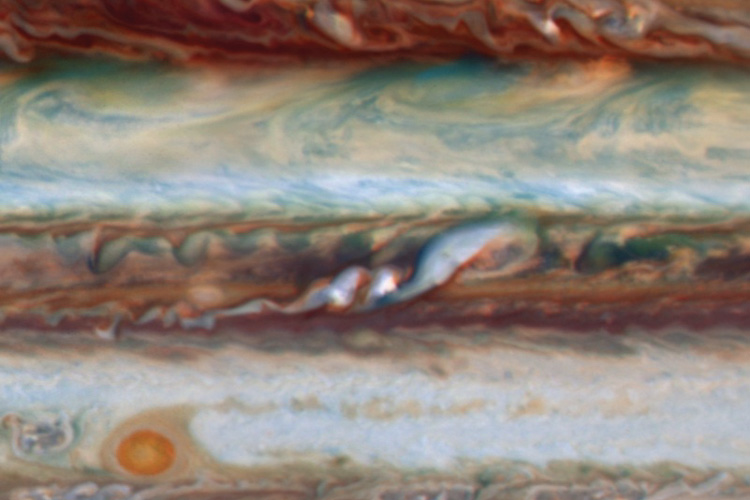
A closeup of the two bright white plumes (center) in the South Equatorial Belt of Jupiter and a large downstream disturbance to their right. Image by Imke de Pater, UC Berkeley; Robert Sault, University of Melbourne; Chris Moeckel, UC Berkeley; Michael Wong, UC Berkeley; Leigh Fletcher, University of Leicester. Storm clouds rooted deep in Jupiter’s atmosphere are affecting the planet’s white zones and colorful belts, creating disturbances in their flow and even changing their color.
Thanks to coordinated observations of the planet in January 2017 by six ground-based optical and radio telescopes and NASA’s Hubble Space Telescope, a University of California, Berkeley, astronomer and her colleagues have been able to track the effects of these storms — visible as bright plumes above the planet’s ammonia ice clouds — on the belts in which they appear.
The observations will ultimately help planetary scientists understand the complex atmospheric dynamics on Jupiter, which, with its Great Red Spot and colorful, layer cake-like bands, make it one of the most beautiful and changeable of the giant gas planets in the solar system.
One such plume was noticed by amateur astronomer Phil Miles in Australia a few days before the first observations by the Atacama Large Millimeter/Submillimeter Array (ALMA) in Chile, and photos captured a week later by Hubble showed that the plume had spawned a second plume and left a downstream disturbance in the band of clouds, the South Equatorial Belt. The rising plumes then interacted with Jupiter’s powerful winds, which stretched the clouds east and west from their point of origin.
Three months earlier, four bright spots were seen slightly north of the North Equatorial Belt. Though those plumes had disappeared by 2017, the belt had since widened northward, and its northern edge had changed color from white to orangish brown.
“If these plumes are vigorous and continue to have convective events, they may disturb one of these entire bands over time, though it may take a few months,” said study leader Imke de Pater, a UC Berkeley professor emerita of astronomy. “With these observations, we see one plume in progress and the aftereffects of the others.”
The analysis of the plumes supports the theory that they originate about 80 kilometers below the cloud tops at a place dominated by clouds of liquid water. A paper describing the results has been accepted for publication in the Astronomical Journal and is now online.
Into the stratosphere
Jupiter’s atmosphere is mostly hydrogen and helium, with trace amounts of methane, ammonia, hydrogen sulfide and water. The top-most cloud layer is made up of ammonia ice and comprises the brown belts and white zones we see with the naked eye. Below this outer cloud layer sits a layer of solid ammonium hydrosulfide particles. Deeper still, at around 80 kilometers below the upper cloud deck, is a layer of liquid water droplets.
The storm clouds de Pater and her team studied appear in the belts and zones as bright plumes and behave much like the cumulonimbus clouds that precede thunderstorms on Earth. Jupiter’s storm clouds, like those on Earth, are often accompanied by lightning.
Optical observations cannot see below the ammonia clouds, however, so de Pater and her team have been probing deeper with radio telescopes, including ALMA and also the Very Large Array (VLA) in New Mexico, which is operated by the National Science Foundation-funded National Radio Astronomy Observatory.
ALMA array’s first observations of Jupiter were between Jan. 3 and 5 of 2017, a few days after one of these bright plumes was seen by amateur astronomers in the planet’s South Equatorial Belt. A week later, Hubble, the VLA, the Gemini, Keck and Subaru observatories in Hawaii and the Very Large Telescope (VLT) in Chile captured images in the visible, radio and mid-infrared ranges.
De Pater combined the ALMA radio observations with the other data, focused specifically on the newly brewed storm as it punched through the upper deck clouds of ammonia ice.
The data showed that these storm clouds reached as high as the tropopause — the coldest part of the atmosphere — where they spread out much like the anvil-shaped cumulonimbus clouds that generate lightning and thunder on Earth.
“Our ALMA observations are the first to show that high concentrations of ammonia gas are brought up during an energetic eruption,” de Pater said.
The observations are consistent with one theory, called moist convection, about how these plumes form. According to this theory, convection brings a mix of ammonia and water vapor high enough — about 80 kilometers below the cloud tops — for the water to condense into liquid droplets. The condensing water releases heat that expands the cloud and buoys it quickly upward through other cloud layers, ultimately breaking through the ammonia ice clouds at the top of the atmosphere.
The plume’s momentum carries the supercooled ammonia cloud above the existing ammonia-ice clouds until the ammonia freezes, creating a bright, white plume that stands out against the colorful bands encircling Jupiter.
“We were really lucky with these data, because they were taken just a few days after amateur astronomers found a bright plume in the South Equatorial Belt,” said de Pater. “With ALMA, we observed the whole planet and saw that plume, and since ALMA probes below the cloud layers, we could actually see what was going on below the ammonia clouds.”
Hubble took images a week after ALMA and captured two separate bright spots, which suggests that the plumes originate from the same source and are carried eastward by the high altitude jet stream, leading to the large disturbances seen in the belt.
Coincidentally, three months before, bright plumes had been observed north of the Northern Equatorial Belt. The January 2017 observations showed that that belt had expanded in width, and the band where the plumes had first been seen turned from white to orange. De Pater suspects that the northward expansion of the North Equatorial Belt is a result of gas from the ammonia-depleted plumes falling back into the deeper atmosphere.
De Pater’s colleague and co-author Robert Sault of the University of Melbourne in Australia used special computer software to analyze the ALMA data to obtain radio maps of the surface that are comparable to visible-light photos taken by Hubble.
“Jupiter’s rotation once every 10 hours usually blurs radio maps, because these maps take many hours to observe,” Sault said. “In addition, because of Jupiter’s large size, we had to ‘scan’ the planet, so we could make a large mosaic in the end. We developed a technique to construct a full map of the planet.”
Among the co-authors of the paper with de Pater and Sault are graduate students Chris Moeckel and Charles Goullaud and research astronomers Michael Wong and David DeBoer, all of UC Berkeley, and Bryan Butler of the National Radio Astronomy Observatory. Each was involved in obtaining and analyzing the Hubble, Gemini, ALMA and VLA data.
The VLT data were contributed by Leigh Fletcher and Padraig Donnelly of the University of Leicester in the United Kingdom, while Glenn Orton and James Sinclair of the Jet Propulsion Laboratory in California and Yasuma Kasaba of Tokyo University in Japan supplied the SUBARU data. Gordon Bjoraker of the NASA Goddard Space Flight Center in Maryland and Máté Ádámkovics of Clemson University in South Carolina analyzed the Keck data.
The work was supported by a NASA Planetary Astronomy award (NNX14AJ43G) and a Solar System Observations award (80NSSC18K1001).
Robert Sanders writes for the UC Berkeley News Center.
This hand dyed felted wool pillow shown off by Lake County Quilt Guild member Marianne Mulheren of Ukiah, Calif., uses hand applique, embroidery and beading. Photo by Suzanne Lee. LAKEPORT, Calif. – The Ladies of the Lake Quilt Guild present the 18th annual Falling Leaves Quilt Show in Fritch Hall and Little Theatre at the Lake County Fairgrounds in Lakeport on Saturday, Oct. 5, and Sunday, Oct. 6.
The hours on Saturday are 10 a.m. to 5 p.m. and on Sunday 10 a.m. to 4 p.m.
The show includes a judged quilt display, VIP award-winning quilts, the Country Store boutique, a vendor mall, quilting demonstrations, a silent auction, themed gift baskets and an opportunity quilt.
Our vendors supply a unique mix of tools, tool holders, quilt hangers, adjustable tables, sewing machines, kits for piecing and applique, hand dyed and other lovely fabrics.
Door prizes to be announced throughout the show will include a range of gifts such as pot holders, fabric, a hand-made journal and the main prize: a sewing machine from Village Sewing.
Lisa McKissick, the featured artist, is an award winning quilter, carrying on a 125 year family tradition of quilting. McKissick learned the art of quilting from her mom and sister. She is an expert in machine piecing, machine appliqué, paper piecing and tools.
Lake County Quilt Guild member Christy Bengston of Ukiah, Calif., shows the “Big Pink” dahlia with detailed quilting on this whole cloth quilt. This quilt received Best of Category – Innovative and First Place ribbons in the 2018 quilt show in Lakeport, Calif. Photo by Suzanne Lee. McKissick will demonstrate using the Quick Curved Ruler during the day at her booth. She warmly welcomes questions about all of her techniques and tools she likes to use.
Discount pre-sale tickets are available at Lake County Chamber of Commerce, 875 Lakeport Blvd. in Lakeport; Clear Lake Chamber of Commerce, 14295 Lakeshore Dr. in Clearlake; and at Village Sewing, 1252 Airport Park Blvd. in Ukiah now through Oct. 2.
Pre-sale tickets are $8, $10 at the door. Children ages 5 to 12 are $2. Children under 5 are free.
Billy Flynn, played by Jeff Pearce, coaches Roxie, played by Laura Barnes, on how to flim flam a jury in the rehearsals for the Lake County Theatre Co.’s production of “Chicago.” Courtesy photo. LAKEPORT, Calif. – When Lake County Theatre Co. in partnership with Mendocino College decided to bring Broadway’s hit musical, “Chicago,” to town no one realized how much undiscovered talent was waiting in the wings.
The show’s producers said the newcomers coming to the stage in the fall production have an astonishing level of talent.
Filling the role of Billy Flynn, a wily defense attorney who only takes notorious cases involving attractive, female murderesses, is Lake County newcomer, Jeff Pearce.
Pearce moved here in 2015 with his family. His day job is in real estate and his night job is as a bartender at the Blue Wing Saloon, but he is a man who belongs on stage.
Pearce began performing at age 7 in a Eureka children’s play. Since then he has earned a Bachelor of Arts degree in Theater Arts at CSU Long Beach and starred in many shows.
“Chicago” is his first in Lake County. Pearce has a rich baritone singing voice that easily sways the 1920’s Chicago juries and will Razzle Dazzle the audience.
Choreographers, Larry and Zoe Richardson, and Sarah Dutra upped the ante on the dance floor for this spectacular jazz-infused production.
Although most of the show’s performers participate in some of the big dance numbers, the vaudeville dance acts are performed by a group of elite dancers.
Joining the Lake County Theatre Co. for the first time are Alisa Barnes, Leah Pabst and Leanna Schoeneman. They are supported by a very talented chorus of singers and dancers.
The musical “Chicago” is based on real events and people during the apex of the jazz age.
Authors Fred Ebb, Bob Fosse and John Kander used a play by the same name written by Maurine Watkins, and the trials of accused murderers Beulah Annan and Belva Gaertner, to create the longest running musical in Broadway history.
Billy Flynn defends Velma Kelly, a vaudeville star played by Laura Sammel, and Roxie Hart, a naïve dancer, played by Laura Barnes.
Barnes has entertained the community for years. Some of her favorite roles have been “Janet” in the Rocky Horror Show and most recently, “Petruchio” in the Taming of the Shrew. Barnes, a schoolteacher, also directs the drama program at Lucerne Elementary School.
“It’s been a pleasure and a privilege to ignite a passion for the performing arts in the hearts of kids,” she said.
Last year’s musical “Oklahoma!” sold out so get your tickets early. Chicago will be performed at the Soper Reese Theatre Oct. 25 to 27, Nov. 1 to 3, and Nov. 7 to 10.
CLEARLAKE, Calif. – After adopting out most of its available dogs at the Bay Area Pet Fair last weekend, Clearlake Animal Control has a small group of dogs that still need homes.
The kennels also have many dogs that need to be reunited with their owners. To find the lost/found pet section, click here.
The following dogs are ready for adoption. They include mixes of American Staffordshire Terrier, husky and shepherd.
“Balto.” Photo courtesy of Clearlake Animal Control. ‘Balto’
“Balto” is a male husky mix with a short black and brown coat.
He already has been neutered.
He is No. 2739.
“Bernard.” Photo courtesy of Clearlake Animal Control. ‘Bernard’
“Bernard” is a male Staffordshire Bull Terrier mix with a short brindle and white coat.
He already has been neutered.
He is No. 280.
“Chase.” Photo courtesy of Clearlake Animal Control. ‘Chase’
“Chase” is a male shepherd mix with a medium-length brindle coat.
He is dog No. 2618.
“Frank.” Photo courtesy of Clearlake Animal Control. ‘Frank’
“Frank” is a male American Staffordshire Terrier mix with a short black and white coat.
He is No. 2345.
Clearlake Animal Control’s shelter is located at 6820 Old Highway 53, off Airport Road.
Hours of operation area noon to 4 p.m. Tuesday through Saturday. The shelter is closed Sundays, Mondays and major holidays; the shelter offers appointments on the days it’s closed to accommodate people.
Call the Clearlake Animal Control shelter at 707-273-9440, or email This email address is being protected from spambots. You need JavaScript enabled to view it. to inquire about adoptions.
Visit Clearlake Animal Control on Facebook or at the city’s Web site.
Email Elizabeth Larson at This email address is being protected from spambots. You need JavaScript enabled to view it.. Follow her on Twitter, @ERLarson, or Lake County News, @LakeCoNews.
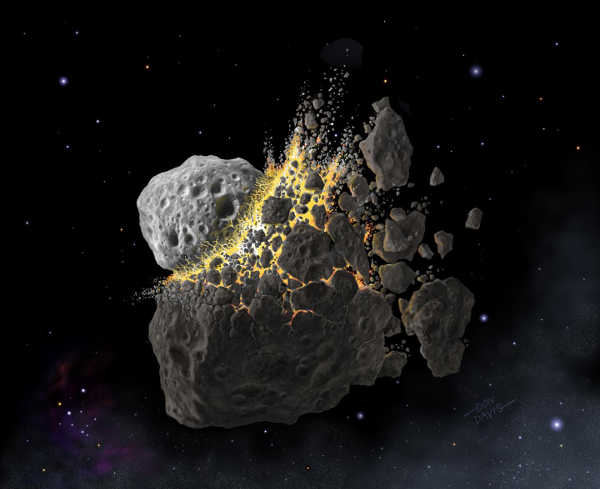
This is an illustration of the giant asteroid collision in outer space that produced the dust that led to an ice age on Earth. Image (c) Don Davis, Southwest Research Institute. About 466 million years ago, long before the age of the dinosaurs, the Earth froze.
The seas began to ice over at the Earth's poles, and the new range of temperatures around the planet set the stage for a boom of new species evolving.
The cause of this ice age was a mystery, until now: a new study in Science Advances argues that the ice age was caused by global cooling, triggered by extra dust in the atmosphere from a giant asteroid collision in outer space.
There's always a lot of dust from outer space floating down to Earth, little bits of asteroids and comets, but this dust is normally only a tiny fraction of the other dust in our atmosphere such as volcanic ash, dust from deserts and sea salt.
But when a 93-mile-wide asteroid between Mars and Jupiter broke apart 466 million years ago, it created way more dust than usual.
"Normally, Earth gains about 40,000 tons of extraterrestrial material every year," said Philipp Heck, a curator at the Field Museum, associate professor at the University of Chicago, and one of the paper's authors. "Imagine multiplying that by a factor of a thousand or ten thousand."
To contextualize that, in a typical year, one thousand semi trucks' worth of interplanetary dust fall to Earth. In the couple million years following the collision, it'd be more like ten million semis.
"Our hypothesis is that the large amounts of extraterrestrial dust over a timeframe of at least two million years played an important role in changing the climate on Earth, contributing to cooling," said Heck.
"Our results show for the first time that such dust, at times, has cooled Earth dramatically," said Birger Schmitz of Sweden's Lund University, the study's lead author and a research associate at the Field Museum. "Our studies can give a more detailed, empirical-based understanding of how this works, and this in turn can be used to evaluate if model simulations are realistic."
To figure it out, researchers looked for traces of space dust in 466-million-year-old rocks, and compared it to tiny micrometeorites from Antarctica as a reference.
"We studied extraterrestrial matter, meteorites and micrometeorites, in the sedimentary record of Earth, meaning rocks that were once sea floor," said Heck. "And then we extracted the extraterrestrial matter to discover what it was and where it came from."
Extracting the extraterrestrial matter – the tiny meteorites and bits of dust from outer space – involves taking the ancient rock and treating it with acid that eats away the stone and leaves the space stuff.
The team then analyzed the chemical makeup of the remaining dust. The team also analyzed rocks from the ancient seafloor and looked for elements that rarely appear in Earth rocks and for isotopes – different forms of atoms – that show hallmarks of coming from outer space.
For instance, helium atoms normally have two protons, two neutrons, and two electrons, but some that are shot out of the Sun and into space are missing a neutron. The presence of these special helium isotopes, along with rare metals often found in asteroids, proves that the dust originated from space.
Other scientists had already established that our planet was undergoing an ice age around this time. The amount of water in the Earth's oceans influences the way that rocks on the seabed form, and the rocks from this time period show signs of shallower oceans – a hint that some of the Earth's water was trapped in glaciers and sea ice.
Schmitz and his colleagues are the first to show that this ice age syncs up with the extra dust in the atmosphere. "The timing appears to be perfect," he said.
The extra dust in the atmosphere helps explain the ice age – by filtering out sunlight, the dust would have caused global cooling.
Since the dust floated down to Earth over at least two million years, the cooling was gradual enough for life to adapt and even benefit from the changes. An explosion of new species evolved as creatures adapted for survival in regions with different temperatures.
Heck notes that while this period of global cooling proved beneficial to life on Earth, fast-paced climate change can be catastrophic. "In the global cooling we studied, we're talking about timescales of millions of years. It's very different from the climate change caused by the meteorite 65 million years ago that killed the dinosaurs, and it's different from the global warming today – this global cooling was a gentle nudge. There was less stress."
It's tempting to think that today's global warming could be solved by replicating the dust shower that triggered global cooling 466 million years ago. But Heck said he would be cautious: "Geoengineering proposals should be evaluated very critically and very carefully, because if something goes wrong, things could become worse than before."
While Heck isn't convinced that we've found the solution to climate change, he said it's a good idea for us to be thinking along these lines.
"We're experiencing global warming, it's undeniable," said Heck. "And we need to think about how we can prevent catastrophic consequences, or minimize them. Any idea that's reasonable should be explored."
This study was contributed to by scientists from the Field Museum, the University of Chicago, Lund University (lead), the California Institute of Technology, Vriije Universiteit Brussel, Ohio State University, Université Libre de Bruxelles, Russian Academy of Sciences, Federal University Kazan, Royal Belgian Institute of Natural Sciences, Durham University, Chinese Academy of Sciences, Center for Excellence in Comparative Paleontology China, ETH Zürich, Naturmuseum St. Gallen Switzerland, and Woods Hole Oceanographic Institution.
LAKEPORT, Calif. – Help from the community has led to police arresting two teenage boys for vehicle theft, vandalism and tampering.
At noon on Friday the Lakeport Police Department put out a request for public assistance to help identify two male subjects who were involved in a series of vehicle tampering/vandalism/theft cases that occurred in a Lakeport neighborhood early Friday morning, as Lake County News has reported.
Throughout the day, several Lakeport Police officers continued to investigate these cases. Then, during the early afternoon hours, police said they received leads as to the identity of both subjects.
Officers followed up and confirmed the identities of the two subjects, who are 15-year-old males from Lakeport, police said in a followup report.
Police found the teens at different times during the afternoon and at different locations where they were arrested for various charges related to the cases, the department reported.
One of the boys was cited and released to a parent, police said, while the other was taken into custody and transferred to the Lake County Juvenile Probation Department for further adjudication.
“We sincerely thank the many members of the public who provided information which quickly led to all of these cases being solved,” the Lakeport Police Department said in its Friday afternoon followup report. “We would like to remind the public to continue to report all suspicious activity, persons and vehicles to us immediately. With your assistance we can work as a team to keep Lakeport safe and crime free.”
 How to resolve AdBlock issue?