 How to resolve AdBlock issue?
News
LAKE COUNTY, Calif. – Lake County Public Health is urging boaters and recreational users to be cautious after recent testing of samples of Clear Lake’s water has confirmed the detection of a harmful toxin in three locations.
The recommendation is based on the potential health risks from low levels of anatoxin which was detected in three out of five water testing samples obtained on Sept. 17.
The three locations where the anatoxins were found are Jago Bay/Jones Bay Anderson Road in Lower Lake, Redbud Park in the city of Clearlake and at the Sulphur Bank Mercury Mine, county officials reported.
Public Health reported that anatoxin hasn’t been seen in Clear Lake for several years.
Anatoxin is different from microcystin, the algae toxin that is typically found in the lake and for which warning signs have been posted in the past.
The levels that have been detected are lower than the level that would trigger a warning notice, but Gary Pace, MD, Lake County’s interim Public Health officer, encourages caution when in contact with the lake water in the affected areas.
Caution signs have been placed at Redbud Park, the public area where these low levels of the toxin were detected, and the private parties have been contacted. Further testing will be performed next week.
Water monitoring is done as a service to the community by Big Valley Band of Pomo Indians and Elem Indian Colony.
Anatoxins can pose health risks, particularly to children and pets. County officials urge people to choose safe activities when visiting the areas with signage and wherever blooms are visible.
It is strongly recommended that people and their pets avoid contact with water and avoid swallowing lake water in an algae bloom area
Recommendations from the Statewide Guidance on Cyanobacteria and Harmful Algal Blooms include the following:
• Take care that pets and livestock do not drink the water, swim through algae, scums or mats, or lick their fur after going in the water. Rinse pets in clean water to remove algae from fur.
• Avoid wading, swimming, jet or water skiing in water containing algae blooms, scums or mats.
• Do not drink, cook or wash dishes with untreated surface water from these areas under any circumstances; common water purification techniques such as camping filters, tablets and boiling do not remove toxins.
• People should not eat mussels or other bivalves collected from these areas. Limit or avoid eating fish from these areas; if fish are consumed, remove the guts and liver, and rinse filets in clean drinking water.
• Get medical treatment immediately if you think that you, your pet, or livestock might have been poisoned by cyanobacteria toxins. Be sure to alert the medical professional to the possible contact with cyanobacteria. Also, make sure to contact the local county public health department at 707-263-1090.
Possible health effects or symptoms of contact with anatoxin include tingling, burning, numbness, drowsiness, incoherent speech, salivation and respiratory paralysis leading to death.
Seek immediate medical assistance if you experience these symptoms after contact with water from the lake.
Contact Public Health for more information or to report an exposure at 707-263-1090
For current lab results, please visit the Big Valley Band of Pomo Indians cyanotoxin monitoring Web site.
The recommendation is based on the potential health risks from low levels of anatoxin which was detected in three out of five water testing samples obtained on Sept. 17.
The three locations where the anatoxins were found are Jago Bay/Jones Bay Anderson Road in Lower Lake, Redbud Park in the city of Clearlake and at the Sulphur Bank Mercury Mine, county officials reported.
Public Health reported that anatoxin hasn’t been seen in Clear Lake for several years.
Anatoxin is different from microcystin, the algae toxin that is typically found in the lake and for which warning signs have been posted in the past.
The levels that have been detected are lower than the level that would trigger a warning notice, but Gary Pace, MD, Lake County’s interim Public Health officer, encourages caution when in contact with the lake water in the affected areas.
Caution signs have been placed at Redbud Park, the public area where these low levels of the toxin were detected, and the private parties have been contacted. Further testing will be performed next week.
Water monitoring is done as a service to the community by Big Valley Band of Pomo Indians and Elem Indian Colony.
Anatoxins can pose health risks, particularly to children and pets. County officials urge people to choose safe activities when visiting the areas with signage and wherever blooms are visible.
It is strongly recommended that people and their pets avoid contact with water and avoid swallowing lake water in an algae bloom area
Recommendations from the Statewide Guidance on Cyanobacteria and Harmful Algal Blooms include the following:
• Take care that pets and livestock do not drink the water, swim through algae, scums or mats, or lick their fur after going in the water. Rinse pets in clean water to remove algae from fur.
• Avoid wading, swimming, jet or water skiing in water containing algae blooms, scums or mats.
• Do not drink, cook or wash dishes with untreated surface water from these areas under any circumstances; common water purification techniques such as camping filters, tablets and boiling do not remove toxins.
• People should not eat mussels or other bivalves collected from these areas. Limit or avoid eating fish from these areas; if fish are consumed, remove the guts and liver, and rinse filets in clean drinking water.
• Get medical treatment immediately if you think that you, your pet, or livestock might have been poisoned by cyanobacteria toxins. Be sure to alert the medical professional to the possible contact with cyanobacteria. Also, make sure to contact the local county public health department at 707-263-1090.
Possible health effects or symptoms of contact with anatoxin include tingling, burning, numbness, drowsiness, incoherent speech, salivation and respiratory paralysis leading to death.
Seek immediate medical assistance if you experience these symptoms after contact with water from the lake.
Contact Public Health for more information or to report an exposure at 707-263-1090
For current lab results, please visit the Big Valley Band of Pomo Indians cyanotoxin monitoring Web site.
LAKE COUNTY, Calif. – Fall arrived this week and is bringing with it cooler temperatures, wind and a chance of rain.
The National Weather Service said significant cooling is expected over the weekend and into next week because of a weather system coming from western Canada.
The forecast across the region suggests temperatures could drop as much as 15 to 30 degrees below normal over the coming week.
The are predictions of rain showers over the southern Cascades, northern Sierra and the foothills, as well as the possibility of early season high elevation snowfall will also be possible across the higher elevations of the northern Sierra Nevada and southern Cascade Range this weekend into Monday.
The National Weather Service has issued a winter weather advisory for the Northern Sierra on Saturday afternoon.
Temperatures across the region are forecast to warm slightly on Wednesday but will remain below normal as another weather system moves in from the Pacific and over the Pacific Northwest.
The Lake County forecast calls for breezy and cooler conditions on Saturday and the potential for rain on Sunday and Sunday night.
Northwest winds are forecast to range in speed up to 20 miles per hour, with gusts of as high as 25 miles per hour on Saturday, with southwest winds of about 17 miles per hour on Sunday.
Daytime temperatures are expected to range into the high 60s from Saturday through Monday, rising into the high 70s through Friday. Nighttime temperatures will range from the high 30s over the weekend to the low 50s late next week.
Email Elizabeth Larson atThis email address is being protected from spambots. You need JavaScript enabled to view it. . Follow her on Twitter, @ERLarson, or Lake County News, @LakeCoNews.
The National Weather Service said significant cooling is expected over the weekend and into next week because of a weather system coming from western Canada.
The forecast across the region suggests temperatures could drop as much as 15 to 30 degrees below normal over the coming week.
The are predictions of rain showers over the southern Cascades, northern Sierra and the foothills, as well as the possibility of early season high elevation snowfall will also be possible across the higher elevations of the northern Sierra Nevada and southern Cascade Range this weekend into Monday.
The National Weather Service has issued a winter weather advisory for the Northern Sierra on Saturday afternoon.
Temperatures across the region are forecast to warm slightly on Wednesday but will remain below normal as another weather system moves in from the Pacific and over the Pacific Northwest.
The Lake County forecast calls for breezy and cooler conditions on Saturday and the potential for rain on Sunday and Sunday night.
Northwest winds are forecast to range in speed up to 20 miles per hour, with gusts of as high as 25 miles per hour on Saturday, with southwest winds of about 17 miles per hour on Sunday.
Daytime temperatures are expected to range into the high 60s from Saturday through Monday, rising into the high 70s through Friday. Nighttime temperatures will range from the high 30s over the weekend to the low 50s late next week.
Email Elizabeth Larson at
Experts from academic, government and private organizations met at the California Earthquake Authority’s third annual research forum earlier this month to discuss how best to collect information about earthquakes and the damage they cause, so that findings can be used to improve building safety faster.
The forum, held in Sacramento on Sept. 17, featured round-table discussions about how data was collected following the 1994 Northridge earthquake and how methods then differed, both in timing and sophistication, from how the engineering and scientific communities are evaluating the July 2019 Ridgecrest earthquakes today.
“The Ridgecrest earthquakes provided some clear examples of how much has changed since Northridge, from the expanded earthquake expertise we have now to the technology available,” said CEA Chief Mitigation Officer Janiele Maffei.
The discussions comparing the Northridge and Ridgecrest quakes included participants representing the University of California, Berkeley; the U.S. Geological Survey; the California Geological Survey; the nonprofit Earthquake Engineering Research Institute; engineering and scientific consulting firm Exponent; and multidisciplinary consulting firm Wiss, Janney, Elstner Associates, Inc.
Panelists described that after the Northridge earthquake, they did not have laptops and smart phones. Many observations were hand-written, paper maps were taped to walls, and in some cases it took years to process and then use the information gathered.
Today, researchers have easy access to geographic information systems, or GIS, apps, Wi-Fi, digital cameras, drones, lidar, global positioning system instruments and even automated aftershock forecasts – and can go into the field much better informed and know much more very quickly.
“The recent Ridgecrest earthquake sequence produced more than 40 miles of surface fault rupture,” said Cynthia L. Pridmore, an engineering geologist with the California Geological Survey and chair of the California Earthquake Clearinghouse. “The rapid and detailed acquisition of fault data using GIS-based field mapping devices resulted in an unprecedented amount of scientific information collected by scientists and engineers. All data collected from this event, including airborne imagery, will lead to a better understanding of the impact a similar earthquake might have in densely populated regions of the state.”
“Our technical capacities today allow us to gather and process data on the level of damage caused by an earthquake and its impact on people, buildings and infrastructure,” said Mary Comerio, professor of the Graduate School, Department of Architecture, at UC Berkeley. “We can also model the effects of a range of earthquake impacts for different scenarios, in order to better plan for our response to future earthquakes. The modeling and mapping tools we now have allow us to improve our building codes and construction practices so that, over time, we can make our buildings, infrastructure and cities more resilient and shorten the recovery process.”
Panelists also described information they lacked in the past and described wish lists for types of data they would like to see gathered and made easily available to both researchers and the public.
A CEA presentation in the afternoon covered CEA’s vision for learning from future earthquakes and its plans to seek outside expertise for technical evaluations, in order to better understand how residential structures perform in California.
“On the hazards side of earthquake science, the body of information improves with every earthquake, everywhere in the world,” Maffei said. “But in terms of understanding California homes, it really takes a California earthquake.”
The 2011 Christchurch, New Zealand, earthquake provided some relevant information for California, Maffei said, as did the 2018 Anchorage, Alaska, earthquake.
Scientists also learned from some California earthquakes in recent decades, such as the 2003 San Simeon earthquake and the 2014 La Habra and American Canyon earthquakes.
“But a significant amount of our information still comes from the Northridge earthquake,” she said. “And we have an opportunity now, with the Ridgecrest earthquakes and future earthquakes, to update that.”
The afternoon session of the CEA research forum featured presentations from the Pacific Earthquake Engineering Research Center and California Geological Survey on studying and collecting data about ground motion for the Ridgecrest earthquakes, with round-table discussions among the approximately 50 attendees following the presentations.
More information about CEA research efforts, including past research forums, is available on CEA’s Web site, https://www.earthquakeauthority.com/.
Photos and comments from the 2019 research forum are also available, on CEA’s Twitter page and other social media accounts.
The forum, held in Sacramento on Sept. 17, featured round-table discussions about how data was collected following the 1994 Northridge earthquake and how methods then differed, both in timing and sophistication, from how the engineering and scientific communities are evaluating the July 2019 Ridgecrest earthquakes today.
“The Ridgecrest earthquakes provided some clear examples of how much has changed since Northridge, from the expanded earthquake expertise we have now to the technology available,” said CEA Chief Mitigation Officer Janiele Maffei.
The discussions comparing the Northridge and Ridgecrest quakes included participants representing the University of California, Berkeley; the U.S. Geological Survey; the California Geological Survey; the nonprofit Earthquake Engineering Research Institute; engineering and scientific consulting firm Exponent; and multidisciplinary consulting firm Wiss, Janney, Elstner Associates, Inc.
Panelists described that after the Northridge earthquake, they did not have laptops and smart phones. Many observations were hand-written, paper maps were taped to walls, and in some cases it took years to process and then use the information gathered.
Today, researchers have easy access to geographic information systems, or GIS, apps, Wi-Fi, digital cameras, drones, lidar, global positioning system instruments and even automated aftershock forecasts – and can go into the field much better informed and know much more very quickly.
“The recent Ridgecrest earthquake sequence produced more than 40 miles of surface fault rupture,” said Cynthia L. Pridmore, an engineering geologist with the California Geological Survey and chair of the California Earthquake Clearinghouse. “The rapid and detailed acquisition of fault data using GIS-based field mapping devices resulted in an unprecedented amount of scientific information collected by scientists and engineers. All data collected from this event, including airborne imagery, will lead to a better understanding of the impact a similar earthquake might have in densely populated regions of the state.”
“Our technical capacities today allow us to gather and process data on the level of damage caused by an earthquake and its impact on people, buildings and infrastructure,” said Mary Comerio, professor of the Graduate School, Department of Architecture, at UC Berkeley. “We can also model the effects of a range of earthquake impacts for different scenarios, in order to better plan for our response to future earthquakes. The modeling and mapping tools we now have allow us to improve our building codes and construction practices so that, over time, we can make our buildings, infrastructure and cities more resilient and shorten the recovery process.”
Panelists also described information they lacked in the past and described wish lists for types of data they would like to see gathered and made easily available to both researchers and the public.
A CEA presentation in the afternoon covered CEA’s vision for learning from future earthquakes and its plans to seek outside expertise for technical evaluations, in order to better understand how residential structures perform in California.
“On the hazards side of earthquake science, the body of information improves with every earthquake, everywhere in the world,” Maffei said. “But in terms of understanding California homes, it really takes a California earthquake.”
The 2011 Christchurch, New Zealand, earthquake provided some relevant information for California, Maffei said, as did the 2018 Anchorage, Alaska, earthquake.
Scientists also learned from some California earthquakes in recent decades, such as the 2003 San Simeon earthquake and the 2014 La Habra and American Canyon earthquakes.
“But a significant amount of our information still comes from the Northridge earthquake,” she said. “And we have an opportunity now, with the Ridgecrest earthquakes and future earthquakes, to update that.”
The afternoon session of the CEA research forum featured presentations from the Pacific Earthquake Engineering Research Center and California Geological Survey on studying and collecting data about ground motion for the Ridgecrest earthquakes, with round-table discussions among the approximately 50 attendees following the presentations.
More information about CEA research efforts, including past research forums, is available on CEA’s Web site, https://www.earthquakeauthority.com/.
Photos and comments from the 2019 research forum are also available, on CEA’s Twitter page and other social media accounts.

In the vast garden of the universe, the heaviest black holes grew from seeds. Nourished by the gas and dust they consumed, or by merging with other dense objects, these seeds grew in size and heft to form the centers of galaxies, such as our own Milky Way.
But unlike in the realm of plants, the seeds of giant black holes must have been black holes, too. And no one has ever found these seeds – yet.
One idea is that supermassive black holes – the equivalent of hundreds of thousands to billions of Suns in mass – grew from a population of smaller black holes that has never been seen.
This elusive group, the "intermediate-mass black holes," would weigh in somewhere between 100 and 100,000 Suns. Among the hundreds of black holes found so far, there have been plenty of relatively small ones, but none for sure in the intermediate mass-range "desert."
Scientists are working with powerful space telescopes from NASA, as well as other observatories, to track down far-flung objects that fit the description of these exotic entities. They have found dozens of possible candidates, and are working toward confirming them as black holes. But even if they do, that opens up a whole new mystery: How did intermediate-mass black holes form?
"What is fascinating, and why people have spent so much time trying to find these intermediate-mass black holes, is because they shed light on processes that happened in the early universe, what were the masses of relic black holes, and new formation mechanisms for black holes that we haven't thought of yet," said Fiona Harrison, professor of physics at Caltech in Pasadena, California, and principal investigator for NASA's NuSTAR mission.
Black Hole 101
A black hole is an extremely dense object in space from which no light can escape. When material falls into a black hole, it has no way out. And the more a black hole eats, the more it grows in both mass and size.
The smallest black holes are called "stellar mass," with between 1 and 100 times the mass of the Sun. They form when stars explode in violent processes called supernovae.
Supermassive black holes, on the other hand, are the central anchors of large galaxies – for example, our Sun and all other stars in the Milky Way orbit a black hole called Sagittarius A* that weighs about 4.1 million solar masses.
An even heavier black hole – at a whopping 6.5 billion solar masses – serves as the centerpiece for the galaxy Messier 87 (M87). M87's supermassive black hole appears in the famous image from the Event Horizon Telescope, showing a black hole and its "shadow" for the very first time. This shadow is caused by the event horizon, the black hole's point of no return, bending and capturing light with its strong gravity.
Supermassive black holes tend to have disks of material around them called "accretion disks," made of extremely hot, high-energy particles that shine bright as they get closer to the event horizon – the black hole's region of no return. Those that make their disks shine brightly because they eat a lot are called "active galactic nuclei."
The density of matter needed to create a black hole is mind-boggling. To make a black hole 50 times the mass of the Sun, you would have to pack the equivalent of 50 Suns into a ball less than 200 miles (300 kilometers) across.
But in the case of M87's centerpiece, it is as though 6.5 billion Suns were compressed into a ball wider than the orbit of Pluto. In both cases, the density is so high that the original material must collapse into a singularity – a rip in the fabric of space-time.
Key to the mystery of black holes' origins is the physical limit on how fast they can grow. Even the giant monsters at the centers of galaxies have limitations on their feeding frenzies, because a certain amount of material is pushed back by the high-energy radiation coming from hot particles accelerated near the event horizon. Just by eating surrounding material, a low-mass black hole might only be able to double its mass in 30 million years, for example.
"If you start from a mass of 50 solar masses, you simply cannot grow it to 1 billion solar masses over 1 billion years," said Igor Chilingarian, an astrophysicist at the Smithsonian Astrophysical Observatory, Cambridge, Massachusetts, and Moscow State University. But, "as we know, there are supermassive black holes that exist less than 1 billion years after the formation of the universe."
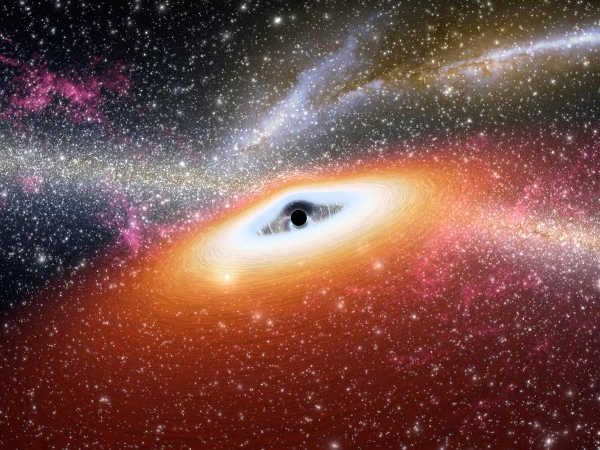
How to make a black hole you can't see
Early in the universe's history, the seed of an intermediate-mass black hole could have formed either from the collapse of a large, dense gas cloud or from a supernova explosion. The very first stars that exploded in our universe had pure hydrogen and helium in their outer layers with heavier elements concentrated in the core. This is a recipe for a much more massive black hole than exploding modern stars, which are "polluted" with heavy elements in their outer layers and therefore lose more mass through their stellar winds.
"If we're forming black holes with 100 solar masses early in the universe, some of them should merge together, but you basically then should produce a whole range of masses, and then some of them should still be around," said Tod Strohmayer, astrophysicist at NASA's Goddard Space Flight Center, Greenbelt, Maryland. "So then, where are they, if they did form?"
One clue that intermediate-mass black holes could still be out there came from the National Science Foundation’s Laser Interferometer Gravitational-Wave Observatory, LIGO, a collaboration between Caltech and the Massachusetts Institute of Technology.
LIGO detectors, combined with a European facility in Italy named Virgo, are turning up many different mergers of black holes through ripples in space-time called gravitational waves.
In 2016, LIGO announced one of the most important scientific discoveries of the last half-century: the first gravitational wave detection. Specifically, the detectors based in Livingston, Louisiana, and Hanford, Washington, picked up the signal of two black holes merging.
The masses of these black holes: 29 and 36 times the mass of the Sun, respectively, surprised scientists. While these are still not technically intermediate-mass, they are large enough to raise eyebrows.
It's possible that all of the intermediate-mass black holes have already merged, but also that technology hasn't been fine tuned to locate them.

So where are they?
Looking for black holes in the intermediate-mass desert is tricky because black holes themselves emit no light. However, scientists can look for specific telltale signs using sophisticated telescopes and other instruments.
For example, because the flow of matter onto a black hole is not constant, the clumpiness of consumed material causes certain variations in light output in the environment. Such changes can be seen more quickly in smaller black holes than larger ones.
"On a timescale of hours, you can do the observational campaign that for classical active galactic nuclei takes months," Chilingarian said.
The most promising intermediate-mass black hole candidate is called HLX-1, with a mass of about 20,000 times the Sun's. HLX-1 stands for "Hyper-Luminous X-ray source 1," and its energy output is a lot higher than Sun-like stars.
It was discovered in 2009 by Australian astronomer Sean Farrell, using the European Space Agency's XMM-Newton X-ray space telescope.
A 2012 study using NASA's Hubble and Swift space telescopes found suggestions of a cluster of young blue stars orbiting this object. It may have once been the center of a dwarf galaxy that was swallowed by the larger galaxy ESO 243-49. Many scientists consider HLX-1 a proven intermediate-mass black hole, Harrison said.
"The colors of X-ray light it emits, and just the way it behaves, is very similar to a black hole," Harrison said. "A lot of people, including my group, have programs to find things that look like HLX-1, but so far none are consistent. But the hunt goes on."
Less-bright objects that could be intermediate-mass black holes are called ultraluminous X-ray sources, or ULXs. A flickering ULX called NGC 5408 X-1 has been especially intriguing to scientists looking for intermediate-mass black holes.
But NASA's NuSTAR and Chandra X-ray observatories astonished scientists by revealing that many ULX objects are not black holes – instead, they are pulsars, extremely dense stellar remnants that appear to pulse like lighthouses.
M82 X-1, the brightest X-ray source in the galaxy M82, is another very bright object that seems to flicker on timescales consistent with an intermediate-mass black hole. These changes in brightness are related to the mass of the black hole, and are caused by orbiting material near the inner region of the accretion disk.
A 2014 study looked at specific variations in X-ray light and estimated that M82 X-1 has a mass of about 400 Suns. Scientists used archival data from NASA's Rossi X-ray Timing Explorer (RXTE) satellite to study these X-ray brightness variations.
Most recently, scientists investigated a bigger group of possible intermediate-mass black holes. In 2018, Chilingarian and colleagues described a sample of 10 candidates by re-analyzing optical data from the Sloan Digital Sky Survey and matching the initial prospects with X-ray data from Chandra and XMM-Newton. They are now following up with ground-based telescopes in Chile and Arizona.
Mar Mezcua of Spain's Institute for Space Sciences led a separate 2018 study, also using Chandra data, finding 40 growing black holes in dwarf galaxies that could be in that special intermediate mass range.
But Mezcua and collaborators argue these black holes formed originally in the collapse of giant clouds, rather than by originating in stellar explosions.
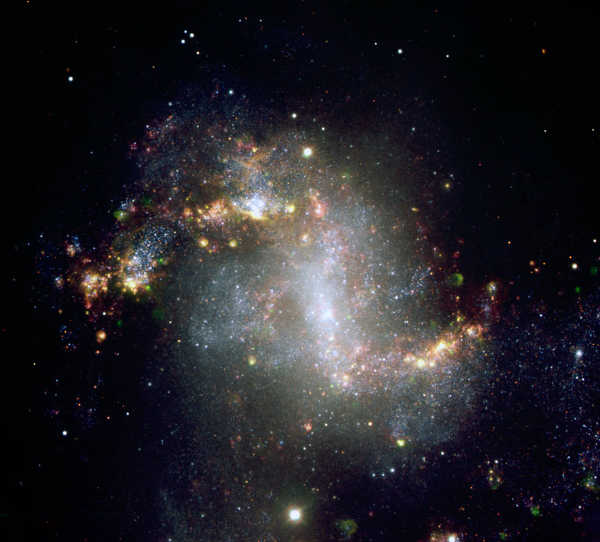
What's next
Dwarf galaxies are interesting places to continue looking because, in theory, smaller star systems could host black holes of much lower mass than those found in the centers of larger galaxies like our own.
Scientists are also searching globular clusters – spherical concentrations of stars located in the outskirts of the Milky Way and other galaxies – for the same reason.
"It could be there are black holes like that, in galaxies like that, but if they're not accreting a lot of matter, it might be hard to see them," Strohmayer said.
Intermediate-mass black hole hunters eagerly await the launch of NASA's James Webb Space Telescope, which will peer back to the dawn of the first galaxies.
Webb will help astronomers figure out which came first – the galaxy or its central black hole – and how that black hole might have been put together.
In combination with X-ray observations, Webb's infrared data will be important for identifying some of the most ancient black hole candidates.
Another new tool launched in July by the Russian space agency Roscosmos is called Spectrum X-Gamma, a spacecraft that will scan the sky in X-rays, and carries an instrument with mirrors developed and built with NASA Marshall Space Flight Center, Huntsville, Alabama.
Gravitational-wave information flowing from the LIGO-Virgo collaboration will also aid in the search, as will the European Space Agency's planned Laser Interferometer Space Antenna (LISA) mission.
This fleet of new instruments and technologies, in addition to current ones, will help astronomers as they continue to scour the cosmic garden for seeds of black holes, and galaxies like our own.
Elizabeth Landau works at NASA Headquarters in Washington, DC.
LAKEPORT, Calif. – The Board of Supervisors this week issued a proclamation designating Friday, Sept. 27, as Native American Day.
Lake County’s Board of Supervisors has the distinction of having two tribal leaders among its members – EJ Crandell of Robinson Rancheria, who represents District 3, and Moke Simon, who represents District 1 and is chair of the Middletown Rancheria.
District 2 Supervisor Bruno Sabatier presented the proclamation to Crandell, Simon and Sorhna Li Jordan, appearing on behalf of the Scotts Valley Band of Pomo Indians.
Lake County has been home to people for more than 12,000 years, “and the richly diverse cultures of the seven Tribal Nations indigenous to Lake County, Middletown Rancheria of Pomo Indians of California, Koi Nation of Northern California, Big Valley Band of Pomo Indians, Scotts Valley Band of Pomo Indians, Habematolel Pomo of Upper Lake, Robinson Rancheria of Pomo Indians of California and Elem Colony, have informed every aspect of our community’s history,” the proclamation explains.
“Native Americans have helped to make our community stronger and more prosperous,” and the proclamation also celebrates the richness of the county’s unique tribal history and traditions as well as the impact Native American cultures have had upon every American.
“Lake County is committed to protecting the Sovereign right of Native American Tribal organizations and institutions to strengthen our communities,” the proclamation continues, ending with encouraging “all citizens to join in recognizing the accomplishments and contributions Native Americans have made to our County,” and also saluting “those who have sought to honor the important role of Tribal leadership in our County’s past, present and future.”
Simon, Crandell and Jordan all expressed their thanks for the proclamation. “
A lot of new things are happening in Lake County with relationships with tribes, Crandell noted.
“It’s coming to a point of synergy,” he said.
Email Elizabeth Larson atThis email address is being protected from spambots. You need JavaScript enabled to view it. . Follow her on Twitter, @ERLarson, or Lake County News, @LakeCoNews.
Lake County’s Board of Supervisors has the distinction of having two tribal leaders among its members – EJ Crandell of Robinson Rancheria, who represents District 3, and Moke Simon, who represents District 1 and is chair of the Middletown Rancheria.
District 2 Supervisor Bruno Sabatier presented the proclamation to Crandell, Simon and Sorhna Li Jordan, appearing on behalf of the Scotts Valley Band of Pomo Indians.
Lake County has been home to people for more than 12,000 years, “and the richly diverse cultures of the seven Tribal Nations indigenous to Lake County, Middletown Rancheria of Pomo Indians of California, Koi Nation of Northern California, Big Valley Band of Pomo Indians, Scotts Valley Band of Pomo Indians, Habematolel Pomo of Upper Lake, Robinson Rancheria of Pomo Indians of California and Elem Colony, have informed every aspect of our community’s history,” the proclamation explains.
“Native Americans have helped to make our community stronger and more prosperous,” and the proclamation also celebrates the richness of the county’s unique tribal history and traditions as well as the impact Native American cultures have had upon every American.
“Lake County is committed to protecting the Sovereign right of Native American Tribal organizations and institutions to strengthen our communities,” the proclamation continues, ending with encouraging “all citizens to join in recognizing the accomplishments and contributions Native Americans have made to our County,” and also saluting “those who have sought to honor the important role of Tribal leadership in our County’s past, present and future.”
Simon, Crandell and Jordan all expressed their thanks for the proclamation. “
A lot of new things are happening in Lake County with relationships with tribes, Crandell noted.
“It’s coming to a point of synergy,” he said.
Email Elizabeth Larson at
CLEARLAKE, Calif. – After being on hold for 14 years, the city of Clearlake’s rental inspection ordinance could soon be enforced once more after a proposed recrafting by staff.
The Clearlake City Council on Thursday evening heard a presentation from staff about reimplenting the ordinance, placed in the city municipal code in 2001 in response to dilapidated rental units in the city but suspended in 2005 due to the city’s budget constraints.
Issues with city rental standards came into sharp focus in the spring, when a Clearlake man and his four dogs were found dead of suspected carbon monoxide poisoning in a substandard rental, a case which led to the issuance of notices of violation and citations to the owners of more than 20 properties, as Lake County News has reported.
The discussion begins in the video above at the 34:44 minute mark in the video above and the staff report begins on page 104 of the agenda packet below.
Police Chief Andrew White, whose department oversees the Clearlake Code Enforcement division, said staff wanted to discuss the proposal with the council and the public, and gauge interest.
He didn’t have information on how successful the program had been in the four years it was enforced in Clearlake, but White pointed to cities such as Sacramento and Greensboro, North Carolina, where such measures reduced code enforcement issues and improved rental quality.
White said the goal is to protect the city’s most vulnerable residents; the question, he said, is how to fund it.
He also showed the council pictures of serious code violations in city rentals, including spliced electrical codes and a bathtub that required pliers to use it.
White said he’s seen some egregious rental code enforcement cases and the situation is impacting people who don’t know what recourse they have or what their rights are.
He said the program will encourage landlords to improve the housing stock. “We can prevent cases, hopefully, from becoming red tags and so forth,” he said.
Council members during the discussion voiced their support, but were concerned about how to fund it and how to enforce it so that it doesn’t force people from their homes.
City Manager Alan Flora said staff is recommending the establishment of a fee program that covers the cost of the staff time to administer it.
“The scope and the scale of the problem here in the city is something that shouldn’t be underestimated,” Flora said. “We have a much higher renter population than a lot of communities. It’s almost 50 percent.”
Addressing all of that will be a challenge, said Flora, adding that 43 percent of homes in the city need substantial rehabilitation or already are dilapidated. “It’s a big thing to get our arms around.”
While the shape of the program is yet to be fully determined, White said some of the possibilities include random sampling inspections for multi-unit dwellings in order to lower the cost. There also can be incentive programs, including inspection exemptions for those who are complying, explaining that it wouldn’t be feasible to inspect every rental property in the city every year.
Councilman Russ Perdock said he’s seen a lot of serious issues and health hazards with rentals in the city. “It’s a long time overdue,” he said of the proposal, adding that he hopes it will be another tool to make Clearlake a better managed city.
Councilman Phil Harris asked how the city would identify rental homes. White said it’s a good question, and he didn’t yet have the full answer. He said the current ordinance requires a business license for those who rent homes, which he hadn’t seen before.
“I love this concept, by the way, it’s just the implementation that concerns me,” said Harris.
He also raised issue with the potential for displacement, with landlords raising rent to the extent that their current tenants are forced out. “There very well may be a counter effect,” Harris said, pointing out that the city already has a homeless population.
Regarding the problem of backlash, “I’ve been struggling with that issue, too,” said Councilman Dirk Slooten.
However, “We cannot do nothing,” Slooten said. “There are horrible living conditions for a lot of people in this town and we can’t just let that go.”
Slooten acknowledged it will cost more but he said they could possibly implement some programs to encourage the improvement of properties.
He said he had a rental home in Sacramento, where in the first year it cost $120 to participate, but two years later there was no cost. Slooten suggested such a sliding scale could work in Clearlake.
White said the city of Los Angeles has a rent escrow account program that’s tied into its rental inspection ordinance. It’s activated when a property owner fails to fix code violations within the allotted time. That program can place a lien on property, and it also helps reduce the monthly rent for tenants while repairs are under way, with the landlord assessed a monthly fee.
During the discussion, Flora told the council that the city could hire a firm to help identify rental properties. He said the current rental inspection ordinance needs some improvements, and that staff wants to propose revisions to it. When staff returns with a plan to fund the program, the council could consider at that time amending the existing ordinance.
Perdock said he thought the rent escrow account program that Los Angeles has could help protect people from being evicted, explaining he also doesn’t want people to become homeless. “We can’t turn a blind eye to this any longer.”
Clearlake resident Sheryl Almon said she appreciated the direction the council was moving in, noting that as a homeowner she has concerns about property values.
She said she’s in the process of upgrading a home and when she asked city staff if she needed a permit to rent it, she was told no. Almon also mentioned that the county’s Social Services Department has an extensive checklist for rentals for its clients, and that agency does annual inspections.
Robert Coker, a business owner and landlord, said he agreed with everything the council was talking about except for adding another fee onto landlords. “Our rents are low enough,” he said, adding they haven’t been raised in five years.
Mayor Russ Cremer asked White how many additional staffers would be needed to keep up with the rental program. White said he didn’t yet know, and that staff would return with an estimate. He said the new front office assistant job the council had approved for his department at the last meeting would help take on some of the load for processing properties.
Cremer said the council consensus was to move forward, and he directed staff to return with some specific recommendations at a later date.
Email Elizabeth Larson at
092619 Clearlake City Council meeting agenda packet by LakeCoNews on Scribd