 How to resolve AdBlock issue?
News
When people say that the sunsets in Hawaii are especially spectacular, it’s not just sentiment. There’s a scientific reason why the evening colors there are among the most vibrant in the world.
It just so happens that Hawaii has the perfect cocktail of conditions for such a display.
For one, volcanic dust in the atmosphere aids in the scattering of light. There are a number of currently active volcanoes in the area, including Kilauea on the big island of Hawaii, which has been erupting since 1983.
Thanks to their location, the Hawaiian Islands have balmy weather year-round. Because of the heat, a fair amount of water vapor escapes into the air and the resulting humidity aids in the intensifying and scattering of light.
And finally, the sun sinks into the Pacific Ocean far from any landmass that could disturb the atmosphere or break the horizon line. The angle of a sunset over water makes for a beautiful one.
I once had the blessing of visiting Hawaii to witness those sunsets for myself; it was almost two decades ago when my youngest son wanted to assist with a vacation Bible school in one of Oahu’s poorest districts.
I’ll never forget the people we encountered there; I hold memories of that trip very close to my heart.
One afternoon when school was over, we visited a small farm owned by a co-teacher. Humble though it was, or perhaps because of that, it was a precious experience to chat and laugh together while sitting under a lush canopy of fruit- and nut-bearing trees.
I saw a cashew tree for the first time that day and learned that the nut is actually a small appendage hanging from a larger red fruit known as a cashew apple.
Trees bearing guavas, passion fruit, mangoes and other tropical treasures shaded our sitting area, and we were able to taste the fruits in season straight from the trees.
My son wasn’t feeling well, and our host offered him a pickled sour plum to suck on to relieve his sore throat, a home remedy of sorts.
He didn’t tell us what an unpleasant experience it was for him to suck on that sour and salty fruit. I learned later that it took a lot of willpower to not spit it out.
Like many foods in Hawaii, those plums were incorporated into local cuisine from another country. They hail from Japan and are known as umeboshi there, often translated into English as “salted Japanese plums” or “preserved plums.”
Distinct styles of food influence the cuisine of the Hawaiian Islands, each stemming from a corresponding historical period of immigration and settlement.
It’s truly a cuisine made up of the fusion of many food cultures.
Much of that is due to the growth of sugarcane and pineapple plantations in the late 19th and early 20th centuries, which created a demand for immigrant labor.
Workers from China, Korea, Japan, the Philippines, Puerto Rico and Portugal came to work in the fields and brought their own foods and cooking traditions with them.
Earlier in Hawaii’s history, during the era of ‘First Contact’ in the late 18th century when European explorers came to the islands, European foods, livestock and traditions were introduced.
In addition, whalers and others brought their own brand of dining to the islands, such as the New England cuisine that came with some of the visiting Christian missionaries.
Portuguese immigrants introduced their tradition of making sweet bread (pao dulce in Portuguese) to the islands, and in the 1950s a local baker developed a Hawaiian version of this bread. It became very popular in the islands and eventually beyond, putting King’s Hawaiian Bakery on the map.
During World War II, Spam was introduced to the islands in the rations of American servicemen. This canned meat product became an important source of protein for local residents after fishing around the islands was banned due to the war.
Hawaiians are now the second largest consumers of Spam in the world (Guam is first), at times consuming upwards of five million cans annually.
It’s used in a variety of ways there, including a sushi-like preparation on rice wrapped with a strip of nori seaweed.
I once took a sushi class which included a teriyaki glazed version of the above. I was very skeptical about the use of Spam in sushi, but it ended up being a pretty decent bite.
Hawaii is known for its Kona coffee, the most expensive (and some would say most delicious) in the world. Grown on the slopes of active volcanoes Hualalai and Mauna Loa, it was brought to Hawaii in the early 1800s from Brazilian cuttings.
Only coffee from the two Kona districts on the Big Island of Hawaii can be marketed as such; however, Kona blends are sold at cheaper prices.
Favorable conditions exist in these areas for cultivating Kona coffee: sunny mornings, moist afternoons, little wind, mild nights and porous, mineral-rich volcanic soil.
I once indulged in a small five-dollar cup of pure Kona coffee at a Hawaiian-themed coffee shop. I found it worth the price; however, I don’t recommend Kona blends, which often contain only 10 percent Kona coffee.
Prior to the arrival of Polynesian seafarers more than 2,500 years ago, the Hawaiian Islands were uninhabited with very few food-bearing plants.
These first settlers brought seeds and plants with them in their outrigger canoes, perhaps more than 30 types, mainly for food.
Among these were sweet potatoes, yams, breadfruit, banana, coconut, sugarcane and taro.
The early Hawaiian diet was quite diverse. Experts believe that well over 100 types of seafood were consumed, and (amazingly!) more than 200 types of sweet potatoes.
Polynesians brought pigs, dogs and chickens across the Pacific, and meat was cooked in ovens dug into the ground, as it had been in Polynesia.
Sea salt was a common condiment, sometimes made into a relish with kukio nuts or seaweed.
Of particular importance was the taro plant, which was used to make poi, a mainstay of the Hawaiian diet for centuries.
Poi is a purple-colored paste made from pounding cooked taro root (it’s toxic when raw) and is still very much part of Hawaiian food culture today.
Tourists in the Aloha State are typically introduced to poi at a Hawaiian luau, a traditional party that includes a feast, often with a roasted pig.
Fighting is not allowed when eating from a bowl of poi, a tradition that comes from the belief that Taro is the first-born son of the parents who started the human race.
Japanese immigrants introduced their tradition of bento, meals in segmented boxes, which influenced what many consider the quintessential Hawaiian meal, the “plate lunch.”
This developed as an inexpensive and carbohydrate-dense meal for workers in sugarcane and pineapple fields.
A plate lunch consists of generous scoops of white rice and macaroni salad along with an entrée. The entrees are often of Asian origin, such as beef teriyaki or chicken katsu, but can also be traditional Hawaiian pork dishes.
While in Hawaii, a local took us to a small roadside stand in the country for a traditional plate lunch. The experience was entirely new to me, and what stands out the most in my memory is the tenderness and flavor of the pork cooked in a banana leaf.
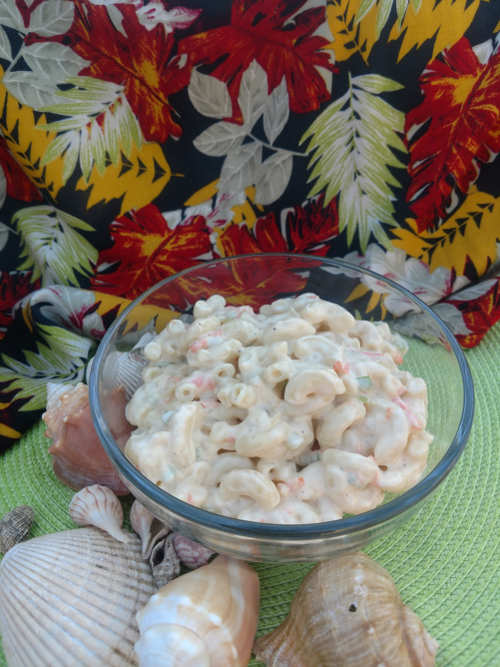
Today’s recipe is for authentic Hawaiian macaroni salad, known for its mild flavor and ultra-creamy texture. It’s a favorite side dish on the islands and an integral component of a Hawaiian plate lunch.
Composing a Hawaiian macaroni salad is different than making what we’re used to having on the mainland, so technique is key.
The traditional Hawaiian method is to overcook the pasta. It should be very soft and very plump.
Thinning the mayonnaise with milk to make a less dense dressing contributes to the signature creaminess of this dish. The pasta more easily absorbs the dressing, giving every bite a velvety texture.
Tossing the pasta with vinegar helps the soft pasta to stay moist and also assists in absorption of the sauce.
In addition, the dressing is added in a two-step process, the first when the pasta is still warm, another factor which enables the pasta to soak up the sauce.
As to the ingredients, since the dressing is mayonnaise-based, it’s very important to use a good quality mayonnaise. I don’t normally mention specific products or brands, but in this case I highly recommend Best Foods mayonnaise (marketed as Hellman’s on the East Coast).
I used buttermilk in my recipe because it gives the salad extra tang, but milk can be subbed for a more traditional version.
My oldest son, who stops occasionally for a Hawaiian plate lunch with his work crew, gave the recipe below his stamp of approval.
Mahalo and enjoy!
Hawaiian Macaroni Salad
Ingredients:
2 cups mayonnaise, divided
2 cups buttermilk, divided
1 tablespoon sugar
1 teaspoon salt, plus 1 tablespoon for cooking water
½ teaspoon black pepper
16 oz. elbow macaroni
¼ cup cider vinegar
¼ cup white or yellow onion, grated
½ carrot, peeled and shredded
½ cup celery, finely chopped
½ cup frozen peas
2 tablespoons scallions, finely chopped
Instructions:
Whisk together 1-1/2 cups buttermilk, 1 cup mayonnaise, sugar, a teaspoon of salt, and pepper. Set aside.
Bring 4 quarts of water to a rolling boil in a large pot. Add pasta and 1 tablespoon of salt to the water and cook the pasta for about 15 minutes, until it’s plump and very soft. Drain the pasta and pour it into a bowl. Pour vinegar over pasta and stir until it’s evenly distributed and absorbed. Allow pasta to cool for 10 minutes. Add the buttermilk-mayonnaise mixture and stir until evenly combined, then cool completely in the refrigerator.
Once cooled, add the grated onion, carrots, celery, peas and the remaining buttermilk and mayonnaise to the pasta and mix until evenly distributed. Cover and refrigerate for at least an hour and for up to 2 days. Adjust seasoning if necessary and sprinkle scallions over salad before serving.
Making in advance is a good idea, as salad is best when flavors have melded for at least two to four hours.
Esther Oertel is a writer and passionate home cook from a family of chefs. She grew up in a restaurant, where she began creating recipes from a young age. She’s taught culinary classes in a variety of venues in Lake County and previously wrote “The Veggie Girl” column for Lake County News. Most recently she’s taught culinary classes at Sur La Table in Santa Rosa, Calif. She lives in Middletown, Calif.
The organization has been building the program over the past year.
The United Nations defines human trafficking as "the recruitment, transportation, transfer, harboring, or receipt of persons by improper means (such as force, abduction, fraud, or coercion) for an improper purpose including forced labor or sexual exploitation."
It is a form of modern day slavery where people are forced in one way or another to perform acts against their will.
An estimated 27 million adults and 13 million children are trafficked worldwide profiting $32 billion a year.
Human trafficking has become the second largest criminal industry following the drug cartel. Nearly 80 percent of human trafficking is for sex and 20 percent is for labor exploitation.
California is one of the nation’s top four destination states for human trafficking. Three of the top 13 cities in the nation for human trafficking are located in California.
Eighty percent of the state’s human trafficking cases occur in the Bay Area, Los Angeles and San Diego, according to the California Department of Justice.
Lake County is only two hours north of San Francisco, is close to the Pacific Coast and only 60 miles from Interstate 5, one of the state’s most commonly traveled routes that is known for many truck stops and motels that are used for luring, recruiting and transporting trafficked victims.
“Our location has made Lake County a prime area for human trafficking activity,” the Lake Family Resource Center said in its new program announcement.
Over the past several years, Lake County has had high profile human trafficking cases that have resulted in criminal convictions.
They include a case that involved two men keeping a teenager at a marijuana grow and confining her in a metal box.
In another case, Lakeport resident Sam Massette was convicted in 2018 and sentenced to prison for selling teenage girls into prostitution in the Bay Area.
The Lake Family Resource Center’s new program will offer services including individual case management, safety planning, social and criminal justice advocacy, community crisis line response, restraining order assistance, support groups, psychotherapy, and emergency shelter and housing establishment assistance.
All services offered will be provided by trained human trafficking advocates and services are free and confidential.
The human trafficking team will offer community education and will be involved in outreach activities and awareness events through Lake County.
Additionally, the Lake Family Resource Center has been certified through the California Commission on Peace Officer Standards and Training, or POST.
The Lake Family Resource Center is working with local law enforcement officials to provide POST and Standards and Training for Corrections-certified training to build skills and capacity to adhere to best practices on human trafficking victim-centered investigations, prosecutions and victim service referral procedures.
The organization thanked all of the community partners for their support and offered a special thank you to the Lake County Rollerette, Community First Credit Union and Clearlake Rotary for much-appreciated donations which are being used to get the new program off to a good start.
The Lake Family Resource Center provides a multitude of services to build family stability and strength. The agency supports Lake County residents in achieving stable, self-sufficient, and healthy families and communities.
Call the center at 707-279-0563 to find out more about their services.
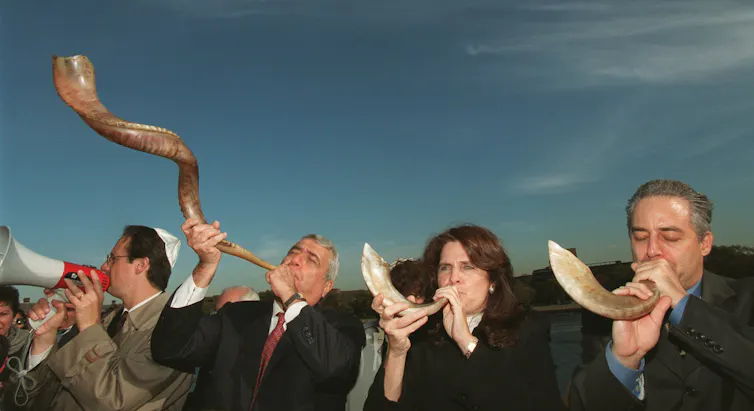
My most vivid adolescent memories of the Jewish High Holy Days are the painful rumbling of my empty stomach as I fasted on Yom Kippur, and the sharp blasts of the shofar – the ram’s horn – sounding from the synagogue pulpit.
I was one of millions of Jews the world over who observe “Yamim Nora’im.” That’s Hebrew for “Days of Awe” or “High Holy Days.”
This 10-day period begins with the two-day celebration of the Jewish New Year, Rosh Hashana. It ends with the one-day observance of Yom Kippur, when adult Jews in good health are expected to fast.
What is the significance of these holy days for orthodox Jews, secular Jews and perhaps even for non-Jews?
Traditional beliefs
Rosh Hashana and Yom Kippur are known, respectively, as “The Day of Judgment” and “The Day of Atonement.” In Orthodox Judaism, these combined Days of Awe embody both celebration and trepidation, renewal and repentance.
This is a time when Jews believe that all humankind is judged by God and inscribed either in “The Book of Life” or “The Book of Death.” Judaism doesn’t believe these are actual “books.” However, Jewish tradition tells us that God writes down the names of the righteous in The Book of Life, and the names of the wicked in the Book of Death.
The belief is that the righteous will live through the coming year; the wicked will not. All others – neither fully wicked nor fully righteous – will have their fate decided between Rosh Hashana and Yom Kippur.
The angst surrounding these holidays is captured in a liturgical poem called the “Unetanneh Tokef,” translated as “let us speak of the awesomeness.” This ancient prayer is chanted during both Rosh Hashana and Yom Kippur services, and states that,
“On Rosh Hashanah they are inscribed, and on the fast day of Yom Kippur they are sealed…who shall live and who shall die… who shall perish by water and who by fire; who by the sword, and who by a wild beast; who by hunger and who by thirst…”
Leonard Cohen, considered among the greatest of songwriters, was inspired by this poem and used similar words in his song, “Who By Fire.” He wrote,
And who by fire, who by water
Who in the sunshine, who in the night time
Who by high ordeal, who by common trial
Who in your merry merry month of May
Who by very slow decay
And who shall I say is calling?
Given the apprehension that accompanies these stark pronouncements, it is hardly surprising that during the Days of Awe, observant Jews often greet each other with a phrase of hope, “G’mar Chatimah Tovah” – roughly translated, “May you be inscribed in the Book of Life.”
As a psychiatrist reflecting on the High Holy Days, I have often wondered how many traditionally raised Jewish children have been frightened by the prospect of winding up in the Book of Death. I know I was.
As someone who has written extensively on Jewish ethics, I know that the High Holy Days also embody an “ethical core” that transcends religious doctrines and embodies universal ethical truths.
The varieties of Jewish beliefs
Judaism encompasses a wide range of beliefs. Orthodox Judaism is based on the premise that the Torah – essentially, the first five books of the Hebrew Bible –represents God’s eternal and unchangeable rules for Jewish living and religious observance.
But non-Orthodox branches of Judaism emphasize Jewish ethical and cultural traditions more than strict adherence to Jewish law and scripture. They seek to adapt Jewish traditions to modern needs.
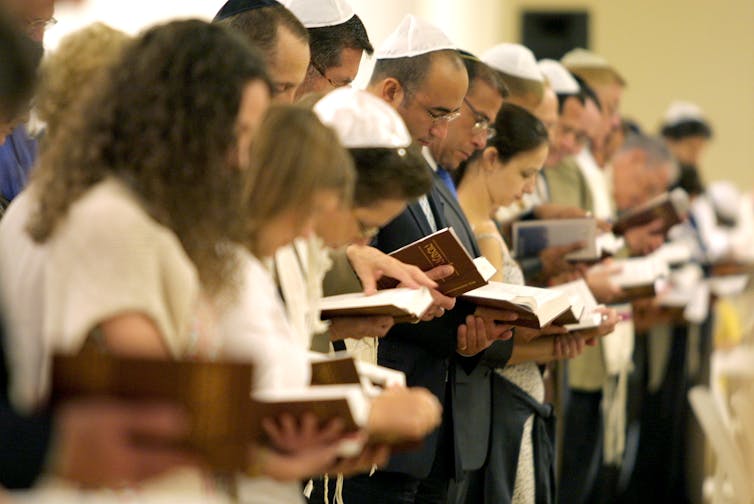
Judaism in all its varieties is, at heart, a religion of hope and optimism. For example, the somber warnings of the liturgical poem “Unetanneh Tokef” are softened by its reminder that one can avert being inscribed in the “Book of Death” by means of repentance, prayer and charity. That is done in the interval between Rosh Hashana and Yom Kippur.
Repentance, or teshuvah in Hebrew, requires taking a kind of “spiritual inventory” aimed at improving the health of our souls. True repentance during the High Holy Days also requires making amends to those we have sinned against or mistreated. Merely asking God to forgive such sins is not enough.
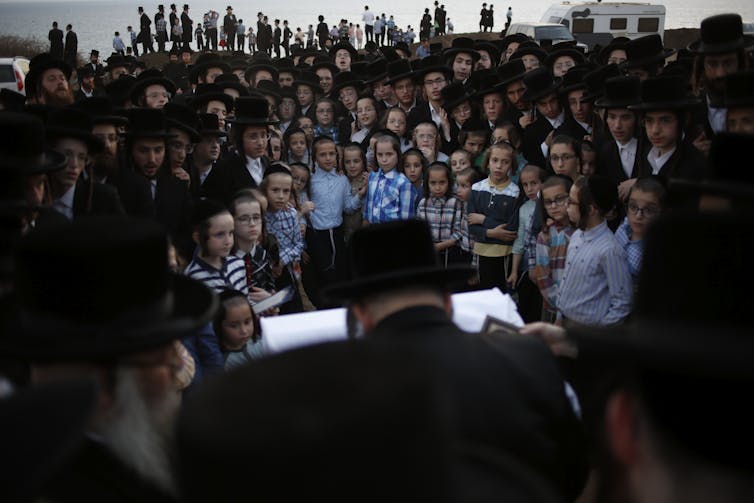
The ethical core of the High Holy Days
Secular and Humanistic Judaism are branches of non-Orthodox Judaism and are often considered together under the rubric, “Secular Humanistic Judaism.” This tradition does not invoke or accept the concept of an eternal, transcendent God. During the High Holy Days, emphasis is placed on how all people – Jews and non-Jews – can become better human beings.
In this secular humanist tradition, Rosh Hashana is seen as a time for self-evaluation and self-improvement, without reference to God. Instead, emphasis is placed on the cultural, historical and ethical aspects of Judaism.
A common ceremony in the secular humanist tradition is “Tashlikh,” which involves symbolically casting off one’s sins by throwing bread crumbs into the water.
Tashlikh allows Humanistic Jews “…to reflect on their behavior; to cast off behaviors they are not proud of; and to vow to be better people in the year to come.”
Finally, although Rosh Hashana and Yom Kippur are quintessentially Jewish holidays, their ethical values transcend any one religion.
[ Like what you’ve read? Want more? Sign up for The Conversation’s daily newsletter. ]
Ronald W. Pies, Emeritus Professor of Psychiatry, Lecturer on Bioethics & Humanities at SUNY Upstate Medical University; and Clinical Professor of Psychiatry, Tufts University School of Medicine [through Dec. 2019], Tufts University
This article is republished from The Conversation under a Creative Commons license. Read the original article.
Dogs available for adoption this week include mixes of Alaskan Malamute, American Staffordshire Terrier, Cane Corso mastiff, Chihuahua, Labrador Retriever, pit bull, pug, shepherd and terrier.
Dogs that are adopted from Lake County Animal Care and Control are either neutered or spayed, microchipped and, if old enough, given a rabies shot and county license before being released to their new owner. License fees do not apply to residents of the cities of Lakeport or Clearlake.
If you're looking for a new companion, visit the shelter. There are many great pets hoping you'll choose them.
The following dogs at the Lake County Animal Care and Control shelter have been cleared for adoption (additional dogs on the animal control Web site not listed are still “on hold”).

“Lucy” is a female Labrador Retriever with a short black and tan coat.
She is in kennel No. 14b, ID No. 12951.
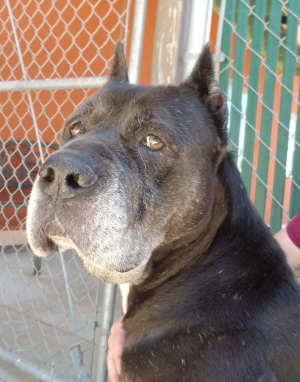
‘Nova’
“Nova” is a female Cane Corso mastiff with a short black coat.
She is in kennel No. 17, ID No. 6579.

‘Corn’
“Corn” is a male American Staffordshire Terrier with a short red coat.
He’s in kennel No. 18, ID No. 12967.

‘Boo’
“Boo” is a senior female terrier-pit bull mix with a short white and gray coat.
She has already been spayed.
She’s in kennel No. 19, ID No. 12902.

‘Ace’
“Ace” is a male Rottweiler-shepherd mix with a medium-length black and brown coat.
He already has been neutered.
He’s in kennel No. 20, ID No. 12899.
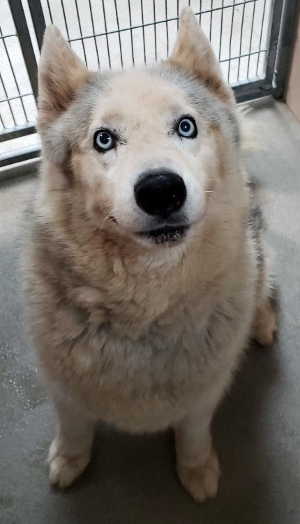
‘Kiko’
“Kiko” is a senior male Alaskan Malamute with a long white and gray coat and blue eyes.
He already has been neutered.
He’s in kennel No. 21, ID No. 12966.

‘Lola’
“Lola” is a female pug with a short tan coat.
She already has been spayed.
She’s in kennel No. 22, ID No. 12974.

Male Labrador Retriever
This male Labrador Retriever has a short black and white coat.
He is in kennel No. 25, ID No. 12850.

“Benny” is a young male shepherd with a short brindle coat.
He has been neutered.
He is in kennel No. 27, ID No. 12717.

‘Coco’
“Coco” is a female Labrador Retriever with a short black and white coat.
Coco is in kennel No. 34, ID No. 12764.
Lake County Animal Care and Control is located at 4949 Helbush in Lakeport, next to the Hill Road Correctional Facility.
Office hours are Monday through Friday, 11 a.m. to 5 p.m., and 11 a.m. to 3 p.m., Saturday. The shelter is open from 11 a.m. to 4 p.m., Monday through Friday and on Saturday from 11 a.m. to 3 p.m.
Visit the shelter online at http://www.co.lake.ca.us/Government/Directory/Animal_Care_And_Control.htm.
For more information call Lake County Animal Care and Control at 707-263-0278.
Email Elizabeth Larson at
The extent of Arctic sea ice at the end of this summer was effectively tied with 2007 and 2016 for second lowest since modern record keeping began in the late 1970s.
An analysis of satellite data by NASA and the National Snow and Ice Data Center, or NSIDC, at the University of Colorado Boulder shows that the 2019 minimum extent, which was likely reached on Sept. 18, measured 1.60 million square miles (4.15 million square kilometers).
The Arctic sea ice cap is an expanse of frozen seawater floating on top of the Arctic Ocean and neighboring seas.
Every year, it expands and thickens during the fall and winter and grows smaller and thinner during the spring and summer.
But in the past decades, increasing temperatures have caused marked decreases in the Arctic sea ice extents in all seasons, with particularly rapid reductions in the minimum end-of-summer ice extent.
Changes in Arctic sea ice cover have wide-ranging impacts. The sea ice affects local ecosystems, regional and global weather patterns, and the circulation of the oceans.
“This year’s minimum sea ice extent shows that there is no sign that the sea ice cover is rebounding,” said Claire Parkinson, a climate change senior scientist at NASA’s Goddard Space Flight Center in Greenbelt, Maryland. “The long-term trend for Arctic sea ice extent has been definitively downward. But in recent years, the extent is low enough that weather conditions can either make that particular year’s extent into a new record low or keep it within the group of the lowest.”
The melt season started with a very low sea ice extent, followed by a very rapid ice loss in July that slowed down considerably after mid-August. Microwave instruments onboard United States Department of Defense’s meteorological satellites monitored the changes from space.
“This was an interesting melt season,” said Walt Meier, a sea ice researcher at NSIDC. “At the beginning of August we were at record low ice levels for that time of the year, so a new minimum record low could have been in the offering.
”But unlike 2012, the year with the lowest ice extent on record, which experienced a powerful August cyclone that smashed the ice cover and accelerated its decline, the 2019 melt season didn’t see any extreme weather events. Although it was a warm summer in the Arctic, with average temperatures 7 to 9 degrees Fahrenheit (4 to 5 degrees Celsius) above what is normal for the central Arctic, events such as this year’s severe Arctic wildfire season or European heat wave ended up not having much impact on the sea ice melt.
“By the time the Siberian fires kicked into high gear in late July, the Sun was already getting low in the Arctic, so the effect of the soot from the fires darkening the sea ice surface wasn’t that large,” Meier said. “As for the European heat wave, it definitely affected land ice loss in Greenland and also caused a spike in melt along Greenland’s east coast, but that’s an area where sea ice is being transported down the coast and melting fairly quickly anyway.”
Maria-José Viñas is a member of NASA’s Earth Science News Team.

CLEARLAKE OAKS, Calif. – Authorities this week took a Clearlake Oaks man with a history of arson into custody for setting a fire near a senior apartment complex on Monday, and since his arrest he’s admitted to setting other fires over the summer.
Matthew Samuel Miravalle, 35, was arrested on Thursday, according to a report from Lt. Corey Paulich of the Lake County Sheriff’s Office.
Paulich said Northshore Fire units responded to a fire in the area of Highway 20 and Lake Street in Clearlake Oaks at approximately 5:40 p.m. Monday.
The fire burned a small area of grass and caused damage to a wood fence next to the Eskaton Clearlake Oaks Manor Senior Apartments, according to Paulich.
Cal Fire investigators also responded to the scene, determining the fire to be case of arson, Paulich said.
Paulich said the fire investigators identified Miravalle as the suspect. He had been seen in the area of the fire just prior to it starting and also is an arson registrant.
Lake County Sheriff’s Major Crimes detectives worked cooperatively with Cal Fire investigators and Paulich said their work led to Miravalle’s Thursday afternoon arrest.
During an interview with investigators, Miravalle admitted to starting the fire on Monday. Paulich said he also admitted to being responsible for starting two other fires in Clearlake Oaks in June.
Paulich said those earlier fires were located in the area of Oak Grove Avenue and Highway 20 on June 23 and behind the Dollar General store in Clearlake Oaks on June 27.
Miravalle was booked into custody on charges of aggravated arson with a prior, arson, unlawfully causing a fire and a probation violation, Paulich said. Miravelle remains in custody on a no-bail hold due to the probation violation.
Jail records show that Miravalle is scheduled to be in Lake County Superior Court on Monday.
Miravalle’s arrest is the latest in a series of arson arrests authorities have made over the summer.
They include the July 27 arrest of Adam Joseph Miller, 28, of Clearlake, who authorities believe set a fire that same day that burned in the field behind Cache Creek Apartments, and near the Tractor Supply and Big 5 Sporting Goods stores in Clearlake.
Miller remains in custody at the Lake County Jail with bail set at $50,000. He’s set to return to Lake County Superior Court on Nov. 5, based on his booking records.
On July 28, a Cal Fire law enforcement officer arrested Kristina Loraine Doll, 25, of Clearlake, who is charged with setting a fire earlier that day at Highway 20 and Rancho Vista Road in Lucerne.
Passersby and firefighters quickly knocked down the 10-foot by 10-foot roadside spot before it could do any serious damage.
Like Miller, Doll has remained in custody since her arrest. She’s being held in the Lake County Jail, with bail set at $50,000. She’s due to be back in court on Oct. 16, according to jail records.
In another fire-related case, Jody Buck Hickey, 40, of Kelseyville was arrested for causing the Oak fire due to equipment use on Sept. 7 near Kelseyville.
The Oak fire burned 53 acres and one outbuilding, threatened many other structures and led to the evacuation of 300 people.
Authorities said Hickey was welding and grinding in dry grass, which sparked the fire.
Hickey was arrested for the penal code section that covers “reckless burning,” not arson. Penal Code 452(c) states that a person is guilty of unlawfully causing a fire when he recklessly sets fire to or burns or causes to be burned any structure, forest land or property.
Chief Deputy District Attorney Rich Hinchcliff said Hickey had been set for a preliminary hearing on Wednesday morning but his attorney had asked for more time to prepare.
The preliminary hearing for Hickey, who since his arrested posted bail and was released, has been rescheduled for Oct. 28, Hinchcliff said.
Email Elizabeth Larson at