 How to resolve AdBlock issue?
News

The Jason-2/Ocean Surface Topography Mission (OSTM), the third in a U.S.-European series of satellite missions designed to measure sea surface height, successfully ended its science mission on Oct. 1. NASA and its mission partners made the decision to end the mission after detecting deterioration in the spacecraft's power system.
Jason-2/OSTM, a joint NASA mission with the French space agency Centre National d'Etudes Spatiales (CNES), the National Oceanic and Atmospheric Administration (NOAA), and the European Organisation for the Exploitation of Meteorological Satellites (EUMETSAT), launched in June 2008.
The mission extended the long-term record of sea surface height measurements started by the NASA-CNES TOPEX/Poseidon and Jason-1 missions. Jason-2/OSTM’s 11-year lifetime well exceeded its three-year design life. These measurements are being continued by its successor, Jason-3, launched in 2016.
"Today we celebrate the end of this resoundingly successful international mission," said Thomas Zurbuchen, associate administrator of the Science Mission Directorate at NASA Headquarters in Washington. “Jason-2/OSTM has provided unique insight into ocean currents and sea level rise with tangible benefits to marine forecasting, meteorology and our understanding of climate change.”
Since its launch, Jason-2/OSTM charted nearly 2 inches (5 centimeters) of global sea level rise, a critical measure of climate change. The mission has also resulted in the distribution of over a million data products and the publication of more than 2,100 science papers.
"Jason-2/OSTM was a high point of operational satellite oceanography as the first Jason mission to formally include EUMETSAT and NOAA as partners," said Steve Volz, assistant administrator of NOAA’s Satellite and Information Service. “During its 11-year run, Jason-2/OSTM helped improve NOAA’s hurricane intensity forecasts and provided important observations of marine winds and waves and in doing so has anchored these essential ocean altimetry observations in NOAA’s operational observing system requirements.”
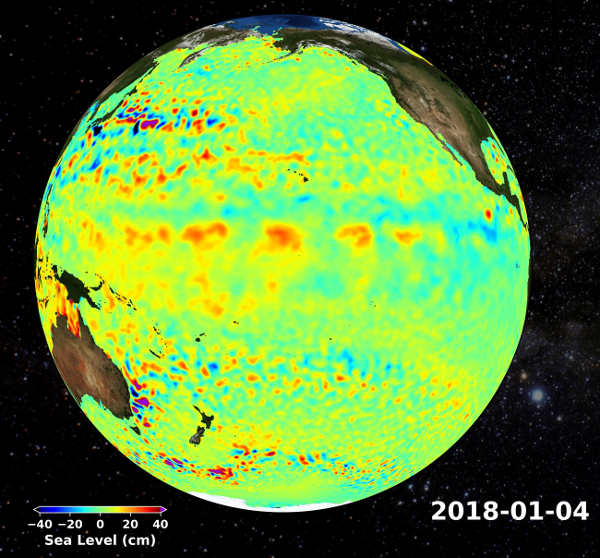
With the recent degradation of the spacecraft's power system, mission partners decided to end the mission to decrease risks to other satellites and future altimetry missions, and to comply with French space law. Final decommissioning operations for Jason-2/OSTM are scheduled to be completed by CNES on Oct. 10.
"With the involvement of EUMETSAT and NOAA, Jason-2 brought high precision monitoring of ocean surface topography and mean sea level to operational status," said Alain Ratier, EUMETSAT's director general. "Its 11-year lifetime in orbit was rewarding for the four program partners and the ocean and climate user community."
Jason-2/OSTM’s mission might have ended earlier if not for the ingenuity of its mission teams. In July 2017, the degradation of critical onboard components and control systems required that Jason-2/OSTM move from its original science orbit, deplete excess propellant reserves, and be maneuvered into a slightly lower orbit away from functioning satellites.
In close collaboration with the Ocean Surface Topography Science Team, mission partners identified an orbit that would allow for the continuation of the Jason-2/OSTM measurements, while still being compatible with orbital debris mitigation constraints and of scientific benefit.
This new orbit resulted in less frequent observations of the same location on Earth but overall resolution of the data improved because the ground tracks of the observations were closer together. This improved resolution is extremely useful for marine gravity studies and the mapping of seafloor topography. It also allowed for valuable operational oceanographic and science observations.
"Not only did Jason-2 extend the precise climate record established by TOPEX/Poseidon and continued by Jason-1, it also made invaluable observations for small to medium-scale ocean studies in its second, interleaved orbit," said CNES President Jean-Yves Le Gall. "Even when moved to the 'graveyard' orbit, Jason-2 continued to make unprecedented new observations of the Earth's gravity field, with precise measurements right until the end."
The technological advancements proven on Jason-1, Jason-2/OSTM, and Jason-3 will be put to use well into future decades. Following Jason-3 will be two future Sentinel-6/Jason-CS satellites, planned for launch in 2020 and 2025.
For more information about NASA’s Earth science activities, visit https://www.nasa.gov/earth .

LAKE COUNTY, Calif. – The National Weather Service has issued a red flag warning for parts of the North Coast and the Sacramento Valley that has prompted Pacific Gas and Electric to report that there is an elevated risk of public safety power shutoffs for Lake County over the weekend and again late next week.
The red flag warning goes into effect at 1 p.m. Saturday and will continue until 5 p.m. Sunday.
The National Weather Service said a red flag warning means that critical fire weather conditions are either occurring now or will shortly.
Forecasters said building high pressure will result in breezy northerly winds with warming temperatures and lowering humidity through the weekend.
It’s that combination of breezy winds and low humidity that the National Weather Service will bring critical fire weather conditions over the western side of the Sacramento Valley into the northern Coastal Range and adjacent foothills.
Winds are forecast to decrease by early Sunday evening, based on the forecast.
The red flag warnings says there will be north to northeast winds of between 10 to 20 miles per hour with gusts of between 25 and 35 miles per hour in the warning area.
In response, on Friday PG&E reported that its emergency operations center is now activated for a potential public safety power shutoff due to the offshore wind event that’s heading toward Northern California.
PG&E reported that Lake County has an “elevated” risk of a power shutoff on Sunday, but as of Friday evening no shutoff had been announced.
Additionally, PG&E said that based on the forecast Lake County also has an elevated risk of a public safety power shutoff on Thursday.
PG&E said the weather models are indicating the warmer autumn weather will continue into Monday, to be followed by a slight cooldown through midweek as a weak weather system will pass to the north.
On Wednesday, high pressure is forecast to build and bring with it the potential for gusty offshore winds at times through the end of next week, when the second power shutoff for Lake County is possible.
Email Elizabeth Larson atThis email address is being protected from spambots. You need JavaScript enabled to view it. . Follow her on Twitter, @ERLarson, or Lake County News, @LakeCoNews.
The red flag warning goes into effect at 1 p.m. Saturday and will continue until 5 p.m. Sunday.
The National Weather Service said a red flag warning means that critical fire weather conditions are either occurring now or will shortly.
Forecasters said building high pressure will result in breezy northerly winds with warming temperatures and lowering humidity through the weekend.
It’s that combination of breezy winds and low humidity that the National Weather Service will bring critical fire weather conditions over the western side of the Sacramento Valley into the northern Coastal Range and adjacent foothills.
Winds are forecast to decrease by early Sunday evening, based on the forecast.
The red flag warnings says there will be north to northeast winds of between 10 to 20 miles per hour with gusts of between 25 and 35 miles per hour in the warning area.
In response, on Friday PG&E reported that its emergency operations center is now activated for a potential public safety power shutoff due to the offshore wind event that’s heading toward Northern California.
PG&E reported that Lake County has an “elevated” risk of a power shutoff on Sunday, but as of Friday evening no shutoff had been announced.
Additionally, PG&E said that based on the forecast Lake County also has an elevated risk of a public safety power shutoff on Thursday.
PG&E said the weather models are indicating the warmer autumn weather will continue into Monday, to be followed by a slight cooldown through midweek as a weak weather system will pass to the north.
On Wednesday, high pressure is forecast to build and bring with it the potential for gusty offshore winds at times through the end of next week, when the second power shutoff for Lake County is possible.
Email Elizabeth Larson at

LAKE COUNTY, Calif. – Volunteers taking part in the annual Coastal Cleanup Day removed thousands of pounds of trash in Lake County – far surpassing last year’s totals – and were part of a larger statewide effort that included tens of thousands of participants.
The 35th annual Coastal Cleanup Day took place Saturday, Sept. 21.
Begun by the California Coastal Commission in 1983, it isn’t limited to coastal areas, but also includes creeks, rivers and lakes.
This year, statewide there were 68,152 volunteers, 812,121 pounds of debris removed and 1,428 miles of shoreline cleaned, according to Eben Schwartz, a California Coastal Commission spokesperson.
That’s compared to more than 53,000 volunteers, 698,931 pounds of trash and an additional 35,674 pounds of recyclable materials, for a total of 734,606 pounds or 367 tons removed in 2018.
The Coastal Commission reported that, besides every day garbage and debris, including plastics, volunteers picked up a number of “unusual” items during this year’s cleanup.
The winners of the 2019 Most Unusual Item contest are a volunteer at Middle Harbor Shoreline Park in Oakland who found a beautiful statue of Vishnu, and a volunteer at Swami’s State Beach in Encinitas who found a message in a bottle.
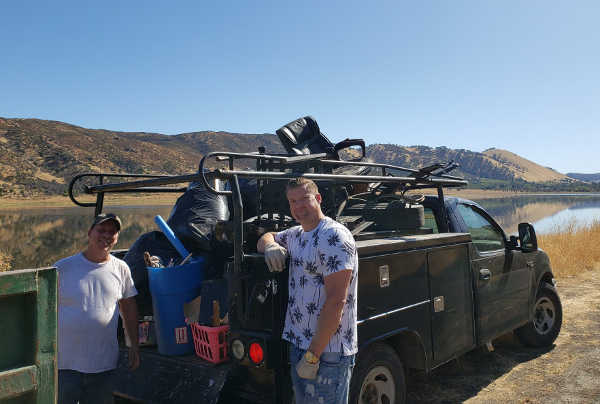
This year, volunteers in Lake County gathered at Keeling Park in Nice, Rodman Slough in Lakeport, the Nice-Lucerne Cutoff and Highlands Springs, and in Clearlake at the Clear Lake Campground, Austin Park and Borax Lake.
Angela De Palma-Dow, Lake County Water Resources’ invasive species coordinator and an organizer of the local event, said the local cleanup went really well.
This year, she said there were a total of 57 volunteers, compared to the 39 reported to have participated last year.
Those 57 volunteers collected 6,457 pounds of trash and 55 pounds of recyclables, filled 147 bags and cleaned 15.5 miles, De Palma-Dow said.
Of the total pounds of trash picked up, De Palma-Dow said 2,400 pounds came from the Austin Park area in Clearlake.
The amount of trash picked up this year was more than 10 times greater than the amount reported last year, when 500 pounds were removed.
De Palma-Dow said it was “not too shabby for a single morning!”
It also was a busy morning, with a number of other events going on around the county the same day.
DePalma-Dow offered thanks and recognition to C&S Waste Solutions and Lake County Public Services for sponsoring the event. “We could not have done this event without them and their dumpster donations.”
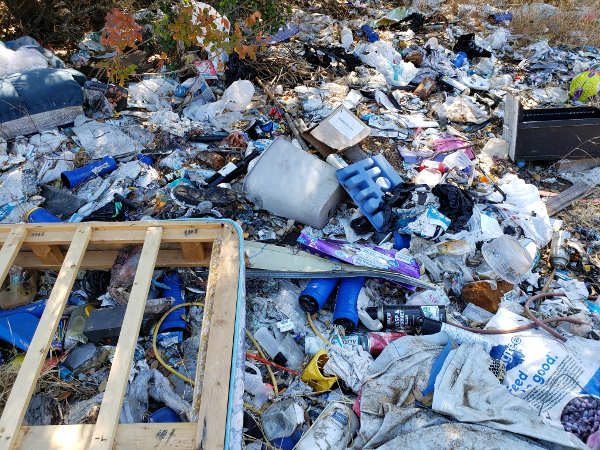
She said Lower Lake High School Upward Bound volunteers helped Barbara Christwitz and Citizens Caring for Clearlake pick up the 2,400 pounds of trash from the Austin Park area.
County Supervisors Eddie Crandall and Tina Scott picked up trash on the Nice-Lucerne Cutoff, where Thomas Aceves and his adopt-a-road volunteer team regularly also meet to clean up the roadway.
DePalma-Dow said Edgar Ketchum and his volunteer team removed more than 3,000 pounds of trash from around Borax Lake off Sulfur Bank Drive in Clearlake.
Lisa Wilson and her dedicated kayakers and boaters at Clear Lake Campground also participated, as did Highland Springs caretaker James Davis and his volunteers, DePalma-Dow said.
On the Northshore, Water Resources staffers and site captains Marina Deligiannis and Yuliya Osetrova helped volunteers. In that area, DePalma-Dow said lots of tires were picked up.
In addition to the Coastal Cleanup Day volunteers, DePalma-Dow said there were a lot of volunteers on Highway 20 in the Upper Lake and Lucerne area that weren’t officially a part of Coastal Clean Up Day, but she thanked them for their efforts to keep Lake County Clean.
If anyone wants to sponsor this event or be a site captain for next year’s Coastal Clean Up Day, they can contact De Palma-Dow at Water Resources at 707-263-2344.
Email Elizabeth Larson at
LAKE COUNTY, Calif. – The California Department of Public Health reported that California’s adolescent birth rate continues to decline, with declines also noted over the most recent two-year study period in Lake County.
A new report the agency released Thursday showed a record low of 13.9 births per 1,000 females between the ages of 15 and 19.
Those numbers reflect an 11.5-percent decline between 2016 and 2017, the California Department of Public Health reported.
State officials said declining rates can be attributed to a number of factors, including improved access to reproductive health services and increased use of contraception; delayed first sexual intercourse; and public health prevention, education and support programs.
“California’s commitment to ensuring access to reproductive health care services and sexual health education are helping teens make safe and healthy choices about pregnancy prevention,” said acting State Public Health Officer Dr. Charity Dean.
Lake County’s adolescent birth rate in the latest report is 28.6 births per 1,000, or 154 births per year, down from 34.8 births per 1,000, or 198 births, in the 2012-14 time frame.
For comparison, the local adolescent birth rate has shown a large decrease since 2000-02, when it was at 47.2 births per 1,000, or 273 overall births.
Based on the data, Lake County had the sixth-highest rate statewide for its adolescent birth rate.
In related data, the state reported that 91.7 percent of the deliveries for adolescent mothers in Lake County were paid for by MediCal from 2015 to 2017, compared to 71.5 percent for all mothers. That’s higher than the state average.
Despite the declining birth rates reported this week, state officials said racial disparities persist in adolescent childbearing in California.
African-American and Hispanic adolescents are three to four times as likely to give birth as white youth.
Rates also vary dramatically across counties: the county with the highest adolescent birth rate has a rate 5.4 times greater than the county with the lowest rate.
The 10 highest rates in the report are as follows: Imperial, 33.4; Tulare, 32.7; Kern, 31.8; Madera, 31.3; Kings, 30.2; Lake, 28.6; Yuba, 27.5; Fresno and Tehama, 26.5; Merced, 25.9; and Monterey, 25.8.
The 10 counties with the lowest birth rates are Marin, 6.2; San Francisco, 6.6; Placer, 7.1; El Dorado, 7.8; Yolo, 8.0; Alameda, 8.5; Santa Clara, 8.7; San Mateo, 9.1; Sonoma, 9.3; and Contra Costa, 10.
Lake’s neighboring counties reported the following rates: Mendocino, 21.6; Napa, 11.5; Sonoma, 9.3; and Yolo, 8. All of those rates showed decreases since the last report.
Colusa and Glenn had rates too small to report, the state said.
For more birth rate data, visit CDPH’s Adolescent Health Data and Statistics webpage.
Email Elizabeth Larson atThis email address is being protected from spambots. You need JavaScript enabled to view it. . Follow her on Twitter, @ERLarson, or Lake County News, @LakeCoNews.
A new report the agency released Thursday showed a record low of 13.9 births per 1,000 females between the ages of 15 and 19.
Those numbers reflect an 11.5-percent decline between 2016 and 2017, the California Department of Public Health reported.
State officials said declining rates can be attributed to a number of factors, including improved access to reproductive health services and increased use of contraception; delayed first sexual intercourse; and public health prevention, education and support programs.
“California’s commitment to ensuring access to reproductive health care services and sexual health education are helping teens make safe and healthy choices about pregnancy prevention,” said acting State Public Health Officer Dr. Charity Dean.
Lake County’s adolescent birth rate in the latest report is 28.6 births per 1,000, or 154 births per year, down from 34.8 births per 1,000, or 198 births, in the 2012-14 time frame.
For comparison, the local adolescent birth rate has shown a large decrease since 2000-02, when it was at 47.2 births per 1,000, or 273 overall births.
Based on the data, Lake County had the sixth-highest rate statewide for its adolescent birth rate.
In related data, the state reported that 91.7 percent of the deliveries for adolescent mothers in Lake County were paid for by MediCal from 2015 to 2017, compared to 71.5 percent for all mothers. That’s higher than the state average.
Despite the declining birth rates reported this week, state officials said racial disparities persist in adolescent childbearing in California.
African-American and Hispanic adolescents are three to four times as likely to give birth as white youth.
Rates also vary dramatically across counties: the county with the highest adolescent birth rate has a rate 5.4 times greater than the county with the lowest rate.
The 10 highest rates in the report are as follows: Imperial, 33.4; Tulare, 32.7; Kern, 31.8; Madera, 31.3; Kings, 30.2; Lake, 28.6; Yuba, 27.5; Fresno and Tehama, 26.5; Merced, 25.9; and Monterey, 25.8.
The 10 counties with the lowest birth rates are Marin, 6.2; San Francisco, 6.6; Placer, 7.1; El Dorado, 7.8; Yolo, 8.0; Alameda, 8.5; Santa Clara, 8.7; San Mateo, 9.1; Sonoma, 9.3; and Contra Costa, 10.
Lake’s neighboring counties reported the following rates: Mendocino, 21.6; Napa, 11.5; Sonoma, 9.3; and Yolo, 8. All of those rates showed decreases since the last report.
Colusa and Glenn had rates too small to report, the state said.
For more birth rate data, visit CDPH’s Adolescent Health Data and Statistics webpage.
Email Elizabeth Larson at
LAKE COUNTY, Calif. – The county of Lake reported that laboratory tests conducted to determine why a dog that had been swimming in a south county creek suddenly became sick and died have yielded inconclusive results.
The dog died in late August following a brief severe illness that began immediately after swimming in the Putah Creek area, as Lake County News has reported.
Although no prior cyanobacteria-related animal deaths had been confirmed in this area, local water and health officials were concerned cyanobacteria may be the cause.
The county reported than an investigation was launched, which included testing of water at the incident site, water as far as a mile downstream and biological samples from the deceased animal.
Water samples from the incident area were collected and delivered to the Big Valley Band of Pomo Indians for cyanobacteria identification, preliminary testing and toxin analysis.
With the permission of the family, the body of the dog was sent to the California Animal Health and Food Safety Laboratory at UC Davis for testing of the stomach contents and some body tissue, and complex tests were performed looking for anatoxin and microcystin, specific cyanobacteria toxins. Testing included mass spectrometry.
The California Office of Environmental Health Hazard Assessment performed its own evaluation of the incident, as well.
Because the dog’s symptoms could have been caused by a toxin from algae, local and state groups have helped in evaluating the cause of the animal’s death and level of concern for that location.
The county said the testing did not detect any of the common types of cyanobacteria toxins in the body of water where the incident reportedly occurred or in the animal tissues.
Although no evidence of toxins was found, county officials said testing did not conclusively rule out an algae-related cause.
The results are inconclusive regarding cyanotoxin as the cause of this dog’s death, officials said.
Accumulations of cyanobacteria are a common and familiar sight in all freshwater lakes, ponds, creeks and streams.
Most frequently visible as green, soup-like water, oily-appearing surface scum or foamy mats, blue-green algae – or cyanobacteria – tends to flourish or collect in sunny areas where water is shallow and undisturbed, or in locations where wind and currents cause surface blooms to collect.
Pets, such as dogs, are particularly at risk. Because they are not deterred by the disagreeable odors of decaying algal mats, they are prone to swallowing water while swimming, and they can also ingest cyanobacteria while self-cleaning their coat following contact with the water. Contact with visible algal blooms should be avoided.
If an animal becomes sick or dies suddenly after recreating in any body of water, please call and/or take the animal to a veterinarian and call your local health department.
In Lake County, report such incidents to Lake County Health Services, Public Health Division, at 707-263-1090.
The dog died in late August following a brief severe illness that began immediately after swimming in the Putah Creek area, as Lake County News has reported.
Although no prior cyanobacteria-related animal deaths had been confirmed in this area, local water and health officials were concerned cyanobacteria may be the cause.
The county reported than an investigation was launched, which included testing of water at the incident site, water as far as a mile downstream and biological samples from the deceased animal.
Water samples from the incident area were collected and delivered to the Big Valley Band of Pomo Indians for cyanobacteria identification, preliminary testing and toxin analysis.
With the permission of the family, the body of the dog was sent to the California Animal Health and Food Safety Laboratory at UC Davis for testing of the stomach contents and some body tissue, and complex tests were performed looking for anatoxin and microcystin, specific cyanobacteria toxins. Testing included mass spectrometry.
The California Office of Environmental Health Hazard Assessment performed its own evaluation of the incident, as well.
Because the dog’s symptoms could have been caused by a toxin from algae, local and state groups have helped in evaluating the cause of the animal’s death and level of concern for that location.
The county said the testing did not detect any of the common types of cyanobacteria toxins in the body of water where the incident reportedly occurred or in the animal tissues.
Although no evidence of toxins was found, county officials said testing did not conclusively rule out an algae-related cause.
The results are inconclusive regarding cyanotoxin as the cause of this dog’s death, officials said.
Accumulations of cyanobacteria are a common and familiar sight in all freshwater lakes, ponds, creeks and streams.
Most frequently visible as green, soup-like water, oily-appearing surface scum or foamy mats, blue-green algae – or cyanobacteria – tends to flourish or collect in sunny areas where water is shallow and undisturbed, or in locations where wind and currents cause surface blooms to collect.
Pets, such as dogs, are particularly at risk. Because they are not deterred by the disagreeable odors of decaying algal mats, they are prone to swallowing water while swimming, and they can also ingest cyanobacteria while self-cleaning their coat following contact with the water. Contact with visible algal blooms should be avoided.
If an animal becomes sick or dies suddenly after recreating in any body of water, please call and/or take the animal to a veterinarian and call your local health department.
In Lake County, report such incidents to Lake County Health Services, Public Health Division, at 707-263-1090.
LAKE COUNTY, Calif. – The 29th running of the Konocti Challenge cycling event is set to occur this Saturday, Oct. 5, with riders challenging themselves in a variety of terrains across Lake County.
This event, produced by the Rotary Club of Lakeport, brings in hundreds of cyclists and their guests into Lake County to participate in this very unique and fun event.
It also brings in hundreds of thousands of dollars to the local economy and showcases Lake County for the cyclists to come back and visit at other times throughout the year.
Organizers ask that the public watch for the cyclists and give them the 3 feet of room required by law.
“We ask you to please drive safely, share the road and welcome these guests to our community,” Ride Director Jennifer Strong said.
The ride is staged from the Skylark Shores Resort in Lakeport with the cyclists leaving between 7 and 10 a.m. on Saturday. They should all be off the roads by no later than 6 p.m.
There are four different routes: a 20-mile, a 40-mile, a 65-mile and an 85-mile.
The 20-mile and 40-mile routes travel through Scotts Valley and to Kelseyville through Big Valley.
The 65-mile and 100-mile routes circle Clear Lake with the 85-mile route also travelling through Scotts Valley.
The ride route maps can be found at www.konoctichallenge.com.
This event, produced by the Rotary Club of Lakeport, brings in hundreds of cyclists and their guests into Lake County to participate in this very unique and fun event.
It also brings in hundreds of thousands of dollars to the local economy and showcases Lake County for the cyclists to come back and visit at other times throughout the year.
Organizers ask that the public watch for the cyclists and give them the 3 feet of room required by law.
“We ask you to please drive safely, share the road and welcome these guests to our community,” Ride Director Jennifer Strong said.
The ride is staged from the Skylark Shores Resort in Lakeport with the cyclists leaving between 7 and 10 a.m. on Saturday. They should all be off the roads by no later than 6 p.m.
There are four different routes: a 20-mile, a 40-mile, a 65-mile and an 85-mile.
The 20-mile and 40-mile routes travel through Scotts Valley and to Kelseyville through Big Valley.
The 65-mile and 100-mile routes circle Clear Lake with the 85-mile route also travelling through Scotts Valley.
The ride route maps can be found at www.konoctichallenge.com.