 How to resolve AdBlock issue?
News
Lake County 4-H will observe National 4-H Week this year by showcasing the incredible experiences that 4-H offers young people, and will highlight the remarkable 4-H youth in our community who work each day to make a positive impact on those around them.
The theme of this year’s National 4-H Week is “Inspire Kids to Do,” which highlights how
4-H encourages kids to take part in hands-on learning experiences in areas such as health, science, agriculture and civic engagement.
The positive environment provided by 4-H mentors ensures that kids in every county and parish in the country – from urban neighbourhoods to suburban schoolyards to rural farming communities ̶ are encouraged to take on proactive leadership roles and are empowered with the skills to lead in life and career.
“The 4-H program guides youth to find their ‘spark’ – to find what inspires them and lead them into becoming true leaders and stewards of the community. By engaging in the various opportunities and experiences that 4-H has to offer, youth develop skills like leadership, communication, public speaking, and teamwork – all while engaging in topics of their interest which includes, but not limited to, cooking, robotics, sewing, animal science, and citizen science. All these also contribute to the UC 4-H Youth Development Program increasing access for youth to improve science literacy and healthy living.” said Car Mun Kok, Lake/Mendocino Counties 4-H youth development advisor.
In Lake County, more than 290 4-H youth and 100 volunteers are enrolled in the 4-H Club Program.
In addition, Lake County 4-H is also partnering with various after school and tribal health programs.
The Lake County 4-H Program strives to offer a variety of projects and programs to fit the needs of the youth as well as the families and to give back to the community.
Giving back to the community has always been an important part of the 4-H program and something that is strongly encouraged to all members and clubs to do.
This past year Jaden Bussard from Blue Heron 4-H club completed his All Star project where he organized and held a golf tournament which raised money for the Tango Mike Project.
Bussard is now currently creating a 4-H project based off his All Star that will have 4-H members assist the Operation Tango Mike Project at their packing parties throughout the year.
The Lake County 4-H Program is also partnering with After School and Tribal Health programs to incorporate 4-H Cooking Academy curriculum into their programs.
This hands-on, experiential, skill-based program includes seven weeks of cooking and food safety instruction.
Students learn basic nutrition information to plan meals, safely prepare and enjoy food, and try new foods like tofu, whole-wheat tortillas and zucchini.
Cooking Academy promotes the three pillars of dietary behavior change; skills, attitudes and knowledge. Students try new foods in delicious ways (attitudes), learn the skills needed to prepare fruits, vegetables, and other healthy items (skills) and increase food literacy around recipe reading and food preparation concepts (knowledge).
Next week on Tuesday October 8th Lake County 4-H will be presented with a proclamation honoring National 4-H Week at the Lake County Board of Supervisors meeting. All community members, current 4-H Families, and 4-H Alumni are invited to attend the presentation of the proclamation which will happen shortly after the Board of Supervisor meeting begins at 9:00 a.m.
One of the most anticipated events of National 4-H Week every year is 4-H National Youth Science Day, which sees hundreds of thousands of youth across the nation taking part in the world’s largest youth-led STEM challenge. The exciting theme for this year’s challenge is Game Changers, which will run throughout October.
Developed by Google and West Virginia University Extension Service, Game Changers will teach kids coding skills through fun exercises including gaming, puzzles and physical activity.
To learn more about how you can get involved, visit http://celake.ucanr.edu , find them on Facebook under @LakeCounty4HProgram or contact the 4-H Office at 707-263-6838.
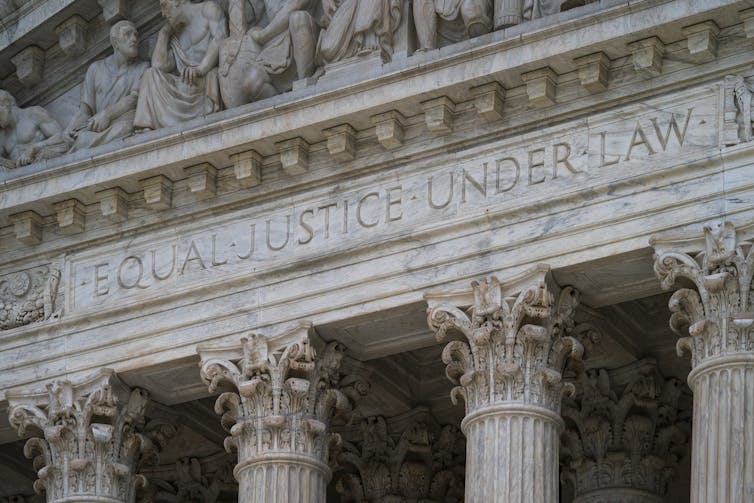
The Supreme Court begins its annual session on Oct. 7 and will take up a series of cases likely to have political reverberations in the 2020 elections.
Major cases this year address the immigration program for young people (“Dreamers”) known as DACA, the Affordable Care Act (again), and public money for religious schools.
Justices will also consider cases that involve several aspects of defendants’ rights: whether criminal convictions require a unanimous jury, minors can be given a life sentence and a state can abolish the insanity defense.
Some of the most important rulings will address the recognition of rights by the conservative court: gay rights, gun rights and Native rights.
These cases focus on perhaps the deepest divide on the court: Should the justices base their rulings on the contemporary meaning of words in our laws (or in the Constitution itself) as the public understanding of those concepts changes over time?
Or should they insist that our laws can only be changed from their original meaning by the country’s democratic representatives, who are directly accountable to the people?
Gay rights
The justices will consider three cases on LGBT employment rights.
Gerald Bostock was fired by Clayton County, Georgia, because he is gay. Donald Zarda was fired from his job as a tandem sky-dive instructor for being gay (before his death in a BASE-jumping accident). Aimee Stephens transitioned from male to female identity and was fired from her job as a funeral director.
These cases turn on one word’s meaning: the word “sex” in Title VII of the Civil Rights Act of 1964.
Does “sex” mean what legislators thought it meant when the law was passed, barring discrimination against women? Or should it be interpreted more broadly now to mean discrimination against any aspect of sexuality?
Gun rights
It has been almost a decade since the court recognized a fundamental right for individual citizens to bear arms. That case was MacDonald v. Chicago, from the city with the highest total number of gun deaths in the nation.
Since that time, the looming question has been what sort of restrictions would be considered constitutional.
New York State Rifle & Pistol Association v. New York City puts this question to the test. Licensed gun owners were prevented from transporting firearms outside of their homes, even to a second home or to a shooting competition outside the city. The court must decide if this is a reasonable regulation that leaves the essential right to bear arms intact.
In the midst of growing concern over mass shootings, the ruling may have ramifications for future attempts at gun regulations.
To raise the political stakes even further, five U.S. senators in their now infamous “enemy-of-the-Court” brief threaten that if the court does not dismiss the case, the Senate will have to consider adding more justices to the court in an attempt to shift its partisan balance, known as “packing the Court.”
Native rights
The least-known but potentially most important case of the year is not about widely-discussed gay rights or gun rights, but about Native rights.
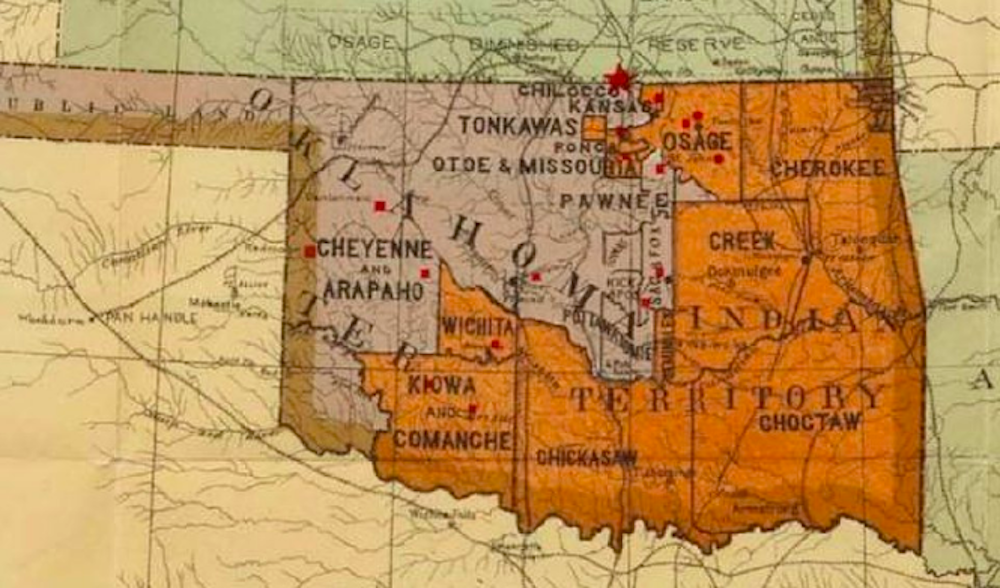
Sharp v. Murphy began as a dispute over jurisdiction in a murder prosecution. But it has become a potentially influential case about who represents the rightful government of Eastern Oklahoma.
The historic reservations of the Cherokee, Chickasaw, Choctaw, Creek and Seminole Nations comprise 40% of Oklahoma land. These tribes were forcibly removed from the eastern U.S. to the Oklahoma Territory in the 1830s, some making the journey along the infamous Trail of Tears.
Since then, parts of their reservation land have been seized by the state government or sold to private citizens, so they are no longer part of the reservation. This includes the city of Tulsa.
The argument in the case is that according to the original treaties the petitioners are asking the court to uphold, those lands are rightfully still under the government of the tribes. What exactly this means in terms of ownership and governance is unclear.
This may at first appear to be a small case about a piece of the American West. But if the Native rights claim is recognized by the court, it may also apply in later cases to a surprisingly large proportion of the United States that was once “Indian country” under official treaties. That is why 10 states filed a friend-of-the-court brief arguing against the Native rights claim.
Bigger implications
The Native rights claims at issue are not individual rights of the type the U.S. Constitution generally contemplates. They are rights held by an ethnic group. The question of who belongs to the group – and hence has access to the group right – is a divisive one because any answer includes some members while excluding others who claim the same identity.
It also is reminiscent of another proposed group right that is being debated in American politics: reparations. This summer the U.S. Congress held contentious hearings to discuss possible payments as reparations for slavery.
But payments to whom? Both Native Americans and African Americans share a distinct problem yet to be solved: how to determine who is a member of the group.
So in the case of reparations: Would they be paid only to direct descendants of slaves? To all African American descendants no matter when their progenitors arrived in the U.S.? To all people who have any black ancestors regardless of their current status or wealth?
Many Native tribes use what’s called the “blood quantum” approach, which forces individuals to document their lineage and proportional ancestry to prove membership. But scholars in this area argue that this approach is fraught with complications in many contexts.
Election 2020
Democratic presidential hopefuls have already grappled with questions around tribal membership and the country’s history of racism. Sen. Elizabeth Warren has dealt with a damaging controversy over her claims to Native American ancestry. Former Vice President Joe Biden has come under fire for his earlier opposition to reparations.
In terms of both legal and political influence, Sharp v. Murphy is a case with potentially major ramifications. And with the combined focus on politically divisive issues like gay rights, gun rights and Native rights, this year’s docket is likely to have an unusually strong presence in the 2020 campaigns.
[ Like what you’ve read? Want more? Sign up for The Conversation’s daily newsletter. ]
Morgan Marietta, Associate Professor of Political Science, University of Massachusetts Lowell
This article is republished from The Conversation under a Creative Commons license. Read the original article.
The following cats and kittens at the Lake County Animal Care and Control shelter have been cleared for adoption.
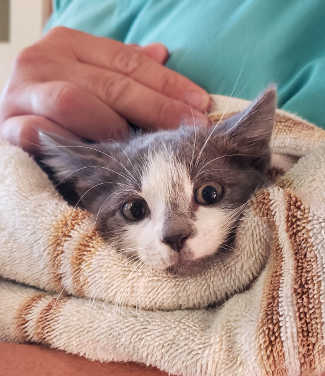
Domestic short hair kitten
This male domestic short hair kitten has a gray tabby and white coat.
He is in kennel V No. 10, ID No. 13033.

Domestic short hair kitten
This female domestic short hair kitten has a black and gray tabby coat and gold eyes.
She is in cat room kennel No. 41a, ID No. 12847.
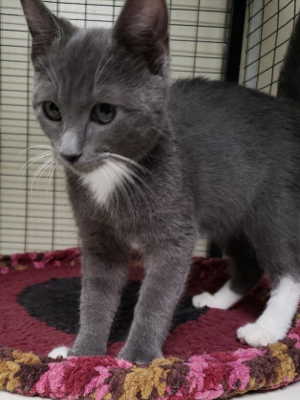
Male domestic short hair cat
This male domestic short hair cat has a gray and white coat and green eyes.
He is in cat room kennel No. 63, ID No. 12710.
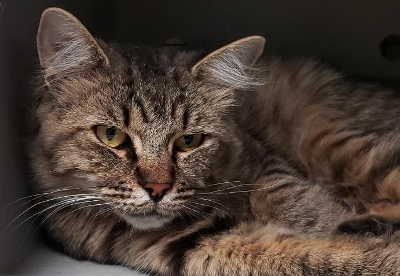
Male brown tabby
This male brown tabby has a long coat and green eyes.
He’s in cat room kennel No. 143, ID No. 13006.
Lake County Animal Care and Control is located at 4949 Helbush in Lakeport, next to the Hill Road Correctional Facility.
Office hours are Monday through Friday, 11 a.m. to 5 p.m., and 11 a.m. to 3 p.m., Saturday. The shelter is open from 11 a.m. to 4 p.m. Monday through Friday and on Saturday from 11 a.m. to 3 p.m.
Visit the shelter online at http://www.co.lake.ca.us/Government/Directory/Animal_Care_And_Control.htm.
For more information call Lake County Animal Care and Control at 707-263-0278.
Email Elizabeth Larson at
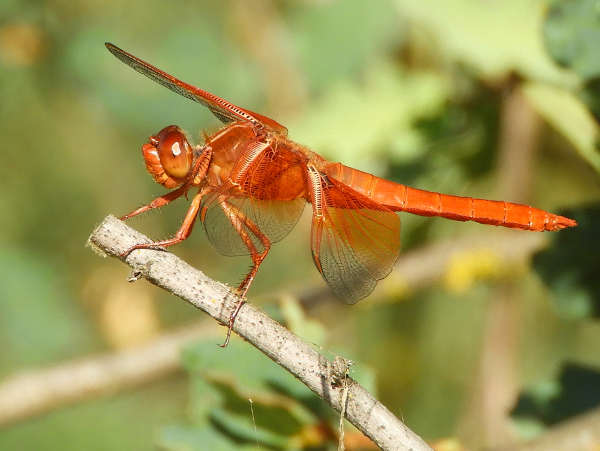
NORTHERN CALIFORNIA – Sometimes you may see dragonflies standing with their rear up in the air.
Why are they doing that? Or you may see them perching, and it looks like they only have four legs instead of six. Where did the other two legs go?
Let’s find out.
Many dragonflies, and most specifically those species which perch a lot rather than fly a majority of the time, use that rear-up-in-the-air posture, called the “obelisk stance,” for a couple of different reasons.
In a species like the blue dasher (Pachydiplax longipennis) or the common whitetail (Libellula lydia), the posture can be used as a threat. Both of these species excrete a kind of waxy substance, or pruinosity, onto their abdomens which gives the surface a sort of dusty or frosty look to them.
Not all dragonflies have this pruinescence, but those that do often use it in part to help them recognize members of their own species, attract mates and to make themselves look more formidable when they’re defending their territories.
Blue dashers will raise their abdomens in the obelisk position and orient their bodies to the sun in order to reflect light off that pruinocity and flash bright-white warnings to other males to stay off their turf.
Another facet of the pruinescence is that it can reflect ultraviolet light, which helps the dasher thermoregulate. Dashers, like all dragonflies are ectothermic which means they need outside influences to help them regulate their body temperature. Generally, shade to cool off, sunlight to warm up.
So, what about the dragonflies that have no pruinocity? They use the obelisk position to thermoregulate as well, but in a slightly different fashion. When their bodies or flight gear become overheated, dragonflies like the variegated Meadowhawk (Sympetrum corruptum), will straighten their bodies out in the obelisk position so that only the tip of the abdomen is getting direct sunlight and the rest of their body is casting a shadow over the powerpack on their back that houses their flight muscles.

If the powerpack gets too hot or too cold, the dragonfly can’t fly – and flight is essential to these insects. They can’t find mates, defend their territories or eat without it. So, keeping that powerpack at just the right temperature ensures their survival.
A modified obelisk position can also help the dragonfly to warm up on chilly mornings. It will turn its back to face the sun and lift its abdomen so that the sunlight strikes as much of the body and wing surface as possible. Even a fraction of a degree is enough to make a difference.
As I mentioned, flight is at the heart of all dragonfly activity, and dragonflies are amazing fliers. Each of their four wings can move independently from one another and can flap as quickly as 90-beats per second.
The top forward-motion flight speed of the larger dragonflies can get up to 60 miles per hour. They can also fly backwards, zigzag and hover in the blink of an eye. Now, try to imagine the impact that speed and maneuverability can have on the dragonfly’s head, neck and body.
The dragonfly’s large bulbous head (made up primarily of the eyes) is attached to its body by a fine thread-like neck. The neck is flexible enough to allow the dragonfly to tilt its head sideways up to 180 degrees, drop its head about 40 degrees and lift the head about 70 degrees, but it’s relatively weak.
In fact, most dragonflies have special “arrester systems” built of tiny microsculptures to help support the head, especially when in flight. But some dragonflies augment those arresters by using their front legs.
On occasion you may see a dragonfly fold its two front legs on either side of the neck when its perching to help stabilize the head so the eyes can focus more clearly on what’s around it. And in flight, some dragonflies tuck the front legs up behind their eyes to protect the neck from the g-forces and sudden changes in trajectory the dragonfly experiences in flight.
So, that’s why you sometimes see dragonflies that look like they only have four legs instead of six (or no legs at all).
Pretty interesting, huh? Look more closely at the next dragonflies you see and try to discover what other unique and fascinating characteristics and adaptations they may have.
Mary K. Hanson is a Certified California Naturalist, author, nature photographer and blogger. She also teaches naturalist classes through Tuleyome, a501(c)(3) nonprofit conservation organization based in Woodland, California. For more information, visit www.tuleyome.org.

The red flag warning across Lake and several neighboring counties will continue until 5 p.m. on Sunday.
Pacific Gas and Electric Co. has so far not called for a public safety power shutoff for Lake County due to the weather, however, conditions in the Sacramento Valley and foothills led to PG&E shutting off power late Saturday to about 10,300 customers in parts of Butte, Plumas and Yuba counties.
PG&E, which activated its emergency operations center to monitor conditions, said portions of Napa, Lake and Sonoma counties remain under an elevated risk for a public safety power shutoff on Sunday as well as on Wednesday and Thursday.
The weather forecast for the region notes a high pressure system that is expected to bring warmer, above-normal temperatures and breezier conditions over the next few days.
Temperatures are expected to cool on Tuesday and Wednesday, with gusting north or northeast winds from Wednesday afternoon through Thursday, prompting PG&E’s concerns that a power shutoff may be necessary.
Email Elizabeth Larson at
As Fire Prevention Week takes place Oct. 6 to 12, planning and practicing a safe escape is the key to getting out of a house fire or wildfire in time.
“Being aware of your surroundings is an ability people need to use wherever they go,” said Cal Fire Director Thom Porter. “No matter where you are, look for two ways out. If the alarm system sounds, take it seriously and exit immediately. If you are in a wildfire situation, leave early.”
Complacency can result in disaster. Now is the time to educate yourself and your family about the small but important actions to keep everyone safe.
Start with a home escape plan and practice it monthly, during the day and at night so it becomes muscle memory.
Have an outside meeting place that your family knows where to go and to stay at, and have a communication plan in place.
In a wildfire, don’t wait to evacuate. If it’s an uncomfortable situation, leave early and make sure to take your pets and important items with you.
“Your ability to get out safely depends on advance planning and warning,” said California State Fire Marshal Mike Richwine. “Per the National Fire Protection Association, only one out of every three American households have actually developed and practiced a home fire escape plan. While 71 percent of Americans have an escape plan in case of a fire, only 47 percent of those have practiced it. We can do better.”
By being a hero, you can be someone who takes small, but important actions to keep yourself and those around you safe from fire?
When it comes to fire safety, be the hero in your household and your community.
Here are a few things you can do:
– Make an escape plan, practice your plan monthly during the day and at night to make sure that children and adults react to the smoke alarm and know what to do.
– Draw a map of each level of the home. Show two ways out of every room.
– Have an outside meeting place like a mailbox, tree, or light. Call 911 from your meeting place.
– Children, older adults and people with disabilities may need assistance to wake up and get out. Make sure that someone helps them.
– Install smoke alarms inside every sleeping area, in hallways outside of sleeping areas and on every level of your home.
– If people are trapped, firefighters have the best chance of rescuing them. Firefighters have the training, experience and protective equipment needed to enter burning buildings.
Become a hero by learning fire safety skills to protect you, your family, and your community.
For more detailed information, visit www.readyforwildfire.org or www.fire.ca.gov .