LAKE COUNTY, Calif. – Lake County Animal Care and Control has many new dogs this week, including a group of terriers.
Dogs available for adoption this week include mixes of boxer, Chihuahua, dachshund, German Shepherd, Labrador Retriever, terrier and wirehaired terrier.
Dogs that are adopted from Lake County Animal Care and Control are either neutered or spayed, microchipped and, if old enough, given a rabies shot and county license before being released to their new owner. License fees do not apply to residents of the cities of Lakeport or Clearlake.
If you're looking for a new companion, visit the shelter. There are many great pets hoping you'll choose them.
The following dogs at the Lake County Animal Care and Control shelter have been cleared for adoption (additional dogs on the animal control Web site not listed are still “on hold”).
This male Labrador Retriever is in kennel No. 19, ID No. 12930. Photo courtesy of Lake County Animal Care and Control. Male Labrador Retriever
This male Labrador Retriever has a short yellow coat.
He is in kennel No. 19, ID No. 12930.
This female wirehaired terrier is in kennel No. 21a, ID No. 13069. Photo courtesy of Lake County Animal Care and Control. Female wirehaired terrier
This female wirehaired terrier has a long black and tan coat.
She is in kennel No. 21a, ID No. 13069.
This female dachshund is in kennel No. 21b, ID No. 13070. Photo courtesy of Lake County Animal Care and Control. Female dachshund
This female dachshund has a short brown and tan coat.
She is in kennel No. 21b, ID No. 13070.
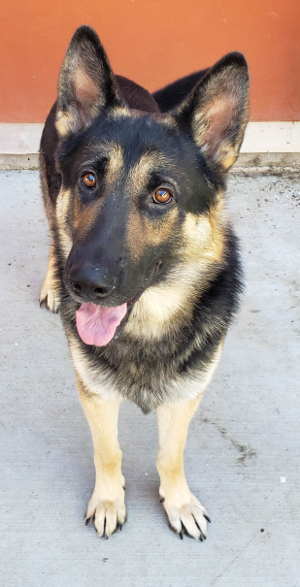
“Dante” is a male German Shepherd in kennel No. 23, ID No. 12972. Photo courtesy of Lake County Animal Care and Control. ‘Dante’
“Dante” is a male German Shepherd with a medium-length black and tan coat.
He’s in kennel No. 23, ID No. 12972.
This male terrier is in kennel No. 27, ID No. 13050. Photo courtesy of Lake County Animal Care and Control. Male terrier
This male terrier has a coarse brown and black coat.
He is in kennel No. 27, ID No. 13050.
This female boxer is in kennel No. 29, ID No. 13048. Photo courtesy of Lake County Animal Care and Control. Female boxer
This female boxer has a short white coat.
She is in kennel No. 29, ID No. 13048.
This male terrier is in kennel No. 31, ID No. 13027. Photo courtesy of Lake County Animal Care and Control. Male terrier
This male terrier has a short brown and tricolor coat.
He is in kennel No. 31, ID No. 13027.
This male Chihuahua is in kennel No. 33, ID No. 13018. Photo courtesy of Lake County Animal Care and Control. Male Chihuahua
This male Chihuahua has a short brindle coat.
He is in kennel No. 33, ID No. 13018.
Lake County Animal Care and Control is located at 4949 Helbush in Lakeport, next to the Hill Road Correctional Facility.
Office hours are Monday through Friday, 11 a.m. to 5 p.m., and 11 a.m. to 3 p.m., Saturday. The shelter is open from 11 a.m. to 4 p.m., Monday through Friday and on Saturday from 11 a.m. to 3 p.m.
For more information call Lake County Animal Care and Control at 707-263-0278.
Email Elizabeth Larson at This email address is being protected from spambots. You need JavaScript enabled to view it.. Follow her on Twitter, @ERLarson, or Lake County News, @LakeCoNews.
Gov. Gavin Newsom on Saturday signed into law a package of bills to fight animal cruelty and promote animal welfare.
They include first-in-the-nation legislation to ban the sale of new fur products, groundbreaking legislation that bans animals like elephants and bears from being used in circus acts and legislation prohibiting hunting or killing bobcats in California.
AB 44 by Assemblymember Laura Friedman (D-Glendale) implements a statewide prohibition on the sale and manufacture of new fur products in California.
“California is a leader when it comes to animal welfare and today that leadership includes banning the sale of fur,” said Gov. Newsom. “But we are doing more than that. We are making a statement to the world that beautiful wild animals like bears and tigers have no place on trapeze wires or jumping through flames. Just YouTube the videos showing the cruel way these animals – often stripped from their mothers as babies – are trained to do dangerous tricks. It’s deeply disturbing.”
AB 44 would make it unlawful to manufacture, sell, offer for sale, display for sale, trade, give donate or otherwise distribute a fur product in the state. The prohibition would apply to clothing, handbags, shoes, slippers, hats, or key chains that contain fur and provides for a civil penalty for each violation.
The new law exempts leather, cowhide and shearling, as well as fur products used for religious purposes.
The law also has provisions that exempt taxidermy products, fur from an animal lawfully taken with a hunting license, and used fur.
The governor also signed the following legislation into law:
SB 313 by Senator Ben Hueso (D-San Diego) bans the use of bears, tigers, elephants, monkeys and other wild animals in circuses.
AB 1254 by Assemblymember Sydney Kamlager-Dove (D-Los Angeles) prohibits hunting, trapping or killing bobcats in California until 2025 at which point the state can issue limited licenses and implement a bobcat management plan that protects the species.
AB 128 by Assemblymember Todd Gloria (D-San Diego) protects California’s wild and domestic horses from slaughter. AB 128 requires the operator of an animal auction yard to determine and post online any identifying brand, tattoo, or implanted microchip an animal may have before being sold at auction. The operator is also required to maintain records of sales for one year and make such records available to specified officials and to post notice at an auction that the sale of horses in California for slaughter for human consumption is a felony. The bill also requires a purchaser of an animal at auction to sign a sworn statement, under penalty of perjury, agreeing to comply with provisions of the Penal Code relating to the slaughter and sale of horses or horse meat for human consumption.
AB 1260 by Assemblymember Brian Maienschein (D-San Diego) adds more types of animals – iguana, skink, caiman, hippopotamus, and three types of lizards – to the import and trade prohibition of dead animals and dead animal parts.
The network of cracks in this Martian rock slab called "Old Soaker" may have formed from the drying of a mud layer more than 3 billion years ago. The view spans about 3 feet (90 centimeters) left-to-right and combines three images taken by the MAHLI camera on the arm of NASA's Curiosity Mars rover. Credits: NASA/JPL-Caltech/MSSS. If you could travel back in time 3.5 billion years, what would Mars look like?
The picture is evolving among scientists working with NASA's Curiosity rover.
Imagine ponds dotting the floor of Gale Crater, the 100-mile-wide (150-kilometer-wide) ancient basin that Curiosity is exploring. Streams might have laced the crater's walls, running toward its base.
Watch history in fast forward, and you'd see these waterways overflow then dry up, a cycle that probably repeated itself numerous times over millions of years.
That is the landscape described by Curiosity scientists in a Nature Geoscience paper published today. The authors interpret rocks enriched in mineral salts discovered by the rover as evidence of shallow briny ponds that went through episodes of overflow and drying.
The deposits serve as a watermark created by climate fluctuations as the Martian environment transitioned from a wetter one to the freezing desert it is today.
Scientists would like to understand how long this transition took and when exactly it occurred. This latest clue may be a sign of findings to come as Curiosity heads toward a region called the "sulfate-bearing unit," which is expected to have formed in an even drier environment. It represents a stark difference from lower down the mountain, where Curiosity discovered evidence of persistent freshwater lakes.
Gale Crater is the ancient remnant of a massive impact. Sediment carried by water and wind eventually filled in the crater floor, layer by layer.
After the sediment hardened, wind carved the layered rock into the towering Mount Sharp, which Curiosity is climbing today.
Now exposed on the mountain's slopes, each layer reveals a different era of Martian history and holds clues about the prevailing environment at the time.
"We went to Gale Crater because it preserves this unique record of a changing Mars," said lead author William Rapin of Caltech. "Understanding when and how the planet's climate started evolving is a piece of another puzzle: When and how long was Mars capable of supporting microbial life at the surface?"
He and his co-authors describe salts found across a 500-foot-tall (150-meter-tall) section of sedimentary rocks called "Sutton Island," which Curiosity visited in 2017. Based on a series of mud cracks at a location named "Old Soaker," the team already knew the area had intermittent drier periods. But the Sutton Island salts suggest the water also concentrated into brine.
Typically, when a lake dries up entirely, it leaves piles of pure salt crystals behind. But the Sutton Island salts are different: For one thing, they're mineral salts, not table salt. They're also mixed with sediment, suggesting they crystallized in a wet environment — possibly just beneath evaporating shallow ponds filled with briny water.
Given that Earth and Mars were similar in their early days, Rapin speculated that Sutton Island might have resembled saline lakes on South America's Altiplano. Streams and rivers flowing from mountain ranges into this arid, high-altitude plateau lead to closed basins similar to Mars' ancient Gale Crater. Lakes on the Altiplano are heavily influenced by climate in the same way as Gale.
"During drier periods, the Altiplano lakes become shallower, and some can dry out completely," Rapin said. "The fact that they're vegetation-free even makes them look a little like Mars."
Signs of a drying Mars
Sutton Island's salt-enriched rocks are just one clue among several the rover team is using to piece together how the Martian climate changed. Looking across the entirety of Curiosity's journey, which began in 2012, the science team sees a cycle of wet to dry across long timescales on Mars.
"As we climb Mount Sharp, we see an overall trend from a wet landscape to a drier one," said Curiosity Project Scientist Ashwin Vasavada of NASA's Jet Propulsion Laboratory in Pasadena, California. JPL leads the Mars Science Laboratory mission that Curiosity is a part of. "But that trend didn't necessarily occur in a linear fashion. More likely, it was messy, including drier periods, like what we're seeing at Sutton Island, followed by wetter periods, like what we're seeing in the 'clay-bearing unit' that Curiosity is exploring today."Up until now, the rover has encountered lots of flat sediment layers that had been gently deposited at the bottom of a lake. Team member Chris
Fedo, who specializes in the study of sedimentary layers at the University of Tennessee, noted that Curiosity is currently running across large rock structures that could have formed only in a higher-energy environment such as a windswept area or flowing streams.
Wind or flowing water piles sediment into layers that gradually incline. When they harden into rock, they become large structures similar to "Teal Ridge," which Curiosity investigated this past summer.
"Finding inclined layers represents a major change, where the landscape isn't completely underwater anymore," said Fedo. "We may have left the era of deep lakes behind."
Curiosity has already spied more inclined layers in the distant sulfate-bearing unit. The science team plans to drive there in the next couple years and investigate its many rock structures.
If they formed in drier conditions that persisted for a long period, that might mean that the clay-bearing unit represents an in-between stage — a gateway to a different era in Gale Crater's watery history.
"We can't say whether we're seeing wind or river deposits yet in the clay-bearing unit, but we're comfortable saying is it's definitely not the same thing as what came before or what lies ahead," Fedo said.
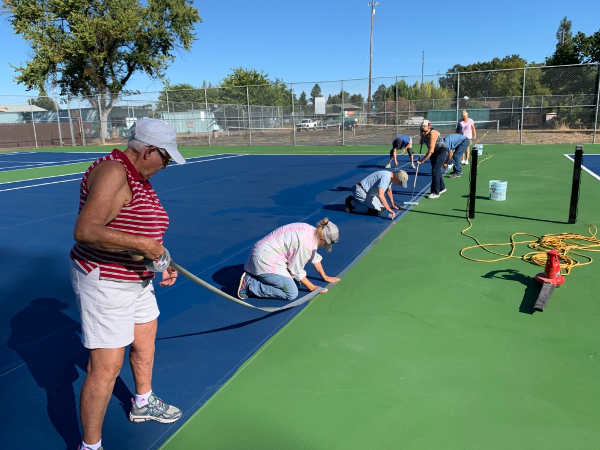
Lake County Tennis Association volunteers work to renovate the Gard Street tennis courts in Kelseyville, Calif. Courtesy photo. KELSEYVILLE, Calif. – A group of community volunteers have formed a nonprofit dedicated to fundraising for Kelseyville’s tennis courts and promoting tennis for players of all ages.
The Lake County Tennis Association was officially formed in May.
Its purpose is to provide a vehicle to conduct fundraising efforts designed to target maintenance and improvement costs, to carry out funding for future replacement of the old Gard Street courts with new ones, and to promote ongoing tennis opportunities among the young and old for the entire county.
The Gard Street tennis courts, located in Kelseyville at the corner of Second and Gard streets, have provided the community and high school students with a tennis sanctuary for generations.
The six tennis courts are located on the Kelseyville Unified School District property, providing a facility for the Kelseyville High School tennis team and tennis enjoyment to the general public.
Generations of community tennis players have enjoyed the use of the courts over the years and many have devoted their time, effort and money to keeping the courts maintained and usable as a viable tennis facility for all.
Kelseyville Unified Superintendent Dave McQueen recalls playing on these courts while attending high school.
The association said the mortality of these facilities is all too real when faced with the costs of maintaining and/or replacing tennis courts in small and rural communities. These tennis courts are the only viable courts remaining in the entire Lake County which are presently serving the students and community.
Three of the six courts have struggled with disrepair over the years due to ground movement and playing surface wear which have resulted in a constant battle against the effects of weather extremes in our area.
Two of the six courts are practice courts on the badly cracked original asphalt play surface which existed for the old Gard Street grammar school.
The sixth court was removed and remains as a weed patch serving as a reminder of the fate looming for the rest of the courts if people were to just stop caring.
This is why a handful of concerned community volunteers formed the Lake County Tennis Association.
The association will conduct fundraising efforts at local, state and national levels, including the US Tennis Association, for future maintenance monies and possible replacement of six new courts for the facility.
The group’s future dream features six brand new courts on site for all to enjoy tennis.
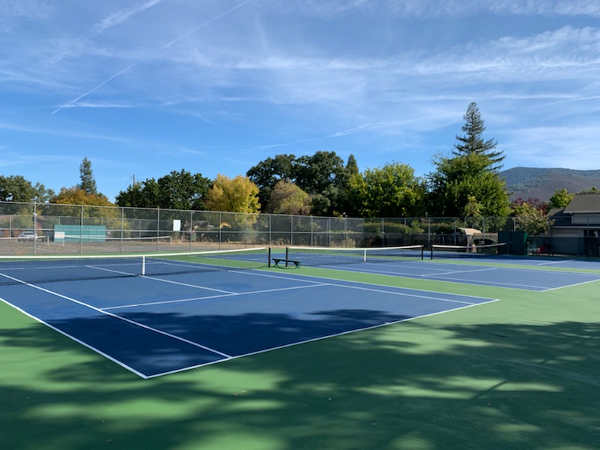
Renovations of the Gard Street tennis courts in Kelseyville, Calif., recently were completed by members of the newly formed Lake County Tennis Association. Courtesy photo.
Completed repairs on three courts
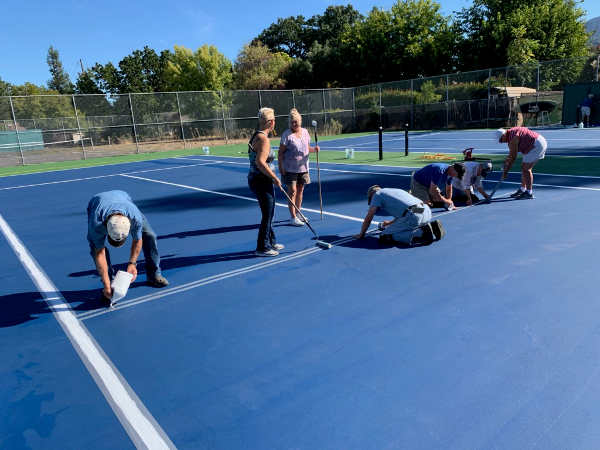
An exhaustive, two-week repair process was completed on Sept. 27. It consisted of the complete removal, repair and replacement of the playing surface on the three courts facing Gard Street.
This project required more than 600 work hours by 25 volunteers from the local tennis community. It was carefully planned and executed by the association members, resulting in approximately $5,500 of material cost which was paid for by Kelseyville Unified.
The new court surfacing was installed over a heavy coating of a special bonding agent which will provide increased protection against future blistering caused by moisture and poor adhesion.
Association welcomes members
The Lake County Tennis Association is offering voluntary, annual memberships for $50 per individual or $100 per family. Students are free and so are families with a student participating on a tennis team.
All contributions can be provided with nonprofit, tax-exempt information. Support from a caring community will make a difference in the quest of the Lake County Tennis Association.
On Saturday, Oct. 12, at 4 p.m. at the Clear Lake Riviera Community Hall, 9689 Highway 281, Kelseyville, a meet and greet will be hosted by the Association for all members and future members who wish to attend.
Special thanks are extended to the following founding Lake County Tennis Association Board Members for their participation: Mike Shay, Richard Hernaez, Di Roger, Kim Shay, Iris Angeleri, Andy Dobusch, Ellen Karnowski, Jane McKnight and Connie Wright.
Memberships by community members will greatly assist the goals of the tennis association and can be obtained by contacting Mike Shay at This email address is being protected from spambots. You need JavaScript enabled to view it. or by phone at 310-486-8427.
The newly renovated tennis courts on Gard Street in Kelseyville, Calif. Courtesy photo.
LAKE COUNTY, Calif. – As power restoration continued on Friday following what is believed to be the biggest electrical shutoff of its kind, more waves of residents around Lake County reported getting power service back.
As of the latest information released Friday night, Pacific Gas and Electric said it had restored power to 97 percent of the customers impacted by the public safety power shutoff which began early Wednesday.
Systemwide, 738,000 customers – a number relating to accounts – were affected from the Northern Sierra to the Greater Bay Area to Kern County, PG&E said.
In Lake County, 37,403 customers were included in the shutoff. By Friday night, 98 percent of Lake County’s residents had power restored, according to PG&E spokesperson Fiona Chan.
In Lucerne, where power began to come back late Thursday night, Lucerne Elementary School went on with classes on Friday, although Superintendent Mike Brown reported the bus was running about an hour late.
In the Lakeport, Konocti, Middletown and Upper Lake school districts, school remained closed on Friday due to the continuing outage, with classes in those district set to resume next week.
On Friday morning, residents of areas including Hidden Valley and Lakeport reported their power came back on, with Kelseyville said to be restored Friday night.
PG&E said it initiated the shutoff on Wednesday due to dry, windy weather across its service area, which also had led the National Weather Service to issue a red flag warning for Lake County and much of the rest of Northern California. That warning expired on Friday morning.
Wind gusts in excess of 70 miles per hour were recorded Wednesday evening and into Thursday, PG&E said.
The company’s system for tracking weather includes more than 600 weather stations, 200 of which have been added this year.
Chan said there are 12 weather stations and one high definition wildfire camera installed in Lake County.
Before reenergizing the impacted communities, PG&E deployed 6,300 on-the-ground field personnel and 44 staged helicopters to conduct safety patrols and inspections, which the company said can only take place during daylight hours. Those inspections will continue at daybreak on Saturday.
PG&E officials said those inspections have identified 30 instances of weather-related damage to its system in the shutoff-impacted areas, and the company is working to address these repairs.
Examples of damage included downed lines and vegetation on power lines, which PG&E President and CEO Bill Johnson said during a Friday evening press briefing could have led to fires.
Chan said that in Lake County there were two reports of damage to equipment from the wind event.
There were 25,000 miles of electrical lines that were deenergized across PG&E’s service area as part of the shutoff and which required inspection before restoring power, the company said.
Chan said in Lake County, electrical system line miles total 715.1 for distribution and 201 for transmission. She could not say late Friday how much of the county’s lines had been inspected.
The company said it will be submitting a report detailing the damages to the system to the California Public Utilities Commission within 10 days of the completion of the shutoff.
PG&E has operated more than 30 community resource centers throughout the shutoff areas, including one at the Clearlake Senior/Community Center, 3245 Bowers Ave. in Clearlake. The centers provide water, phone charging stations, air-conditioned seating and restrooms for customers.
Centers in communities where power hasn’t yet been fully restored – including Lake County – will be open again from 8 a.m. to 6 p.m. Saturday, PG&E reported.
Company continues to face criticism over shutoffs
PG&E executives this week have continued to defend and explain the need for cutting power to much of the region in the face of mounting criticism from residents and state leaders.
This week, Gov. Gavin Newsom promised to hold PG&E accountable and said the shutoff had been carried out too broadly and created an “unacceptable” situation.
On Friday, Assemblymember Marc Levine (D-Marin County) joined the chorus of critics, calling the shutoff “irresponsible and incompetent.”
“For decades, PG&E has lined the pockets of their investors with billions while abandoning their legal obligation to deliver energy safely to homes and businesses throughout the state. PG&E’s latest stunt by cutting power to over two million Californians put vulnerable populations at risk, kept over 130,000 students from attending school and failed to address PG&E’s continued neglect of their electrical infrastructure,” Levine said.
Levine even went so far as to suggest that “something more sinister” is on PGE’s agenda. “For years PG&E has unsuccessfully sought legislation to eliminate ‘inverse condemnation,’ or in common terms, the requirement that PG&E be financially liable for wildfire damage caused by their equipment.”
As for the possibility of impacted customers receiving some manner of compensation for losses incurred during the shutoff, during a Friday evening press briefing, Johnson said it’s the policy of all utilities in the state that when there is a weather event, they are not liable for the costs.
With California having experienced winds, drought and wildland fires in the past, Johnson was asked why measures such as the shutoff weren’t taken earlier.
Johnson said the risk has increased dramatically over the past few years. “Were we fully prepared to meet this risk? No, we weren’t,” he said.
He added, “The risk is increasing every year. And this is a climate-related risk.”
Email Elizabeth Larson at This email address is being protected from spambots. You need JavaScript enabled to view it.. Follow her on Twitter, @ERLarson, or Lake County News, @LakeCoNews.
KELSEYVILLE, Calif. – The Lake County Literacy Coalition announced that the 30th Vineyard Run for Literacy will go on as scheduled on Sunday, Oct. 13, at Steele Wines.
The walk (5K) and runs (5K or 10K) start promptly at 9 a.m.
Online registration has closed, but participants can register on-site between 7:45 and 8:30 a.m.
Registration fees are $15 for youth (ages 7-18) and $35 per adult (age 19 and over). There is no fee for children through age 6.
“We are thrilled that Steele Wines decided to proceed with the Harvest Festival, and grateful they encouraged us to do the same,” said Coalition President Deb Ehrhardt. “After the power outages of the last few days, we hope our event will be a breath of fresh air. The weather will be cool in the morning, so dress in layers.”
For additional information about the nonprofit cCoalition and the Vineyard Run for Literacy, visit the coalition’s Web site at http://lclcoalition.wixsite.com/lclc or call 707-263-7633.
Steele Wines is located on Thomas Drive at Highway 29.
 How to resolve AdBlock issue?