How to resolve AdBlock issue?
News
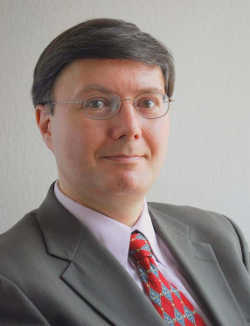
Medi-Cal has different rules governing Medi-Cal reimbursement when a Medi-Cal recipient dies.
One set of rules applies to assets owned by the deceased Medi-Cal recipient’s estate. Another set of rules apply to assets held in a self-settled first party Special Needs Trust and pooled Special Needs Trust funded by the trust beneficiary in order to maintain eligibility to receive Medi-Cal.
As of Jan. 1, 2017, Medi-Cal estate recovery only applies when estate (assets) are subject to probate and there is no surviving spouse. Otherwise there is no Medi-Cal estate recovery.
Estate recovery reimburses Medi-Cal for benefits paid to skilled nursing home or for Medi-Cal community based benefits (doctors, hospitals and prescription benefits) paid after age 55. Important exceptions limit to Medi-Cal’s rights to estate recovery.
Thus, a decedent’s home – an exempt asset for Medi-Cal eligibility purposes during the Medi-Cal beneficiary’s lifetime – can always be protected from Medi-Cal estate recovery by avoiding probate.
Probate can be avoided by transferring the residence into a revocable living trust or gifting it while alive, preferably subject to a reserved life-estate.
A small estate under one-hundred and fifty thousand dollars ($150,000) are usually settled using simplified administration procedures without a probate.
Assets owned by either a first party special needs trusts or a pooled special needs trusts, however, are subject to mandatory federal Medi-Cal “pay-back” that apply when the special needs beneficiary dies or the trust terminates.
Federal law allows a Medi-Cal (Medicaid) beneficiary to transfer assets – such as inheritances and personal injury awards – into such trusts to qualify for needs based Medi-Cal benefits if such trusts contain the “pay-back” provisions.
“Pay-back” provisions, however, are not required – and should not be used – in either a revocable living trust or in a third party special needs trust – i.e., a special needs trust established by a family member, or friend, and funded with assets belonging to someone other than the special trust beneficiary.
In Gonzalez v City Nat'l Bank (2019) 36 CA5th 734, California’s Second District Court of Appeals, recently addressed whether the mandatory Pay-Back provisions required of first party special needs trust apply to a particular type of special needs trust established with personal injury settlements or judgments for minors or disabled persons under section 3600 et. seq. of California’s Probate Code.
Two prior decisions from two other District Court of Appeals courts – i.e., Shewry v. Arnold (2004) 125 Cal.App.4th 186 (Shewry) and Herting v. State Dept. of Health Care Services (2015) 235 Cal.App.4th 607, 609 (Herting) – have opposite holdings to each other.
In Shewry, the court ruled that the first party special needs trust established by a court order to receive a personal injury award was not subject to the pay-back provisions because section 3605 Probate Code (regarding death of a beneficiary) provides that, "the trust property is subject to the claims of the . . . Department . . . to the extent authorized by law as if the trust property is owned by the beneficiary or is part of the beneficiary's estate."
Accordingly, the trust assets were treated as assets of the deceased beneficiary’s estate. Thus, the limitations on Medi-Cal estate applied – and not the pay-back provisions.
In Herting, the court ruled that section 3605 is subordinate to subsequently enacted federal law requiring a first party special needs to contain a mandatory “pay back” provision subjecting trust assets to Medi-Cal reimbursement for all costs paid by Medi-Cal upon the death of beneficiary or trust termination.
The recent Gonzalez Court’s decision agrees with the Herting Court’s decision that pay-back provisions in a special needs trust under section 3600 et. seq. are enforceable notwithstanding any contrary provisions in California’s Probate Code.
Until the California Supreme Court rules on the issue the outcome of whether pay-back provisions apply will depend on which county the special needs trust is administered.
Dennis A. Fordham, attorney, is a State Bar-Certified Specialist in estate planning, probate and trust law. His office is at 870 S. Main St., Lakeport, Calif. He can be reached at
On Friday Gov. Gavin Newsom announced that he has granted 21 commutations.
The California Constitution gives the governor the authority to grant clemency, including in the form of a commutation.
A clemency grant recognizes a person’s efforts in self-development, rehabilitation and prospects for successful community reentry. A clemency grant does not forgive or minimize the harm caused by the crime.
People currently serving sentences in California prisons may apply for a commutation.
The governor regards this responsibility as an important part of the criminal justice system that can incentivize accountability and rehabilitation, increase the safety of the people working and serving sentences in our jails and prisons, increase public safety by removing counterproductive barriers to successful reentry and correct unjust results in the legal system.
All of the commutation grants made today will allow the inmates to go before the Board of Parole Hearings for a hearing at which the parole commissioners assess whether the inmate is suitable for release from prison.
The governor weighs numerous factors in his review of clemency applications, including an applicant’s self-development and conduct since the offense, whether the grant is consistent with public safety and in the interests of justice and the impact of a grant on the community.
Copies of the gubernatorial clemency certificates granted today can be seen below.
Additional information on executive clemency can be found here.
The California Constitution gives the governor the authority to grant clemency, including in the form of a commutation.
A clemency grant recognizes a person’s efforts in self-development, rehabilitation and prospects for successful community reentry. A clemency grant does not forgive or minimize the harm caused by the crime.
People currently serving sentences in California prisons may apply for a commutation.
The governor regards this responsibility as an important part of the criminal justice system that can incentivize accountability and rehabilitation, increase the safety of the people working and serving sentences in our jails and prisons, increase public safety by removing counterproductive barriers to successful reentry and correct unjust results in the legal system.
All of the commutation grants made today will allow the inmates to go before the Board of Parole Hearings for a hearing at which the parole commissioners assess whether the inmate is suitable for release from prison.
The governor weighs numerous factors in his review of clemency applications, including an applicant’s self-development and conduct since the offense, whether the grant is consistent with public safety and in the interests of justice and the impact of a grant on the community.
Copies of the gubernatorial clemency certificates granted today can be seen below.
Additional information on executive clemency can be found here.
September 2019 Clemency by LakeCoNews on Scribd
Its size and surface gravity are much larger than Earth’s, and its radiation environment may be hostile, but a distant planet called K2-18b has captured the interest of scientists all over the world.
For the first time, researchers have detected water vapor signatures in the atmosphere of a planet beyond our solar system that resides in the "habitable zone," the region around a star in which liquid water could potentially pool on the surface of a rocky planet.
Astronomers at the Center for Space Exochemistry Data at the University College London in the United Kingdom used data from NASA’s Hubble Space Telescope to find water vapor in the atmosphere of K2-18b, an exoplanet around a small red dwarf star about 110 light-years away in the constellation Leo.
If confirmed by further studies, this will be the only exoplanet known to have both water in its atmosphere and temperatures that could sustain liquid water on a rocky surface.
Liquid water would only be possible if the planet turns out to be terrestrial in nature, rather than resembling a small version of Neptune.
Given the high level of activity of its red dwarf star, K2-18b may be more hostile to life as we know it than Earth, as it is likely to be exposed to more high-energy radiation.
The planet, discovered by NASA's Kepler Space Telescope in 2015, also has a mass eight times greater than Earth's. That means the surface gravity on this planet would be significantly higher than on our planet.
The team used archive data from 2016 and 2017 captured by Hubble and developed open-source algorithms to analyze the host star’s light filtered through K2-18b’s atmosphere. The results revealed the molecular signature of water vapor, and also suggest the presence of hydrogen and helium in the planet’s atmosphere.
The authors of the paper, published in Nature Astronomy, believe that other molecules, including nitrogen and methane, may be present but they remain undetectable with current observations.
Further studies are required to estimate cloud coverage and the percentage of atmospheric water present.
A paper from a different team of scientists using Hubble observations has been submitted to the Astronomical Journal.
K2-18b is one of hundreds of "super-Earths" — exoplanets with masses between those of Earth and Neptune — found by Kepler. NASA’s TESS mission is expected to detect hundreds more super-Earths in the coming years. The next generation of space telescopes, including the James Webb Space Telescope, will be able to characterize exoplanet atmospheres in more detail.
The Hubble Space Telescope is a project of international cooperation between ESA (the European Space Agency) and NASA.
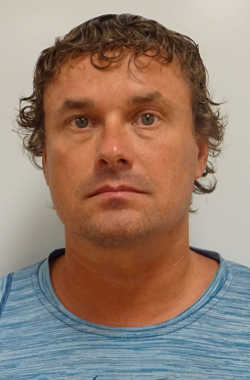
LAKE COUNTY, Calif. – A man who formerly served as a volunteer assistant coach for Lower Lake High School’s award-winning competitive cheer squad has been arrested on charges of annoying or molesting a child and metal knuckles possession.
Joshua Scott Wade, 44, of Clearlake was arrested Wednesday morning on a bench warrant and booked into the Lake County Jail on $15,000 bail.
He has since posted bail and is scheduled to appear in Lake County Superior Court on Nov. 13 for arraignment, according to Senior Deputy District Attorney Ed Borg, who is handling the case.
Borg said Wade is charged with possession of metal knuckles, a felony, and annoying or molesting a child, a misdemeanor.
He said the two charges are not connected – and there is no allegation that the metal knuckles were used to threaten the victim, who didn’t know Wade had them – although the discovery of the knuckles, an illegal weapon, occurred in the context of the annoying or molesting a child investigation.
The investigation began in early August and centers around one alleged female victim under age 18, Borg said.
Borg would not discuss if the alleged victim was known to Wade through cheerleading.
The time frame for the annoying/molesting charge is from June 1 to Aug. 2, while the charge for the metal knuckles dates from Aug. 2, Borg said.
Separately, Lower Lake High School Principal Cecil Edwards told Lake County News that Wade was not a volunteer assistant coach with this year’s cheer squad.
Borg said the investigation was submitted to the District Attorney’s Office for charging on Aug. 22, with the criminal complaint filed the next day.
A warrant was issued for Wade’s arrest – which Borg said is typical in felonies – and that led to Wade’s arrest by the Lake County Sheriff’s Office this week.
Due to the sensitive nature of the case, the specifics of what led to the annoying or molesting charge so far haven’t been made public.
Annoying or molesting a child under age 18, Penal Code 647.6(a)(1), can involve physical contact but Borg said that is not a necessary element.
If convicted, between the two charges Wade could face a maximum sentence of four years – three years for the metal knuckles and one for the annoying or molesting charge, Borg said. An annoying/molesting conviction also would require sexual offender registration.
Borg said Wade has no prior criminal history so he likely would receive probation, not prison time, if convicted of the charges. In that situation, Borg said the District Attorney’s Office would want supervised probation.
For several years Wade has been a part of Lower Lake High cheer activities. He’s been popular with students and parents alike, and lauded for his work with the team as it made its way to the top of the podium at the national championships.
In February, the Clearlake City Council honored Wade and the Lower Lake High School cheer team with a proclamation for having received its second JAMZ Nationals title.
Edwards, who is new to the school this year, told Lake County News on Friday that for about three years Wade served as a volunteer assistant coach for the cheer team. In that capacity, he was not a paid district employee.
“Josh is not part of that team this year,” said Edwards.
At the end of last year, the head coach resigned. Then, this summer, the school hired a new head coach who brought on her own group of assistant coaches, Edwards explained.
Since then, Edwards said Wade has not volunteered to work with the school’s cheer team.
Email Elizabeth Larson at
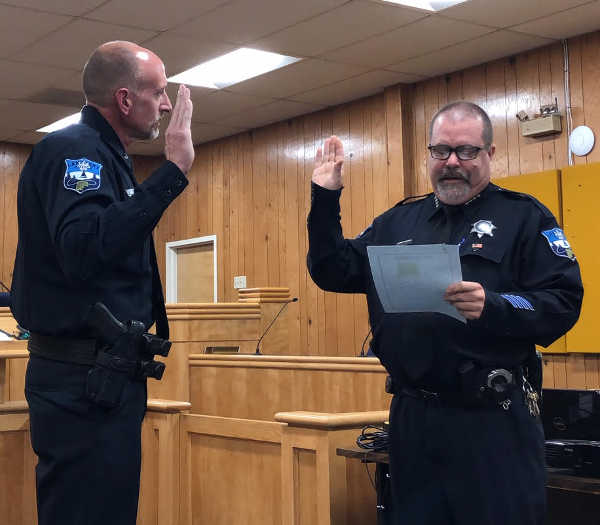
LAKEPORT, Calif. – A Lakeport Police Department veteran was sworn in on Thursday as the agency’s new second in command.
Dale Stoebe took the oath as the department’s new lieutenant from Chief Brad Rasmussen in a Thursday evening ceremony in the city council chambers at Lakeport City Hall.
“Dale will be an asset to and enhance the administration of the police department as well as the city and we welcome him to his new position,” Rasmussen said Thursday.
Stoebe’s appointment as lieutenant went into effect on Monday.
The department’s longtime lieutenant, Jason Ferguson, left in July to take the police chief’s job in Cloverdale, as Lake County News has reported.
Since Ferguson’s departure for Cloverdale, Gerardo Gonzalez, the retired Willits Police chief who also works for the Lakeport Police Department as a reserve police officer, has been filling the lieutenant’s job on an interim basis.
Rasmussen told Lake County News that Stoebe has nearly 29 years of law enforcement experience with the Lakeport Police Department.
Stoebe joined the agency in December of 1990 as a reserve officer, serving in that capacity until being hired as a police officer in March of 1993.
During his tenure as a police officer, Rasmussen said Stoebe has served in patrol and acted as a school resource officer for the Lakeport Unified School District.
Stoebe went on to serve eight years as a sergeant and 10 years as a detective, Rasmussen said.
Rasmussen said that, as an investigator and detective, Stoebe has been assigned to investigate complex narcotic cases as part of the former Lake County Interagency Narcotic Task Force.
Stoebe also investigated the majority of the most complex crimes that have occurred in the city, including sex crimes, financial crimes, computer crimes, burglaries, serious assaults and homicide, Rasmussen said.
Stoebe has amassed more than 3,000 hours of advanced officer training certified through the Commission on Peace Officer Standards and Training, or POST, and hundreds more hours in other non-POST training in all areas of law enforcement and investigations, according to Rasmussen.
Other Lakeport Police officers have credited Stoebe with being an important mentor to them in their law enforcement careers.
Rasmussen said that in his new position, Lt. Stoebe will run the operations section of the department and manage several of its programs, as well as provide leadership to officers and supervisors for the agency, which has 13 sworn personnel.
Email Elizabeth Larson at

CLEARLAKE, Calif. – This week Clearlake Police officers conducting a probation search recovered a stolen handgun.
Tiffany Anne Correia, 35, of Clearlake was arrested Tuesday afternoon, according to a report from the Clearlake Police Department.
Just before noon on Tuesday, Officer Chris Kelleher drove to Correia's residence to conduct a probation search. Police said Correia is on probation out of Lake County and is a convicted felon.
When Kelleher arrived at Correia’s home, he observed the front door of the residence was open. The report said he announced his presence as he saw Correia exiting a bathroom.
While Kelleher was speaking with Correia, Officer Mike Perreault arrived on the scene to assist, police said.
Officer Kelleher searched Correia’s bedroom and located 74 rounds of .22-caliber ammunition and two glass smoking pipes. Police said Kelleher interviewed Correia regarding the ammunition and two glass smoking pipes that were discovered in her bedroom.
Police said Officer Perreault searched the bathroom that Officer Kelleher observed Correia exiting. There, he discovered a black .22-caliber Ruger long rifle semi-automatic pistol lying on the ground behind the toilet.
A records check of the handgun via serial number revealed it had been reported stolen to the Lake County Sheriff's Department, police reported.
Police said Correia was arrested on probable cause for numerous firearm violations along with a violation of her probation terms.
She was transported to the Lake County Jail for booking where she remained in custody on Friday on a no bail hold. Her booking sheet shows she is scheduled to appear in Lake County Superior Court on Sept. 23.