The “Matilliha Manor” at the home of Ken Harper and Sherry Bauman in Kelseyville, Calif. Photo courtesy of the Lake County Quilt Trail. KELSEYVILLE, Calif. – “Matilliha Manor” has been added to the Lake County Quilt Trail.
This quilt block has been installed on the lovely Victorian porch facing Gard Street at the home of Ken Harper and Sherry Bauman at 5205 Second St. in Kelseyville.
Matilliha Manor is a Victorian home built in 1871. In the early 1900s the front bedroom served as a dentist office while the family resided in the rest of the home.
In the late 1980s Marilyn and Myron Holdenried purchased and renovated the home, bringing it back to its former glory.
The home was used as an event center/vacation home before being purchased by current owners Ken Harper and Sherry Bauman.
They have worked hard to honor the tradition of the home with period pieces giving one the feeling of stepping back in time.
This quilt block is in honor of Mr. and Mrs. Holdenried – Marilyn Holdenried founded the Lake County Quilt Trail – bringing together two legacies they have brought to Lake County, Matilliha Manor and the quilt trail.
The Lake County Quilt Trail is an agricultural and tourism project designed to promote community pride.
The 4-foot by 4-foot quilt block was drawn and painted by the Lake County Quilt Trail team, a group of dedicated volunteer quilters, graphic artists, painters, writers and carpenters.
LAKE COUNTY, Calif. – Lake County Animal Care and Control has several dogs this week ready and waiting for their new homes.
Dogs available for adoption this week include mixes of Cane Corso mastiff, Chihuahua, Labrador Retriever, pit bull and terrier.
Dogs that are adopted from Lake County Animal Care and Control are either neutered or spayed, microchipped and, if old enough, given a rabies shot and county license before being released to their new owner. License fees do not apply to residents of the cities of Lakeport or Clearlake.
If you're looking for a new companion, visit the shelter. There are many great pets hoping you'll choose them.
The following dogs at the Lake County Animal Care and Control shelter have been cleared for adoption (additional dogs on the animal control Web site not listed are still “on hold”).
This female Chihuahua-terrier mix is in kennel No. 4, ID No. 12885. Photo courtesy of Lake County Animal Care and Control. Female Chihuahua-terrier mix
This female Chihuahua-terrier mix has a short tan and white coat.
She is in kennel No. 4, ID No. 12885.
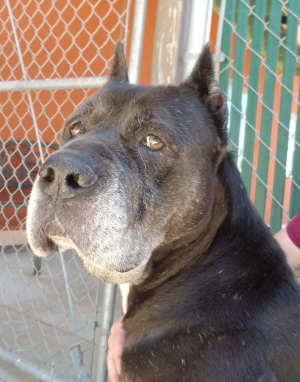
“Nova” is a female Cane Corso mastiff in kennel No. 17, ID No. 6579. Photo courtesy of Lake County Animal Care and Control. ‘Nova’
“Nova” is a female Cane Corso mastiff with a short black coat.
She is in kennel No. 17, ID No. 6579.
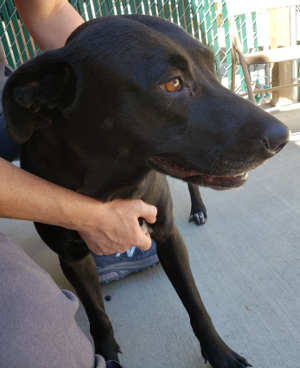
This female Labrador Retriever is in kennel No. 23, ID No. 12697. Photo courtesy of Lake County Animal Care and Control. Female Labrador Retriever
This female Labrador Retriever has a short black.
She is in kennel No. 23, ID No. 12697.
“Misty Marie” is a young female pit bull terrier in kennel No. 29, ID No. 12725. Photo courtesy of Lake County Animal Care and Control. ‘Misty Marie’
“Misty Marie” is a young female pit bull terrier.
She has a short black coat.
She is in kennel No. 29, ID No. 12725.
Lake County Animal Care and Control is located at 4949 Helbush in Lakeport, next to the Hill Road Correctional Facility.
Office hours are Monday through Friday, 11 a.m. to 5 p.m., and 11 a.m. to 3 p.m., Saturday. The shelter is open from 11 a.m. to 4 p.m., Monday through Friday and on Saturday from 11 a.m. to 3 p.m.
For more information call Lake County Animal Care and Control at 707-263-0278.
Email Elizabeth Larson at This email address is being protected from spambots. You need JavaScript enabled to view it.. Follow her on Twitter, @ERLarson, or Lake County News, @LakeCoNews.
Hot and dry. These are the watchwords for large fires.
While every fire needs a spark to ignite and fuel to burn, it's the hot and dry conditions in the atmosphere that determine the likelihood of a fire starting, its intensity and the speed at which it spreads.
Over the past several decades, as the world has increasingly warmed, so has its potential to burn.
Since 1880, the world has warmed by 1.9 degrees Fahrenheit, with the five warmest years on record occurring in the last five years.
Since the 1980s, the wildfire season has lengthened across a quarter of the world's vegetated surface, and in some places like California, fire has become nearly a year-round risk. The year 2018 presented California's worst wildfire season on record, on the heels of a devasting 2017 fire season.
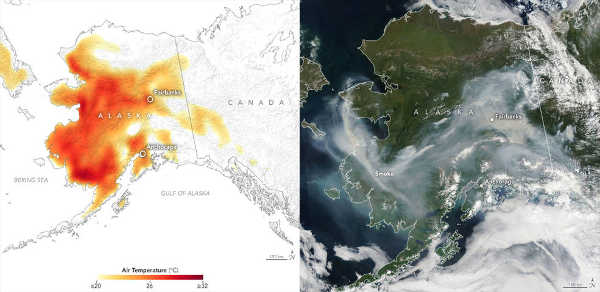
In 2019, wildfires have already burned 2.5 million acres in Alaska in an extreme fire season driven by high temperatures, which have also led to massive fires in Siberia.
Whether started naturally or by people, fires worldwide and the resulting smoke emissions and burned areas have been observed by NASA satellites from space for two decades. Combined with data collected and analyzed by scientists and forest managers on the ground, researchers at NASA, other U.S. agencies and universities are beginning to draw into focus the interplay between fires, climate and humans.
"Our ability to track fires in a concerted way over the last 20 years with satellite data has captured large-scale trends, such as increased fire activity, consistent with a warming climate in places like the western U.S., Canada and other parts of Northern Hemisphere forests where fuels are abundant," said Doug Morton, chief of the Biospheric Sciences Laboratory at NASA's Goddard Space Flight Center in Greenbelt, Maryland. "Where warming and drying climate has increased the risk of fires, we’ve seen an increase in burning."
A hotter, drier world
High temperatures and low humidity are two essential factors behind the rise in fire risk and activity, affecting fire behavior from its ignition to its spread.
Even before a fire starts they set the stage, said Jim Randerson, an Earth system scientist at the University of California, Irvine who studies fires both in the field and with satellite data.
He and his colleagues studied the abundance of lightning strikes in the 2015 Alaskan fire season that burned a record 5.1 million acres. Lightning strikes are the main natural cause of fires.
The researchers found an unusually high number of lightning strikes occurred, generated by the warmer temperatures that cause the atmosphere to create more convective systems — thunderstorms — which ultimately contributed to more burned area that year.
Hotter and drier conditions also set the stage for human-ignited fires. "In the Western U.S., people are accidentally igniting fires all the time," Randerson said. "But when we have a period of extreme weather, high temperatures, low humidity, then it’s more likely that typical outdoor activity might lead to an accidental fire that quickly gets out of control and becomes a large wildfire."
For example, in 2018 sparks flying from hammering a concrete stake into the ground in 100-degree Fahrenheit heat and sparks from a car's tire rim scraping against the asphalt after a flat tire were the causes of California's devastatingly destructive Ranch and Carr Fires, respectively.
These sparks quickly ignited the vegetation that was dried out and made extremely flammable by the same extreme heat and low humidity, which research also shows can contribute to a fire's rapid and uncontrollable spread, said Randerson. The same conditions make it more likely for agricultural fires to get out of control.
A warming world also has another consequence that may be contributing to fire conditions persisting over multiple days where they otherwise might not have in the past: higher nighttime temperatures.
"Warmer nighttime temperature allow fires to burn through the night and burn more intensely, and that allows fires to spread over multiple days where previously, cooler nighttime temperatures might have weakened or extinguished the fire after only one day," Morton said.
In June and early July 2019, a heat wave in Alaska broke temperature records, as seen in this July 8 air temperature map (left). The corresponding image from the Moderate Resolution Imaging Spectroradiometer (MODIS) instrument on Aqua on the right shows smoke from lightening-triggered wildfires. Credits: NASA Earth Observatory. Climate systems at work
Hot and dry conditions that precede fires can be tempered by rain and moisture circulating in the atmosphere. On time scales of months to years, broader climate patterns move moisture and heat around the planet.
Monitoring these systems with satellite observations allows researchers to be able to begin to develop computer models for predicting whether an upcoming fire season in a given region will be light, average or extreme. The most important of these indicators are sea surface temperatures in the Pacific Ocean that govern the El Niño Southern Oscillation, or ENSO.
"ENSO is a major driver of fire activity across multiple continents," Randerson said, who along with Morton and other researchers have studied the relationship between El Niño events and fire seasons in South America, Central America, parts of North America, Indonesia, Southeast Asia and equatorial Asia. "The precipitation both before the fire season and during the fire season can be predicted using sea surface temperatures that are measured by NASA and NOAA satellites."
An ongoing project, said Randerson, is to now extend that prediction capability globally to regions that are affected by other ocean-climate temperature changes and indicators.
The human factor
In studying the long-term trends of fires, human land management is as important to consider as any other factor. Globally, someplace on Earth is always on fire — and most of those fires are set by people, either accidentally in wildlands, or on purpose, for example, to clear land or burn agricultural fields after the harvest to remove crop residues.
But not all fires behave the same way. Their behavior depends on the fuel type and the how people are changing the landscape.
While fire activity has gotten worse in northern latitude forests, research conducted by Randerson and Morton has shown that despite climate conditions that favor fires, the number of fires in grassland and savanna ecosystems worldwide are declining, contributing to an overall decline in global burned area.
The decline is due to an increased human presence creating new cropland and roads that serve as fire breaks and motivate the local population to fight these smaller fires, said Morton.
"Humans and climate together are really the dual factors that are shaping the fires around the world. It's not one or the other," Randerson said.
Fire feedbacks
Fires impact humans and climate in return. For people, beyond the immediate loss of life and property, smoke is a serious health hazard when small soot particles enter the lungs, Long-term exposure has been linked to higher rates of respiratory and heart problems.
Smoke plumes can travel for thousands of miles affecting air quality for people far downwind of the original fire. Fires also pose a threat to local water quality, and the loss of vegetation can lead to erosion and mudslides afterwards, which have been particularly bad in California, Randerson said.
For the climate, fires can directly and indirectly increase carbon emissions to the atmosphere. While they burn, fires release carbon stored in trees or in the soil. In some places like California or Alaska, additional carbon may be released as the dead trees decompose, a process that may take decades because dead trees will stand like ghosts in the forest, decaying slowly, said Morton.
In addition to releasing carbon as they decompose, the dead trees no longer act as a carbon sink by pulling carbon dioxide out of the atmosphere.
In some areas like Indonesia, Randerson and his colleagues have found that the radiocarbon age of carbon emissions from peat fires is about 800 years, which is then added to the greenhouse gases in that atmosphere that drive global warming.
In Arctic and boreal forest ecosystems, fires burn organic carbon stored in the soils and hasten the melting of permafrost, which release methane, another greenhouse gas, when thawed.
Another area of active research is the mixed effect of particulates, or aerosols, in the atmosphere in regional climates due to fires, Randerson said.
Aerosols can be dark like soot, often called black carbon, absorbing heat from sunlight while in the air, and when landing and darkening snow on the ground, accelerating its melt, which affects both local temperatures — raising them since snow reflects sunlight away — and the water cycle.
But other aerosol particles can be light colored, reflecting sunlight and potentially having a cooling effect while they remain in the atmosphere. Whether dark or light, according to Randerson, aerosols from fires may also have an effect on clouds that make it harder for water droplets to form in the tropics, and thus reduce rainfall — and increase drying.
Fires of all types reshape the landscape and the atmosphere in ways that can resonate for decades. Understanding both their immediate and long-term effects requires long-term global data sets that follow fires from their detection to mapping the scale of their burned area, to tracing smoke through the atmosphere and monitoring changes to rainfall patterns.
"As climate warms, we have an increasing frequency of extreme events. It’s critical to monitor and understand extreme fires using satellite data so that we have the tools to successfully manage them in a warmer world," Randerson said.
Ellen Gray is a member of NASA's Earth Science News Team.
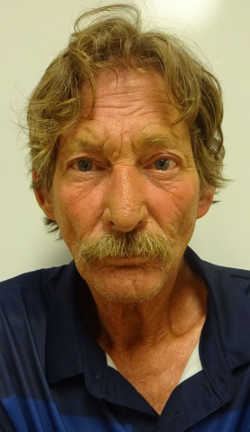
Thomas Andrew Magee, 62, of Clearlake, Calif., has been charged with using his van to kill an acquaintance on the morning of Tuesday, September 10, 2019. Photo courtesy of the Lake County Sheriff’s Office. LAKEPORT, Calif. – The man arrested for killing an acquaintance in Lucerne with a vehicle early Tuesday has been formally charged and made his first court appearance.
Thomas Andrew Magee, 62, of Clearlake, was arrested for the killing of Joseph Symond Jackson, 40, of Lucerne, as Lake County News has reported.
Authorities said Magee ran Jackson over with his van on Highway 20 and Seventh Avenue in Lucerne at about 1:30 a.m. Tuesday before fleeing the scene. A California Highway Patrol officer took Magee into custody about 20 minutes later near Clearlake Oaks.
The sheriff’s office said that the two men, who had been acquaintances for a short time, had a dispute over property leading up to Jackson’s killing.
Magee was arraigned in Lake County Superior Court on Thursday.
Chief Deputy District Attorney Richard Hinchcliff said he has filed a criminal complaint against Magee, charging him with first-degree murder and vehicular manslaughter.
At Thursday’s arraignment, Magee’s bail – which initially was set at $1 million – was raised to $1.3 million, Hinchcliff said.
Jail records show that Magee is set to return to court on Sept. 17.
Email Elizabeth Larson at This email address is being protected from spambots. You need JavaScript enabled to view it.. Follow her on Twitter, @ERLarson, or Lake County News, @LakeCoNews.
PG&E Corp. and Pacific Gas and Electric Co. have agreed in principle with entities representing approximately 85 percent of insurance subrogation claims to an $11 billion settlement to resolve all such claims arising from the 2017 Northern California wildfires and 2018 Camp Fire.
These claims are based on payments made by insurance companies to individuals and businesses with insurance coverage for wildfire damages.
The settlement is subject to definitive documentation and approval of the bankruptcy court overseeing PG&E’s Chapter 11 case.
The settlement is to be implemented pursuant to PG&E’s Chapter 11 plan of reorganization and subject to confirmation of the plan by the bankruptcy court.
“Today’s settlement is another step in doing what’s right for the communities, businesses, and individuals affected by the devastating wildfires,” Bill Johnson, CEO and president of PG&E Corp., said Friday. “As we work to resolve the remaining claims of those who’ve suffered, we are also focused on safely and reliably delivering energy to our customers, improving our systems and infrastructure, and continuing to support California’s clean energy goals. We are committed to becoming the utility our customers deserve.”
This is PG&E’s second major settlement of wildfire claims.
On June 19, PG&E and 18 local public entities that included cities, counties, districts and public agencies – among them the county of Lake and the city of Clearlake – announced that they had reached agreements to settle their claims relating to the 2015, 2017, and 2018 wildfires for a total of $1 billion to be implemented as part of the plan, as Lake County News has reported.
Proceedings regarding the third and final major group of wildfire claims are currently pending in both Federal District Court and State Court.
PG&E said it remains committed to working with the individual plaintiffs to fairly and reasonably resolve their claims and will continue to work to do so.
In connection with Friday’s settlement, PG&E amended the previously announced equity financing commitment agreements to accommodate the total amount of subrogation claims contemplated by the settlement and reaffirmed the total $14 billion equity financing commitment target for the plan.
PG&E has received renewed commitments of $1.5 billion under the revised equity financing commitments and intends to seek remaining equity financing commitments over the next several weeks.
The company expects that the equity financing commitment will be part of a more comprehensive financing package to emerge from Chapter 11.
PG&E also expects to amend the plan to incorporate the terms of the settlement of the subrogation claims after completion of the definitive documentation for the settlement.
Jonathan Washington, 31, walked away from the California Correctional Center Chamberlain Creek Conservation Camp in Mendocino County on Friday, September 13, 2019. Photo courtesy of the California Department of Corrections and Rehabilitation. NORTH COAST, Calif. – California Department of Corrections and Rehabilitation officials are searching for a minimum-security inmate who walked away from the California Correctional Center Chamberlain Creek Conservation Camp in Mendocino County on Friday.
Inmate Jonathan Washington, 31, was discovered missing from Chamberlain Creek Conservation Camp at 12:30 p.m. during a routine count.
Authorities said Washington was last seen at the camp at 8 a.m. Friday wearing grey sweatpants, a white t-shirt and white tennis shoes.
CDCR’s Office of Correctional Safety, Cal Fire, California Highway Patrol and local law enforcement agencies have been notified and are assisting in the search for Washington.
Washington is a black male, 6 feet 4 inches tall, weighing 217 pounds with brown eyes, black hair in dreadlocks, a goatee and mustache.
He was received by CDCR in December from Kings County to serve three years and eight months for vandalism and corporal injury on a specific person resulting in a traumatic condition. He was scheduled to parole in March 2020.
Anyone who sees inmate Washington should contact 911 or law enforcement authorities immediately.
Anyone having information about or knowledge of the location of Washington should contact the CCC watch commander at 530 257-2181, Extension 4173.
 How to resolve AdBlock issue?