 How to resolve AdBlock issue?
News
- Details
- Written by: Briony Horgan, Purdue University and Melissa Rice, Western Washington University

NASA just took the next giant leap in the search for signs of life beyond Earth.
On July 30, NASA launched its most sophisticated and ambitious spacecraft to Mars: the aptly named Perseverance rover. This will be the third launch to Mars this month, following the UAE’s Hope and China’s Tianwen-1 spacecraft. Perseverance will look for signatures of ancient life preserved in Mars rocks. And, for the first time, this rover will collect rock samples that will be brought back to Earth, where they can be scrutinized in laboratories for decades to come.
Mars is one the few destinations in the Solar System that has had conditions suitable for life as we know it. There is a chance that Perseverance will collect the sample from Mars that answers the question: “Are we alone in the universe?” This question is especially relevant right now. During the coronavirus pandemic, the mission has remarkably stayed on track for launch in spite of disruptions and delays, and we have been reminded that life on Earth is vulnerable and precious.
As two experts in planetary science and members of the Perseverance science team, we expect that this mission will be the best chance – within our own lifetimes at least – to create a scientific revolution in astrobiology.

Searching for life in Jezero crater
On Feb. 18, 2021, if all goes according to plan, Perseverance will enter the Martian atmosphere at 13,000 mph, and seven nerve-racking minutes later, will be lowered gently onto the surface by a jetpack. The rover will land in Jezero crater, a site that NASA hopes will provide a window to a time when rain fell and rivers flowed on ancient Mars.
Over the past 30 years, a fleet of rovers and orbiters have built a picture of an Earth-like ancient Mars. Between 3 and 4 billion years ago, Mars hosted vast river networks as long as the Mississippi, deep lakes that contained the building blocks of life, and hot springs that bubbled with potential for life. These watery environments were able to exist because ancient Mars had a thick atmosphere. However, that atmosphere has been leaking away, leaving the surface today cold, dry and inhospitable.
After five years of debate, Jezero crater was selected as the site on Mars that is most likely to preserve signs of life that might have inhabited Mars billions of years ago, when microbial life was first starting on Earth. Satellite images of Jezero show a river leading into the crater and ending in a large delta, which must have formed in a long-lived ancient lake. A bathtub ring of carbonate minerals around the edge of the crater might have formed along ancient beaches, and may preserve rocks with microbial textures known as stromatolites. Stromatolites record some of the earliest signs of life on Earth, and Perseverance will search for similar signs of life on Mars.
Advanced exploration technology
Perseverance will have many new capabilities that will transform how we explore Mars. The rover carries Ingenuity, a small helicopter that will be the first aircraft to fly on another planet. Because Mars’ atmosphere today is so thin – only 1% of the Earth’s – Ingenuity has to be extremely lightweight (4 lbs) with very large blades (4 feet tip-to-tip) to get off the ground. Ingenuity will take images of the distant landscape and help us scout the rover’s traverse; future Mars missions could adopt this model of rovers and aircraft working in tandem.
Looking even further ahead, Perseverance will help prepare for future human missions to Mars. One of many challenges for astronauts will be the packing list for a two-year roundtrip journey, which includes air, water and rocket fuel to get home. If these resources could be harvested on Mars, human missions would be much more feasible. Perseverance will test a process for creating oxygen from Mars’ carbon dioxide atmosphere. In the future, similar instruments could be sent ahead of astronauts, so that breathable air and liquid oxygen rocket propellant are waiting when they arrive.

Getting the samples back to Earth
The most immediate goal of the mission is to search for evidence of past life, and Perseverance’s science payload will allow the rover to search for organic materials and microbial textures at the scale of a grain of salt. However, finding definitive evidence of microbial life is extremely difficult. Ultimately, we will need to look at samples from Jezero with advanced instruments on Earth. This is why Perseverance will also collect pencil-sized rock cores that will be returned to Earth by a series of missions in the late 2020s.
[Deep knowledge, daily. Sign up for The Conversation’s newsletter.]
By laying the groundwork for sample return with Perseverance, NASA is taking the next giant leap in its exploration of Mars. The rocks collected by Perseverance may be our only shot in the foreseeable future to search for signs of life with samples from another planet. This mission, therefore, is not just “go big or go home” – it is “go big and go home.”
Briony Horgan, Associate Professor of Planetary Science, Purdue University and Melissa Rice, Associate Professor of Planetary Science, Western Washington University
This article is republished from The Conversation under a Creative Commons license. Read the original article.
- Details
- Written by: Elizabeth Larson
On Friday state officials reported that 38 of California’s 58 counties were on the list, representing 93 percent of the state’s residents.
Lake County Public Health Officer Dr. Gary Pace confirmed on Friday that Lake wasn’t yet on the list, but that all of its neighboring counties – Colusa, Glenn, Mendocino, Napa, Sonoma and Yolo – are.
All of Lake’s neighboring counties have seen rapid case growth in recent weeks, including Colusa and Glenn in the Sacramento Valley, which have smaller populations but higher caseloads.
As of Friday night, Colusa was reporting 323 cases and four deaths; Glenn, 325 cases, one death; Mendocino, 312 cases, nine deaths; Napa, 888 cases, eight deaths; Sonoma County, 2,842 cases, 32 deaths; and Yolo, 1,510 cases, 41 deaths. Lake County has so far reported 195 cases and one death.
Pace pointed to issues in Mendocino and Sonoma counties where they have recently seen outbreaks in skilled nursing facilities that resulted in deaths.
Statewide, Public Health departments reported nearly 500,000 cases and more than 9,200 deaths on Friday night.
Pace told the Board of Supervisors on Tuesday that while there are new cases being reported daily in the county, and there was a “close call” with an outbreak, there haven’t been explosive rises in the caseload and the hospitals aren’t getting overloaded.
He said the caseload is manageable and the county is meeting the requirements of its reopening variance.
“The state did check in with us and we did have to confirm that we are still meeting all our variance metrics,” he said.
At that point, Lake County’s positivity rate was at 4.4 percent. By Friday, it had dropped to 3.4 percent. Pace told the board that a positivity rate of 8 percent or higher “is a problem.”
Pace said Friday that, despite Lake County’s relative success, it sits one significant outbreak or spike in infection rate that applies pressure to the local hospital capacity away from joining the 38 counties on the state’s county monitoring list.
In his comments to the board on Tuesday, Pace said once a county gets on the watch list, it doesn’t get off of it until the state changes the requirements.
Being added to the list means a loss of local control, he said.
The counties on the monitoring list for three or more consecutive days must close indoor operations for certain sectors, Pace explained.
If Lake County were to cross the threshold and be added to the monitoring list, Pace said gyms and fitness centers, places of worship, hair salons and barbershops, and personal care services (including nail salons, massage parlors, and tattoo parlors) would be required to close or shift to entirely outdoor services and activities. In counties on the monitoring list, schools cannot open, he added.
“Unfortunately, we cannot guarantee Lake County will maintain local control throughout the remainder of the pandemic. Work in critical sectors must go on at all times, and there will continue to be significant risks until a vaccine is developed and readily available,” Pace said.
However, he encouraged the community to do several simple things that make a significant difference.
Pace said those measures include washing hands, wearing a facial covering when outside of one’s home, observing social distancing, canceling and avoiding gatherings with individuals outside of your immediate household, particularly indoor activities, and complying with health orders, which are designed to limit overall risk.
Email Elizabeth Larson at
- Details
- Written by: J. Alexander Navarro, University of Michigan
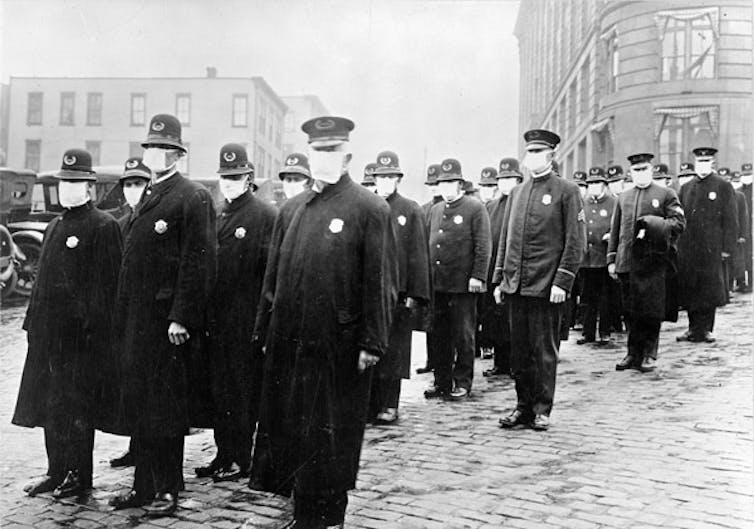
We have all seen the alarming headlines: Coronavirus cases are surging in 40 states, with new cases and hospitalization rates climbing at an alarming rate. Health officials have warned that the U.S. must act quickly to halt the spread – or we risk losing control over the pandemic.
There’s a clear consensus that Americans should wear masks in public and continue to practice proper social distancing. While a majority of Americans support wearing masks, widespread and consistent compliance has proven difficult to maintain in communities across the country. Demonstrators gathered outside city halls in Scottsdale, Arizona; Austin, Texas; and other cities to protest local mask mandates. Several Washington state and North Carolina sheriffs have announced they will not enforce their state’s mask order.
I’ve researched the history of the 1918 pandemic extensively. At that time, with no effective vaccine or drug therapies, communities across the country instituted a host of public health measures to slow the spread of a deadly influenza epidemic: They closed schools and businesses, banned public gatherings and isolated and quarantined those who were infected. Many communities recommended or required that citizens wear face masks in public – and this, not the onerous lockdowns, drew the most ire.
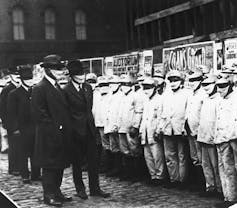
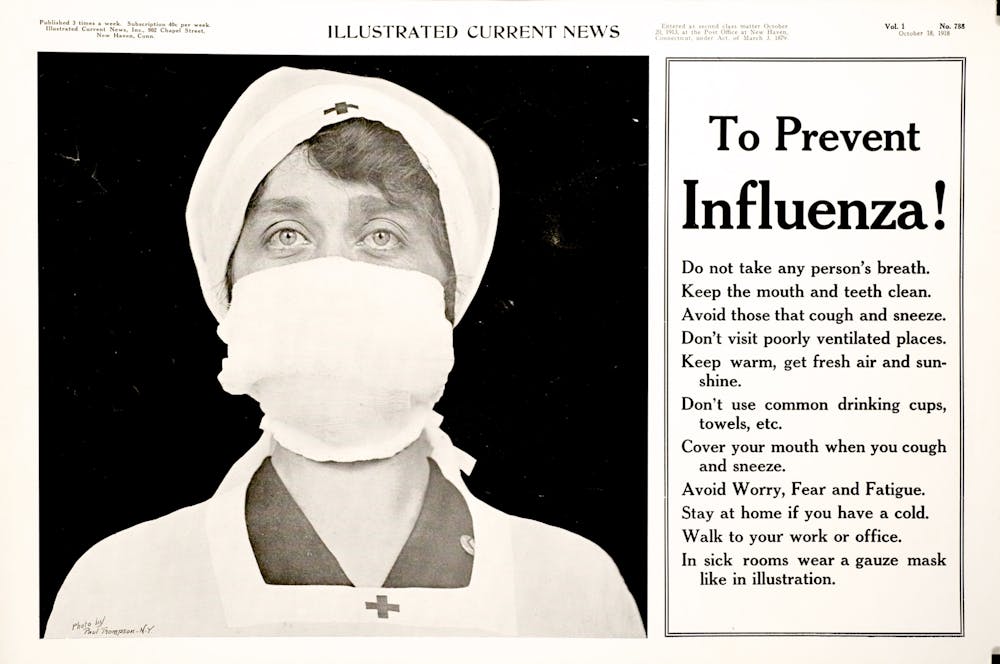
In mid-October of 1918, amidst a raging epidemic in the Northeast and rapidly growing outbreaks nationwide, the United States Public Health Service circulated leaflets recommending that all citizens wear a mask. The Red Cross took out newspaper ads encouraging their use and offered instructions on how to construct masks at home using gauze and cotton string. Some state health departments launched their own initiatives, most notably California, Utah and Washington.
[Deep knowledge, daily. Sign up for The Conversation’s newsletter.]
Nationwide, posters presented mask-wearing as a civic duty – social responsibility had been embedded into the social fabric by a massive wartime federal propaganda campaign launched in early 1917 when the U.S. entered the Great War. San Francisco Mayor James Rolph announced that “conscience, patriotism and self-protection demand immediate and rigid compliance” with mask wearing. In nearby Oakland, Mayor John Davie stated that “it is sensible and patriotic, no matter what our personal beliefs may be, to safeguard our fellow citizens by joining in this practice” of wearing a mask.
Health officials understood that radically changing public behavior was a difficult undertaking, especially since many found masks uncomfortable to wear. Appeals to patriotism could go only so far. As one Sacramento official noted, people “must be forced to do the things that are for their best interests.” The Red Cross bluntly stated that “the man or woman or child who will not wear a mask now is a dangerous slacker.” Numerous communities, particularly across the West, imposed mandatory ordinances. Some sentenced scofflaws to short jail terms, and fines ranged from US$5 to $200.

Passing these ordinances was frequently a contentious affair. For example, it took several attempts for Sacramento’s health officer to convince city officials to enact the order. In Los Angeles, it was scuttled. A draft resolution in Portland, Oregon led to heated city council debate, with one official declaring the measure “autocratic and unconstitutional,” adding that “under no circumstances will I be muzzled like a hydrophobic dog.” It was voted down.
Utah’s board of health considered issuing a mandatory statewide mask order but decided against it, arguing that citizens would take false security in the effectiveness of masks and relax their vigilance. As the epidemic resurged, Oakland tabled its debate over a second mask order after the mayor angrily recounted his arrest in Sacramento for not wearing a mask. A prominent physician in attendance commented that “if a cave man should appear…he would think the masked citizens all lunatics.”
In places where mask orders were successfully implemented, noncompliance and outright defiance quickly became a problem. Many businesses, unwilling to turn away shoppers, wouldn’t bar unmasked customers from their stores. Workers complained that masks were too uncomfortable to wear all day. One Denver salesperson refused because she said her “nose went to sleep” every time she put one on. Another said she believed that “an authority higher than the Denver Department of Health was looking after her well-being.” As one local newspaper put it, the order to wear masks “was almost totally ignored by the people; in fact, the order was cause of mirth.” The rule was amended to apply only to streetcar conductors – who then threatened to strike. A walkout was averted when the city watered down the order yet again. Denver endured the remainder of the epidemic without any measures protecting public health.
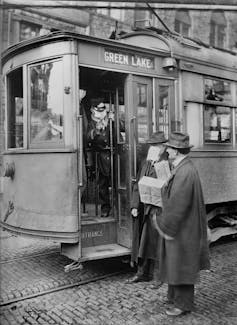
In Seattle, streetcar conductors refused to turn away unmasked passengers. Noncompliance was so widespread in Oakland that officials deputized 300 War Service civilian volunteers to secure the names and addresses of violators so they could be charged. When a mask order went into effect in Sacramento, the police chief instructed officers to “Go out on the streets, and whenever you see a man without a mask, bring him in or send for the wagon.” Within 20 minutes, police stations were flooded with offenders. In San Francisco, there were so many arrests that the police chief warned city officials he was running out of jail cells. Judges and officers were forced to work late nights and weekends to clear the backlog of cases.
Many who were caught without masks thought they might get away with running an errand or commuting to work without being nabbed. In San Francisco, however, initial noncompliance turned to large-scale defiance when the city enacted a second mask ordinance in January 1919 as the epidemic spiked anew. Many decried what they viewed as an unconstitutional infringement of their civil liberties. On January 25, 1919, approximately 2,000 members of the “Anti-Mask League” packed the city’s old Dreamland Rink for a rally denouncing the mask ordinance and proposing ways to defeat it. Attendees included several prominent physicians and a member of the San Francisco Board of Supervisors.
It is difficult to ascertain the effectiveness of the masks used in 1918. Today, we have a growing body of evidence that well-constructed cloth face coverings are an effective tool in slowing the spread of COVID-19. It remains to be seen, however, whether Americans will maintain the widespread use of face masks as our current pandemic continues to unfold. Deeply entrenched ideals of individual freedom, the lack of cohesive messaging and leadership on mask wearing, and pervasive misinformation have proven to be major hindrances thus far, precisely when the crisis demands consensus and widespread compliance. This was certainly the case in many communities during the fall of 1918. That pandemic ultimately killed about 675,000 people in the U.S. Hopefully, history is not in the process of repeating itself today.
This article was updated to correct the location of sheriffs mentioned.
J. Alexander Navarro, Assistant Director, Center for the History of Medicine, University of Michigan
This article is republished from The Conversation under a Creative Commons license. Read the original article.
- Details
- Written by: LAKE COUNTY NEWS REPORTS
The virtual event will take place at 9 a.m. Friday, Aug. 7, on Thompson’s Facebook page.
The event will feature animals from Forget Me Not Farm Children’s Services.
Thompson will have a short discussion with animal handlers about each animal that will be streamed live on his Facebook page and discuss the work done at the farm to address food insecurity for children.
All constituents and particularly children of California’s Fifth Congressional District are invited to participate.
Thompson represents California’s Fifth Congressional District, which includes all or part of Contra Costa, Lake, Napa, Solano and Sonoma counties.