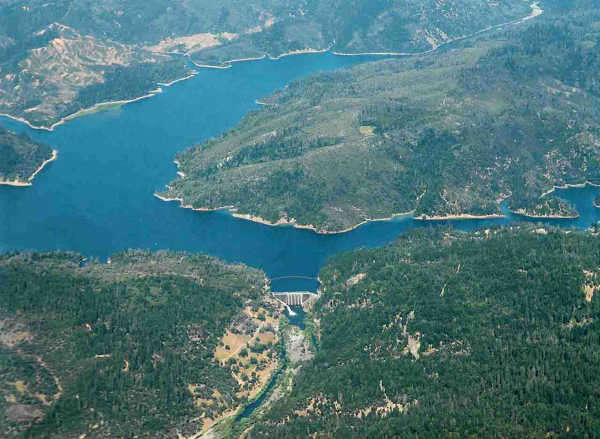
The Scott Dam at Lake Pillsbury in Lake County, California. File photo/courtesy of Pacific Gas and Electric Co.
LAKE COUNTY, Calif. — Pacific Gas and Electric said it has filed the necessary documents to decommission — and eventually remove — the Potter Valley Project, which includes the Scott Dam and Lake Pillsbury in Lake County.
The utility announced on Friday that it had filed the final surrender application and decommissioning plan for the project with the Federal Energy Regulatory Commission, or FERC.
The Potter Valley Project is located in Lake and Mendocino counties.
It consists of two dams along the upper main stem of the Eel River, the Scott Dam and the Cape Horn Dam — as well as the Potter Valley powerhouse, the 80,000-acre-foot Lake Pillsbury in Lake County, the Van Arsdale Reservoir, a fish passage structure and salmon and steelhead counting station at the Cape Horn Dam, and and 5,600 acres of land.
The filing comes six years after PG&E initially informed FERC that it would not pursue a renewed operating license.
The draft of the surrender application and decommissioning plan was released for public comment at the end of January and closed in March.
Dave Gabbard, vice president of power generation for PG&E, said the filing “marks the next step of a thoughtful and transparent decommissioning journey for the Potter Valley Project — but it does not change our operational responsibilities or obligations. We remain fully committed to meeting all current FERC requirements as we work through the decommissioning up until the license is terminated by FERC. As stewards of public resources and partners to the communities we serve, our priority is clear: to move forward responsibly, collaboratively, and with the continued reliability our stakeholders expect."
While Gabbard said PG&E will “move forward responsibly, collaboratively, and with the continued reliability our stakeholders expect,” the company’s announcement doesn’t specifically mention working with Lake County while referencing numerous other regional stakeholders, many of whom have participated in a “two basin solution” that sought to exclude Lake County’s interests from the beginning, according to local leaders.
“As PG&E moves forward with plans to decommission and eventually remove Cape Horn and Scott dams, PG&E continues to coordinate closely with parties to support a new water diversion facility, including Sonoma County Water Agency, Inland Water & Power Commission of Mendocino County, Round Valley Tribes, Humboldt County, Cal Trout, Trout Unlimited and California Department of Fish & Wildlife,” the company said.
PG&E said its FERC submittal includes a request to allow the Eel-Russian Project Authority to construct the New Eel-Russian Facility at the current location of Cape Horn Dam. That facility will provide diversion flows from the Eel River to the Russian River watershed after PG&E’s removal of Cape Horn Dam and Scott Dam.
Reached for comment on the documents’ release, Lake County District 2 Supervisor Bruno Sabatier said Friday that neither he nor the rest of the county of Lake’s leadership were prepared at that point to offer a comment on the massive filing.
PG&E’s five documents for the application and plan released Friday — four days ahead of schedule — total 2,324 pages.
The documents can be downloaded at the PG&E Potter Valley Project Surrender Application and Decommissioning Plan Stakeholder website. Select “Documents” and enter the credentials “PV_Surrender” when the “Guest Area” comes up.
Project history and importance
PG&E acquired the Potter Valley Project in 1930.
In May of 2017, the company said it planned to begin auctioning off the project the following year.
When that auction began the following year, PG&E said it wanted to find a new owner “with the appropriate qualifications and experience to operate the project in a safe and compliant fashion.”
“The project has unique characteristics and we believe they have the potential to yield significant value for the right owner,” said Alvin Thoma, then the senior director of power generation at PG&E. He retired in 2021.
Since then, however, PG&E has taken a different approach. The company changed course from seeing it continue and instead decided to abandon the project and support its removal, emphasizing improved habitat for salmon and steelhead and removal of the project due to seismic concerns that Lake County officials have questioned.
The company’s main justification for not continuing to operate the project has been its claim that it’s not economic for its customers, which was a determination made “after years of internal analysis,” PG&E said in the Friday afternoon announcement.
Estimates have put PG&E’s annual losses from the project at between $5 million and $10 million.
These estimates have arisen at the same time as PG&E has been criticized for the compensation given to its chief executive officer, Patricia Poppe, who is reported to be the highest paid utility CEO in the nation, taking home $17 million in 2023.
To get rid of the project, PG&E also intends to pass the cost on to customers.
During a May 28 town hall held in Lakeport on the future of the project, Lake County District 3 Supervisor EJ Crandell — who along with Sabatier has led the county’s effort to advocate against the project’s removal — said the cost analysis is $100 million for fish passage and $300 for seismic retrofit, while decommissioning could cost $500 million and will increase PG&E rates.
“They’re forcing us and you to pay for the decommissioning costs,” Crandell said.
At that town hall, opponents of the decommissioning plan also pointed repeatedly to the importance of Lake Pillsbury as a source of water to fight the region’s many wildland fires.
With the surrender application and decommissioning plan now submitted, PG&E said the official FERC proceeding will begin. It includes a 30-day public comment period that the federal agency will announce.
To register for the FERC distribution list for the Potter Valley Project, which is FERC Docket No. P-77-000, visit the FERC website.
This past week, PG&E also announced that it will have an online meeting on the surrender application and decommissioning plan, the regulatory process and public participation opportunities from 3 to 5 p.m. Aug. 11. That meeting can be accessed here.
The company previously held an online meeting about its plans to abandon the project earlier this year, but so far has not been willing to hold an in-person meeting in Lake County regarding the matter.
PG&E representatives also weren’t present at the May 28 town hall held in Lakeport in which leaders from around the region shared their views and concerns about the plans to decommission and remove the Potter Valley Project.
County officials push back against project removal
County officials including Sabatier and Crandell have fought to stop the project’s removal, arguing that Lake County has been kept out of much of the process of negotiation when it comes to the future of the project and, in particular, Lake Pillsbury.
In 2023, the county of Lake released a video titled “Keeping Lake County Whole: The True Cost of Decommissioning” that looks at the matter from the perspective of Lake Pillsbury residents, firefighters, community leaders and county officials. That video is shown above.
At the same time, it approved a letter to Gov. Gavin Newsom raising issue with the state taking sides in the process when they said it should have been neutral. That letter points out that removal of the Scott Dam contradicts Newsom’s own January executive order on maximizing water storage, and that the California Department of Water Resources is a party to a memorandum of understanding on the process to remove the project that does not include Lake County.
The board also wrote to President Donald Trump’s secretaries of Energy, Interior, Agriculture, Defense, Homeland Security, Commerce and U.S. Attorney General Pam Bondi, asking them to intervene and pointing out that destroying and draining Lake Pillsbury “would constitute an expensive and irresponsible gamble with regional water supply in an area that has repeatedly been threatened by catastrophic wildfire events.”
In its communication with the federal government, county leadership said that if FERC approved the dam’s removal, it would directly contradict Trump’s Executive Order No. 14181, “Emergency Measures To Provide Water Resources in California and Improve Disaster Response in Certain Areas.”
More stakeholders tout plan excluding Lake County
In related news, on Friday, the Mendocino County Inland Water and Power Commission released a statement heralding its “landmark” water diversion agreement with other partners, in tandem with the filing of the PG&E surrender application and decommissioning plan.
The Mendocino County Inland Water and Power Commission said the agreement, developed by it and “key” regional and tribal partners, “will guide how future water diversions are managed after PVP [Potter Valley Project] facilities are removed. The agreement also supports environmental restoration and ensures that communities relying on Russian River water have a sustainable, reliable supply.”
The commission said the agreement is anchored in a memorandum of understanding signed earlier this year, and that the agreement “protects the water supply relied upon by communities, farms, and businesses throughout Mendocino, Sonoma, and Marin counties.”
The statement, which touts collaboration, notably makes no mention of Lake County or its interests as being among the key regional partners.
“Water diversions through the Potter Valley Project have been the backbone of our regional water system for generations,” said Mari Rodin, Ukiah City council member and Inland Water and Power Commission representative. “We knew we couldn’t stop PG&E from exiting, but we could work to create a viable plan for the future for our communities. That’s exactly what we’ve done.”
The statement goes on to state that, “With both the Water Diversion Agreement advancing and the license surrender filing submitted, the region is positioned to move forward with critical infrastructure planning, including environmental review of the New Eel-Russian Facility, and pursuit of long-term strategies for increased water storage like the potential modernization of Coyote Valley Dam.”
Rodin said that due to the pressure of drought, climate change and aging infrastructure, “We must be proactive about storage, diversions, and environmental stewardship. These agreements help us do exactly that – they’re the foundation of a future water system that works for people, farms, fish, and the environment.”
Email Elizabeth Larson at This email address is being protected from spambots. You need JavaScript enabled to view it.. Follow her on Twitter, @ERLarson, and on Bluesky, @erlarson.bsky.social. Find Lake County News on the following platforms: Facebook, @LakeCoNews; X, @LakeCoNews; Threads, @lakeconews, and on Bluesky, @lakeconews.bsky.social.
For most of the past decade, forecasters have been able to use satellites to track these smoke plumes, but the view was only two-dimensional: The satellites couldn’t determine how close the smoke was to Earth’s surface.
The altitude of the smoke matters.
If a plume is high in the atmosphere, it won’t affect the air people breathe – it simply floats by far overhead.
But when smoke plumes are close to the surface, people are breathing in wildfire chemicals and tiny particles. Those particles, known as PM2.5, can get deep into the lungs and exacerbate asthma and other respiratory and cardiac problems.
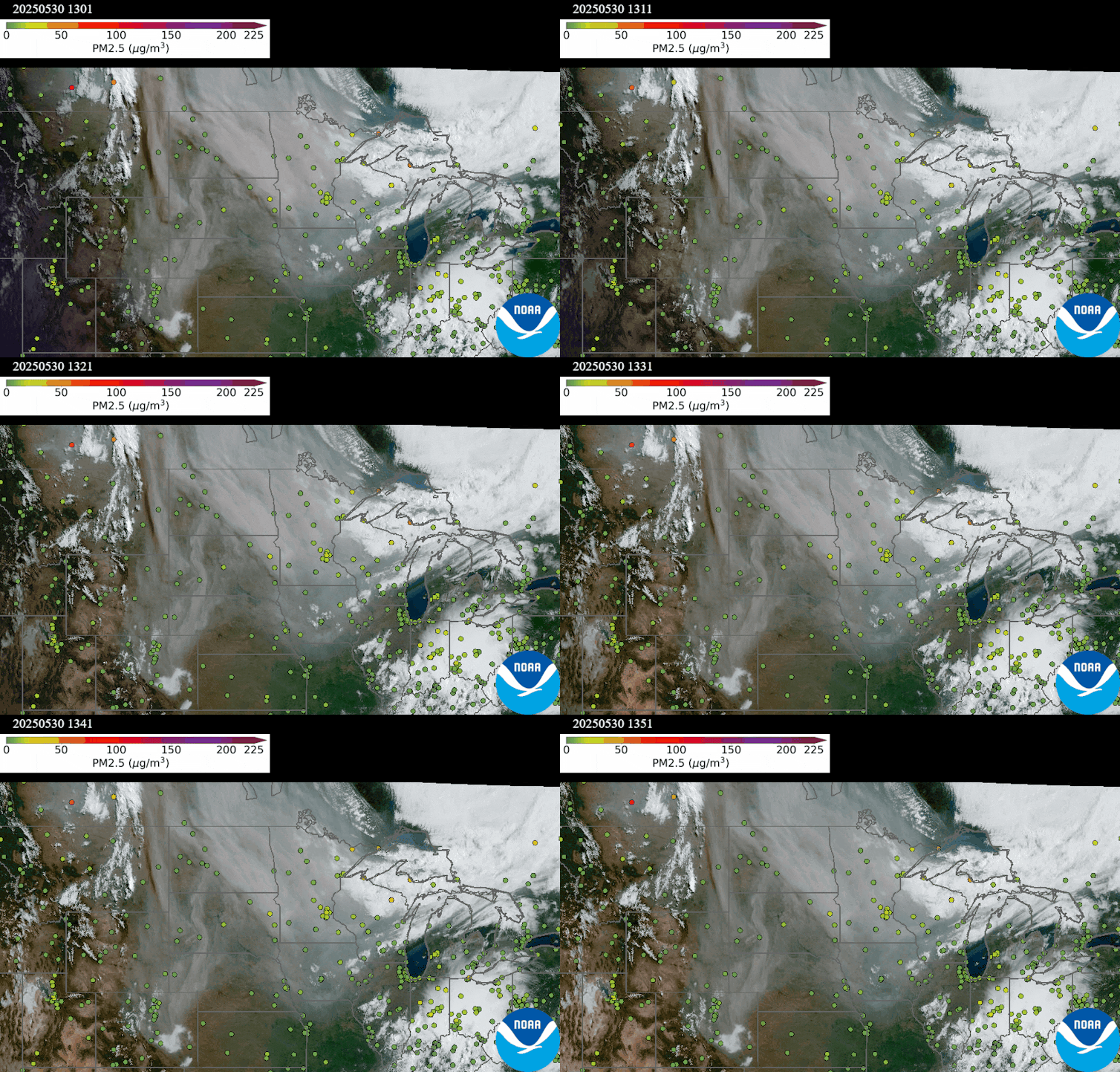
An animation on May 30, 2025, shows a thick smoke plume from Canada moving over Minnesota, but the air quality monitors on the ground detected minimal risk, suggesting it was a high-level smoke plume.NOAA NESDIS Center for Satellite Applications and Research
The Environmental Protection Agency uses a network of ground-based air quality monitors to issue air quality alerts, but the monitors are few and far between, meaning forecasts have been broad estimates in much of the country.
Now, a new satellite-based method that I and colleagues at universities and federal agencies have been working on for the past two years is able to give scientists and air quality managers a 3D picture of the smoke plumes, providing detailed data of the risks down to the neighborhood level for urban and rural areas alike.
Data from the TEMPO satellite shows the height of the smoke plume, measured in kilometers. Light blue areas are closest to the ground, suggesting the worst air quality. Pink areas suggest the smoke is more than 2 miles (3.2 kilometers) above the ground, where it poses little risk to human health. The data aligns with air monitor readings taken on the ground at the same time.NOAA NESDIS Center for Satellite Applications and Research
TEMPO makes it possible to determine a smoke plume’s height by providing data on how much the oxygen molecules absorb sunlight at the 688 nanometer wavelength. Smoke plumes that are high in the atmosphere reflect more solar radiation at this wavelength back to space, while those lower in the atmosphere, where there is more oxygen to absorb the light, reflect less.
Understanding the physics allowed scientists to develop algorithms that use TEMPO’s data to infer the smoke plume’s altitude and map its 3D movement in nearly real time.
Aerosol particles in high smoke plumes reflect more light back into space. Closer to Earth’s surface, there is more oxygen to absorb light at the 688 nanometer wavelength, so less light is reflected. Satellites can detect the difference, and that can be used to determine the height of the smoke plume.Adapted from Xu et al, 2019, CC BY
By combining TEMPO’s data with measurements of particles in the atmosphere, taken by the Advanced Baseline Imager on the NOAA’s GOES-R satellites, forecasters can better assess the health risk from smoke plumes in almost real time, provided clouds aren’t in the way.
That’s a big jump from relying on ground-based air quality monitors, which may be hundreds of miles apart. Iowa, for example, had about 50 air quality monitors reporting data on a recent day for a state that covers 56,273 square miles. Most of those monitors were clustered around its largest cities.
NOAA’s AerosolWatch tool currently provides a near-real-time stream of wildfire smoke images from its GOES-R satellites, and the agency plans to incorporate TEMPO’s height data. A prototype of this system from my team’s NASA-supported research project on fire and air quality, called FireAQ, shows how users can zoom in to the neighborhood level to see how high the smoke plume is, however the prototype is currently only updated once a day, so the data is delayed, and it isn’t able to provide smoke height data where clouds are also overhead.
While air quality in most of the U.S. improved between 2000 and 2020, thanks to stricter emissions regulations on vehicles and power plants, wildfires have reversed that trend in parts of the western U.S. Research has found that wildfire smoke has effectively erased nearly two decades of air quality progress there.
Our advances in smoke monitoring mark a new era in air quality forecasting, offering more accurate and timely information to better protect public health in the face of these escalating wildfire threats.
LAKE COUNTY, Calif. — Lake County Animal Care and Control has many beautiful dogs of all ages waiting to be adopted this week.
The dogs available for adoption this week include mixes of border collie, French bulldog, German shepherd, husky, Labrador Retriever, pit bull terrier, terrier and shepherd.
Dogs that are adopted from Lake County Animal Care and Control are either neutered or spayed, microchipped and, if old enough, given a rabies shot and county license before being released to their new owner. License fees do not apply to residents of the cities of Lakeport or Clearlake.
Those animals shown on this page at the Lake County Animal Care and Control shelter have been cleared for adoption.
Call Lake County Animal Care and Control at 707-263-0278 or visit the shelter online for information on visiting or adopting.
The shelter is located at 4949 Helbush in Lakeport.
Email Elizabeth Larson at This email address is being protected from spambots. You need JavaScript enabled to view it.. Follow her on Twitter, @ERLarson, and on Bluesky, @erlarson.bsky.social. Find Lake County News on the following platforms: Facebook, @LakeCoNews; X, @LakeCoNews; Threads, @lakeconews, and on Bluesky, @lakeconews.bsky.social.
In a binary star system, two stars orbit around each other. ESO/L. Calçada, CC BY
Stars are the fundamental building blocks of our universe. Most stars host planets, like our Sun hosts our solar system, and if you look more broadly, groups of stars make up huge structures such as clusters and galaxies. So before astrophysicists can attempt to understand these large-scale structures, we first need to understand basic properties of stars, such as their mass, radius and temperature.
But measuring these basic properties has proved exceedingly difficult. This is because stars are quite literally at astronomical distances. If our Sun were a basketball on the East Coast of the U.S., then the closest star, Proxima, would be an orange in Hawaii. Even the world’s largest telescopes cannot resolve an orange in Hawaii. Measuring radii and masses of stars appears to be out of scientists’ reach.
Enter binary stars. Binaries are systems of two stars revolving around a mutual center of mass. Their motion is governed by Kepler’s harmonic law, which connects three important quantities: the sizes of each orbit, the time it takes for them to orbit, called the orbital period, and the total mass of the system.
I’m an astronomer, and my research team has been working on advancing our theoretical understanding and modeling approaches to binary stars and multiple stellar systems. For the past two decades we’ve also been pioneering the use of artificial intelligence in interpreting observations of these cornerstone celestial objects.
Measuring stellar masses
Astronomers can measure orbital size and period of a binary system easily enough from observations, so with those two pieces they can calculate the total mass of the system. Kepler’s harmonic law acts as a scale to weigh celestial bodies.
Binary stars orbit around each other, and in eclipsing binary stars, one passes in front of the other, relative to the telescope lens.Merikanto/Wikimedia Commons, CC BY-SA
Think of a playground seesaw. If the two kids weigh about the same, they’ll have to sit at about the same distance from the midpoint. If, however, one child is bigger, he or she will have to sit closer, and the smaller kid farther from the midpoint.
It’s the same with stars: The more massive the star in a binary pair, the closer to the center it is and the slower it revolves about the center. When astronomers measure the speeds at which the stars move, they can also tell how large the stars’ orbits are, and as a result, what they must weigh.
Measuring stellar radii
Kepler’s harmonic law, unfortunately, tells astronomers nothing about the radii of stars. For those, astronomers rely on another serendipitous feature of Mother Nature.
Binary star orbits are oriented randomly. Sometimes, it happens that a telescope’s line of sight aligns with the plane a binary star system orbits on. This fortuitous alignment means the stars eclipse one another as they revolve about the center. The shapes of these eclipses allow astronomers to find out the stars’ radii using straightforward geometry. These systems are called eclipsing binary stars.
By taking measurements from an eclipsing binary star system, astronomers can measure the radii of the stars.
More than half of all Sun-like stars are found in binaries, and eclipsing binaries account for about 1% to 2% of all stars. That may sound low, but the universe is vast, so there are lots and lots of eclipsing systems out there – hundreds of millions in our galaxy alone.
By observing eclipsing binaries, astronomers can measure not only the masses and radii of stars but also how hot and how bright they are.
Complex problems require complex computing
Even with eclipsing binaries, measuring the properties of stars is no easy task. Stars are deformed as they rotate and pull on each other in a binary system. They interact, they irradiate one another, they can have spots and magnetic fields, and they can be tilted this way or that.
To study them, astronomers use complex models that have many knobs and switches. As an input, the models take parameters – for example, a star’s shape and size, its orbital properties, or how much light it emits – to predict how an observer would see such an eclipsing binary system.
Computer models take time. Computing model predictions typically takes a few minutes. To be sure that we can trust them, we need to try lots of parameter combinations – typically tens of millions.
This many combinations requires hundreds of millions of minutes of compute time, just to determine basic properties of stars. That amounts to over 200 years of computer time.
Computers linked in a cluster can compute faster, but even using a computer cluster, it takes three or more weeks to “solve,” or determine all the parameters for, a single binary. This challenge explains why there are only about 300 stars for which astronomers have accurate measurements of their fundamental parameters.
The models used to solve these systems have already been heavily optimized and can’t go much faster than they already do. So, researchers need an entirely new approach to reducing computing time.
First, we computed a huge database of predictions about a hypothetical binary star – using the features that astronomers can readily observe – where we varied the hypothetical binary star’s properties. We are talking hundreds of millions of parameter combinations. Then, we compared these results to the actual observations to see which ones best match up. AI and neural networks are ideally suited for this task.
In a nutshell, neural networks are mappings. They map a certain known input to a given output. In our case, they map the properties of eclipsing binaries to the expected predictions. Neural networks emulate the model of a binary but without having to account for all the complexity of the physical model.
Neural networks detect patterns and use their training to predict an output, based on an input.
We train the neural network by showing it each prediction from our database, along with the set of properties used to generate it. Once fully trained, the neural network will be able to accurately predict what astronomers should observe from the given properties of a binary system.
Compared to a few minutes of runtime for the physical model, a neural network uses artificial intelligence to get the same result within a tiny fraction of a second.
Reaping the benefits
A tiny fraction of a second works out to about a millionfold runtime reduction. This brings the time down from weeks on a supercomputer to mere minutes on a single laptop. It also means that we can analyze hundreds of thousands of binary systems in a couple of weeks on a computer cluster.
This reduction means we can obtain fundamental properties – stellar masses, radii, temperatures and luminosities – for every eclipsing binary star ever observed within a month or two. The big challenge remaining is to show that AI results really give the same results as the physical model.
This task is the crux of my team’s new paper. In it we’ve shown that, indeed, the AI-driven model yields the same results as the physical model across over 99% of parameter combinations. This result means the AI’s performance is robust. Our next step? Deploy the AI on all observed eclipsing binaries.
Best of all? While we applied this methodology to binaries, the basic principle applies to any complex physical model out there. Similar AI models are already speeding up many real-world applications, from weather forecasting to stock market analysis.
 How to resolve AdBlock issue?