How to resolve AdBlock issue?
Refresh this page
How to resolve AdBlock issue?
Refresh this page
Lake County News,California
  • Home
    • Registration Form
  • News
    • Education
    • Veterans
    • Community
      • Obituaries
      • Letters
      • Commentary
    • Police Logs
    • Business
    • Recreation
    • Health
    • Religion
    • Legals
    • Arts & Life
    • Regional
  • Calendar
  • Contact us
    • FAQs
    • Phones, E-Mail
    • Subscribe
  • Advertise Here
  • Login
How to resolve AdBlock issue?
Refresh this page

News

One of the biggest microplastic pollution sources isn’t straws or grocery bags – it’s your tires

Details
Written by: Boluwatife S. Olubusoye, University of Mississippi and James V Cizdziel, University of Mississippi
Published: 25 July 2025
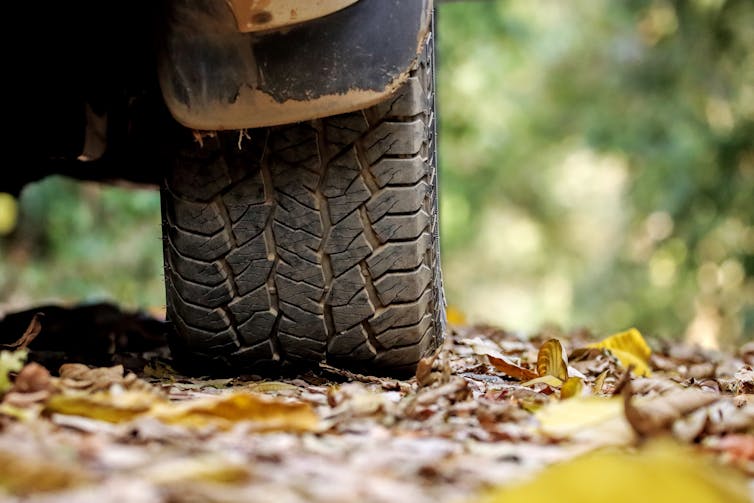
Most tires are made of synthetic rubber that sheds particles of microplastics over time. Rapeepong Puttakumwong/Moment via Getty Images

Every few years, the tires on your car wear thin and need to be replaced. But where does that lost tire material go?

The answer, unfortunately, is often waterways, where the tiny microplastic particles from the tires’ synthetic rubber carry several chemicals that can transfer into fish, crabs and perhaps even the people who eat them.

We are analytical and environmental chemists who are studying ways to remove those microplastics – and the toxic chemicals they carry – before they reach waterways and the aquatic organisms that live there.

Microplastics, macro-problem

Millions of metric tons of plastic waste enter the world’s oceans every year. In recent times, tire wear particles have been found to account for about 45% of all microplastics in both terrestrial and aquatic systems.

Tires shed tiny microplastics as they move over roadways. Rain washes those tire wear particles into ditches, where they flow into streams, lakes, rivers and oceans.

Along the way, fish, crabs, oysters and other aquatic life often find these tire wear particles in their food. With each bite, the fish also consume extremely toxic chemicals that can affect both the fish themselves and whatever creatures eat them.

Some fish species, like rainbow trout, brook trout and coho salmon, are dying from toxic chemicals linked to tire wear particles.

Researchers in 2020 found that more than half of the coho salmon returning to streams in Washington state died before spawning, largely because of 6PPD-Q, a chemical stemming from 6PPD, which is added to tires to help keep them from degrading.

A small jar with liquid containing tiny black flecks.
Most tire particles are tiny. Saskia Madlener/Stacey Harper/Oregon State University, CC BY-SA

But the effects of tire wear particles aren’t just on aquatic organisms. Humans and animals alike may be exposed to airborne tire wear particles, especially people and animals who live near major roadways.

In a study in China, the same chemical, 6PPD-Q, was also found in the urine of children and adults. While the effects of this chemical on the human body are still being studied, recent research shows that exposure to this chemical could harm multiple human organs, including the liver, lungs and kidneys.

In Oxford, Mississippi, we identified more than 30,000 tire wear particles in 24 liters of stormwater runoff from roads and parking lots after two rainstorms. In heavy traffic areas, we believe the concentrations could be much higher.

The Interstate Technology and Regulatory Council, a states-led coalition, in 2023 recommended identifying and deploying alternatives to 6PPD in tires to reduce 6PPD-Q in the environment. But tire manufacturers say there’s no suitable replacement yet.

What can communities do to reduce harm?

At the University of Mississippi, we are experimenting with sustainable ways of removing tire wear particles from waterways with accessible and low-cost natural materials from agricultural wastes.

The idea is simple: Capture the tire wear particles before they reach the streams, rivers and oceans.

In a recent study, we tested pine wood chips and biochar – a form or charcoal made from heating rice husks in a limited oxygen chamber, a process known as pyrolysis – and found they could remove approximately 90% of tire wear particles from water runoff at our test sites in Oxford.

Biochar is an established material for removing contaminants from water due to its large surface area and pores, abundant chemical binding groups, high stability, strong adsorption capacity and low cost. Wood chips, because of their rich composition of natural organic compounds, have also been shown to remove contaminants. Other scientists have also used sand to filter out microplastics, but its removal rate was low compared with biochar.
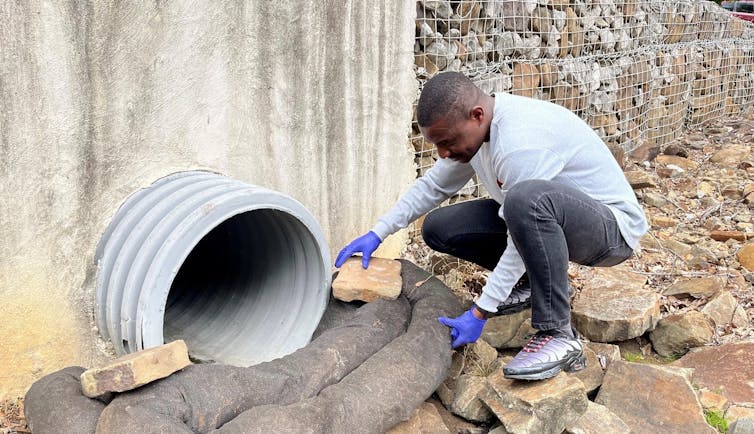
A man places flexible tubes filled with biochar under a storm drain.
Boluwatife S. Olubusoye, one of the authors of this article, positions a filter sock filled with biochar under a storm drain. James Cizdziel/University of Mississippi

We designed a biofiltration system using biochar and wood chips in a filter sock and placed it at the mouth of a drainage outlet. Then we collected stormwater runoff samples and measured the tire wear particles before and after the biofilters were in place during two storms over the span of two months. The concentration of tire wear particles was found to be significantly lower after the biofilter was in place.

The unique elongated and jagged features of tire wear particles make it easy for them to get trapped or entangled in the pores of these materials during a storm event. Even the smallest tire wear particles were trapped in the intricate network of these materials.

Using biomass filters in the future

We believe this approach holds strong potential for scalability to mitigate tire wear particle pollution and other contaminants during rainstorms.

Since biochar and wood chips can be generated from agricultural waste, they are relatively inexpensive and readily available to local communities.

Long-term monitoring studies will be needed, especially in heavy traffic environments, to fully determine the effectiveness and scalability of the approach. The source of the filtering material is also important. There have been some concerns about whether raw farm waste that has not undergone pyrolysis could release organic pollutants.

Like most filters, the biofilters would need to be replaced over time – with used filters disposed of properly – since the contaminants build up and the filters degrade.

Plastic waste is harming the environment, the food people eat and potentially human health. We believe biofilters made from plant waste could be an effective and relatively inexpensive, environmentally friendly solution.The Conversation

Boluwatife S. Olubusoye, Ph.D. Candidate in Chemistry, University of Mississippi and James V Cizdziel, Professor of Chemistry, University of Mississippi

This article is republished from The Conversation under a Creative Commons license. Read the original article.

Three children injured in golf cart crash

Details
Written by: LAKE COUNTY NEWS REPORTS
Published: 24 July 2025

LAKE COUNTY, Calif. — Three children were seriously injured late last week when they were involved in a golf cart crash.


The California Highway Patrol’s Clear Lake Area office said the crash occurred just before 7 p.m. Thursday, July 17.


That evening, the CHP said its officers received a call about a solo vehicle rollover involving a golf cart and three juveniles on Nicholas Way west of Francis Lane, near Hidden Valley Lake.


The CHP said its investigation determined an 11-year-old girl was driving the Club Car DS electric golf cart with two passengers, a 10-year-old girl and a 6-year-old girl.


As the golf cart continued west on Nicholas Way, the driver lost control and the golf cart overturned, ejecting all three occupants, the CHP said.


All three children were transported to Adventist Health Clear Lake and transferred to UC Davis for continued treatment of injuries sustained in the crash, according to the CHP report.


The CHP said the cause of the crash is under investigation. Officer Luis Estrada is the investigating officer. 


Anyone with information is encouraged to call the Clear Lake Area CHP office at 707-281-5200.

Crash involving vehicle hitting building results in major injuries

Details
Written by: Elizabeth Larson
Published: 24 July 2025

LAKE COUNTY, Calif. — A Wednesday night crash involving a vehicle hitting a building sent one person to a trauma center.

The crash occurred at the Sandpiper RV Park, 2630 Lakeshore Blvd. in Nice, shortly after 10:30 p.m. Wednesday.

Reports from the scene said a midsized Mazda SUV hit a home at the resort.

The vehicle, which was seen weaving and swerving before the crash, took out the entire building, according to scene reports.

Incident command reported over the radio that one person had moderate injuries and one had major injuries.

A REACH air ambulance was requested to respond to the scene to transport one of the injured people.

The California Highway Patrol’s online reports said a wrecker was requested to come to the scene to remove the SUV, which was wedged between the building and a telephone pole, and sitting on a fire hydrant.

The Wednesday night trash was the latest in a series of several serious wrecks that have taken place over the last week.

Email Elizabeth Larson at This email address is being protected from spambots. You need JavaScript enabled to view it.. Follow her on Twitter, @ERLarson, and on Bluesky, @erlarson.bsky.social. Find Lake County News on the following platforms: Facebook, @LakeCoNews; X, @LakeCoNews; Threads, @lakeconews, and on Bluesky, @lakeconews.bsky.social. 

Following increased CHP operations, California sees 13% reduction in stolen vehicles statewide

Details
Written by: LAKE COUNTY NEWS REPORTS
Published: 24 July 2025

State officials said Wednesday that, following the COVID-induced crime surge, the number of vehicles stolen statewide has dropped by 13% from 2023 to 2024 — the first year-over-year decrease since 2019. 

Of those vehicles stolen, nearly 92% of cars, trucks and SUVs successfully recovered.

“We continue to put the safety of California communities first. Through strategic funding and partnerships with local and state law enforcement partners, we are putting a brake on lawlessness and criminals disrupting our way of life,” said Gov. Gavin Newsom.

Of the stolen vehicles in California, nearly 94% cars and 90% personal trucks and SUVs were recovered. 
 
Significant regional investment by the state

Through expanded regional efforts with the California Highway Patrol and local law enforcement agencies, Gov. Newsom sought to strengthen efforts to fight vehicle theft through crime suppression operations in key areas, including Oakland, Bakersfield and San Bernardino. 

These ongoing regional operations have shown positive results throughout the broader communities in Alameda, Kern and San Bernardino counties. 

Working closely with local law enforcement agencies, auto thieves, repeat offenders and organized crime groups have been disrupted, and their activities have been thwarted. 

As a result of these public safety collaborations, each of these counties saw a significant drop in vehicle thefts in 2024:

• Alameda: down 18% from 2023.
• Kern: down 28% from 2023.
• San Bernardino: down 11% from 2023.

Other notable drops by county in stolen vehicles from 2023 includes:

• Imperial: down 13%.
• Orange: down 16%.
• Riverside: down 24%.
• Sacramento: down 23%.
• San Diego: down 11%.
• San Francisco: down 17%.
• Santa Barbara: down 29%.
• Tulare: down 22%.
• Yolo: down 24%.

“We are proud to see fewer vehicles being stolen across the state,” said CHP Commissioner Sean Duryee. “The CHP and our law enforcement partners are working hard every day to stop these crimes, protect California’s communities and hold criminals responsible.”

Automobiles are a vital part of daily life for work, school and family. When a vehicle is stolen, it impacts more than just property — it can take away a person’s freedom and sense of security. View the 2024 report on stolen vehicles and their recoveries here.
 
Stronger enforcement, serious penalties, real consequences

California has invested $1.6 billion since 2019 to fight crime, help local governments hire more police, and improve public safety. 

In 2023, as part of California’s Public Safety Plan, Newsom announced the largest-ever investment to combat organized retail crime in state history, an annual 310% increase in proactive operations targeting organized retail crime, and special operations across the state to fight crime and improve public safety.

Last August, Gov. Newsom signed into law the most significant bipartisan legislation to crack down on property crime in modern California history. These bipartisan bills offer new tools to bolster ongoing efforts to hold criminals accountable for smash-and-grab robberies, property crime, retail theft, and auto burglaries. 

While state officials said California’s crime rate remains at near historic lows, Newsom’s office said these laws help California adapt to evolving criminal tactics to ensure perpetrators are effectively held accountable.

  1. How the nature of environmental law is changing in defense of the planet and the climate
  2. Former Clearlake resident receives 200 years to life sentence for sex abuse case
  3. CDPH recommends families add vaccines to back-to-school checklists
  • 216
  • 217
  • 218
  • 219
  • 220
  • 221
  • 222
  • 223
  • 224
  • 225
How to resolve AdBlock issue?
Refresh this page