 How to resolve AdBlock issue?
News
- Details
- Written by: Lake County News reports
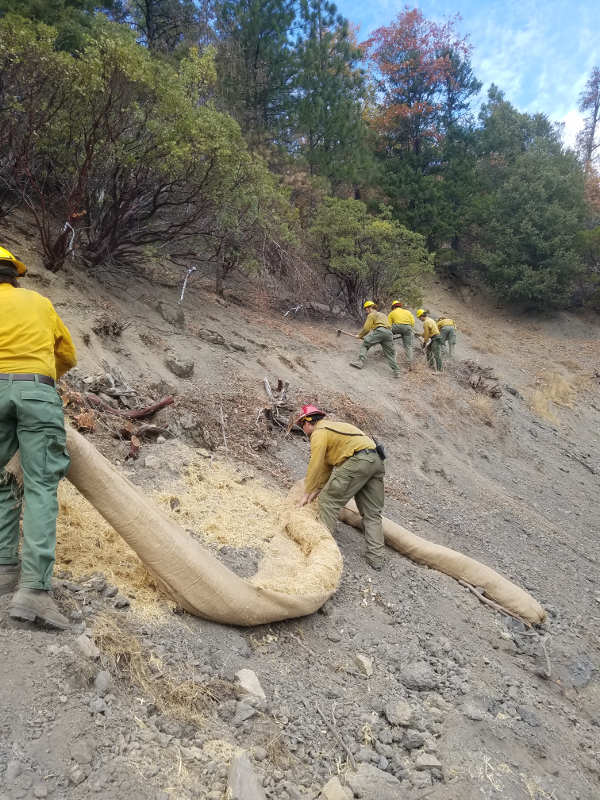
NORTHERN CALIFORNIA – Cooler temperatures and the continued hard work of crews on the fire lines have raised containment on the August Complex South Zone.
The US Forest Service said Sunday that crews on the South Zone of the August Complex completed an additional 6.7 miles of fireline repair Saturday.
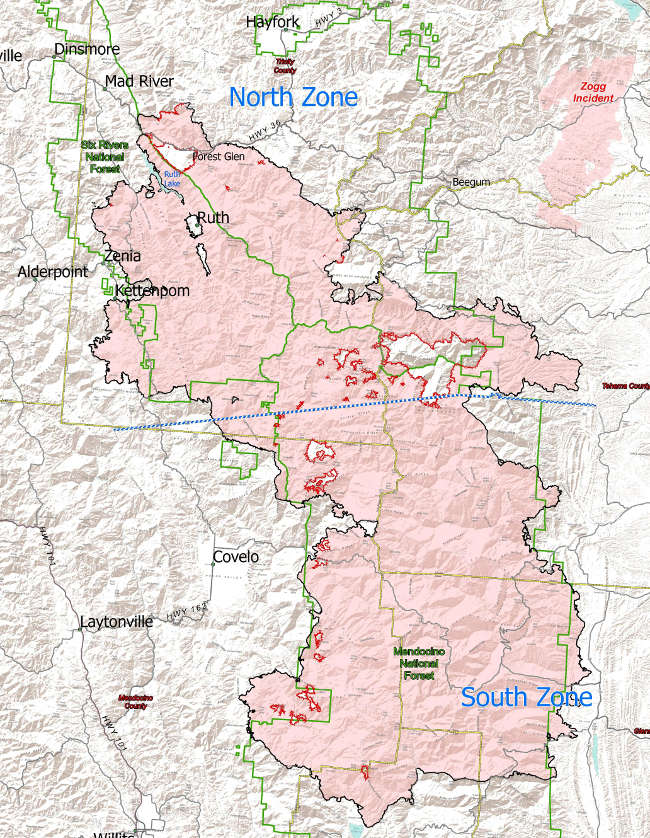
This effort combined with recent precipitation contributed to an increase in containment on the 499,827-acre South Zone to 99 percent.
The complex as a whole remained at 1,032,648 acres and 96 percent containment on Sunday, officials said.
It began on Aug. 16 and 17 due to lightning. It’s burning on the Mendocino, Six Rivers and Shasta-Trinity National Forests.
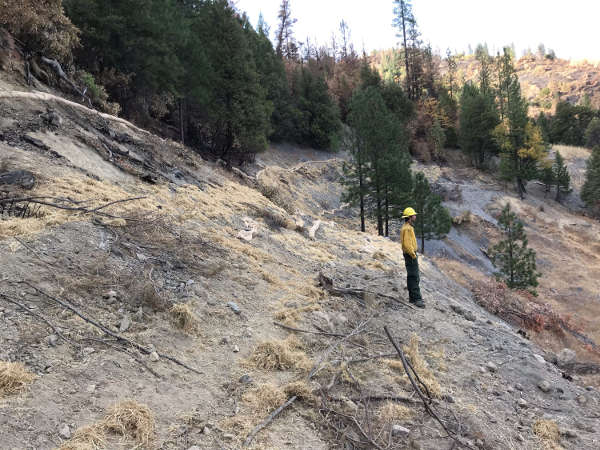
The Forest Service said crews continued fire suppression repair operations around the M4 and M2 roads, Gloyd Slide, Mill Creek and Mendocino Pass.
Rehabilitation work included obliterating berms, providing drainage to prevent erosion, stabilizing landslide-prone areas and repairing roads damaged during suppression activities, officials said.
In addition, the Forest Service said crews completed repair of the Oak Flat Campground, which was used by crews as a spike camp, and it is reopened to the public.
The transition of command of the South Zone to the Mendocino National Forest district fire
managers is scheduled for Monday, the Forest Service said.
The Forest Service said fire suppression repair work is slated to continue until winter
weather prevents operations.
The entire August Complex is expected by the Forest Service to be fully contained on Dec. 15.
- Details
- Written by: Lake County News reports
Courts in Ukiah and Fort Bragg will be closed Monday through Friday, officials said.
Individuals with court dates this week should call their attorney for further information and direction.
District Attorney David Eyster said his office operations including the Victim/Witness offices in Ukiah and Fort Bragg will remain open as much as possible during the week-long court closure.
Because the public entrances to the main courthouse in Ukiah and the Fort Bragg course will be closed by order of Judge Moorman, anybody with urgent business with the DA or his staff should call the DA's main reception in Ukiah at 707-463-4211 and schedule an appointment time, to include an escort into the DA's offices, if appropriate.
For more information visit the Mendocino County Superior Court’s website.
- Details
- Written by: Nükhet Varlik, University of South Carolina

When will the pandemic end? All these months in, with over 37 million COVID-19 cases and more than 1 million deaths globally, you may be wondering, with increasing exasperation, how long this will continue.
Since the beginning of the pandemic, epidemiologists and public health specialists have been using mathematical models to forecast the future in an effort to curb the coronvirus’s spread. But infectious disease modeling is tricky. Epidemiologists warn that “[m]odels are not crystal balls,” and even sophisticated versions, like those that combine forecasts or use machine learning, can’t necessarily reveal when the pandemic will end or how many people will die.
As a historian who studies disease and public health, I suggest that instead of looking forward for clues, you can look back to see what brought past outbreaks to a close – or didn’t.

Where we are now in the course of the pandemic
In the early days of the pandemic, many people hoped the coronavirus would simply fade away. Some argued that it would disappear on its own with the summer heat. Others claimed that herd immunity would kick in once enough people had been infected. But none of that has happened.
A combination of public health efforts to contain and mitigate the pandemic – from rigorous testing and contact tracing to social distancing and wearing masks – have been proven to help. Given that the virus has spread almost everywhere in the world, though, such measures alone can’t bring the pandemic to an end. All eyes are now turned to vaccine development, which is being pursued at unprecedented speed.
Yet experts tell us that even with a successful vaccine and effective treatment, COVID-19 may never go away. Even if the pandemic is curbed in one part of the world, it will likely continue in other places, causing infections elsewhere. And even if it is no longer an immediate pandemic-level threat, the coronavirus will likely become endemic – meaning slow, sustained transmission will persist. The coronavirus will continue to cause smaller outbreaks, much like seasonal flu.
The history of pandemics is full of such frustrating examples.
Once they emerge, diseases rarely leave
Whether bacterial, viral or parasitic, virtually every disease pathogen that has affected people over the last several thousand years is still with us, because it is nearly impossible to fully eradicate them.
The only disease that has been eradicated through vaccination is smallpox. Mass vaccination campaigns led by the World Health Organization in the 1960s and 1970s were successful, and in 1980, smallpox was declared the first – and still, the only – human disease to be fully eradicated.

So success stories like smallpox are exceptional. It is rather the rule that diseases come to stay.
Take, for example, pathogens like malaria. Transmitted via parasite, it’s almost as old as humanity and still exacts a heavy disease burden today: There were about 228 million malaria cases and 405,000 deaths worldwide in 2018. Since 1955, global programs to eradicate malaria, assisted by the use of DDT and chloroquine, brought some success, but the disease is still endemic in many countries of the Global South.
Similarly, diseases such as tuberculosis, leprosy and measles have been with us for several millennia. And despite all efforts, immediate eradication is still not in sight.
Add to this mix relatively younger pathogens, such as HIV and Ebola virus, along with influenza and coronaviruses including SARS, MERS and SARS-CoV-2 that causes COVID-19, and the overall epidemiological picture becomes clear. Research on the global burden of disease finds that annual mortality caused by infectious diseases – most of which occurs in the developing world – is nearly one-third of all deaths globally.
Today, in an age of global air travel, climate change and ecological disturbances, we are constantly exposed to the threat of emerging infectious diseases while continuing to suffer from much older diseases that remain alive and well.
Once added to the repertoire of pathogens that affect human societies, most infectious diseases are here to stay.
Plague caused past pandemics – and still pops up
Even infections that now have effective vaccines and treatments continue to take lives. Perhaps no disease can help illustrate this point better than plague, the single most deadly infectious disease in human history. Its name continues to be synonymous with horror even today.

Plague is caused by the bacterium Yersinia pestis. There have been countless local outbreaks and at least three documented plague pandemics over the last 5,000 years, killing hundreds of millions of people. The most notorious of all pandemics was the Black Death of the mid-14th century.
Yet the Black Death was far from being an isolated outburst. Plague returned every decade or even more frequently, each time hitting already weakened societies and taking its toll during at least six centuries. Even before the sanitary revolution of the 19th century, each outbreak gradually died down over the course of months and sometimes years as a result of changes in temperature, humidity and the availability of hosts, vectors and a sufficient number of susceptible individuals.
Some societies recovered relatively quickly from their losses caused by the Black Death. Others never did. For example, medieval Egypt could not fully recover from the lingering effects of the pandemic, which particularly devastated its agricultural sector. The cumulative effects of declining populations became impossible to recoup. It led to the gradual decline of the Mamluk Sultanate and its conquest by the Ottomans within less than two centuries.
[Deep knowledge, daily. Sign up for The Conversation’s newsletter.]
That very same state-wrecking plague bacterium remains with us even today, a reminder of the very long persistence and resilience of pathogens.
Hopefully COVID-19 will not persist for millennia. But until there’s a successful vaccine, and likely even after, no one is safe. Politics here are crucial: When vaccination programs are weakened, infections can come roaring back. Just look at measles and polio, which resurge as soon as vaccination efforts falter.
Given such historical and contemporary precedents, humanity can only hope that the coronavirus that causes COVID-19 will prove to be a tractable and eradicable pathogen. But the history of pandemics teaches us to expect otherwise.
Nükhet Varlik, Associate Professor of History, University of South Carolina
This article is republished from The Conversation under a Creative Commons license. Read the original article.
- Details
- Written by: Kathleen Scavone
LAKE COUNTY, Calif. – One of the treasures and pleasures of taking a walkabout in Lake County is that no two days are alike.
One morning I was on a pelican hunt. As I made my way along the tree-lined boardwalk at Clear Lake State Park the fermented scents of decaying leaves and lively algae guided my walk. The sensuous surroundings nourish me.
I spied an enormous squadron of American white pelicans floating like bright, white living angles between Clear Lake State Park and Lakeside Park, but alas, they were out of reach of my camera lens.
So I thought, wait! I can hear the distinctive calls of red-winged blackbirds singing in the swaying reeds along the lakeshore, and I would love to capture them on camera.
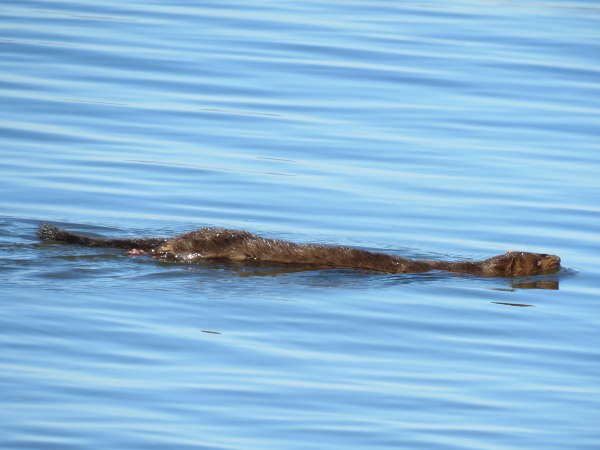
As I stood by the still lakeshore an American mink silently swam across the beach, directly in front of me!
Lake County is full-to-the-brim with a wide variety of mammal species like elk, coyote, bear, fox, deer, raccoon and more. Most are secretive and not easy to spy, and the American mink is no exception.
Related to ferrets, these elongated creatures thrive in areas near water and wetlands, making their meal choices of amphibians, fish and crustaceans readily available. American mink have also been known to consume gulls and cormorants by first drowning them.
Other carnivorous relations to the mink are river otters, which are larger, weighing in at up to 30-odd pounds and possess a streamlined tail, while American mink are cat-like in size and weigh around 2 to 4 pounds.
Mink's predators include great horned owls, bobcats, coyotes and foxes.
American mink wear dense fur coats that are sprigged with greasy guard-hairs that provide waterproofing.
Minks were avidly hunted in the 19th century when their thick pelts were used for fur coats. In some places, such as the Pacific Northwest they are still hunted.
Around 1960 scientists made a study of minks, along with ferrets, cats and skunks to determine behavior characteristics, and they found that minks were able to surpass the other critters in identifying objects and select them from memory. Who knew slinky minks were so intelligent?
Kathleen Scavone, M.A., is a retired educator, potter, freelance writer and author of “Anderson Marsh State Historic Park: A Walking History, Prehistory, Flora, and Fauna Tour of a California State Park” and “Native Americans of Lake County.”