 How to resolve AdBlock issue?
News
- Details
- Written by: Lake County News reports
The California Highway Patrol’s Clear Lake Area office said the crash occurred at 6:50 p.m. on Monday.
Susanna E. Wright, 39, was traveling southbound on Highway 29 south of Seigler Canyon Road, driving a 2014 Toyota Corolla, the CHP said.
Wright had a 7-year-old girl and a 5-year-old boy seated in the rear of the vehicle. The CHP said Wright was wearing her seat belt but the children were not using safety equipment.
The CHP said Wright allowed her vehicle to travel off the west road edge of the highway. She overcorrected to the left and lost control of her vehicle.
Wright's vehicle traveled off the east roadway edge of Highway 29, hitting an uphill dirt embankment. The CHP said this impact caused her vehicle to overturn, impacting and coming to rest against a tree.
The CHP said Wright and the girl were transported via ambulance to Adventist Health Clear Lake Hospital in Clearlake for treatment. Wright had moderate injuries while the girl had major injuries.
The boy, who also had major injuries, was transported via air ambulance to UCSF Benioff Children's Hospital in Oakland, the CHP said.
Drugs and alcohol are not suspected to have been factors in the wreck, according to the CHP report.
- Details
- Written by: CLAYTON GUMBER AND JONATHAN VESPA
In contrast with older veteran groups, such as those from the Vietnam era or Gulf War, post-9/11 veterans encountered very different labor markets after returning from the armed forces. As a result, post-9/11 veterans represent a unique and growing segment of the veteran population and the broader U.S. workforce.
Employment characteristics of post-9/11 veterans
In the 2014-2018 period, about 80 percent of post-9/11 veterans were employed compared with only 75 percent of nonveterans.
Among the employed, post-9/11 veterans were also more likely than nonveterans to work year-round (50 to 52 weeks a year) and full-time (35 hours or more a week). About 81 percent of post-9/11 veterans and 71 percent of nonveterans had year-round, full-time jobs.
Post-9/11 veterans worked longer hours than nonveterans – an average of two hours longer for men (44 hours a week vs. 42) and nearly three hours longer each week for women (40 hours vs. 37 hours).
They were also more likely than nonveterans to work for federal, state, or local governments. For example, 32 percent of post-9/11 male veterans worked in government compared to 10 percent of male nonveterans. In contrast, male nonveterans were more likely to work in the private sector (81 percent vs. 63 percent of post-9/11 veterans).
Post-9/11 veterans earned more than nonveterans depending on their education level: a median $46,000 a year compared to about $35,000 for nonveterans.
Occupations among post-9/11 veterans
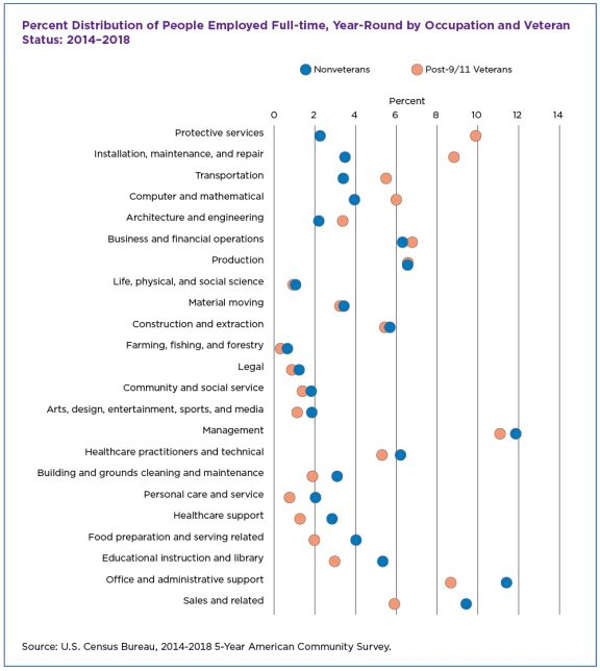
Among people employed year-round and full-time, post-9/11 veterans often were overrepresented in only a few occupation groups.
For instance, a greater proportion of veterans than nonveterans were employed in protective service occupations, such as police officer, firefighter and similar jobs.
Post-9/11 veterans also were frequently in installation, maintenance, and repair occupations and less regularly in office and administrative support, sales, and related occupations.
These results are roughly consistent with the notion that post-9/11 veterans seek civilian jobs that utilize their military skills and training.
Occupations among men and women by veteran status
In addition to overall differences in employment between post-9/11 veterans and nonveterans, the proportion of workers in different occupations varied by sex.
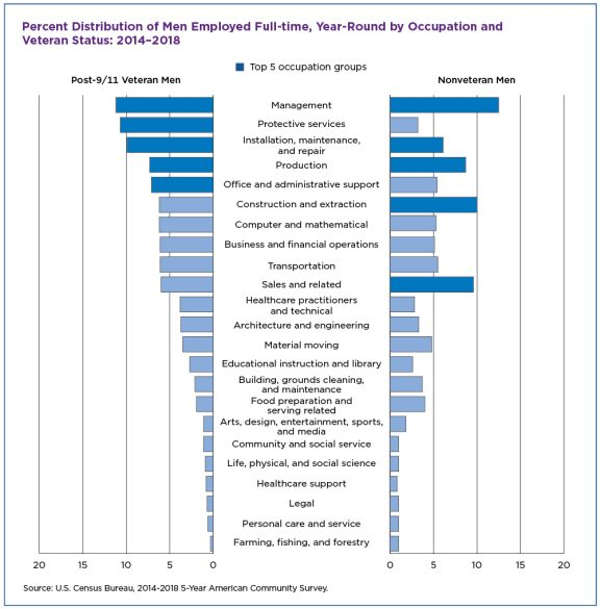
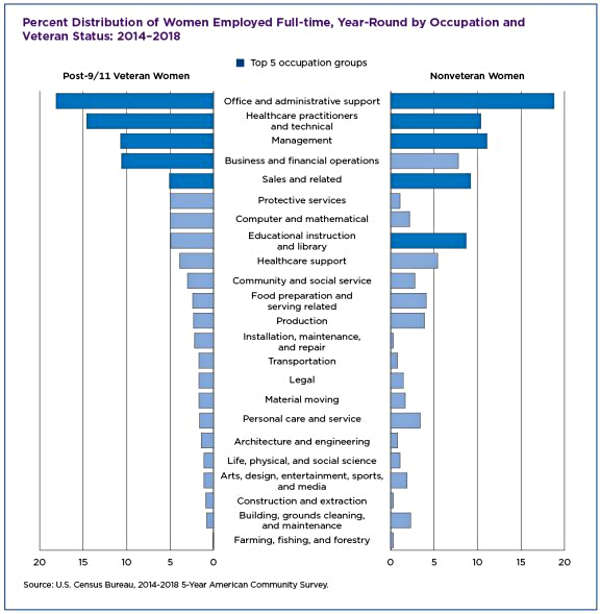
The figures below show the percentage of men and women who were post-9/11 veterans and nonveterans employed year-round and full-time in 24 occupation groups and which jobs are more common for each group.
Top occupation groups for men, whether they were post-9/11 veterans or nonveterans, were: management; installation, maintenance, and repair; and production.
However, post-9/11 veteran men were more likely than their nonveteran peers to work in protective service and office and administrative support occupations.
In contrast, a greater percentage of men who never served were employed in construction and extraction occupations and sales and related occupations.
The pattern was similar among women. Post-9/11 veteran and nonveteran women also shared four of the same top occupation groups: office and administrative support, health care practitioners and technical, management, and sales and related.
Among the remaining occupation groups, a larger percentage of post-9/11 veteran women worked in business and financial operations, while more nonveterans worked in educational instruction and library occupations.
Clayton Gumber and Jonathan Vespa are survey statisticians in the Census Bureau’s Social, Economic and Housing Statistics Division.
- Details
- Written by: Elizabeth Larson
In a split decision – with board members Dan Buffalo, Jennifer Hanson and Phil Kirby voting yes, and Jeannie Markham and Carly Alvord voting no – the board decided after a three-hour discussion to enter hybrid learning, which is “stage two” of the Lake County Return to School Continuum Plan, at the start of the new semester, after Christmas break.
Markham and Alvord, who argued that it was in the best interests of students to get back to campus sooner rather than later, favored the start of hybrid learning on Nov. 30, after Thanksgiving but before the holiday break.
Nov. 30 was the date that district Superintendent Jill Falconer told the board was the date when staff would be fully prepared to switch from distance learning to the hybrid model, which will include having some students on campus at all times.
“As I’ve said all along, we’ll be ready when we’re ready,” said Falconer.
That’s also the date that the Kelseyville Unified School District announced last week that it plans to move to the hybrid model.
As proposed in Lakeport Unified’s case, students would be on campus for certain days of the week. Falconer said students would have “grab and go” breakfasts and lunches on the days they were on campus, and would have additional meals sent home with them for the other days when they’re learning at home.
During the course of the meeting, the board would hear about the challenges that the pandemic and its impact on school is creating for children, their families and teachers.
Absenteeism is up, there is an increase in failing grades, and students are enduring emotional stress and burnout from the combination of trying to learn online while being isolated from their social networks at school.
Alvord, who noted her own challenges with her children, said other parents have shared with her their struggles – such as a child developing an eating disorder and others suffering from increased anxiety and depression as a result of being separated from their classmates and teachers.
Like the majority of Lake County’s school districts, Lakeport Unified has been in the distance learning phase one of the Return to School Continuum Plan since the start of the year.
That phase calls for staff to be on campus with only a limited number of students – including those in special education – having class in-person, while the rest of the students participate in instruction virtually. There is no athletic competition or practice.
Lucerne Elementary and Upper Lake Unified schools started the school year with in-person instruction and have kept their campuses open thanks to numerous modifications and enhanced safety protocols.
Falconer said Lakeport Unified’s staffers are still finalizing their plan for the transition, and because it involves ongoing negotiations with their employee bargaining units, the plan wasn’t ready to be made public for Tuesday’s meeting.
Growing rates for absenteeism, lower grades
As an introduction to the Monday night discussion, Falconer presented data to the board showing attendance and engagement which helps monitor how students are performing.
“I warn you, the numbers are not great but we are in the middle of a pandemic,” said Falconer.
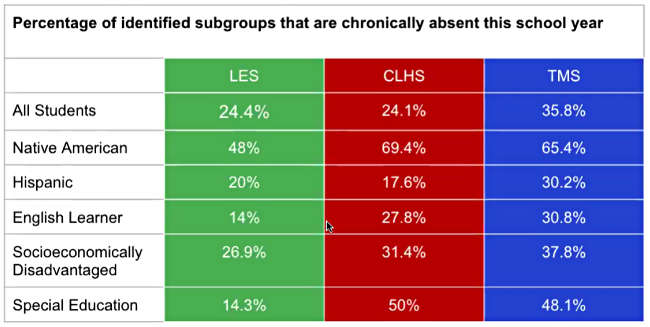
For Lakeport Elementary School, in the 2019-20 academic year, the school reported a 9.5 percent rate for chronic absenteeism, which is defined as missing 10 percent or more of school days in an academic year. For this year, that number has risen to 24.4 percent.
For Terrace Middle School, Falconer said the absentee rates rose from 8.3 percent last year to 35.8 percent this year, and at Clear Lake High School, the steepest increase was noted – 3.8 percent last year to 24.1 percent this year.
At the Lakeport Alternative Education Center, however, the numbers Falconer showed are encouraging: the 15.1-percent absentee rate reported in the 2019-20 school year has dropped to 2.1 percent this year.
“Our alternative education program kids are really engaging in distancing learning,” Falconer said.
She said the district’s student and family advocate continues to conduct several home visits a day to try to remove barriers to students’ engagement and attendance. “It remains a challenge.”
In a breakdown of subgroups, which can be seen below, Falconer said some groups of students are having higher absenteeism. Native American students have the highest absenteeism at the elementary, middle and high schools, with socioeconomically disadvantaged students, special education students and Hispanic students also registering high absentee numbers.
Regarding academic progress, the first quarter showed a sharp rise in the number of D and F grades given at the middle and high schools, according to Falconer’s report.
At Terrace Middle School, there were 175 Ds or Fs given in the 2019-20 first quarter, compared to 351 this year. At Clear Lake High School, the numbers are worse: 190 Ds or Fs in the first quarter of last year versus 436 this year, Falconer reported.
Falconer pointed out that chronic absenteeism goes hand in hand with lower grades.
The district contacted parents to ask about their preferences, and Falconer said that 75 percent of parents wanted hybrid learning – and soon – while 25 percent wanted to stay on distance learning.
Teachers share concerns
Markham, a retired teacher, said she believed it would be easier to make the transition from distance learning to the hybrid model between the Thanksgiving and Christmas holidays. She suggested students and teachers could ease into it rather than having to hit the ground running in January.
However, teachers like Catherine Dunne believed that coming back between the holidays would be challenging.
Clear Lake High School woodshop teacher John Moorhead said he is in no hurry to have students come back for in-person instruction. “It’s another wrinkle in a landscape that is only filled with wrinkles.”
Moorhead said he’s for keeping things the way they are through the end of semester, and maybe into the second semester. Explaining that he’s spoken with his coworkers about the issues, Moorhead noted, “We’re not quite ready for primetime.”
High school biology teacher William Pettus said he and his science colleagues also have serious concerns about moving to the hybrid model due to the inability to properly clean items that are shared – everything from pencils, desks and dividers, to microscopes, beakers and glassware.
“I would love to say we have a solution for this, and we don’t,” Pettus said.
High school special education teacher Cary Stillman explained that she’s doing some in-person teaching now, along with distance learning. Bathrooms, handwashing, going in and out of classrooms and bussing can be handled fairly safely now, but Stillwell said they will become more convoluted as more people are on campus, and they don’t yet have a solution.
Stillman agreed that the mental health of students is imperative, but that they need to come back to school – safely.
School nurse Diane Gunther pointed to growing COVID-19 case numbers across the nation and the state, and said that the Thanksgiving holiday is a big concern nationwide, as it will increase the chance for virus transmissions.
“We need to be on our toes” when transitioning to the hybrid model, Gunther said.
She said she thought the district has been “pretty lucky” in having minimal problems due to some significant situations involving the virus. That’s with a limited number of students on campus, and the risk is likely to increase with more students present.
Board weighs risks, plans separate sports discussion
While Markham said she was anxious to have children back on campus for school, even if only part-time, “Athletics worries me.”
“I share that sentiment,” said Buffalo, noting that it’s a very real risk. “At the same time, athletics is important to the well-being of our students.”
Buffalo said he saw the upcoming holidays as a litmus test for the community and the nation as a whole as far as COVID-19 transmission.
Gunther said that caseload increases generally are seen two weeks after a holiday, followed by hospitalizations and deaths. The biggest case spike in Lake County came exactly two weeks after Labor Day, she added.
Markham said she thought the district needed to transition to hybrid learning on Nov. 30, adding that it won’t accomplish anything to wait until January. “I do think it’s hurting kids to have them not at school.”
“I’m with you,” said Alvord.
Alvord asked Falconer what she would like to see happen.
Falconer deferred, saying she serves at the board’s will and that she and district employees “will make your decision work.”
Buffalo offered the motion to transition to the stage two hybrid model at the start of the calendar year and the next semester, and to give Falconer authority to make changes to that start date if necessary, which the board approved 3-2.
Buffalo thanked the district’s team for their efforts, noting he knows the community wants to move to the hybrid model and the faculty wants to teach students.
At its meeting next week, the board also will have a discussion on sports, as high school Athletic Director Milo Meyer received news on Monday that state sports officials are set to let competitions for sports including football, volleyball, cross country and wrestling begin in December.
“The school district is going to have to make a decision” as to whether or not to allow sports, Meyer told the board.
He said coaches will need guidelines and parents will have to arrange for physicals for their children as the usual free physicals at the school won’t be available this year. There also will be questions about transportation and scheduling.
Falconer also noted that the Lake County Return to School Continuum Plan allows sports only if the school district is in stage three.
Email Elizabeth Larson at
20JULY Return2School EngSpan FINALFinal by LakeCoNews on Scribd
- Details
- Written by: Elizabeth Larson
MATH will meet at 7 p.m. Thursday, Nov. 12, via Zoom. The meeting is open to the public.
To join the Zoom meeting click on this link; the meeting ID is 872 2935 2332. Call in at 888-788-0099.
At 7:10 p.m., District 1 Supervisor Moke Simon will give his monthly update to the group.
At 7:30 p.m., MATH will hold nominations for three board seats for the coming year – one at-large and two representing Middletown proper.
At 7:40 p.m., the group will have a discussion and vote on the clarification to Article 4 Section 1 regarding the board election.
There also will be opportunities for public input and discussion of items on the December agenda.
The MATH Board includes Chair Tom Darms, Vice Chair Sally Peterson, Secretary Paul Baker, and at-large members Rosemary Córdova and Lisa Kaplan.
MATH – established by resolution of the Lake County Board of Supervisors on Dec. 12, 2006 – is a municipal advisory council serving the residents of Anderson Springs, Cobb, Coyote Valley (including Hidden Valley Lake), Long Valley and Middletown.
For more information email
Email Elizabeth Larson at