 How to resolve AdBlock issue?
News
- Details
- Written by: Lake County News reports
“In a community like ours where 40 percent of the population identifies as Hispanic, providing real-time Spanish translation of our board meeting proceedings allows us to reach more KVUSD families and more Kelseyville residents. Our goal is to make it easier for everyone’s voice to be heard,” said District Superintendent Dave McQueen.
For safety during the pandemic, school board meetings are currently held via Zoom video conferencing, using the Zoom function that allows meeting attendees to select which channel they wish to use: either the English-language channel or the Spanish-language channel where Kelseyville Unified School District translator Adriana Macias provides real-time translations.
When meetings return to an in-person format, meetings will be held in the Tom Aiken Student Center at Kelseyville High School at 5480 Main St. in Kelseyville. They will also be broadcast via a video conferencing option.
At that time, the district will offer headsets that allow on-site Spanish-speaking attendees to hear Macias’s translations in real-time, and the video broadcast will continue in both languages.
Kelseyville Unified anticipates resuming in-person school board meetings when Lake County Public Health Officer Dr. Pace says it is advisable to meet in person based on the reduced spread and prevalence of COVID-19.
- Details
- Written by: VICTORIA UDALOVA
Racial disparities in the mortality impact of the pandemic vary widely across U.S. states and are even more pronounced when accounting for age, according to independent research by the U.S. Census Bureau.
A recent research paper also shows that the total reported death toll from COVID-19 actually undercounts mortality. That's because it does not take into account factors indirectly associated with the pandemic, including people who died because they delayed health care.
Measuring true impact of COVID-19 on mortality
Understanding the total death toll of the current pandemic requires measuring what’s called “excess all-cause mortality,” which provides an estimate of the additional number of deaths from any cause — not just from COVID-19 infections — beyond what is normally expected during a given period.
This measure includes people who died from COVID-19 and people who died for other reasons related to the pandemic.
For example, some may have died of heart attacks or uncontrolled diabetes because they delayed seeking health care for fear of catching the virus. Others may have suffered anxiety and depression from related job loss and financial uncertainty, which may have led them to take their own lives.
This measure also captures any reduction in mortality that can be attributed to the pandemic, such as decreased seasonal influenza (more people staying home and wearing masks) or improved air quality (less pollution as fewer drive to work).
Measuring both direct and indirect impacts on mortality paints a more complete picture of the devastation caused by the ongoing COVID-19 pandemic. Excess all-cause mortality is calculated by taking the difference between expected (based on historical trends) and observed mortality during a given period.
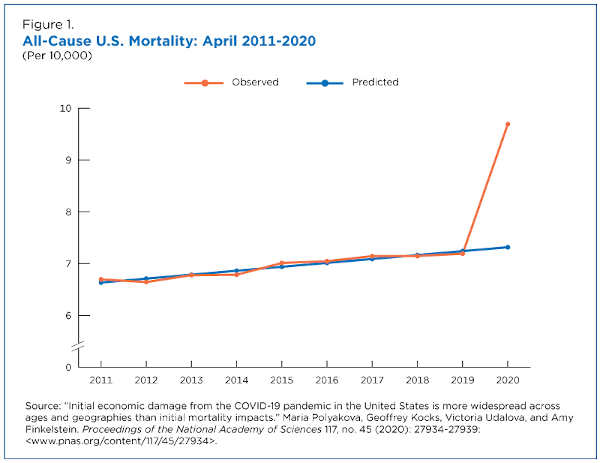
Recent research indicates that excess all-cause mortality was 2.4 per 10,000 individuals in the United States in April 2020 – the first full month of the pandemic – which represents about 30% more deaths than the number of COVID deaths reported in that month (Figure 1).
Greater mortality impacts on older individuals
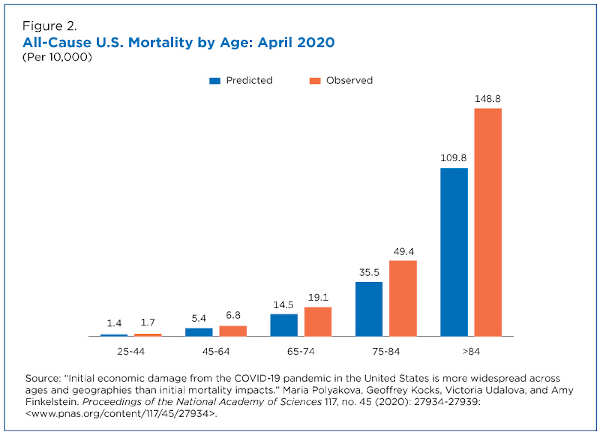
Excess all-cause mortality in April 2020 increased with age. Mortality from direct and indirect impact of the pandemic was highly concentrated in older age groups.
While individuals 85 years old and older accounted for only 3% of the U.S. population ages 25 years and older, they accounted for a disproportionate 34% of the overall excess mortality in the country during the first full month (Figure 2).
Racial disparities
Racial disparities in the direct impact of the pandemic on mortality (number who died from the virus) have been widely reported. New research now focuses on mortality by race from any cause associated with COVID-19, which also shows significant racial disparities.
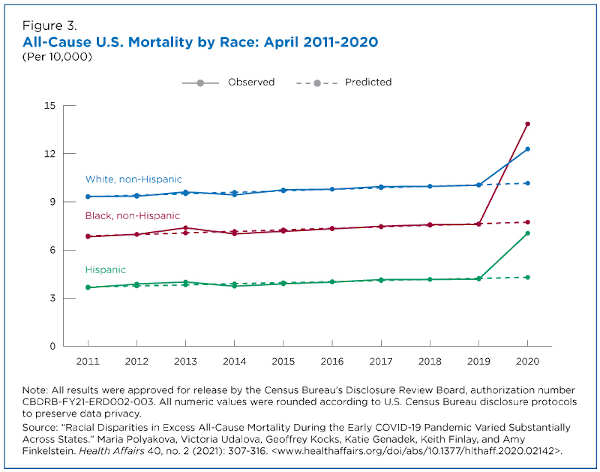
Research based on individual-level administrative data (that nearly covers the universe of the U.S. population) from January 2011 through April 2020, found a significant deviation in mortality from the historic trend for all race and ethnicity groups (Figure 3).
This research relied on death information from the U.S. Census Bureau’s version of the Social Security Administration’s Numerical Identification (Census Numident) database and additional individual-level demographic information, particularly self-reported race information from the 2010 Census.
Findings:
– Excess all-cause mortality was the lowest for Hawaiian and Pacific Islander, non-Hispanic individuals at 1.3 excess deaths per 10,000 individuals, a 22% increase from the predicted rate in April 2020.
– At the other end of the spectrum, Black, non-Hispanic individuals experienced the highest excess all-cause mortality of 6.1 excess deaths per 10,000 individuals, a 79% increase from their predicted rate.
– The other five race and ethnicity groups experienced excess mortality between the two extremes. White, non-Hispanic individuals had 2.1 excess deaths (21% increase); Hispanics of any race had 2.7 excess deaths (64% increase); Asian, non-Hispanic individuals had 2.9 excess deaths (64% increase); American Indian and Alaska Native, non-Hispanic individuals had 1.9 excess deaths (22% increase); and those reporting other race or two or more races had 2.7 excess deaths (60% increase).
Age and race
Racial disparities were even larger after adjusting for differences in age distributions.
There are large differences in age distribution across race groups and it is important to account for age when comparing excess mortality across racial groups.
Age differences increase disparities in excess mortality for every racial group compared to White, non-Hispanic individuals.
Without adjusting for age differences, excess mortality overstates the impact of the pandemic on White, non-Hispanic individuals who are, on average, older relative to other racial groups, and it understates it for all other racial and ethnic groups.
Racial disparities in the mortality impact of the pandemic in April 2020 were more pronounced when controlling for other demographic characteristics and geographic location.
In addition to age, when sex and geographic differences are taken into account, White, non-Hispanic individuals had the lowest excess mortality of 1.5 deaths per 10,000. Black, non-Hispanic individuals had the highest excess mortality of 6.8 deaths per 10,000.
Pandemic’s racial disparities varied across states
Even when adjusting for sex and age differences across race and ethnicity, racial gaps in excess all-cause mortality during April 2020 were not uniform across all states.
Some states had similar rates of mortality among White, non-Hispanics but very different rates among Black, non-Hispanic and Hispanic individuals. Some states had no significant increase in mortality for White, non-Hispanics but significant excess mortality for the other groups.
This research shows the breadth of factors affecting the indirect impact of the virus.
More research is needed
These findings are limited to the impact of the pandemic in April 2020. Future research is needed to evaluate the trajectory of these impacts since then.
It is also important to study causes and consequences of racial disparities in the pandemic’s impact on mortality. For example: Why are there significant geographic differences in racial disparities? What role do social and environmental factors, such as income, education and occupation, play?
The Census Bureau’s existing data from surveys, decennial censuses, and administrative records, along with the ability to link data across all sources and over time, is invaluable in understanding health disparities during the ongoing pandemic and beyond.
Victoria Udalova is a senior economist and program manager of the Enhancing Health Data program at the U.S. Census Bureau.
- Details
- Written by: Elizabeth Larson
The incident occurred just before 2 a.m. Monday, according to radio traffic.
A caller reported to authorities that someone had just driven by their home in the 800 block of 16th Street and had shot numerous times into the house, radio traffic indicated.
The vehicle associated with the shooting is described as a dark-colored sedan. Radio traffic said it was last seen heading toward Clearlake Avenue.
Lakeport Police Chief Brad Rasmussen said no one in the home was injured.
Officers responded to the scene and began an investigation which Rasmussen said on Monday afternoon remained underway.
“At this point, we don’t believe it’s a random shooting,” Rasmussen said.
Late Monday morning, the police put a call out to the community for information.
Rasmussen said they’ve received messages from the community that they were following up on Monday afternoon.
Anyone with information is urged to contact the Lakeport Police Department.
Anonymous messages can be sent to the police department by texting the words TIP LAKEPORT followed by your message to 888777. The agency also can be contacted via email at
Email Elizabeth Larson at
- Details
- Written by: Elizabeth Larson
The meeting will begin at 9 a.m. Tuesday, Feb. 23, and will be available to the public virtually only.
The meeting can be watched live on Channel 8, online at https://countyoflake.legistar.com/Calendar.aspx and on the county’s Facebook page. Accompanying board documents, the agenda and archived board meeting videos also are available at that link.
To participate in real-time, join the Zoom meeting by clicking this link at 9 a.m. The meeting ID is 992 6246 9530, password 716806. The meeting also can be accessed via on tap mobile at +16699006833,,96861017739#,,,,*659362# US (San Jose).
All interested members of the public that do not have internet access or a Mediacom cable subscription are encouraged to call 669-900-6833, and enter the Zoom meeting ID and passcode information above.
Chromebook devices are also available at the Lakeport and Clearlake Library branches, which will open early on Tuesday. Chromebooks can be checked out for three hours for use on the library premises and contactless pickup is available. The Lakeport Library Branch can be reached at 707-263-8817, and Clearlake at 707-994-5115.
WiFi is accessible in the parking lot of each County Library Branch, so residents can park at these locations to use WiFi on borrowed or personal devices, by connecting to the “Lake County Library” network (no password) anytime from 7 a.m. to 8 p.m.
While the board chambers remain closed, outdoor viewing and participation is also available during each meeting on the Third Street side of the courthouse building.
To submit a written comment on any agenda item please visit https://countyoflake.legistar.com/Calendar.aspx and click on the eComment feature linked to the meeting date. If a comment is submitted after the meeting begins, it may not be read during the meeting but will become a part of the record.
In an untimed item, the board will discuss a recruitment strategy for the Public Health officer position.
Dr. Gary Pace, who has held the job for the past 16 months, announced his resignation last week, as Lake County News has reported.
County Administrative Officer Carol Huchingon’s report to the board said that Pace’s resignation is effective April 16, although he has indicated he may be able to continue on here for a short time thereafter, under contract, to support the county’s transition with a new Public Health officer.
Huchingson said staff is requesting an opportunity to discuss recruitment strategies with the board.
In another untimed item, the board will consider updating its resolution authorizing temporary reduction of in-person delivery of county services to the public due to COVID-19 pandemic conditions, with the county’s return to the red tier on the state’s Blueprint for a Safer Economy to trigger reopening.
At 9:15 a.m, the board will hold a public hearing on the next rounds of CARES Act funding through the Community Development Block Grant Program, with the board to consider a resolution to pursue grant funding for in the amount of $738,187 for a Small Business Assistance Loan Fund Program.
At 9:45 a.m., Dr. Pace will give the board an update on COVID-19.
At 11 a.m., the board will present a proclamation promoting tolerance, respect, equity and inclusion in Lake County.
The full agenda follows.
CONSENT AGENDA
5.1: Adopt proclamation promoting tolerance, respect, equity and inclusion in Lake County.
5.2: Adopt resolution approving Agreement No. 20-SD17 with the State of California, Department of Food and Agriculture for compliance with the Seed Service Program for Period July 1, 2020, through June 30, 2021, in the amount of $100.
5.3: Approve reissuance of tax refund check from FY 16/17 in the amount of $1,403.52 issued to Teddy C. & Deanna M. Hingst.
5.4: Approve Amendment No. 1 to the agreement between the county of Lake and Vista Pacifica Enterprises Inc. for adult residential support services and specialty mental health services for Fiscal Year 2020-21 to reflect adjustment to service rates and authorize the board chair to sign the amendment.
5.5: Adopt resolution amending Resolution No 2020-134 amending the position allocation for year 2020-2021, Budget unit No. 2112 Child Support Services.
5.6: Approve minutes of the Board of Supervisors meetings on Oct. 6, Feb. 2 and Feb. 9.
5.7: Approve the cost sharing agreement between the county of Lake and the city of Lakeport for phase one of the Lake County Recreation Center Feasibility Study and authorize the chair to sign the agreement.
5.8: Approve second reading of an ordinance amending Chapter 25 – Floodplain Management of the Lake County Code.
5.9: Adopt resolution of intent to vacate a roadway known as Arabian Lane (CR#148D) in the Hidden Valley Lake area.
5.10: Approve contract between the county of Lake and Lake County Office of Education for differential response services in the amount of $70,000 per Fiscal Year from July 1, 2020, to June 30, 2023, and authorize the chair to sign.
5.11: Approve memorandum of understanding between Social Services and Behavioral Health Services for residential treatment room and board payments for welfare-to-work linkages clients in the amount of $50,000 per fiscal year, and authorize the chair to sign.
TIMED ITEMS
6.2, 9:06 a.m.: Consideration to (a) waive the formal bidding process, pursuant to Lake County Code Section 38.2, as it is not in the public interest due to the unique nature of goods or services; (b) approve agreement for provision of satellite imagery services by Planet Labs to the county of Lake, authorizing the chair to sign.
6.3, 9:15 a.m.: Public hearing, Community Development Block Grant Program - CARES Act Round 2 and 3, presentation and consideration of resolution approving an application for CDBG CARES Act Round 2 and 3 funding and the execution of grant agreement and any amendments for funds in the amount of $738,187 for a Small Business Assistance Loan Fund Program
6.4, 9:45 a.m.: Consideration of Update on COVID-19.
6.5, 10:15 a.m.: Sitting as the Lake County Housing Commission Board of Directors, consideration of the Lake County Housing Commission Housing Choice Voucher Program Administrative Plan for 2021 and authorize the chair to sign the annual Civil Rights Certification (HUD Form HUD-50077-CR).
6.6, 11 a.m.: Presentation of proclamation promoting tolerance, respect, equity and inclusion in Lake County.
6.7, 11:30 a.m.: Consideration of the Everbridge Mass Notification User Agreement in the amount of $18,207.95 from March 20, 2021, to March 19, 2022, and authorize the chair to sign.
UNTIMED ITEMS
7.2: (a) Consideration of a review of Resolution No. 2021-11 authorizing temporary reduction of in-person delivery of county services to the public due to COVID-19 pandemic conditions; and (b) consideration of resolution amending Resolution No. 2021-11 authorizing temporary reduction of in-person delivery of county services to the public due to COVID-19 pandemic conditions.
7.3: Consideration of recruitment strategy for Public Health officer.
7.4: Consideration of addition of special meeting to the board’s annual meeting calendar for 2021.
7.5: Consideration of the following advisory board appointments: Agriculture Advisory Committee, Spring Valley CSA#2 Advisory Board, Lake County Public Authority Advisory Committee, Scotts Valley Community Advisory Council, Western Region Town Hall.
7.6: Consideration of Change Order No. Two, Supplement No. 1 for Clayton Creek Road at Clayton Creek Bridge Replacement Project, Federal Project No. BRLO-5914(077); Bid No. 20-10.
7.7: Consideration of Change Order No. Three for Clayton Creek Road at Clayton Creek Bridge Replacement Project, Federal Project No. BRLO-5914(077); Bid No. 20-10.
7.8: Consideration of request of Kelseyville Unified School District that the county of Lake provide notification to the district that the county will not authorize the issuance of tax and revenue anticipation notes on the district’s behalf.
CLOSED SESSION
8.1: Public employee evaluation: Agriculture Commissioner Steve Hajik.
8.2: Conference with labor negotiator: (a) Chief negotiator: M. Long; County Negotiators: C. Huchingson and P. Samac; and (b) employee organizations: LCDDAA, LCDSA, LCCOA, LCEA, LCSEA and LCSMA.
8.3: Conference with legal counsel: Significant exposure to litigation pursuant to Gov. Code section 54956.9 (d)(2)(e)(1): One potential case.
8.4: Conference with legal counsel: Significant exposure to litigation pursuant to Gov. Code section 54956.9 (d)(2)(e)(3): Claim of Earthways Inc.
8.5: Conference with legal counsel: Significant exposure to litigation pursuant to Gov. Code section 54956.9 (d)(2) (e)(3): Claim of McQueen.
Email Elizabeth Larson at