 How to resolve AdBlock issue?
News
- Details
- Written by: Lake County News reports
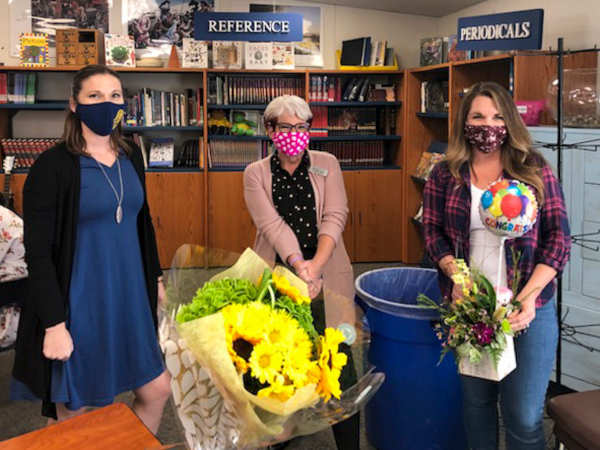
LAKE COUNTY, Calif. – On April 2, the Konocti Unified School District announced its teachers of the year for each school site.
“These teachers embodied the dedication, creativity, and good humor that makes learning possible even in the most challenging of times – and this year has certainly been challenging,” said district Superintendent Becky Salato.
Teachers are selected for this honor by their peers.
Konocti Unified School Districtwide Teacher of the Year: Andrea Pullman
Burns Valley Elementary School chose instructional coach Andrea Pullman as their teacher of the year.
In her role, Pullman supports all teachers and students at Burns Valley Elementary. She is known for her willingness to speak up for what is right and as someone who does not shy away from a challenge.
Colleagues called her “a phenomenal coach who [they] were proud to have as part of the BVS team and family.”
Pullman was not only honored by her school; she also received the Konocti Unified School District Teacher of the Year Award.
Alternative Education: Kim VanHorn
The Alternative Education teacher of the year is Kim VanHorn who teaches English language arts and science at Blue Heron School.
VanHorn is a strong student advocate and a nurturing educator who collaborates with her colleagues and works hard to implement top-quality teaching strategies.
Although this is only her second year as a teacher, VanHorn’s ability to build relationships with students and families has helped students succeed academically and contributed to their social and emotional wellbeing.
East Lake Elementary: Kaytlin Zolensky
At East Lake School, first-grade teacher Kaytlin Zolensky was named teacher of the year by colleagues who described her as an energetic and motivational classroom teacher determined to help every single one of her students learn to read.
Zolensky was the first teacher to bring students back on campus in small groups during the pandemic when allowed to do so by Public Health.
Zolensky’s colleagues also lauded her as a leader who “is always willing to train others on technology, collaborate, or lend an ear to brainstorm solutions.”
Konocti Education Center: Babette Wellock
The KEC teacher of the year is sixth-grade teacher Babette Wellock.
A 15-year veteran of Konocti Unified, Wellock’s colleagues said she leads her students by example as a life-long learner.
“She is always seeking to improve her practice and is not afraid to try new things,” they said.
She also encourages and uplifts colleagues with compliments and fun stories. As in years past, this year Wellock’s dedication to her students stood out in a competitive field.
Lower Lake Elementary: Suzy Tucker
Lower Lake Elementary announced teacher Suzy Tucker as teacher of the year.
Principal Tara Bianchi said Tucker went out of her comfort zone this year to provide the best education possible for her students.
Tucker developed meaningful relationships with her students and their families and collaborated well with her team and other teachers on campus, which was no simple task through video conferencing, mask-wearing, and social distancing.
Lower Lake High School: Tracy Lahr
Associated Student Body Director and long-time Konocti Unified veteran Tracy Lahr was honored by her Lower Lake High School peers as teacher of the year.
During a difficult year, they said she made the school a better place to be.
“No matter the obstacles, she has continued to have a positive attitude about the school and her students. She works effectively with fellow staff members to get them engaged in school spirit, and one of her biggest strengths is her love of students,” said LLHS Principal Victor Uribe.
Uribe noted that Lahr is particularly gifted in establishing and maintaining open lines of communication with all her students, and that her rapport with her Associated Student Body students was instrumental in developing a safe and secure learning environment focused on school spirit this year.
Pomo Elementary: Janelle Schneider
Second-grade teacher Janelle Schneider is Pomo Elementary’s teacher of the year.
Schneider embraced distance learning and helped her colleagues do the same.
Throughout the school year, she created YouTube video clips and Boom Card decks for her students, and then shared them with other teachers who said both they and Schneider’s students “love the online resources she creates and shares.”
The second-grade team credited Schneider’s Boom Cards for their students' mastery of addition with regrouping.
While creating highly effective resources for students and colleagues, Schneider has also been busy working on her master's degree in curriculum and instruction.
- Details
- Written by: Elizabeth Larson
During its April 1 meeting, the council awarded the $552,662 project bid to Granite Construction.
The city’s construction plans show that work will include sidewalk and crosswalk improvements, new LED flashing traffic signage, crosswalk warning pavement lights, signage, an electric utilities vault in the sidewalk and irrigation control, along with the new bus stop.
Public Works Director Dale Goodman said the city had to put the project out to rebid.
On March 18, the city opened bids from Granite, the low bidder; as well as Darren Taylor, $556,915; M3 Integrated, $607,200; and Team Ghilotti, $877,141.
Goodman said they were satisfied with the Granite Construction bid.
City Manager Alan Flora said the promenade and bus stop projects were combined in order to get better bids. He said the Lake Transit Authority will reimburse the city for the bus stop project.
The cost breakdown in city documents shows that the city’s cost share is $475,000 while Lake Transit’s is $138,427.
Flora told Lake County News that the promenade was originally bid as part of the larger Austin Park project, “but we didn’t have enough money to tackle it at that time so we cut it out.”
Staff recommended the city council approve the contract with Granite Construction. There was no public comment, and the council approved the contract unanimously.
Also during the April 1 meeting, the council approved a resolution approving responsibilities and guidelines for Measure V Citizen Oversight Committee members, got an update on the Hope Center, and presented proclamations declaring Public Safety Telecommunicators Week, Sexual Assault Awareness Month and Child Abuse Prevention Month.
Email Elizabeth Larson at
- Details
- Written by: Elizabeth Larson
Lake County registered an 8.3-percent unemployment rate in February, down from 8.9 percent in January, according to the Employment Development Department. Lake County’s February 2020 rate was 5.8 percent.
The February jobless rate is the second-lowest Lake County has experienced since the pandemic began last spring. It recorded a 7.4-percent rate in November and October also was 8.3 percent.
The EDD’s report said the state’s overall unemployment rate dropped 0.5 percentage points to 8.5 percent in February as employers gained 141,000 jobs. The February 2020 unemployment rate in California was 4.3 percent.
On the national level, February’s unemployment rate was 6.2 percent, down from 6.3 percent in January. The February 2020 rate ws 3.5 percent.
In Lake County, farming jobs in February were up by 27.5 percent over January and were 1 percent above the previous year, EDD data showed.
Total nonfarm jobs are up by 0.9 percent in a month-over comparison but down by 4.4 percent when compared to last year, based on the data.
Job categories or subcategories showing growth over this time last year include federal government jobs, up 13.3 percent; retail trade, up 4.5 percent; and trade, transportation and utilities, up by 3.2 percent.
All industries and subcategories in Lake County showed positive job growth or no change over the month, with the exception of financial activities, which was down by 3.4 percent, according to the report.
Lake’s neighboring counties’ jobless rates and ranks in the latest report are Colusa, 15.9 percent, No. 57; Glenn, 7.6 percent, No. 25; Napa, 7.1 percent, No. 18; Sonoma, 6.4 percent, No. 8; and Yolo, 6.8 percent, No. 12.
The statewide snapshot
In California, the EDD said December and January combined for a two-month total of 155,400 jobs lost, but February’s gain recovered nearly 91 percent of that loss, the state said.
California has now regained nearly 39 percent of the 2,714,800 total nonfarm jobs lost in March and April 2020 due to the COVID-19 pandemic.
In California payroll jobs totaled 15,998,900 in February 2021, up 141,000 from January 2021 but down from 1,662,000 from February 2020.
The number of Californians with jobs in February was 17,334,300, an increase of 345,600 jobs from January’s total of 16,988,700, but down 1,253,500 from the employment total in February of last year, the report said.
The EDD said the number of unemployed Californians was 1,610,200 in February, a decrease of 69,600 over the month, but up by 764,900 in comparison to February of last year.
Statewide, the number of jobs in the agriculture industry increased by 2,900 from January to 423,100 jobs in February. The agricultural industry had 2,300 more farm jobs in February 2021 than it did the February prior.
Among industries, leisure and hospitality led the gains, with 102,200 new jobs over the month, followed by other services, 14,100; education and health services, 13,000; manufacturing, 8,900; trade, transportation and utilities, 8,200; professional and business services, 5,400; and construction, 600.
Industries that showed declines included government, which the EDD said lost 6,000 jobs, mainly due to reductions in federal government jobs such as census and postal workers; followed by information, -2,800; financial activities, -1.900; and mining and logging, -700.
In related data that figures into the state’s unemployment rate, there were 794,348 people certifying for Unemployment Insurance benefits during the February 2021 sample week. That compares to 818,589 people in January and 351,766 people in February 2020, EDD said.
Concurrently, EDD said 90,662 initial claims were processed in the February 2021 sample week, which was a month-over increase of 32,285 claims from January, as well as a year-over increase of 55,533 claims from February 2020.
Email Elizabeth Larson at
- Details
- Written by: Lake County News reports
LAKE COUNTY, Calif. – The U.S. Small Business Administration will officially open the Shuttered Venue Operators Grant, or SVOG, application portal on Thursday, April 8.
The portal will open at 9 a.m. Pacific Time.
The grants are for operators of live venues, live performing arts organizations, museums and movie theatres, as well as live venue promoters, theatrical producers and talent representatives.
Those eligible entities are some of the first that had to shutter their doors a year ago in response to the COVID-19 pandemic.
“Concerts, plays, dance performances, movie premieres, museum exhibits – these are the lifeblood of culture and community, and often the anchor for travel, tourism and neighborhood food and retail stores. We know that for the stage and venue operators across the nation that help make this culture happen, the pandemic has been devastating. Too many have been forced to lower the final curtain on their businesses. Today, with more than $16.2 billion available through the Shuttered Venue Operators Grants, help is here,” said SBA Administrator Isabella Casillas Guzman. “The SBA is committed to moving as quickly as possible to deliver this vital funding effectively and equitably - ensuring relief goes to those venue operators whose revenues have been most impacted by the pandemic.”
The SVOG program was appropriated more than $16.2 billion for grants via the Economic Aid to Hard-Hit Small Businesses, Nonprofits and Venues Act and the American Rescue Plan Act. Of these funds, at least $2 billion is reserved for eligible SVOG applications with up to 50 full-time employees. Eligible applicants may qualify for grants equal to 45% of their gross earned revenue up to a maximum amount of $10 million for a single grant.
The SBA is accepting SVOG applications on a first-in, first-out basis and allocating applicants to respective priority periods as it receives applications.
The first 14 days of SVOG awards, which are expected to begin in late April, will be dedicated to entities that suffered a 90 percent or greater revenue loss between April and December 2020 due to the COVID-19 pandemic.
The second 14 days (days 15-28) will include entities that suffered a 70% or greater revenue loss between April and December 2020.
Following those periods, SVOG awards will include entities that suffered a 25% or greater revenue loss between one quarter of 2019 and the corresponding quarter of 2020.
Prior to the opening for SVOG applications, the SBA has hosted a national informational webinar – which can be viewed above – to highlight the application process for potential eligible entities.
The agency also provided recurrent program updates and information via frequently asked questions, additional video tutorials, an application checklist, eligibility requirements and applicant user guide through SBA’s dedicated SVOG website and targeted outreach to potential applicants.
As the SBA built the SVOG program from the ground up, it worked closely with its federal partners, including those dedicated to the affected industries such as the National Endowment for the Arts and Institute of Museum and Library Services, and Congressional authors in analyzing the legislation and Congress’ intent.
The agency also consulted industry partners, such as the National Independent Venue Association, National Association of Theatre Owners, National Independent Talent Organization, Performing Arts Alliance, Broadway League, American Alliance of Museums and the Associations of Art Museum Directors, Children’s Museums, Science and Technology Centers, and Zoos & Aquariums.
The SBA’s collaboration with these organizations has been vital to SBA’s understanding of and guidance for potential SVOG applicants and the agency looks forward to their continued partnership during the launch of the program.
In addition, SBA’s resource partners, including SCORE Mentors, Small Business Development Centers, Women’s Business Centers and Veterans Business Outreach Centers, are available to provide entities with individual guidance on their applications.
Applicants can find a local resource partner via SBA’s website at www.sba.gov/local-assistance or via a zip code at www.sba.gov/localassistance.
Per federal grant program guidelines that the same and equal information needs to be provided to each applicant, SBA’s team members are limited on responses they can provide to individual, specific questions regarding SVOG eligibility, potential grant amount, or other detailed information.