 How to resolve AdBlock issue?
News
- Details
- Written by: Karen Sullivan, Kim Riley and Terre Logsdon
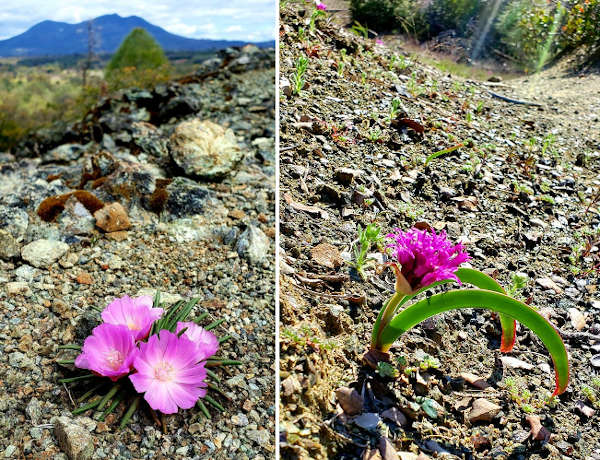
LAKE COUNTY, Calif. – With a background of slick green pebbles, the vibrant wildflowers on serpentine soils send a siren song of vibrant colors; many of them pink to fuschia, and all of them unique as the seemingly sprout from gravel.
Serpentine, the official California state rock is apple-green to black and is often speckled with light and dark colored areas as is found at Highland Springs Recreation outside of Lakeport, the McLaughlin Natural Reserve outside of Lower Lake, as well as many areas around Lake County and the state.
“Soil created from ultramafic rocks, serpentine soil, covers about 1% of California, but 13% of the state’s endemic plant species call it home,” according to the California Native Plant Society, and as serpentine rock is exposed to the elements of wind, sun, and rain – it decomposes to create a nutrient-deficient soil that not only stunts the growth of plants, but keeps other plants from successfully growing on these soils.
Composed of one or more of the three magnesium silicate minerals, "lizardite," "chrysotile" and "antigorite," the California Department of Conservation notes that, “Chrysotile in fibrous form is the most common type of asbestos. Asbestos is a term applied to a group of silicate minerals that readily separates into thin, strong, and flexible fibers that are heat resistant,” which made it popular to use in housing insulation and siding, as well as heat-resistant fabrics up to the late 20th century until it was phased out and banned due to the human health consequences of breathing in asbestos fibers; but serpentine soils are home for some stunning – but small – wildflowers.
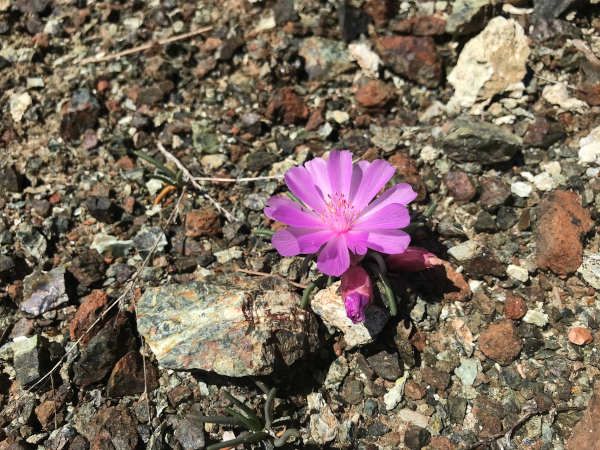
One of these serpentine-growing wildflowers is known as Bitterroot, which also is the state flower of Montana, with delicate pale to vibrant pink flowers growing on what appears to be a succulent-type plant. Only visible for a few months in early spring, the bitterroot plant withers away when the heat sets in above ground, but a long taproot lies in wait for the next spring to grow again.
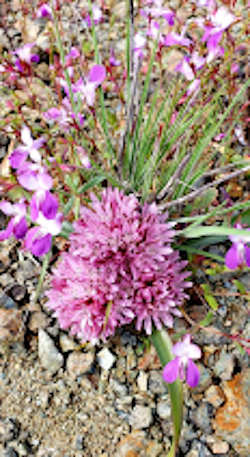
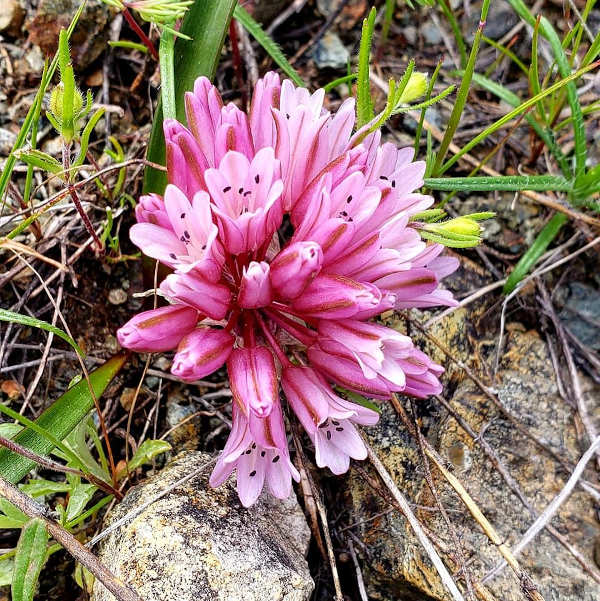
Wildflowers in the onion (allium) genus also are quite happy on serpentine soils and are related to the onions and garlic that we commonly eat, with California having over 45 different species of native onions, with 15 of those species growing in Lake County such as the scythe (or sickle) leaf onion, so named for the curve of the leaves similar to a scythe (a hand tool to cut grass or grains) and the Siskiyou onion (allium siskiyouense).
Highly developed in California, the allium genus often provides great drifts of color on dry slopes, ridges, and open fields with vivid shades of pink, rose, rose-purple, and wine.
Like bitterroot and other wildflowers growing on serpentine soils, the leaves die back after flowering as temperatures warm into mid-spring, with peak bloom time in late March through April – so #GetOutThere now and succumb to their siren song of spring!
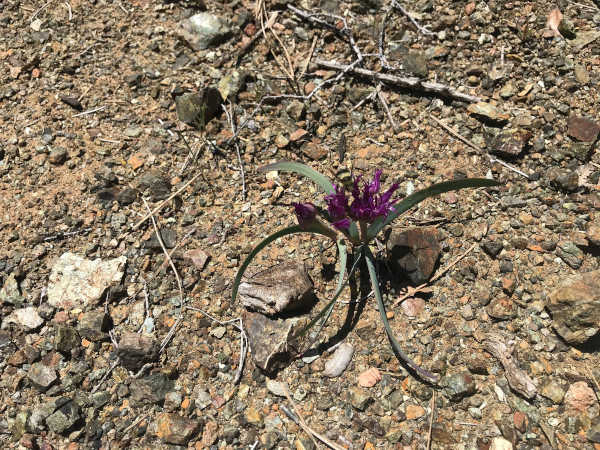
Nurseries where you can purchase seeds/starts:
Bitterroot: https://calscape.org/nurseries.php?id=2168&showmap=1
Scythe leaf onion: https://calscape.org/nurseries.php?id=136&showmap=1
Siskiyou onion: Unknown at this time
Terre Logsdon is an environmentalist, certified master composter, and advocate for agroecology solutions to farming. An avid fan and protector of California wildflowers, plants, natural resources, and the environment, she seeks collaborative solutions to mitigate the effects of climate change. Kim Riley is retired, an avid hiker at Highland Springs, and has lived in Lake County since 1985. After 15 years of trail recovery and maintenance on the Highland Springs trails, she is now focused on native plants, including a native plant and pollinator garden on her property as well as promoting and preserving the beauty of the Highland Springs Recreation Area. Karen Sullivan has operated two nurseries to propagate and cultivate native plants and wildflowers, has lived in Kelseyville for the past 30 years, rides horses far and wide to see as many flowers as possible, and offers native plants and wildflowers for sale to the public. You can check her nursery stock here: https://calscape.org/nurseryplants/416/ord-popular/np-0/page-all?fbclid=IwAR1qIxpajtUTpRKm4yRl_GjZK4h4El3yJNU4vojBg_C9d3Hdp-5_qJ1UMYI. They are collaborating on a book, Highland Springs Recreation Area: A Field Guide, which will be published in the future. In the meanwhile, please visit https://www.facebook.com/HighlandSpringsNaturalists and https://www.facebook.com/HighlandSpringsRecreationArea.
- Details
- Written by: Lake County News reports
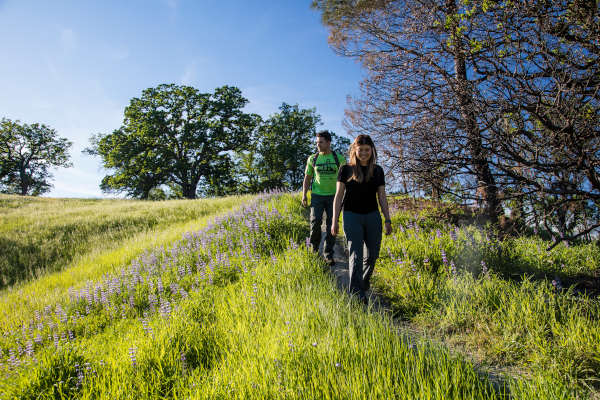
LAKE COUNTY, Calif. – The Bureau of Land Management Ukiah Field Office will host a second virtual Berryessa Snow Mountain National Monument Trails and Travel Management Planning Workshop on Wednesday, April 21, from 5:30 to 8 p.m.
Similar to the first workshop, the public will be able to use an online map and survey tools to help the BLM build a database of existing trails and routes within the monument, understand how each route is used and the amount of use.
During the workshop, the BLM will provide an overview of public input received to date, summarize the points of interest identified on the interactive map, explain the travel management planning process and timeline, as well as highlight the additional public input still needed.
Travel Management Planning can help the BLM provide better access to public lands, improve route connectivity to ensure a more enjoyable experience, increase efficiency and reduce impacts to the environment.
The BLM Trails and Travel Management Planning Workshop will focus on identifying existing routes and is designed to engage stakeholders and members of the public about the vision for travel management at the Berryessa Snow Mountain National Monument.
The plan will be important for designating a wide variety of roads and trails for motorized, non-motorized and non-mechanized recreational opportunities.
This summer, when scoping begins for an environmental assessment, the public will have an opportunity to propose new routes within the monument.
The BLM and Mendocino National Forest co-manage the Berryessa Snow Mountain National Monument and believe partnerships and inclusion are vital to managing sustainable, working public lands. This workshop and associated planning efforts are specific to travel management on public lands administered by the BLM within the monument.
To participate in the workshop, please register at least 30 minutes prior to the event at https://register.gotowebinar.com/register/5815845177969242640.
Please contact the BLM for reasonable accommodations to participate.
For specific questions, please contact Rebecca Carr Wong at 707-468-4023 or
- Details
- Written by: Lake County News reports
In recognition of their service, the CHP joins other law enforcement agencies to recognize National Public Safety Telecommunicators Week on April 11 to 17.
California legislation enacted in 2020 reclassified public safety dispatchers as “first responders.” The new classification acknowledges their vital role in the state’s emergency response chain.
“As recognized first responders in California, our CHP public safety dispatchers and operators remain resilient in times of crisis,” CHP Commissioner Amanda Ray said. “They are devoted professionals who provide the timely handling of all calls for services and are the lifeline between the public and emergency services.”
The CHP employs more than 700 dispatchers who provide critical services to communities throughout California.
In 2020, these dispatchers who work out of one of the 24 CHP communications centers statewide handled more than 4.9 million 911 calls from the public.
In emergency situations, dispatchers must instantly determine the correct response to ensure the safety of all parties involved.
They are also in constant communication with patrol officers, looking up license plates, driver license numbers, and running criminal record checks on wanted subjects.
Those interested in a rewarding career as a CHP public safety dispatcher are encouraged to apply for one of the more than 175 positions available statewide. Details are available at www.chp.ca.gov/chp-careers.
- Details
- Written by: Elizabeth Larson
Dogs available for adoption this week include mixes of boxer, husky, shepherd, terrier and pit bull.
Dogs that are adopted from Lake County Animal Care and Control are either neutered or spayed, microchipped and, if old enough, given a rabies shot and county license before being released to their new owner. License fees do not apply to residents of the cities of Lakeport or Clearlake.
The following dogs at the Lake County Animal Care and Control shelter have been cleared for adoption (additional dogs on the animal control Web site not listed are still “on hold”).
Call Lake County Animal Care and Control at 707-263-0278 or visit the shelter online at http://www.co.lake.ca.us/Government/Directory/Animal_Care_And_Control.htm for information on visiting or adopting.

‘Sophie’
“Sophie” is a female boxer-pit bull mix with a short red coat.
She is in kennel No. 18, ID No. 14356.

Pit bull terrier mix
This female pit bull terrier mix has a short brown coat.
She is in kennel No. 19, ID No. 14459.

‘Lobo’
“Lobo” is a male husky with a medium-length fawn and white coat.
He is in kennel No. 25, ID No. 14453.

Husky-pit bull terrier
This young male husky-pit bull terrier mix has a short blue and white coat.
He’s in kennel No. 26, ID No. 14437.
Email Elizabeth Larson at