 How to resolve AdBlock issue?
News
- Details
- Written by: Elizabeth Larson
LAKE COUNTY, Calif. – A long-disputed building project at Hidden Valley Lake received a unanimous vote from the Lake County Planning Commission on Thursday that will allow construction to move forward.
The Hidden Valley Lake Homeowners Association’s Hartmann Complex received a 4-0 vote approving a mitigated negative declaration and the granting of a major use permit during a discussion that ran less than 45 minutes on Thursday morning.
The discussion can be viewed in the video above, starting at the 2:08:20 mark.
The association plans to build the new 12,483 square foot Hartmann Complex at 19210 Hartmann Road, a short distance away from the 7,200 square foot building that currently houses the Greenview Restaurant and pro shop.
Once the new building is completed, it will house the restaurant and pro shop. The older building will then be demolished.
Planning documents said the new building will have expanded banquet facilities and a 3,180 square foot covered patio, with its proximity to the golfing facilities requiring new netting on driving range tees, the relocation of practice greens and repositioning of the first hole golf tees, more parking, a dedicated drop-off area and new sidewalk, curb and gutter.
Associate Planner Eric Porter said the county received a lot of feedback on the project in 2015 not long after it was initially proposed, and on Thursday morning received a petition with 28 property owners objecting to it, along with about 10 other letters raising concerns.
“My job is to look at it in terms of compliance with the code, the general plan and the area plan that applies,” Porter said, adding that’s what he did.
He reviewed the plan with the commission, and explained construction of the new building and demolition of the old one should take a total of four to six months.
An environmental review was conducted and Porter said the county didn’t receive any adverse comments from local or state agencies. The Middletown Rancheria expressed interest and has entered into a contractual agreement with the homeowners association, with the tribe notifying Porter of its support for the project proceeding.
“I couldn't find a reason to recommend anything but approval” of the mitigated negative declaration and use permit, Porter said.
Despite Porter’s stated expectation during the meeting of receiving a large amount of public comment, only four community members spoke about the project, in addition to Hidden Valley Lake Association General Manager Randy Murphy.
“The project is a long time coming. It’s been in the works over 10 years,” said Murphy.
He said there is a “small but vocal contingent” that has stalled it and delayed it through recalls and other actions. Murphy blamed those delays for costing the association several million more dollars to build the complex than it would have cost to build it five or six years ago.
Murphy said the current building was designed and built in the late 1960s when the community was much smaller. “The new project will be the crown jewel for our association.”
He said the demand for property in Hidden Valley Lake is higher than it’s been in years, and he asserted that new residents are very supportive of the project.
Commissioner Lance Williams asked how many people live in the community. Murphy said the most recent population estimate is between 6,000 and 6,500 residents. There are just under 3,300 lots, of which about 2,400 are developed.
Residents raise concerns
Hidden Valley Lake homeowner Elizabeth Montgomery told the commission she opposes the project, which she said the homeowners association can’t afford.
“We are struggling financially already,” and don’t have the $8 million to $10 million to build the complex, Montgomery said. She suggested the building could start and then not be completed.
“Urgent wildfire safety needs are being neglected in my neighborhood, they are being neglected in favor of this project,” said Montgomery, who also raised issues about the building being located in a flood zone, the need to consider climate change and inadequate stormwater drainage infrastructure.
Resident Lisa Kaplan told the commission that the community is “pretty much divided” over the project. She said that after 10 years – with a wildfire in the middle – people are exhausted due to the fight.
“When it comes to our pocketbooks, this is a real problem,” she said, adding, “All of our real public spaces are being neglected in favor of this building.”
Lakeport resident Bobby Dutcher said he’s served on boards and they never get 100-percent approval on issues. He suggested giving the association the benefit of the doubt and supporting the project, allowing the association to upgrade itself.
In response to objections raised during public comment, Murphy said none of the concerns about flooding or the homeowners association’s financial status are real. He said they’re ready to break ground as soon as they get the permit.
Commissioner John Hess, who lives in Hidden Valley Lake, asked if the current building is in the floodplain. Staff said it is.
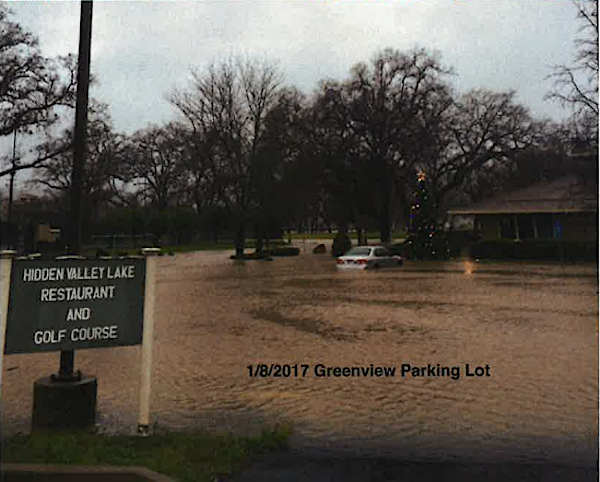
He referred to a picture of the Greenview Restaurant parking lot in 2017 – which was included in public comment documents – that showed it flooded and asked how to avoid such a situation for the new facility.
Murphy said it was his understanding that the 2017 flooding was the result of a tree blocking a culvert under Hartmann Road. He said the final finished floor elevation for the existing building is a couple of feet above flood elevation and the new building will be 3 feet higher than the old one.
Hess asked about the parking lot. Murphy said the design has drainage improvements but he said “all bets are off” if the creek is blocked off due to a tree.
When Hess asked if that issue had been fixed with the tree, Murphy said the tree was removed but added it could happen again.
Williams, who said he’d also seen the flooded parking lot picture, understood there were to be mitigations, but Murphy said mitigations aren’t part of the project.
“To me, mitigating it would be improving the drainage,” Williams said.
Hess, noting he had lived through the 2017 flood and the 2015 Valley fire evacuation, said, “I don’t see a strong enough reason to oppose the entire major use permit.”
He said he’s well aware of a number of recall elections and the criticisms targeting the homeowners association board and management, as well as subsidies for the restaurant and golf shop.
However, “Those are not part of our purview,” Hess said, explaining that he wanted to make that distinction in his own mind and for the public.
Commissioner Christina Price said she appreciated Hess sharing that.
Community Development Deputy Director Toccarra Thomas told the commission that there are further mitigations that can go along with the parking lot and staff can work with the applicant on those. She said there are some cool innovations for dispersing water quickly.
In reading through the mitigations, Williams said the drainage is adequately sized for the proposed site runoff. “I don’t know if we can ask for it to go bigger.”
Price offered separate motions for the commission to approve the mitigated negative declaration and the major use permit, with the commission approving both motions 4-0. Commissioner Everardo Chavez Perez had to leave the meeting before the votes.
Commission Chair Batsulwin Brown said there is a seven calendar day appeal period.
Porter told Lake County News later on Thursday that if the project isn’t appealed, and he said that’s “a very big ‘if,’” it is eligible for its permit seven days following the appeal period.
Lake County News reached out to the leadership of one local group that has voiced opposition to the project, HVL Now, to ask if there are plans to appeal, but did not receive a response.
Email Elizabeth Larson at
- Details
- Written by: Elizabeth Larson
LAKE COUNTY, Calif. – The Lakeport Unified School District Board of Trustees on Thursday night selected its newest member.
During its regular meeting, held at the Marge Alakszay Center on the district campus, the board selected Jennifer Williams-Richardson to fill a board vacancy created last month when Trustee Jeannie Markham moved to Oregon.
Williams-Richardson was one of two community members who submitted a letter of interest to Superintendent Jill Falconer. The second was Wendy Mondfrans.
However, Falconer told the board on Thursday night that since the agenda had been posted earlier in the week, Mondfrans had withdrawn from consideration.
Board Chair Dan Buffalo said that in filling a board vacancy, the board can choose either to go to a special election or to appoint.
Noting that three of the board members – including Buffalo himself, Markham and Phil Kirby – had been reelected in the fall with no opposition, Buffalo said he was comfortable with appointing a new member.
With only one candidate to interview, the board reduced the number of questions they had planned to ask from 10 to six and took turns asking Williams-Richardson about her background, interests, experience and goals.
Williams-Richardson and her family moved from Santa Rosa to Lakeport in May. She has two children who attend school in the district.
She was the parent teacher association president at her children’s previous school, has served on a school site council and also said she has a wealth of knowledge about safety. She is employed as a bookkeeper.
So far, COVID-19 has prevented her from doing the kind of volunteer work she wants to do in the district, and she said she’s looking forward to helping in a classroom as soon as possible.
Asked about her experience in public schools, Williams-Richardson said there are a lot of things to be gained in public schools, noting that being around diverse groups prepares students to be more compassionate and open to other cultures. She added that she is mixed race herself.
Buffalo asked her about what she believes are the district’s biggest challenges. Williams-Richardson said she thought the district is doing an excellent job in its response to COVID-19. “Nobody knew what to expect.”
In response to another question from Buffalo, Williams-Richardson said her goal for her first year on the board is to find out the goals of other board members and discover where she can fit in.
Kirby said being a board member takes a lot of dedication, and after reading Williams-Richardson’s letter and hearing her responses, he was confident that she would be a valued board member.
Kirby then moved to approve Williams-Richardson’s provisional appointment to the board, which Carly Alvord seconded.
Before the vote, Buffalo noted that one of the most important things the board does is hire and fire the superintendent, and they’re now in the middle of hiring the successor for Falconer, who retires this summer.
Kirby asked if Williams-Richardson could be part of the superintendent candidate interviews the board has scheduled for all day Friday at the district office. Falconer said yes, if she’s available, adding that she had understood Williams-Richardson had to work that day.
In the roll call vote, the board unanimously voted for Williams-Richardson’s appointment.
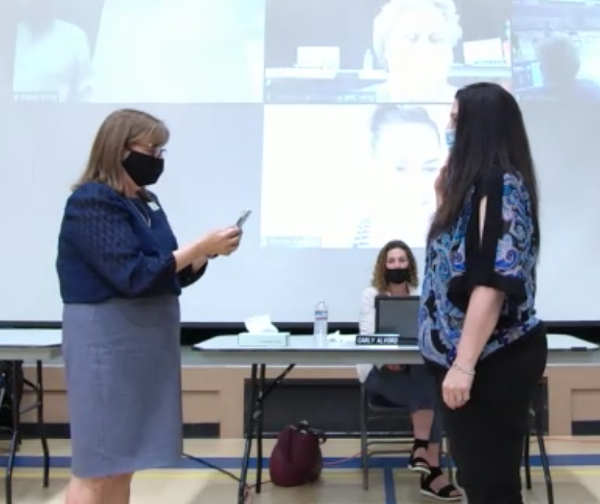
Falconer then administered the oath of office to Williams-Richardson before she took a socially distanced seat next to Kirby.
The board finished up business in open session shortly before 7:30 p.m. and adjourned into closed session. Board members reemerged at 7:45 p.m. to announce they had voted to hire the candidates for several jobs and then Buffalo adjourned the meeting.
On Friday morning, the board will convene in closed session at 8 a.m. to interview superintendent candidates, discuss salary and benefits for the new superintendent, as well as the contract with that individual.
Email Elizabeth Larson at
- Details
- Written by: Lake County News reports
NORTHERN CALIFORNIA – Mendocino National Forest staff are seeking input on a proposed multiphase, forestwide prescribed fire and fuels management strategy.
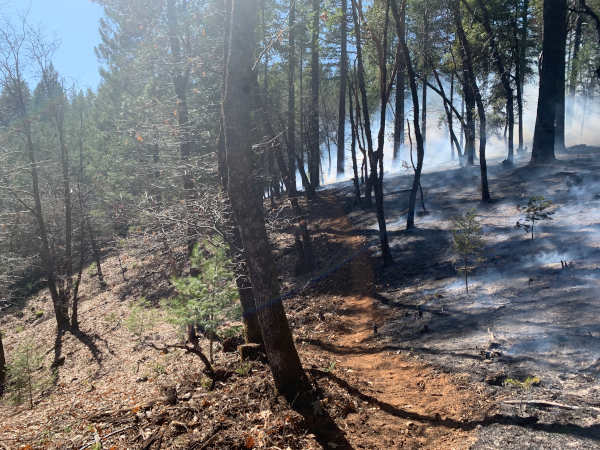
The project would use low intensity fires ignited under controlled conditions, along with manual and possibly mechanical removal methods to reduce debris and vegetation that could fuel more extreme wildfires in the future.
Forest officials issued a letter on Thursday requesting feedback on the proposed project.
Comments citing specific concerns that are submitted during the comment period allow the commenter legal standing to object to the final decision whether to proceed with the project.
Comments are due by Saturday, May 8.
The public is invited to attend one of two virtual open houses on Tuesday, April 20, to learn more about the project and to ask questions.
The first meeting is from 3 to 4 p.m. via Microsoft Teams at http://bit.ly/RxFire1. A call-in-only option is also available at 202-650-0123 (conference ID: 920 502 883#).
The second meeting is from 7 to 8 p.m. via Microsoft Teams at http://bit.ly/RxFire2. A call-in-only option is also available at 202-650-0123 (conference ID: 312 405 752#).
Both meetings will be identical in content and format.
The Mendocino Prescribed Fire and Fuels Management Project would allow for a landscape-scale environmental analysis for the explicit purpose of prescribed burning and fuel-reduction treatments across the entire forest, excluding designated wilderness areas.
This would afford additional opportunities for the Mendocino National Forest to treat more acres in a timely fashion by taking advantage of geographic and seasonal conditions while avoiding delays and inefficiencies associated with developing individualized, smaller-scale proposals.
Reducing the buildup of hazardous fuels supports forest officials’ goals of promoting healthier, more resilient forest stands.
“Taking a condition-based, landscape-scale approach to fuel reduction and fuels management will allow the forest to more quickly and effectively mitigate wildfire risks where it’s needed most and when conditions are most beneficial,” said Mendocino Forest Supervisor Ann Carlson.
The project also includes an alternative proposal to use mechanical methods, in addition to manual treatments, to remove vegetation or thin dense stands of trees in combination with prescribed fire.
A project description and maps can be found at https://go.usa.gov/xHC52.
- Details
- Written by: Lake County News reports
On Thursday, Gov. Gavin Newsom, Senate President pro Tempore Toni G. Atkins (D-San Diego) and Assembly Speaker Anthony Rendon (D-Lakewood) announced the $536 million funding plan to help improve California’s resilience to wildfires.
“With California facing another extremely dry year, it is critical that we get a head start on reducing our fire risk. We are doing that by investing more than half a billion dollars on projects and programs that provide improved fire prevention for all parts of California,” the governor and legislative leaders said in a joint statement.
The $536 million funding package, which is consistent with the Senate’s “Blueprint for a Fire Safe California” released last month, includes $125 million from Greenhouse Gas Reduction Funds and $411 million from the General Fund. State leaders said they also hope to draw federal disaster prevention grants to match money spent on home hardening.
The package includes multi-year funding on projects with both wildfire and drought resilience benefits, and Senate priorities such as Cal Fire grants for small landowners, funding for home hardening, urban greening and forestry, and funding for immediate, shovel-ready projects by conservancies from the Sierras to the Lower LA River and San Diego.
Highlights include:
· More than $280 million to create resilient wildlands and manage forest health;
· $200 million for development of wildfire fuel breaks;
· $30 million for community and home hardening;
· $25 million for forest sector economic stimulus;
· $3 million for science-based forest management.
The early action budget item will be amended into a budget bill and taken up by the Legislature in coming days. Details on this funding package can be found in SB 85 and AB 79.
“For every dollar we spend on wildfire prevention, our state saves $6 to $7 in damage. But it’s not just about saving money – this is about saving Californians’ lives, their homes, and their livelihoods,” Pro Tem Atkins said.
In the Thursday joint statement, state leaders said the key parts of the administration’s initial proposal have been supplemented by legislative ideas that they said will pay dividends over the years.
Those ideas include greater investments in forest health projects, improvements on defensible space, home hardening against fires, fire prevention grants, and prevention workforce training. The plan includes public and private lands vegetation management, community-focused efforts for prevention and resilience and economic stimulus for the forestry economy.
“Because we know that California’s fires are not limited to forested lands, we have built in attention to all kinds of vulnerable terrain and vegetation, with incentives for prevention that protects larger numbers of residents,” the group said.
They added, “We are pleased to have reached an agreement to get California quickly on the road to strong wildfire prevention, but we know more work is needed. This plan could not have been developed without the hard work of Assemblymembers Richard Bloom and Phil Ting, and Senators Bob Wieckowski, Susan Rubio and Mike McGuire, among others. We anticipate additional benefits from discussions on the 2021-2022 budget.”
“California is experiencing a never-ending crisis every summer and fall, losing tens of thousands of homes over the last decade and millions of acres of land burned over by mega fires,” said McGuire (D-Healdsburg), the Wildfire Working Group co-chair whose district includes Lake County.
“The Legislature and governor are moving with speed to pass the largest early budget action in state history investing in wildfire prevention and response. We know this half-of-a-billion-dollar investment will help make communities safer. And, there’s more work to come with a second round of funding this summer and a bold legislative package from the Senate that will focus on keeping California fire safe. We’re grateful to Pro Tem Atkins and Governor Newsom for their leadership on this critical issue, there’s much more work to come,” McGuire said.
“Wildfire prevention and response is a top priority in California, especially with drier conditions expected from this year’s drought. This plan makes sound investments in what we need to safeguard life and property. I applaud my fellow lawmakers for taking this proactive step toward avoiding the devastation we’ve seen over the past five years,” said Sen. Bill Dodd (D-Napa), formerly Lake County’s representative in the Assembly.