 How to resolve AdBlock issue?
News
- Details
- Written by: Lake County News reports
Gov. Gavin Newsom signed the bills in a virtual ceremony with leaders of Native American tribes from across the state on Friday, the same day he proclaimed as the 54th annual Native American Day.
The legislation includes AB 338 by Assemblymember James C. Ramos (D-Highland), which authorizes the placement of a monument in Capitol Park honoring Sacramento-area tribes, replacing the sculpture of missionary Junipero Serra, and AB 855 by Assemblymember Ramos to remove Columbus Day as a judicial holiday and replace it with Native American Day in September.
He said the action “sends a powerful message from the grounds of Capitol Park across California underscoring the state’s commitment to reckoning with our past and working to advance a California for All built on our values of inclusion and equity.”
Newsom added, “I’m proud to sign this long overdue legislation to honor the native peoples who have called this land home since time immemorial and to further our important work in partnership with Native American communities to tackle the multifaceted challenges facing California. I thank our legislative and tribal leaders and everyone whose work has enabled us to take these important strides forward as a state.”
“I am proud to have carried these important bills recognizing California’s First People for their unique and diverse heritage and invaluable contributions to our state,” said Assemblymember Ramos, the first California Native American elected to the state Legislature. “Gov. Newsom has worked with us side by side to address historic wrongs and inequities that continue to affect our communities, and I look forward to our continued partnership.”
The governor also signed other bills by Ramos, including AB 945, which creates a task force of tribal representatives to develop recommendations for protecting the right of Native American students to wear items of spiritual or cultural significance at high school graduations; AB 873, which removes share of cost requirements for tribes to administer child welfare services through Tribal-State IV-E agreements, increasing equity and supporting tribal efforts to safeguard the health and welfare of Native American children; and AB 798, which authorizes federally recognized tribal governments to operate, inspect, maintain, and drive emergency vehicles used in fire or law enforcement emergency calls to often isolated Indian reservations.
Another Ramos bill signed by the governor was AB 1055, which extends the same protections to students in tribal foster care as other foster students.
AB 1055 builds upon the work of AB 1962, a 2018 law allowing schools to count tribal foster youth under the state education Local Control Funding Formula. But it did not function as intended because of conflicts with provisions in California’s Welfare and Institutions Code.
Sherry Treppa, chairperson at Habematolel Pomo of Upper Lake tribe, welcomed the bills.
“The Habematolel Pomo of Upper Lake Tribe is very pleased that Gov. Newsom has, on California Native American Day, signed two important bills to help address gaps in state law that affect our most vulnerable tribal citizens, our children. The Habematolel has long supported efforts to protect the Indian Child Welfare Act and include all tribal youth in educational attainment. These bills move the needle in the right direction. Assemblymember Ramos and California Tribal Families Coalition are to be congratulated on these important efforts,” Treppa said.
Also signed on Friday was AB 957 by Assemblyman Rudy Salas (D-Bakersfield) and state Sen. Mike McGuire (D-Healdsburg), which ratified the tribal-state compact between California and the Middletown Rancheria of Pomo Indians.
The tribe owns and operates Twin Pine Casino.
The Middletown Rancheria of Pomo Indians of California was established with the purchase of
108 acres of land, initiated by members of the small tribe in July of 1910. The tribe was
appropriated by the Congressional Act for California landless Indians in 1906.
The ancestors of the Middletown Rancheria, also known as Lake Miwok Indians, found themselves landless and homeless during the 1800s, and newcomers settled in the area of Middletown and throughout Lake County.
The Middletown Rancheria, which established its own constitution, has a mission to preserve and protect its common and natural resources and to provide for the welfare and prosperity of its people.
A full list of the tribal bills signed by the governor is below.
AB 338 by Assemblymember James C. Ramos (D-Highland) — State Capitol grounds.
AB 516 by Assemblymember Megan Dahle (R-Bieber) — Pupil attendance: excused absences: cultural ceremonies or events.
AB 798 by Assemblymember James C. Ramos (D-Highland) — Vehicles: fire department: federally recognized tribes.
AB 855 by Assemblymember James C. Ramos (D-Highland) — Judicial holidays.
AB 873 by Assemblymember James C. Ramos (D-Highland) — Child welfare services: Indian tribes.
AB 945 by Assemblymember James C. Ramos (D-Highland) — Pupils: adornments at school graduation ceremonies: task force.
AB 957 by Assemblymember Rudy Salas (D-Bakersfield) — Tribal gaming: compact ratification.
AB 1055 by Assemblymember James C. Ramos (D-Highland) — Foster youth: tribal pupils and voluntarily placed children.
AB 1283 by Assemblymember Mark Stone (D-Scotts Valley) — Foster care.
SB 231 by Senator Mike McGuire (D-Healdsburg) — Department of Transportation: transfer of property: Blues Beach property.
SB 302 by Senator Bill Dodd (D-Napa) — Tribal gaming: compact ratification.
SB 712 by Senator Ben Hueso (D-San Diego) — Local government: California tribes: federal fee-to-trust applications to regain ancestral lands.
SB 816 by the Committee on Governmental Organization — Master Mutual Aid Agreement: tribes.
- Details
- Written by: Elizabeth Larson
The wreck occurred at 4:11 p.m. on Highway 20 just east of Marina Drive, according to the California Highway Patrol’s Ukiah Area office.
The CHP on Monday night did not release the name of the man who died pending notification of next of kin.
It also did not identify the second driver, a 26-year-old man from Ukiah who suffered minor injuries.
The agency said the Willits man was driving a 2001 Dodge Ram pickup truck eastbound on Highway 20 at an undetermined speed while towing another 2001 Dodge Ram truck on a flatbed trailer.
For reasons that the CHP said are so far undetermined, the Dodge’s driver lost control of his pickup and it crossed the double yellow lines into the westbound lane.
There, it collided head-on with a 2017 box truck driven by the Ukiah man, the CHP said.
The pickup’s driver was not wearing a seat belt and he sustained fatal injuries, according to the report.
The CHP said the box truck’s driver, who was using his safety equipment, was transported to Howard Memorial Hospital as a precautionary measure.
As of Monday night, the CHP said investigators suspected alcohol and/or drugs were possible factors in the wreck.
The highway was closed while officers conducted the initial investigation, with the CHP reporting shortly after 8 p.m. that the roadway had reopened.
Email Elizabeth Larson at
- Details
- Written by: Lake County News reports

For the first time in four years, the estimated number of violent crimes in the nation increased when compared with the previous year’s statistics, according to FBI figures released on Monday.
In 2020, violent crime was up 5.6% from the 2019 number.
Property crimes dropped 7.8%, marking the 18th consecutive year the collective estimates for these offenses declined.
The 2020 statistics show the estimated rate of violent crime was 387.8 offenses per 100,000 inhabitants, and the estimated rate of property crime was 1,958.2 offenses per 100,000 inhabitants.
The violent crime rate rose 5.2% when compared with the 2019 rate; the property crime rate declined 8.1%.
These and additional data are presented in the 2020 edition of the FBI’s annual report Crime in the United States.
The UCR Program collects information on crimes reported by law enforcement agencies regarding the violent crimes of murder and nonnegligent manslaughter, rape, robbery and aggravated assault, as well as the property crimes of burglary, larceny-theft, motor vehicle theft, and arson.
The FBI classifies arson as a property crime but does not estimate arson data because of variations in the level of participation by the reporting agencies. Consequently, arson data is not included in the property crime estimate.
The program also collects arrest data for the offenses listed above and 20 offenses that include all other crimes except traffic violations.
Of the 18,619 federal, state, county, city, university and college, and tribal agencies eligible to participate in the UCR Program, 15,897 agencies submitted data in 2020.
A high-level summary of the statistics submitted, as well as estimates for those agencies that did not report, follows:
— In 2020, there were an estimated 1,277,696 violent crimes. When compared with the estimates from 2019, the estimated number of robbery offenses fell 9.3% and the estimated volume of rape (revised definition) offenses decreased 12%. The estimated number of aggravated assault offenses rose 12.1%, and the volume of murder and nonnegligent manslaughter offenses increased 29.4%.
— Nationwide, there were an estimated 6,452,038 property crimes. The estimated numbers for two of the three property crimes showed declines when compared with the previous year’s estimates. Burglaries dropped 7.4%, larceny-thefts decreased 10.6%, while motor vehicle thefts rose 11.8%.
— Collectively, victims of property crimes (excluding arson) suffered losses estimated at $17.5 billion in 2020.
— The FBI estimated law enforcement agencies nationwide made 7.6 million arrests, (excluding those for traffic violations) in 2020.
— The arrest rate for violent crime was 147.9 per 100,000 inhabitants, and the arrest rate for property crime was 267.3 per 100,000 inhabitants.
— By violent crime offense, the arrest rate for murder and nonnegligent manslaughter was 3.8 per 100,000 inhabitants; rape (aggregate total using the revised and legacy definition), 6.3; robbery, 21.0; and aggravated assault, 116.8 per 100,000 inhabitants.
— Of the property crime offenses, the arrest rate for burglary was 45.7 per 100,000 inhabitants; larceny-theft, 193.1; and motor vehicle theft, 25.5. The arrest rate for arson was 3.0 per 100,000 inhabitants.
— In 2020, 13,377 law enforcement agencies reported their staffing levels to the FBI. These agencies reported that, as of Oct. 31, 2020, they collectively employed 696,644 sworn officers and 309,135 civilians — a rate of 3.4 employees per 1,000 inhabitants.
- Details
- Written by: Lake County News reports
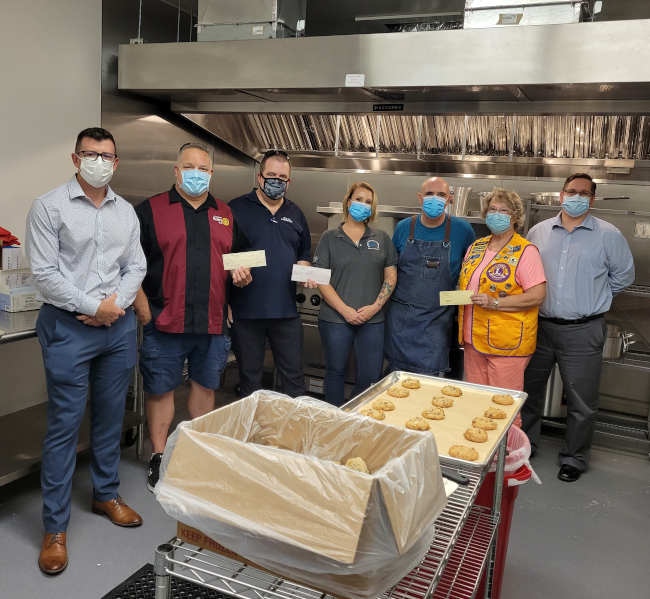
LAKEPORT, Calif. — A new collaborative project is seeking to feed people in need and to connect them to resources for housing and employment opportunities.
“All people deserve access to delicious and nutritious food,” said Deanna Fernweh of North Coast Opportunities' Community Kitchen Project, or CKP. “This project will feed our homeless neighbors, provide a variety of support services to those in need, and develop job skills for cooks-in-training.”
A project of North Coast Opportunities, or NCO, the CKP is a collaboration between the City of Lakeport, Lakeport Police Department and Woodland Community College.
It aims to support Lakeport residents experiencing homelessness or food insecurity by serving ready-to-eat meals and water, twice per week.
Utilizing the new commercial kitchen inside the Silveria Community Center, Fernweh is joined by Chef Jerry Phillips in her mission to feed and support the hungry while offering culinary training.
“Feeding people is just the beginning,” added Fernweh. “In partnership with Woodland Community College, we’ll give students culinary instruction for college credit, allowing them to expand on their growing skill set.”
Phillips, with over 30 years of experience in the restaurant industry, understands the local difficulties of hiring trained cooks.
“This project has it all — it feeds people in need, develops culinary skills in college students, provides on-the-job training to people getting back on their feet, and creates a hiring-pool for local restaurant owners,” he said.
The project began serving meals in late August, starting with direct food-delivery to Lakeport homeless encampments.
Using all biodegradable products, ready-to-eat food is handed to encampment residents by CKP staff, students and volunteers. Eventually, the project hopes to expand into a permanent site or a mobile delivery model.
Sample menu items include roasted chicken and grilled vegetable burritos, braised tri-tip and mashed potatoes, pulled barbecue chicken sandwiches and coleslaw, lemon herb roasted chicken with quinoa sauteed greens, and so much more.
Using a one-on-one approach to build rapport, the goal is to offer additional support services, like referrals to NCO’s New Digs Rapid Rehousing Program, NCO’s Building Homes, Building Lives Program, and referrals to other NCO programs and partner agencies.
“We can’t help people unless we first take the time to get to know them and understand their needs,” said Fernweh. “Food is comfort. Food builds trust.”
In partnership with the Red Cross, the CKP also provided ready to eat meals to Cache Fire evacuees residing at the evacuation shelters.
The CKP is funded through some small grants but mostly relies on contributions from the city of Lakeport and local donations.
“We are thrilled to be working with NCO on this new project,” said Lakeport City Manager Kevin Ingram. “This is the first step in a larger plan to support and ultimately reduce Lakeport’s growing homeless population.”
With a focus on nutrition and sourcing local ingredients, the CKP plans to offer its menu items to all Lake County residents at local events.
“Rest assured that all of Lake County will be able to eat from our menu,” said Phillips. “We plan to be a food vendor at events, often relying on our students to cook and serve.”
While the project is now serving vulnerable residents inside Lakeport city limits, the project hopes to expand to other parts of the county in the coming year.
“This project is about so much more than food,” said Robyn Bera, NCO’s director of community projects. “We have a pipeline of wrap around services and a network of partners with the overarching goal of helping people work through their barriers, build job skills and find employment, and ultimately secure permanent housing.”
CKP staff is currently researching options to expand this project into a mobile, sliding-scale restaurant, allowing customers to simply, “pay what they can,” supporting equality and dignity for everyone in our community.
The success of this new project depends on the community. If you would like to volunteer, donate funds, donate food, learn more, or get involved, please contact Deanna Fernweh at 707-998-8602 or visit the Facebook page for updates.
Donations are also accepted through our website at https://bit.ly/3Ae2OQ8.
The launch of this project is due largely to current and generous supporters, including the Lakeport Lions Club, Lakeport Kiwanis Club, Lakeport Rotary, Woodland Community College and Redwood Empire Food Bank.
NCO is the Community Action Agency that serves Lake and Mendocino Counties, as well as parts of Humboldt, Sonoma, Del Norte and Solano counties. NCO reacts and adjusts to community needs, including homeless advocacy and response. For more information visit www.ncoinc.org.